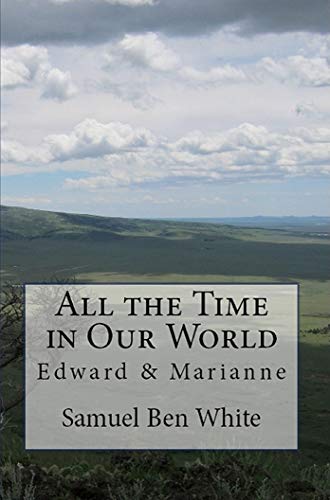
an Edward & Marianne story
by Samuel B. White
Synopsis
Two nervous west Texas teenagers on their first date are suddenly engulfed in a horrific thunderstorm and take shelter in an old barn. When the storm subsides, the barn is gone … and so is everything else, except their bicycles. They ride their bikes on a mysteriously well-maintained road in an otherwise barren land to an ancient castle whose single resident claims to already know them. Edward and Marianne have been whisked thousands of years into the future and their only hope of returning to their own world and time is to follow a mysterious traveler named Marcus and a hulking warrior named Daniel into a battle for the soul of all mankind. Over almost a year’s time and more than a thousand miles of travel, Edward and Marianne are trained “physically and mentally” to put together and lead the army that will fight the battle for the beginning of the end of the world. As Edward is taught to be a general and a sword-fighter and Marianne learns to use a bow and lead as well, they begin to learn that their greatest asset just may be each other.
Order on Kindle or paperback.
And be sure and check out the sequels: Some of the Time and A Thousand Miles Away.
…
Reading Sample
Prologue
A wide plain baked by sunlight.
The lone figure touches a parched tongue to chapped lips and realizes the action no longer seems to have any effect.
She casts a fearful glance up at the sun. She can’t make out its orb, just a brighter spot in the already glassy sky.
It has moved some since last she looked. Still a long way from the horizon, it promises many hours of blinding light.
Still, she doesn’t look forward to night, for at night she cannot work.
She looks down at the sheaf of papers in her hand. Why is she still working on them at all? What could it possibly matter?
She has asked the question out loud many times, but not this time. She knows why she continues to work. She works because she has to. She can do nothing else.
Is it only days now? She tells herself that people have thought that before. She leafs through the pages and her hazel eye stops briefly on a name. She knows the name. She knows what’s on the paper so well that she feels as if she knows the person the name belonged to. He lived back before the world’s middle age, but she would wager that he wondered if the days were almost spent.
Was he wrong?
Her great-grandmother used to tell her that the ending wasn’t just at the end.
Chapter One
Beneath the canopy of pecan trees lay two young people, a chaste distance apart an observer might reckon them, yet closer were they in their own minds than they had ever been to another. They were in the spring of their lives, and a rare occasion it was for their spring coincided with the calendar’s.
He thought about moving closer, but wondered if he could, for he was possessed of that awkwardness that comes from not knowing where one stands in the eyes of the desired and fearful that the standing was further away than hoped. His hand moved closer to hers, but almost imperceptibly so.
She didn’t perceive it. A young woman of light brown hair which tended to grow lighter in the summer months, she possessed the body of a somewhat younger girl, though her body was starting to portend the curves which would come later. She was the younger sister of a woman who drew men’s attention and had never drawn any herself—or so she would have said—yet she was one of those women upon whom age would smile, making her more attractive as the years went by; which was a process that was moving far too slowly as far as she was concerned.
She didn’t perceive the slight motion of his hand because she was too busy thinking about him. She had known him since grammar school, had been his friend, but had only recently noticed him. As she thought of him, she thought he was a handsome young lad, or—perhaps—that he was becoming handsome. He had sandy brown hair that he wore a bit long for the day and a mostly clear complexion around an intelligent smile. Standing, he was tall and lanky, if not actually skinny, with an athlete’s ease of movement combined with the unexpected bursts of clumsiness so prevalent in men of his age.
The pecan trees provided such a canopy overhead that the sky was only visible in small patches. Mockingbirds chittered in the trees, mocking each other most likely. A frog’s call grated in the air, adding to the soft din of families on picnics, and the ever-present crickets whose noise was an underlying constant. Learned men who studied the sounds of the frog would have studiously debated whether the sound were the sound of the frog searching for a mate or flies, but the more mundane answer was probably that the frog just did not like silence. In the distance, another mockingbird spoke, perhaps mimicking the frog.
Neither frogs nor birds took any notice of the young couple who lay on the thin blanket beneath the pecan trees. Neither did the people who ate their sandwiches from plastic bags or tossed a plastic disk back and forth on the warm and windless west Texas day. Had they looked, they might have noticed that the young man was nervous. Nervous, yet underneath—or perhaps overriding—that emotion, he was ecstatic.
Near the old wooden bridge they lay, the waters of the creek already dry for the year, but the young man smiled because beside him lay the woman he had dreamed of for years.
Neither would be mistaken for movie stars. Walking together they would have drawn little to no notice for they turned heads with neither unbelievable good-looks nor eye-catching ugliness. They were the type of people who were easily overlooked by an appearance-conscious world.
This is the way it’s supposed to be, he thought. Hanging out in one of your favorite places in all the world—at least, the small part of the world he had actually seen—with a girl you were … crazy about.
He didn’t know if he were in love with her. He had been given—and occasionally listened to—all the lectures about love versus infatuation and he knew enough about love to know he didn’t know much about love. And what he knew about love and about himself was enough to know that what he felt probably wasn’t love … at least not yet. It wasn’t exactly infatuation, either, he thought. Infatuation was short-lived and he had known her way too long to be infatuated. He liked her, and she was pretty, and she seemed to like him. Enough to go out with him, anyway, which was a good sign. But was it love? Would it turn into love?
He knew better than to even ask such questions. Asking such questions always led to trouble, he knew, because girls never thought the way guys did and when girls found out a guy was thinking along those lines, they always seemed to be way ahead of him on the idea or way behind and the difference led to crashing problems. So Edward lay back and vowed not to voice what he was thinking—even if he could, which was doubtful, considering how much of it consisted of incomplete sentences.
Still, he felt like he had to say something. Like most teenage boys, he thought that to sit in silence for any great length of time was a mistake. Or maybe he had never thought about it at all. He was just going on instinct and instinct said that if you sat silent around a girl for too long, she’d eventually start thinking about other things (meaning: not him) and that couldn’t be a good thing because soon (of course) she’d be thinking about some other guy and—
“I love it here.”
“Hmm,” Marianne replied.
Marianne was thinking that this really was a beautiful place and she couldn’t believe that she had lived this close to it for so long and had never explored it before. She was also thinking that she enjoyed the company she was sharing it with and wondering if it would be a mistake to tell him so. She knew that if you told a guy you were enjoying the time spent with him, he usually made a logic leap to the idea that you were madly in love with him and, so, were either after him and were someone to be avoided or were ready to set a date.
She knew better than to dare speak what was actually on her mind. She was thinking that it wasn’t just that this was a good date, a better than most date, it was that this had so far been a great date. Not because it was exciting or thrilling or the most romantic thing she had ever heard of, but because she was getting the idea in the back of her mind that she was enjoying herself more with this guy than she had with any other guy in … forever. She was starting to see herself wanting to date this young man on a regular basis but could she tell him that now without completely ruining everything? She doubted it.
So, in spite of what initially seemed a major setback, the day had gone better than either could have predicted.
It had all started a couple weeks previous, towards the end of the school year. Edward had ridden his new twelve-speed to school even though he knew that in the minds of most of the people at O.H. Cooper High School there were only two kinds of people who rode bikes to high school: dwizzles who either weren’t old enough to drive a car or weirdoes who rode a bike for some sort of exercising fun. Exercising was highly touted at Cooper High School among the constituents, and even bicycle riding, but only as a recreational activity, never as an actual mode of transportation.
When he had left home that morning, the idea of biking all the way to school had seemed like a good one. He had been riding out in the country and getting in shape and the five or so miles to the school had not been daunting. As he had drawn closer to the sprawling campus at the end of Sayles Boulevard, though, trepidation had begun to set in. Could he get to a good place to lock his bike up without his friends seeing him? What would they say if they did see him? Many of them knew he rode his bike out in the country—but to school? What sort of humiliation might he be setting himself up for? Was it too late to ride home, hop in the car and get to first hour on time?
He figured the only way to deal with it effectively would be to just brazen his way through it. Pretend like it were something he did every day. Maybe even look disdainfully on everyone who didn’t ride their bikes to school. Yeah, that’d be the way to do it, he thought. Attitude was everything.
So he had pulled up to the bike racks and climbed off like he did it every day and reached for the lock as if that were something he did every day. He remembered all the times back at Jefferson Junior High anyone had forgotten to lock their bikes at the bike rack. Rarely were bikes stolen, but the owner generally came out of class to find his mode of transportation dangling from the branches of the nearest tree. It had never happened to him, but he had seen it more than once and had been everlastingly grateful the one time he realized he hadn’t locked up his bike that no one had caught the oversight.
Out of the corner of his eye, he saw someone else pull up to the bike rack. His first thought was that this was good because it would make it look as if he weren’t the only person riding a bike to school that day. With a rapidity to rival the greatest minds in the world, he instantly jumped to the idea that it could be one of the dwizzles or weirdoes, in which case he didn’t want to be seen riding a bike to school like one of them. Now, the only thing for it was to just walk away and pretend he hadn’t noticed anyone else pull up and make sure that—if anyone were watching—they’d know he was walking away without being aware someone else had pulled up. It was all a part of the high school dance he stepped to every day of his life and these moves and motivations didn’t seem to him as ridiculous as they probably do to the reader.
He slung his backpack full of books he rarely opened over his shoulder and was about to step away when a voice asked, “Edward?”
He thought of a dozen people who could be calling him by name right then and none of the faces which jumped to mind were pleasant ones. Maybe nice enough people, granted, but not the kind of people he wanted to be seen walking away from a bike rack with. This was high school, after all, and in spite of what the psychologists might say, image was everything.
But there was no getting out of it now, so he stopped and casually turned his head, making sure that anyone who might be watching would know for sure that he was doing this casually. His momentary surprise at seeing he was not being addressed by either a dwizzle or a weirdo was quickly overcome by the normal teenage boy fear of being addressed by a girl.
“Hey, Marianne,” he replied, trying to sound casual but afraid his tongue was sticking to his mouth like it usually did when addressing someone—anyone—of the opposite sex. Being the girl, his tongue was only following the lead of his flash-frozen brain.
“I didn’t know you rode a bike to school,” Marianne smiled.
“This is actually the first time I’ve done it since Jefferson.”
“Ever get yours thrown into a tree?”
“No, I missed out on that.”
“At Lincoln they just stole your bike if you left it unlocked. If the police ever found it again, it always seemed to be somewhere out by Phantom.”
“Ever happen to you?”
She gave him something between a smirk and a shrug that indicated it probably had.
Edward and Marianne had gone to elementary school together for fourth and fifth grade back at good ol’ David Crockett Elementary and he had had a crush on her almost since the first day she walked into Mrs. Landers’ class. In the two years of elementary school, he had had the nerve to actually talk to her maybe three times. Then junior high had rolled around and, even though he could see her house from his, he was in the Jefferson district and she went to Lincoln. He had seen her a few times over the next three years—in the neighborhood or at a store—and they always spoke cordially, though never had much to say.
He had just about forgotten his crush on her until high school. He had had plenty of other unrequited loves during middle school, after all. Freshman year he had just seen her at a distance and that had been that, sort of. His old crush for her had been in the back of his mind, but had never really been fertilized.
But sophomore year they had both wound up in Miss Gober’s geometry class and, sitting there day after day, he had fallen for her all over again. He had finally talked to her, and—as part of a group—they had even headed over to the mall or Taco Bueno for lunch a time or two. But he had never once gotten the impression she was the least bit interested in him, so he had never asked any questions that might give him the answers he wanted and sophomore year had ended and that had been that.
Junior year had been little different. They had no classes together, but they had many friends in common and so were found in the same group now and again before school, during lunch, at pep rallies and the like. He had spoken to her a few times, though it would be hard to call any of the encounters a true conversation. For one, it was almost always amidst a group so there was no chance for truly close discussion. He had daydreamed what he might say, but had always found a reason not to say it. Someone else walked up, they were in a crowded place, the earth was orbiting the sun. There was always a reason.
They were seniors now, would be graduating from good ol’ Cooper High in a couple weeks, and here he was finally with a chance to talk to her and a five minute window in which to do it. And it had only taken him nine years. With a sense of melodrama that only a high school kid who thinks every moment in time has led up to the one in which he now occupies, it occurred to him that if he didn’t talk to her now he probably never would. She’d go off to college and he would too and they’d probably never come back to Abilene and … he had to say something.
“You bike?” was all he could come up with.
“Yeah,” she shrugged.
He thought about saying that that explained why she had such great legs, but he didn’t and realized it was probably for the best. Not only was it inaccurate (because he had thought her legs nice for as long as he had known her and that probably had nothing to do with the bike), but he also knew that lines like that only worked in old movies and only served to make the user sound like a letch in real life.
Looking for some way to continue the conversation, it suddenly occurred to him that, living two blocks away from him as she did, she had probably taken the same route he had to get to school. “Pretty long ride from our part of town, huh?”
She shrugged, “I like it, though. Gives me some time to think and plan for the day.”
“Kind of bites going home though, doesn’t it? After a long day here.”
“Not really. In a way, it provides a good wall between school and home. Once I leave here, I’ve got a good half hour to put everything about school behind me. By the time I get home, school’s another world.”
Barely hearing her as he steeled his courage, he asked, “You ever go for long rides? Like out in the country?”
“Not really. I’ve thought I’d like it, but I guess I was worried about being a girl alone and all that.”
“I hadn’t thought about that, but I can’t blame you. What about riding with someone? I mean, well, um, ah, I like to ride out to the State Park and I was, uh, wondering if you’d like to do that, too, sometime. Together, I mean.”
“You know, that might be fun,” she replied cheerily. “The State Park, isn’t that out by Buffalo Gap?”
His heart was beating so hard he figured it probably showed through his shirt and his mouth was as dry as new sandpaper. Untying his tongue, he managed to ask, “Are you free this Saturday?”
“Ah, no,” she replied. Then she quickly added, “My mom and I are going down to look at Texas A&M. We’ve had it scheduled for a couple months.”
He figured his window of opportunity had closed with a resounding thud just then, but she told him, “I could go the next Saturday.”
His heart had almost exploded (as well as his head) just then, but he managed to say something unintelligible that was roughly affirmative and they promised to get together the next week and plan out the trip.
They had peddled the twelve miles out to the State Park with the intention of taking a nice dip in the spring fed pool when they got there. They had arrived to find that the pool was not open yet because, it had been discovered, a pipe had ruptured during the winter and hadn’t been discovered until earlier in the week. Men were hard at work on the problem and a park attendant was assuring everyone who came by that the pool would be open the next week, but that didn’t suit the needs of the people who had driven all the way out to go swimming, let alone those who had bicycled out.
This had been a tremendous blow to Edward. He wasn’t a particularly good swimmer, but he had looked forward to seeing Marianne in her swimsuit. Not that that was the only reason he had asked her on a date like this, he reminded himself, but it had been a looked-for perk.
So they had peddled down to one of the tree-shaded picnic tables and eaten their lunches and tried not to let the other person notice just how close they were to exhaustion. They were both hoping and praying that the other person would not suggest turning around and riding back into town, yet. After lunch, they had spread out the sheet they had brought and—in completely chaste fashion—lay down on it to rest and talk.
It had seemed like a good idea at the time, but as they lay there Edward began to think that he might never be able to get up again. So he sat up and pulled his knees to his chest a time or two to stretch his hamstrings. As he did so, he looked over at Marianne.
She was either asleep or had her eyes closed against the bright Texas sunlight that peeked through the pecan branches overhead. Either way, she couldn’t see him staring at her. Even then, he only took furtive glances, then quickly looked away lest she—like some forest animal—could somehow sense his staring.
He wondered what it was that he had always liked so much about her. There were prettier girls at Cooper. Heck, there had been prettier girls at Crockett. So why had he always had this crush on this particular sandy-haired young woman? Her face was pretty, but she was no model. Her figure was attractive but a little on the slight side. She had really nice legs, but she hadn’t in elementary, so that couldn’t have been it.
Maybe it was her smile. Her mouth might have been considered by some to be a little large, but she had a great smile. And she smiled a lot. Maybe that was it, he thought: maybe it was because Marianne almost always seemed happy. Even in those moments when, like most high school students, she complained about the world around her, there was an air of humor and hyperbole behind all the angst.
Suddenly proving that she was awake and had somehow noticed his stealthy glances, she asked, “What?”
“Hmm?” he asked, shaken from his reverie.
“You keep looking at me funny.” Reaching up a hand to check, she asked, “Do I have something in my hair?”
“No,” he replied, blushing.
“Then what?” she asked, sitting up, stretching her legs much as he had.
“Nothing,” he replied shortly, maybe a little too guiltily. Hoping to quickly change the subject, he asked, “You ready to head back?”
Looking at him as if still hoping to discern what had just been going through his mind, she replied with a laugh, “No. I’m wishing I had brought my mother’s cell phone so I could call her to come pick me up.”
He reached into his backpack and offered her his phone. “I always bring it,” he shrugged. “In case I get caught in a storm or have a wreck or something.”
She pushed the phone away and said, “I was joking. I have one, too. I just hate using it.”
“Really?” he asked, truly surprised. He thought he used his phone less than anyone he knew, but he still never went anywhere without it.
“My mother’s always told me that phones were a replacement for true inti—friendship. I guess her words soaked in on me.”
“Your mom sounds a lot like mine.”
She looked around and commented, “It’s so beautiful here. Like we’re in a whole ‘nother world from Abilene. Are there nature trails and stuff like that here?”
“Yeah. Some good ones.”
“Well, sometime—when I’m in shape—I want to come out here and walk around and take a dip in that pool.” She looked at him with that familiar twinkle in her eyes and said, “But today, I better head back while I can. ‘Cause if I stay here one more minute, I’m going to be here until the paramedics come for me.” She held out her hands and asked, “Help me up? ”
He bounced to his feet as if he were sitting on springs and took her hands in his. As he pulled her up, she grimaced and told him, “I feel like a little old lady.”
As he held her hands for that moment, he thought of all that he wished to tell her. How he had had a crush on her for nine years now. How he had sat out on his back porch looking across the park, just hoping she’d come out on the porch of her house so he could wave hello. How he’d sat there all the way through geometry wanting to ask her out. But all he managed was, “I’ll fold the sheet.
They loaded up their backpacks then and got on their bikes. As she groaned at the first pressure to the peddle, he asked, “You sure you don’t want to call?”
“I’m fine,” she laughed.
“That you are,” he wanted to say, but wisely didn’t.
The little hill getting out of the park was hard on their legs. Even his, for though he often rode far more than twelve miles in a day, it was usually in a straight shot and not with a long idle time in the middle. Once out of the park and onto the highway, though, they both began to feel their legs loosen a bit and the prospect of the ride back was not nearly so grim. It was a beautiful day, after all. Not as hot as usual for that time of year, a little bit of cloud cover, and every now and then a touch of a welcome breeze.
They were about halfway to Buffalo Gap when they felt the gust of wind coming up behind them. Edward turned to call back that that ought to help them get back home a little quicker … and then he saw the cloud.
It was a dark cloud. The darkest he had ever seen. It roiled and billowed like the front edge of an alien invasion from an old 2-D movie. It was filled with lightning and the air was suddenly filled with the roar of thunder and before he could tell Marianne to look out or anything (he wasn’t sure what he could have told her), the cloud had caught up with them and they were being pelted with cold, hard rain drops the size of June bugs.
In a matter of seconds, he could no longer see fifty feet ahead of him and had to look hard to make sure Marianne were still with him. He let her pull up alongside and called out over the noise, “We’ve got to find some place to pull over!”
“You lead, I’ll follow!” she shouted back.
There was a bar ditch beside the road, but he figured that would soon be running brim-full with water. So he peddled on a bit until he found a place to pull off. He saw a shelter through the rain and made for it even though at first glance it was just a darker place in the darkness. The going was tough and the road was a washboard, but he finally pulled into what appeared to be an old barn. It was empty, but the smell of manure was fresh in it, so it wasn’t completely out of use.
Marianne pulled in right behind him, soaked to the skin. Even in the midst of a near crisis, the teenage boy side of his brain remarked that he was getting to see her swimsuit after all, but he quickly swatted the thought away and set about closing the big doors.
He was trying to work up the nerve to suggest they get into the loft, where there might be dry hay, when he turned to find her already climbing the ladder. He scampered up after her and found her sitting against a post, trying to put her hair back into a pony tail. She said something to him, but he couldn’t hear her for the sound of the rain on the metal roof.
Edward came closer and asked, “What?”
“I said, ‘It’s kind of loud in here!’” she laughed.
He sat down beside her and thought about saying something about how he’d always liked the sound of rain on a metal roof but figured saying it would spoil the moment because he would probably rupture a lung getting it out loud enough. He took her hand as he leaned against the railing of the hay mow and she didn’t seem to mind so he figured he was in the midst of the best day of his life.
She leaned up against him and said, loud enough for him to hear, “My legs really didn’t need another stop. If this lets up, I may not get going again.”
He made certain the cell phone was still in the backpack and said, “We’ll call as soon as it’s quiet enough for someone to hear us.”
She laid her head against his shoulder, nodding as she did so, and he decided that this was undoubtedly the best day of his life. To have a girl—not just any girl, but Marianne—fall asleep against his shoulder while sitting in a barn on a rainy day … well, it was just something he contemplated with joy right until he fell asleep, too.
It was a pretty good day for Marianne, too. She had never had a crush on Edward, but over the years she had come to have a fondness for him that she realized she didn’t have for any other guys. Until the day he had asked her out, though, she had never really given any thought to going on a date with him. If asked to name her ten best friends at school, he might have appeared on her list, but if asked to name the ten boys she most wanted to date, he would not have appeared. And now she was thinking he might have just jumped to the top of that second list. She asked herself why. Why did she like him? Why had she never realized it before?
He was tall and a tad gangly, but sort of cute. And she had always enjoyed talking to him on the few occasions she had given it a shot. But, she told herself, she had been sucked into the culture of her time and had spent an embarrassing amount of time swooning or pretending to swoon over the same guys the other girls presumed to pursue.
Marianne and her friends had often made up lists. Sometimes lists of movies or favorite songs, but most often lists about guys. Best hair. Best face. Best derriere—though that was not the word they used. She could not remember Edward being on any of those lists even though, as she glanced at him, she realized he was fairly attractive. To her own embarrassment, she could not remember having suggested him for any of those lists. Was she really as shallow as that?
She hadn’t dated much since turning old enough for her mother to allow her out of the house without an armed guard, but when she had, she had been singularly unimpressed with most of the guys she had gone out with. They were either obsessed with themselves or sex and had quickly grown boring if not outright boorish. Yet here they were in a hayloft and rather than try something, he had held her hand. She realized it might sound silly or juvenile to some, but to her it was incredibly sweet.
So here was a nice guy, who she had somehow always known had liked her, who was rather cute, and she had also known that his character was a level or two above most other guys she knew. Why, then, had she waited until senior year to finally decide she liked him, too? And not just senior year but the last week of senior year?
After agreeing to the date, she had mentioned it to some of her friends. While not met with derision or disdain, none of her friends had been particularly impressed. But, as she had started telling them how much she was looking forward to it, she had slowly come to realize just how true that was. Without exaggeration or hyperbole, she had begun to tell her best friend, Shelinda, about Edward and had started realizing then that she liked him—liked him more than she had ever known.
It was with these thoughts that, much to her own surprise had she given it any consideration, she fell asleep.
She was asleep on him for a few minutes before he realized it.
“Edward,” he heard a nervous and scared voice saying.
“Yeah?” he asked, coming awake but not yet opening his eyes because the sun was so brilliant. The realization that the sun was so bright—when the last he remembered, he was in a darkened barn—made his eyes fly open. Marianne was standing next to him and he jumped to his feet beside her.
There was no barn. No rain. And, as far as he could tell, they weren’t anywhere near Buffalo Gap. The row of palm trees made him think they weren’t even in west Texas anymore.