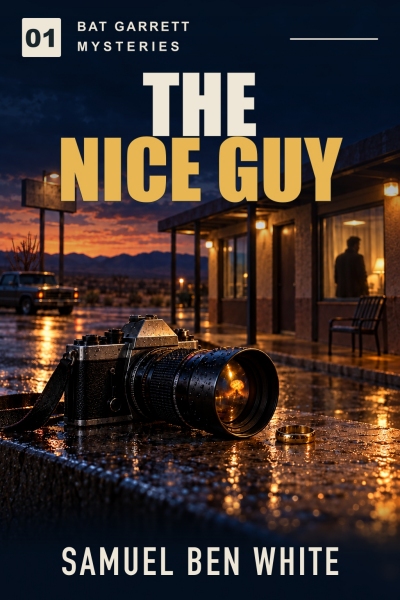
Bat Garrett has spent two years photographing cheating spouses and waiting for a case that matters. Then a secretive government agency sends the young Dallas private eye across the Southwest with reluctant operative Jody Anderson – legally married for cover and unsure whether they can trust each other.
Routine surveillance turns into an explosion, gunfire, missing records, and equipment that fails at suspiciously useful moments. The official reports never match what Bat and Jody witnessed.
Bat wanted to become an agent. To get them both home, he must remain an investigator – and determine whether their target is really the greatest danger in the operation.
Angela Carroll knows who murdered her husband. Texas found him, tried him, convicted him, and put him in prison.
She would still like to know why.
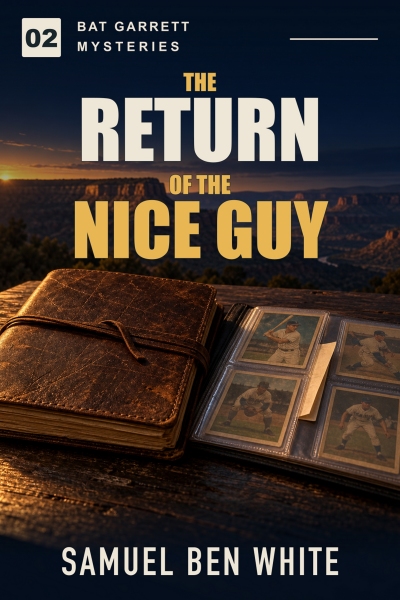
The official motive is robbery. The convicted man claims innocence. Conrad’s former colleagues offer several incompatible versions of the man he was. Bat Garrett accepts the case because unanswered questions rarely improve with age.
Journals with missing pages and a valueless baseball-card album point Bat and Jody toward an old dispute – and records that vanish as soon as they become useful. The courts have finished with the murder. Somebody else has not.
Franklin Gaston has one daughter, a dead wife, a dead brother, and no known enemy. After he is murdered, every part of that family history begins to break apart.
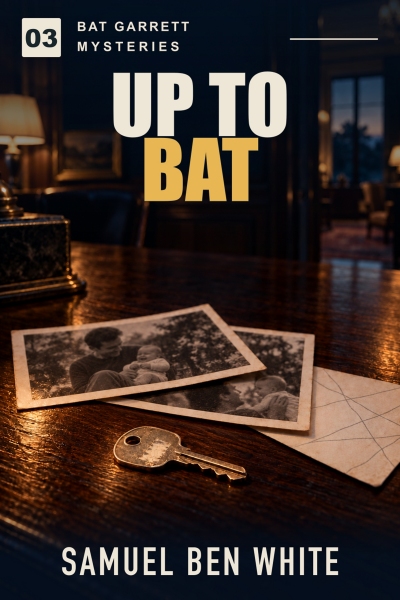
Telephone records reveal another household in Colorado. A bank key hidden beneath a carpet opens a box under an alias. Inside are photographs connecting people who were never supposed to know one another.
Gaston’s daughter wants the truth. Bat Garrett and attorney Heather Dawson follow the pictures through divided families, old loyalties, and a secret somebody has spent years trying to recover. The killer is only one part of the mystery Gaston left behind.
It’s the biggest case Bat’s ever had, but it may cost him more than he’s ever had to give.
Available on Kindle and paperback. Make sure you read the whole Bat Garrett (& Jody) saga, beginning with “The Nice Guy“, followed by “The Return of the Nice Guy“, then this book, then concluded (this arc, anyway) in “Last at Bat”
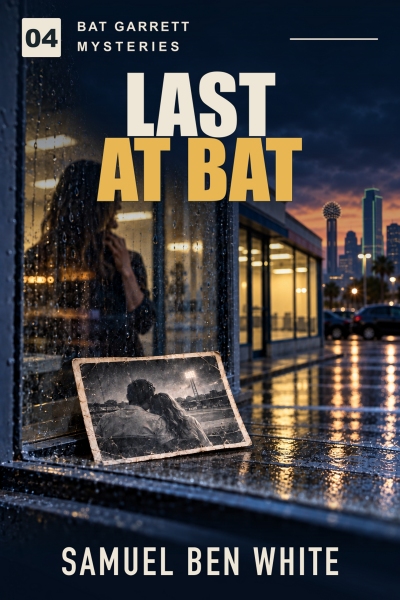
The woman behind the counter looks exactly like Jody Anderson, down to the scars Bat Garrett watched her acquire.
That should be impossible. Bat saw Jody die. The Houston saleswoman insists she is Janet Alexander, and the records support her – for a while.
Her transcript has no matching yearbook photograph. News archives contain incompatible deaths and returns. A family album appears to have been altered. Then Janet remembers something only Jody could know.
As one life becomes credible, the other looks carefully manufactured. Bat must discover who assembled Janet’s history, how they made it hold together, and why they still need her to believe it.
To read more about Bat Garrett, be sure and check out “The Nice Guy“, “The Return of the Nice Guy” and “Up to Bat“. All available on Kindle & in paperback! And, if you want to read this story from Jody’s perspective (as well as find out what happened next), be sure and read “Cheerleader, Gymnast, Flautist, Spy“!
Before Jody Anderson became Bat Garrett’s reluctant partner, she had already rebuilt her future more than once.
Injury ended her Olympic gymnastics dream. Flute, cheerleading, and hard work carried her through college, where she found a calling in speech therapy – and enough debt to make a government recruiter’s offer difficult to ignore.
The Home Agency turns training into dangerous fieldwork, then pairs Jody with a joking Dallas private eye who appears dangerously unqualified.
Told in Jody’s own voice, this is the story behind the partnership: the ambitions that shaped her, the missions that tested her, and the choices through which she claims a life of her own.
Bat Garrett goes to Dumas to bury an old friend. The friend’s parents would like a private investigation while he is there.
Mike Donelly died after eating peanuts. Since Mike had a severe allergy, the official explanation is simple. It becomes harder to accept when his emergency injector is missing, his phone appears recently scrubbed, and the fatal food had a remarkably limited route into his apartment.
Bat knew nearly everyone involved as teenagers. Jody married Bat, not his memories, and she notices the assumptions nostalgia protects. Together they ask who understood Mike well enough to make murder look like carelessness.
At the Toltec Mind-Games, competitors race down a mountain and face off across chessboards. Then a snowboard snaps – and someone wants to know whether it were sabotaged.
Bat Garrett’s equipment checks and video review point toward an accident, but a strange note keeps the inquiry open. With Bat’s identity already public, Jody goes undercover among the competitors and groupies.
Then the injured athlete is found dead.
The broken board, private feuds, and carefully managed public personas now carry new weight. Bat and Jody must determine which secrets belong to a crime before rumor and publicity supply a more convenient answer.
Bat Garrett becomes a mail carrier because regular pay and maternity insurance are useful when one’s wife is expecting a baby.
Then a trading post explodes as he arrives to deliver its mail.
Jody recognizes the presumed victims as the people who once kidnapped her, replaced her identity, and disappeared. Bat wants proof they died in the fire. Jody initially wants distance from the subject.
The trail gives neither of them what they want: a stolen car, an empty house, erased records, bodies without reliable identities, and a locket belonging to somebody’s family. Whatever happened at the trading post, Jody’s past has reached Flagstaff.
When a skeleton is found in the remains of the burnt-out courthouse, most folks just treat it as a curiosity. Ira “Doc” Pearson knows it was murder and wonders if the murderer is still around.
Published by Outlaws Publishing and available on ebook (in many formats) and in paperback!
The Van Bent courthouse burns down and a body is found to have been stuffed into the floorboards years before, when the building was built. Ira Pearson is determined to discover the identity of the woman, but Sheriff Wood has little interest in the matter for he has more important matters on his hands–including a numbers runner and big city tough who came to Van Bent for some reason and promptly lost a thumb in an alley fight. Could the back alley fight and the woman in the floor somehow be connected?
Sample passage
“What’s going on, Chief?”
“I just—you need to see, first.”
The chief led the way over to the smoldering remains of the courthouse and to a ladder that had been lowered into the basement. He handed Ira some big, rubber boots, saying, “Put these on. Foller me. It’s safe,” Buckler directed as he descended the ladder.
Ira hesitated, but the man seemed to be going down with no fear. And it did look like everything was safe but soaked, hence the boots, which he put on. He took a breath, then followed the man down the ladder and into the pit that had so recently been the courthouse basement. He was glad of the rubber boots if for no other reason than that they came up to his knees and the piles of muddy ash were at least that deep.
They slogged over to a space almost in the center of the building’s footprint—which seemed surprisingly small to Ira, now that the building was gone—and Buckler knelt down and pointed. “Looky here, Doc.”
Ira bent over and saw instantly what the man was pointing at. “Human hand, ain’t it?” Buckler asked.
“Sure looks like it. Right hand.”
“No chance it’s just a fake of some kind? I seen a human skeleton over to El Paso once made out of plaster. This looks real to me, but I ain’t seen all that many human bones in my day.”
Ira moved in closer and peered at the strange object before him. “My early thought is that it’s real. Is there more?”
“We stopped work when we seen this,” Buckler answered. “If there is, I reckon it extends in under that pile there,” he continued, pointing. “I didn’t want to go no further ‘til we had you here to supervise. Thought you could tell us if this person died in the fire.”
“At an early guess, I’m going to say no. As hot as that fire was, if this were a, um, ‘fresh body’, there would probably still be more signs of flesh. And the burn marks on the bones would be different if flesh were melted off or if it were just bones in the fire.”
Buckler nodded and said, “I git ya, Doc.”
“Chief, you know of any reason there would be a skeleton in the courthouse?”
“None I can think of. Nobody had one in an office or anything—that I know of.”
“And this is on top of some things,” Ira commented, mostly to himself. Realizing he had said it out loud, he explained, “Not like this courthouse was built on top of an old cemetery and this was someone buried here. This person is above the rock of the basement. Any chance this person was stored in the basement?”
“What for?” Buckler asked, almost laughing.
“Who knows? Any old rumor that there was a body in the basement, though?”
“None that I ever heard. An’ I been here since the foundation was laid on this place. Before that, even. I helped to dig the hole.”
“All right,” Ira said, standing up. He looked around, then said, “This person’s dead, so it’s not like we can hurt him—or her—in any way. Still, let’s see if we can dig him out without jostling the bones around any more than we have to.”
“Okey-dokey,” Buckler said. “We’re going to need to brace that west wall, though. It’s bucklin’ a little and liable to collapse on us if we don’t.”
Ira nodded and said, “You get some men on that. You and me, let’s get some shovels and maybe a pry bar and see if we can find out whether there’s more under here than just a hand.” As the fire chief went off to put those instructions into action, Ira looked at the hand and remembered how finding a hand like this had landed his friends the Jameses in all sorts of trouble. He hadn’t been there, but he had heard the story. He also had thought over the years that, if he had been there, he could have kept Polly from spending that year in prison that she hadn’t deserved.
Buckler was soon back and, as three men worked to shore up the west wall, he went to work with Ira at pushing the ash and dirt away from the hand.
Soon, they were seeing a wrist, and then part of a forearm. And then, it seemed as if the arm were reaching out from within a wooden frame. “A casket?” Buckler asked as he looked at the wood.
Ira took up one of the shovels and scraped some of the dirt and ash away, then said, “Look at this, Chief. This isn’t a casket. Not built like that.”
Buckler shoved some of the dirt away himself and said, “That there’s flooring.” As Ira nodded, Buckler commented in worried awe, “This body was inside a floor! Somebody hid a body in the floor.” He reached out and rubbed some ash away from the top, saying, “That’s the tile from the first floor. I’m picturing in my mind and them joists for the first floor was foot-wide beams. Two foot on center.”
“Plenty of room to hide a body,” Ira commented.
Buckler tried to made a joke as he said, “Ain’t nobody goin’ to fit me in a foot-by-two space lessen they squeeze me down a might.” He looked up suddenly and asked, “You don’t reckon it’s a child, do ya, Doc?”
“Based on the size of that hand, I’d say it’s at least someone fifteen years old, or more. Not a big person. Might be a lady.”
Buckler took off his hat, as if at a funeral, and said with reverence, “God be with us.”
Ira raised up, tapped through the mud and ash in a couple places, then said, “Looks like there’s a fair-sized portion of that floor here still intact. Relatively speaking, anyway. Let’s clear it off and get some more pry-bars over here.”
“Think the whole body’s still together?”
“I’d have to say that would be beyond belief, but finding this at all is pretty incredible. And somebody better go fetch Sheriff Wood.”
“After all this time?”
“Whether we can figure out how this person got here I have my doubts, but it’s not likely to have been for benign reasons that someone hid a body in between floorboards. I think the sheriff needs to know.”
Buckler nodded again, then detailed someone to go get the sheriff and the other two men to help them pry the boards apart. It was not easy for the floor had been well made and they were trying to not disturb the bones any more than absolutely necessary.
Sheriff Wood was with them a while later—and quite a crowd had gathered nearby though the volunteer fire department men and Wood’s deputy Chubby were keeping them back—when they finally got the right boards pried up. There were a couple of reverent exclamations, the Catholics present crossed themselves, and Ira was the first to articulate any recognizable words.
“This was a woman,” he said. Though the visage before them was mostly of bones, there was just enough muscle and tendons still clinging to the form to keep the skeleton intact.
“How old, you reckon?” Buckler asked, watching with great curiosity, but also with a clear reluctance as to touching the bones.
Ira shook his head, but leaned closer and said, “I can give a better answer with more study, but her hips make me think she was old enough to have given birth. There was no sign of arthritis in that hand we saw first.” He then pointed and said, mostly to Wood, “Look there, Sheriff. However she came to be between these boards, someone murdered her to get her here.”
Wood looked, as did the other men close by, and could see the crack in the skull Ira was pointing to. Wood, feeling the need to say something, “She was either dead when she was put in here or close to it. Nobody would have lived long after a rap like that.”
Ira nodded in agreement then said, “It’s been a long time, Sheriff. Trail’s going to be colder than a polar bear. But this fire just revealed a murder.”
That murder was done is clear to all. But who was murdered? And will anyone be brought to justice or will a whole town look the other way?
Published by Outlaws Publishing and available on ebook (in many formats) andin paperback!
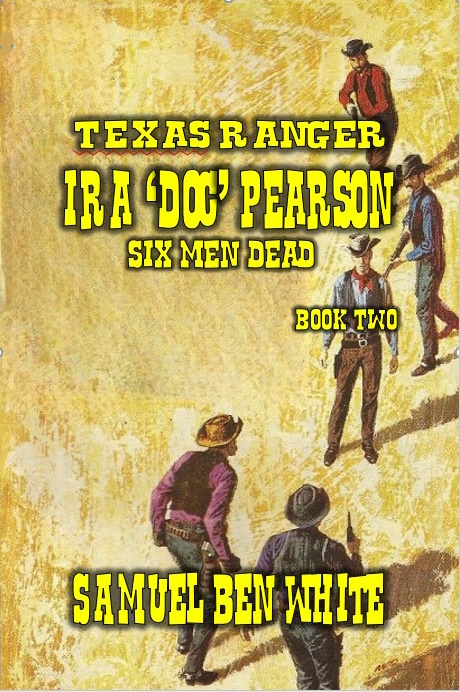
Six men rode into the west Texas town of Rook in December of 1895. Moments later, all six men lay dead in the street, shot to death by the good citizens of the town.
Ira “Doc” Pearson is sent by the Texas Rangers to investigate, expected to just rubber stamp the proceedings for the dead men were known as the Lawrence Gang: wanted in Texas and New Mexico for bank robberies, rustling and murder.
Ira knows, however, that one of the members of the Lawrence Gang was in jail in Lubbock at the time of the massacre. So who was the sixth man who died that day?
Official Texas is satisfied that justice was done, but Ira can’t let it go.
Also available on Audible and iTunes, narrated by Tom Lusty!
Six men rode into the Texas panhandle town of Rook. By the looks of them, six hard men, five of them on fine horses such as only an outlaw could afford, all wearing guns that had seen some use.
The people of Rook took all this in in a moment, and that was all they took.
Rifles, six-shooters and shot-guns seemed to appear as if by magic from every upstairs window on the dusty street. No signal had been heard or seen.
All fired at once and six men went down. Only two were even able to get their guns out of their holsters, but neither got off an effectual shot before scratching their last sign in the dirt of the street.
No horses were hurt more than a couple grazes, for the men (and maybe some women, if the rumors were true) of the west in general and Rook in particular thought a lot of horse flesh and had taken great care not to hit any of the animals.
All six riders died quickly. Nobody was gut-shot and writhing in the dirt, for the people of Rook were good shots
and toasted each other later in the saloons and each other’s houses that there had been no suffering. Not like the banker these men had made die slowly down in Banderas, or that parson who’d just been in the bank at Dimmit at the wrong time and had taken a month to die.
Nope, just six clean deaths.
One couldn’t say it was just six shots, though. Someone counted up later and found that most of a hundred Rook bullets had struck the six bodies. It was a wonder they hadn’t more than grazed the horses.
No one from Rook had so much as a scratch on them. Maybe some red eyes or sore throats from the smoke of the gunpowder, but nothing more. It had just been a few seconds of red-laced hell and then it was over. Six lay dead and a lot of people across west Texas and eastern New Mexico started sleeping easier again.
The worthies of Rook buried the six bodies in a single grave out at the town cemetery and the Campbellite parson said some words over them. A marker was put up but all it said was, “Lawrence Gang” and, below that, “Put here by the good citizens of Rook on 4 December, 1895“.
Chapter One
Folks took notice
when the stranger rode into town on the sorrel horse of his. It wasn’t quite like the old days, when every stranger who passed through Rook was noted, though, for mor
And this stranger wasn’t an especially striking specimen. A shade over six foot, with short light hair and beat-up clothes—though of tough cloth—nice boots, and a saddle that had seen some miles. Nor did his gun catch anyone’s eye, for while things were starting to get civilized, there were still quite a few men who wore guns, especially if they were traveling for civilization hadn’t completely caught up with the road agents. The stranger’s horse was a good-looking animal, one that looked like it could go all day and night, but it wasn’t a “show horse” for all that. Just a good-looking horse anyone would be proud to have, but not the kind that made people say to themselves, “I want that horse!”e people traveled anymore. On any given day, a dozen strangers might ride through, stopping only for water or a meal, before making their way back onto the road to Hereford or maybe McKeon. Most of the time, they drew no more notice than if a local had ridden through.
What got people’s attention, and set the tongues to wagging and brought the whispers to a dull roar was the silver on the man’s chest, for he wore the badge of a Texas Ranger. The badge was polished and glinted in the bright Texas sun, catching the eye of everyone who even glanced that way.
Soon, Sheriff Montgomery was hustling out of his office and greeting the stranger even as the man was tying his horse to the hitching rail in front of the jail. Extending his hand in a manner that seemed to be forced friendliness over an underlying nervousness, he said, “Howdy. I’m Sheriff Montgomery. I, um, I figured one of you would come.”
“Did you now?” the stranger replied, taking off his riding gloves then taking the sheriff’s hand. “Pearson’s my name. Ira Pearson. I reckon you already realized I’m a Ranger.”
“Uh, yes sir,” said the sheriff, even though he was probably a good fifteen years older than the Ranger. “Won’t you come inside?”
“Thank you,” the Ranger said politely.
Sheriff Montgomery watched with keen interest as the Ranger took off a Stetson that had seen some miles but was well-taken care off. The Ranger brushed some dust off the hat and then hung it on a peg just inside the door. The Sheriff saw then that the Ranger had the most grey eyes he had ever seen. Somehow both piercing and bland at the same time.
“Coffee?” the sheriff offered.
“Don’t mind if I do,” Ira Pearson replied. He took the cup gratefully, then sat in the offered seat. He waited a beat for the sheriff to sit down behind his desk, then said, “You probably know why I’m here.”
“To give the town a medal?” the sheriff tried to joke.
Ira Pearson chuckled, shaking his head. “There are some in Austin who have already suggested that. The citizens of some of your nearby towns would probably go along with that idea. But no, Sheriff,” he said, suddenly becoming more stern, “I don’t think anyone is going to try to argue that the Lawrence Gang didn’t have some retribution coming. However, six men shot down in a street with no provocation does look a lot like murder to the courts.”
“Murder?” the sheriff demanded. “After what they did in Monahans, or to them sheepherders down by—“
The Ranger held up his hand to forestall further talk from the sheriff and said, “We know those things. The whole state knows those things. And I have access to crimes I daresay you haven’t even heard of save in rumor, Sheriff. But there are laws in this state and murder is at the top of the list—even when the person murdered deserved what they got by every known set of rules.”
“So what are you going to do, Ranger?” The last word was said with something less than admiration in its tone.
“My orders are to investigate exactly what happened and turn in a report to my superiors. I can make recommendations, but it will be up to the Attorney General what is to be done ultimately.” He smiled then and asked affably, “May I assume that I will have the full cooperation of this office, Sheriff?”
“Um, uh,” the sheriff fumbled, taken off guard by the sudden friendliness, “Sure. Absolutely.”
“Thank you.” The Ranger reached into a vest pocket, pulled out a little notebook such as most ranchers carried for tallying up stock, and a pencil that was already sharp and said, “For starters, I’d like to hear your account of what transpired on Wednesday of last week.”
The sheriff cleared his throat, looked around for help where there was none, then began, “Well, it really started before last Wednesday.” Steeling his will, he said, “Here’s what happened, Ranger—wait, ain’t you the one they call ‘Doc’ Pearson?”
The Ranger hesitated, chagrin on his face, then replied, “Yes. But I prefer Ira, or Pearson, or Ranger or ‘Hey You’ for that matter.”
“All righty,” the sheriff agreed, wondering what the story might be behind both the nickname and the obvious dislike the wearer had for it. Still, he shrugged then began, “I’m sure you know all about the Lawrence Gang. Well, I know it, too, and I may know more than you think I do. But that’s no never mind. What I do know is that in the last week of November they stuck up a stage over by Lubbock. Shot the driver and the express man. Beat up the passengers—three men and a woman—and left them beside the road. One of the men is still laid up, they tell me.
“From there, they drunk up half the liquor in Littlefield and shot out most of the windows. Beat a bank teller half to death ‘cause he didn’t have but twenty dollars to give them. Y’know, Ranger, they used to just rob a bank now and then. But somethin’ went wrong with that Frank Lawrence up here,” he gestured toward his own head. “I ain’t saying they didn’t deserve jail or death for the robbin’, but here lately they just went plumb crazy.
“After Lubbock, and then being in Littlefield, I didn’t worry none ‘cause I figured they was headin’s away from us. Next thing I know, they’re in Olton, then somebody east of Hart said he thought he saw them on the trail to Tulia. Everybody in this town had heard that, too, Ranger, so they got up the citizen’s committee and started asking what they should do.” He looked furtively toward the door, as if hoping someone would come in and interrupt his proceedings, before continuing, “Now I, um, I told them what we’d have to do was arrest them Lawrences and then get word to you—the Rangers, I mean, not just you personal.
“Sudden like, ever’body in town’s walkin’ on eggshells. Men wearing Colts strapped to their pants that hadn’t been fired in ten years. I was, I tell you, I was worried about a accident—“
“Accident?” Pearson questioned.
“You know how it is,” the sheriff explained, somewhat plaintively. “Ever’body’s on edge and, first thing you know, one fella’s bumped into another in the saloon and all of a sudden ever’body’s firin’ guns and somebody lays dead.”
“And that’s not what you wanted? Dead men in the street?”
“What? No sir!” Sheriff Montgomery objected forcefully. “I never wanted no such of a thing! But I tell ya: when it happened, the people of Rook handled it like men.”
“And how was that?” the Ranger asked calmly.
The sheriff was sweating, even though it was a cold panhandle day outside and the pot-bellied stove was only putting a dent in the chill. He suddenly blurted out, “Well, you remember back a couple years ago when that posse caught up with the Lawrences down hear Odessa, don’t you? Had ‘em chained up and everything. But ol’ Pete Lawrence, he had him a cousin there in Odessa who got a file to ‘em. They slipped out slick as whistles in the night and have been raising—well, you done told me you know what they been doin’.”
He stopped for a moment, formulating his words, then offered, “I told ever’body that we needed to catch them Lawrences legal and hold ‘em tight! I was goin’ to swear in a passel of deputies and we was goin’ to watch over them like new mothers over a baby ‘til you could get here.”
“Wise plan. What happened to it?”
“’It’?”
“The plan. What happened to the plan?”
“Went all to pieces,” the sheriff said with a laugh. Suddenly enjoying himself, he explained, “Word had somehow got out that our bank had took delivery of a large sum of money, so I was on edge anyway. Then, we heard about the Lawrences coming. Then, that morning, Collin Warner—he runs a little dairy operation just south of town—he wakes me up and says he seen a bunch of men hiding out in a draw on his place. He said he seen their fire, then snuck up on ‘em knowin’ nobody honest would be a camped out like that without saying ‘hey’ to the owner. Collin, he used to be in the Army and he injunned his way up there and said he seen Pete and Frank big as life—“
“How’d he know it was them?”
“Wanted posters, I reckon. Ever’body knows—knew—Frank had that scarred-up nose from when that feller bit him down in Abilene. And Pete was so skinny he had to stand twice to cast a shadow. And ol’ Onion Taylor, we all knowed what he looked like on account of the stories told about him. And they was true, let me tell you. Must’a took thirty shots hisself before he went down.”