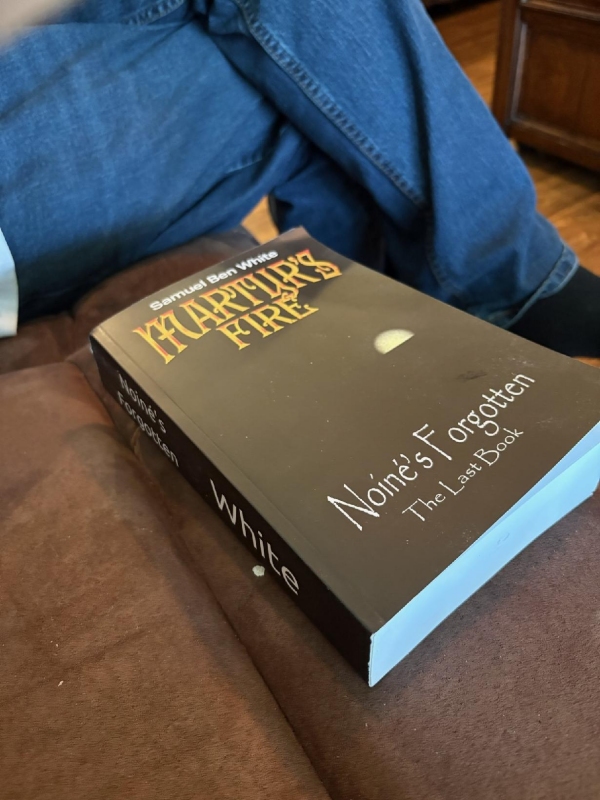
Send me a pic of where you read my books! Write me garisonfitch@gmail.com! And make sure you order your copy of Noiné’s Forgotten on Kindle or in paperback here.
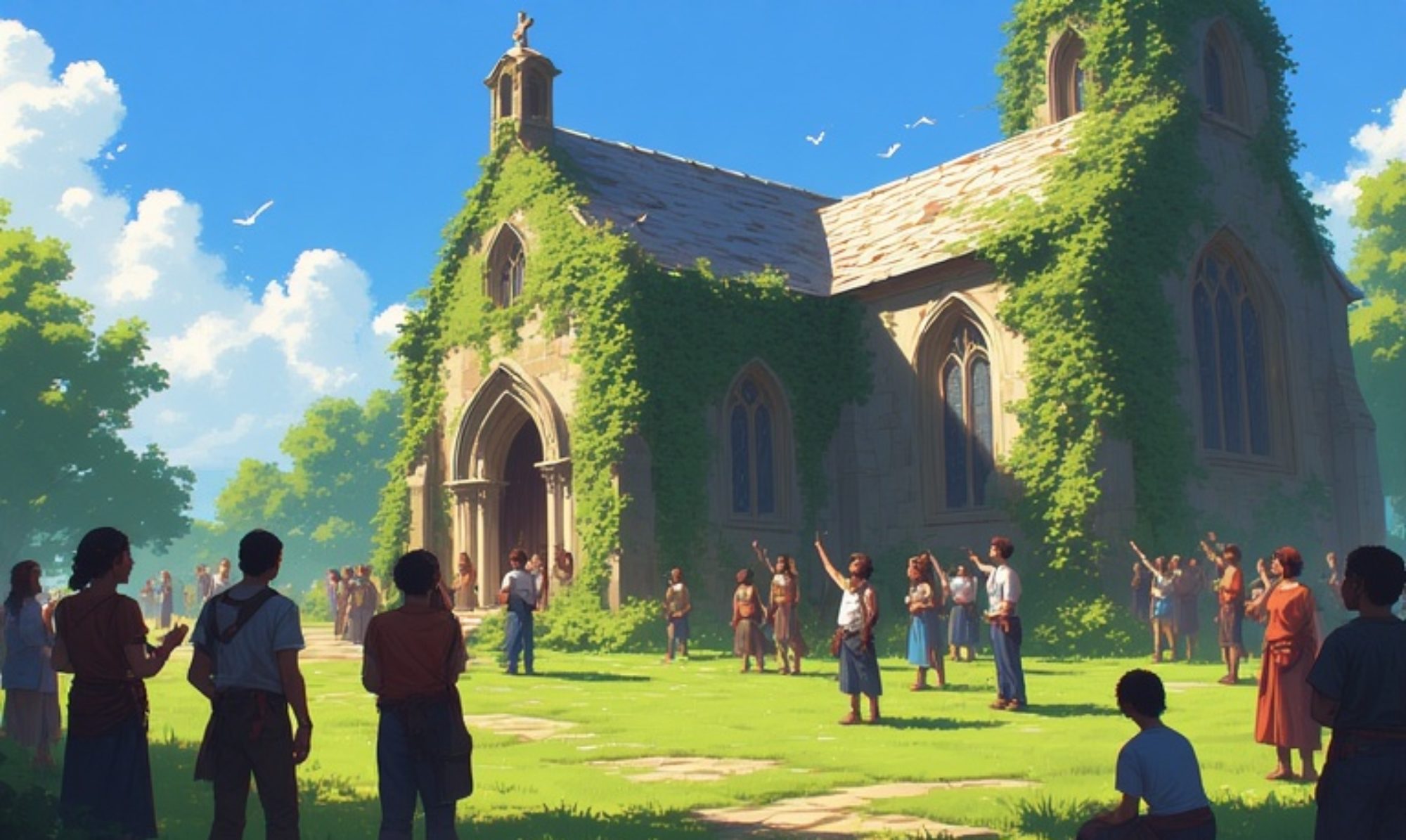
What happens after Gabriel blows his trumpet? Available Now!
Send me a pic of where you read my books! Write me garisonfitch@gmail.com! And make sure you order your copy of Noiné’s Forgotten on Kindle or in paperback here.
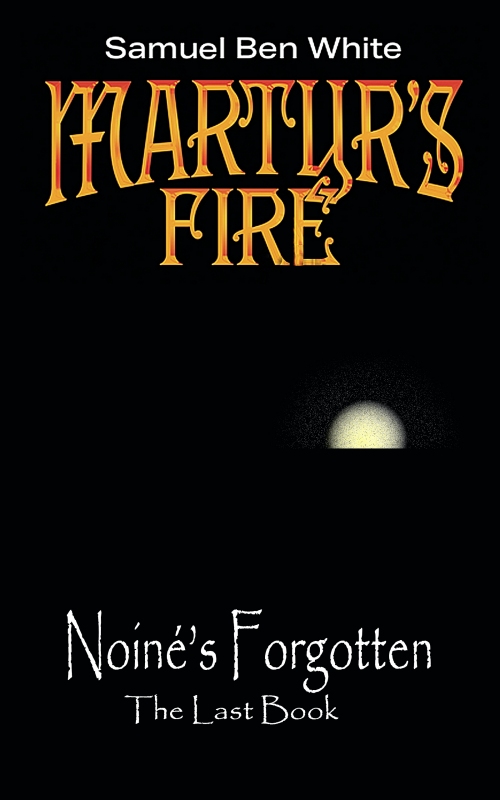
The finale is finally here!
You can order the finale to the Martyr’s Fire series in paperback or for Kindle! And be sure and go back and read the other books in the Martyr’s Fire series: Noiné’s Child, Noiné’s Prayer and Noiné’s Eyes! See the whole series here! Order many copies for yourself and give the extras to your friends!
Description:
6471 A.D.
They said they would never forget. A millennia ago, mankind set aside all boundaries of religion, geography and tribal allegiances to fight the greatest battle in the history of the world.
That battle is now the stuff of legend. People rarely talk about it anymore, and those few who do doubt that it really happened. The old walls are back up, and the old animosities.
In the mountains, Adam Forest is growing to manhood while dreaming of only one thing: flight.
On the plains, Noen is growing up with dreams of a world outside her little community, where the old legends still hold sway and people can believe in the ancient God without fear.
But between the plains and the mountains an ancient evil has been revived. Even if it can be beaten back, is it too late, for the cultures on the mountains and the plains are collapsing. Is there any hope left?
Who knows? Who still remembers?
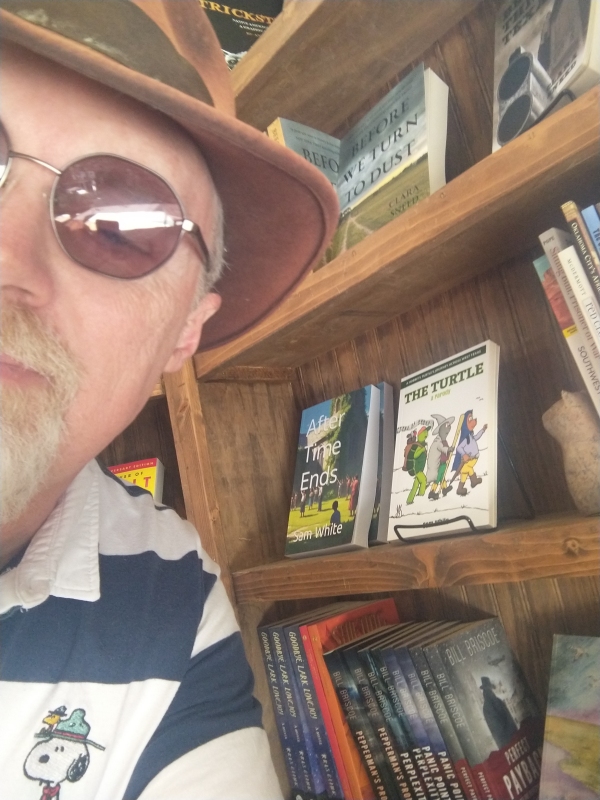
If you live in Canyon or Amarillo, you can now pick up copies of “After Time Ends” and “The Turtle-A Parody” at The Borrowing Owl Bookstores. Tell your friends!
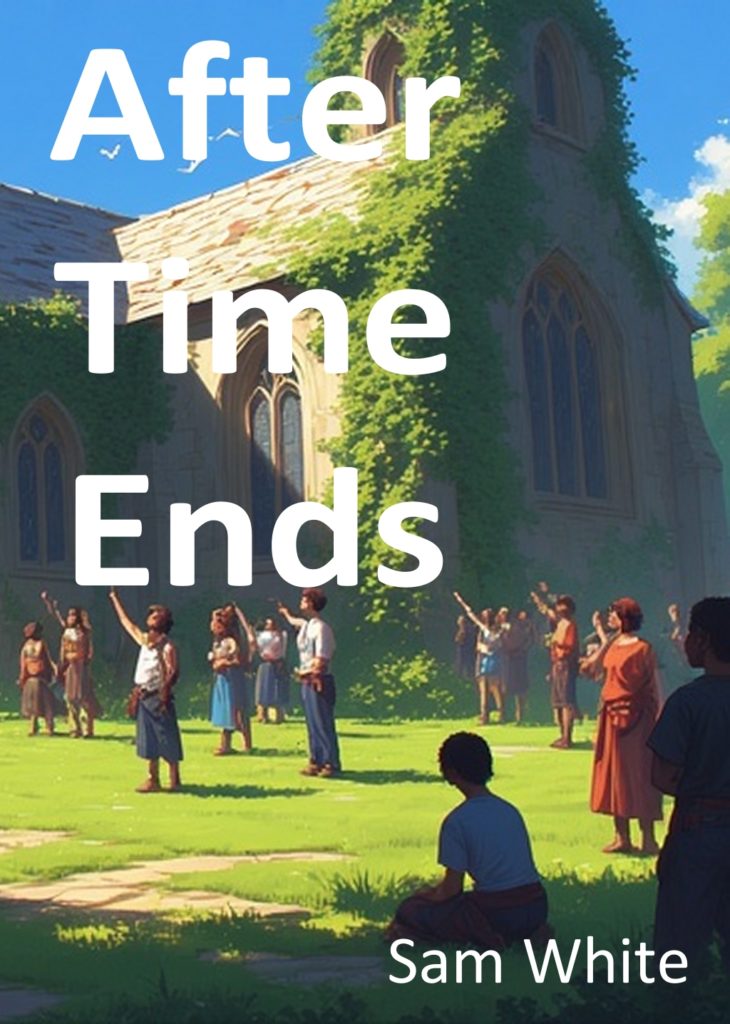
Available Now on Kindle, paperback, hardback and many other formats! (Including Apple, Smashwords, Everand, Tolino, Gardeners, Vivlio, BorrowBox, Fable, Nook, Bookshop, CloudLibrary, Overdrive, Hoopla and Kobo!)
Gabriel’s trumpet has sounded.
In a flash, the wicked have been swept away and only the saved are left. All aches and pains and worries are gone, but this isn’t what those left were expecting. It’s not what they had been taught.
One by one, the saved are finding themselves drawn together; in praise, in worship, in Scripture. The children aren’t children and the elderly are no longer old. There is no more sorrow and no more death.
What comes next?
And where is the Lord?
Sample passage
Clarity woke up suddenly, thinking she had heard some incredibly loud sound, but sitting up in bed with her heart pounding she couldn’t remember what it was. A car back-firing? The city’s tornado sirens? She had no idea and, if a siren, it wasn’t blaring now.
Looking to her left, she was surprised to see that the bed was empty. Had he heard the sound, too, and jumped up to go see what made it? Had someone broken in? Had something fallen somewhere in the house?
It was only then that it registered on her just how light it was outside. As she rubbed her eyes, she mumbled, “Just how late is it?” She glanced over at the clock but it’s face was dark. No numbers, nothing. She glanced up and saw that the ceiling fan wasn’t turning.
“No power,” she muttered. As she got out of bed and put on her summer robe, she assumed then that the noise she had heard was probably what had knocked out the power. Maybe someone had plowed into that transformer on 44th. That seemed the most likely, for there were frequent crashes and fender-benders on that street. How long had it been since that motorcyclist had been hit and killed? Two months? Three?
Stretching, she then walked out into the house calling, “Tim? Are you up?
“Of course he’s up,” she chuckled to herself. “If he weren’t up, he’d still be in bed.” She knew that wasn’t true, for some nights he couldn’t sleep and went out to the living room to watch TV or read and then fell asleep in the recliner.
But no voice answered in return.
Clarity glanced into the guest bedroom as she passed it, for he sometimes slept there rather than come back to bed and wake her up, but no one was there. The home office was equally bereft of occupants. “Tim?” she called again, seeing that no one was in the living room. Neither did any sounds come from the kitchen. The back deck, pleasant at that time of year, was empty as well.
It was coming on to summer, so maybe—she reasoned—he took off early for his daily walk. When she glanced out the window and saw that both cars were there, she nodded, thinking that had to be it. He just went out on his morning walk and would be back at any time. He had done that before. And while he was usually really careful about closing the front door as he left, she was betting the wind had jerked it out of his hand and that was the loud noise she had heard.
Stretching again, yawning, she went to the fridge and pulled out the milk for her cereal. Even knowing that the power was out, she was still surprised when the fridge was dark inside. She laughed at herself for that.
As she sat down to eat her bowl of frosted wheats, she noticed that Tim’s phone was still on the counter. She frowned, but not really with worry. She was always reminding him to take his phone with him when he went on walks. He had never, in all their years of marriage, needed to call her from a walk, but she always wanted him to be able to, should he need to. The truth was, she admitted, that she had always wanted the ability to call him, though that need had rarely arisen. (And the times of “need” were a loose definition of the word.)
“Oh well,” she said with a chuckle and a shrug. He would be back in a bit and she’d give him a light-hearted scolding and he would say, “I’m fine, see?” and they would both laugh at her worry.
Breakfast came and went, though, without his return. She rinsed her dishes and then headed to the bathroom. She left the bathroom door open so she wouldn’t have to shower in the dark, but she still hastened through the ablutions for some reason. “Who am I expecting to walk in?” she asked aloud, with a chuckle. The kids would all be at work by that time, so she need not worry about one of them dropping in—not that they had ever dropped in that early anyway, even when they had lived in town.
When she was dressed and he still hadn’t come back, though, she thought she ought to go look for him. Surely nothing had happened, but if something had, he had no way of calling her. She was betting he had been outside when whoever had plowed into the transformer and, like a little boy, was over there watching the police and firemen and people from the electric company take care of the business at hand.
“But there haven’t been any sirens,” she mumbled aloud. In fact, she thought to herself, I’m not hearing any traffic. The house had new, double-pane windows—put in just last year—and while they had cut down on outside noises considerably, they hadn’t eliminated them entirely. She wasn’t hearing anything, though. Normally, there would be the sound of at least one hopped-up ride on the main street a block away, or just the dull hum of traffic in general.
And it was Tuesday. Shouldn’t she have heard the trash trucks by now? And all the dogs barking at the trash trucks? Even her wonderful windows couldn’t completely eliminate that!
She decided, then, to make up the bed and, if Tim weren’t back by the time she was done, she’d go for a walk herself. She’d head for that transformer first, she determined with a smile, sure to catch all the grown-up men of the neighborhood watching the heavy machinery like little boys. Some of them with their little boys in hand.
She picked up Tim’s pillow and, beneath it, there lay his wedding ring. She picked it up curiously, noting within herself that there were no thoughts of panic or approbation. Just curiosity.
With the ring still in her hand, she pulled back the covers so as to straighten the sheets—how Tim could wrinkle the sheets for a guy who rarely ever moved once asleep!—and there were his boxer shorts. She started to reach for them, then realized they were right where they would be if—
And the ring. He often slept on his stomach—as the shorts would indicate—with his hands under the pillow. The ring was right where it would be if—
Slipping the ring into her pocket and her feet into her shoes, she rushed from the bedroom and out of the front door. Down the steps and into the yard, she looked around and …
Didn’t see another soul.
No one. That the neighborhood would contain empty front yards was not strange, for hadn’t she and Tim both remarked over the years that people just didn’t hang out on front porches anymore? Some even had furniture on their front porches—nice little matching chair and table sets—but she could count on one hand the number of times she had seen people sitting thusly. People came out of their houses just long enough to get to their cars, or go from their cars to their houses. If no one were mowing, no one was in their yard. There were lots of times when she had gone out herself and seen no one else.
But there were no cars moving along 44th, one of the city’s major arteries. And there were no sounds of cars in the distance, or airplanes. Or much of anything else. No machinery at all. No air conditioners spinning. The only sounds she was hearing were that of a few birds, maybe one distant dog barking, and the sound of a sprinkler three houses to the north.
She looked at the sprinkler and watched it spin for a moment. Just a simple, old-fashioned sprinkler on a hose. But it, the wind, the birds and that one dog were the only sounds she could hear. Now there were two dogs barking, but neither seemed frantic. Just the normal greeting of dog to dog.
And yet, she wasn’t afraid. She thought maybe she should be, but she wasn’t.
“Tim!” she called loudly, and then again.
There was no answer, from anyone.
“Maybe I’m dead,” she said, in a normal, casual voice. The thought didn’t scare her.
She was curious, though. What was going on? Where was everyone?
“Surely I’m still asleep,” she said with a laugh. “Yeah. I have to be.” She took a few steps out onto the grass of her front lawn and said, “Yeah. That’s got to be it. Doesn’t feel like a dream—feels too real—but it’s got to be a dream. If this were real, there would be stickers,” she added with a chuckle.
“What else could it be?”
She dropped to her knees and began to pray, but didn’t know what to pray for. She realized, though, that she knew what had happened and where Tim was. With perfect clarity of mind, Clarity still found herself weeping, wondering what she could have done differently, while still praising God for his sovereignty.
Available Now on Kindle, paperback, hardback! Also available on Smashwords and Nook, Kobo & more!
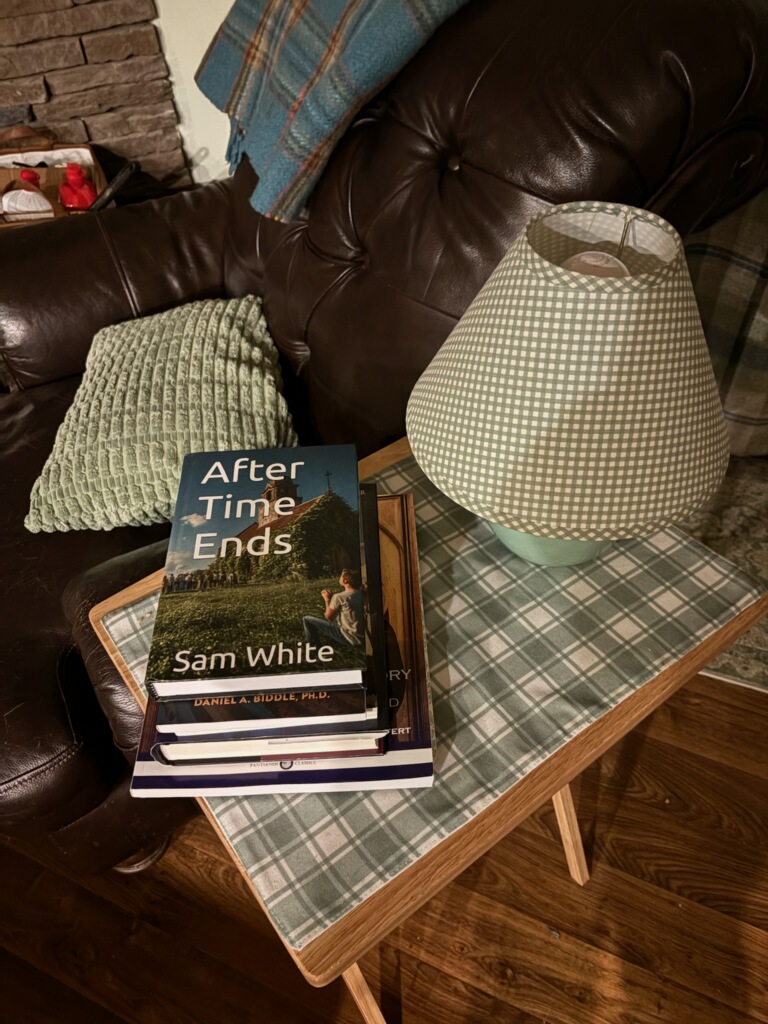
This is where Kryss has her book (when it’s not in her hands!). Where are you reading After Time Ends? Send me a pic!
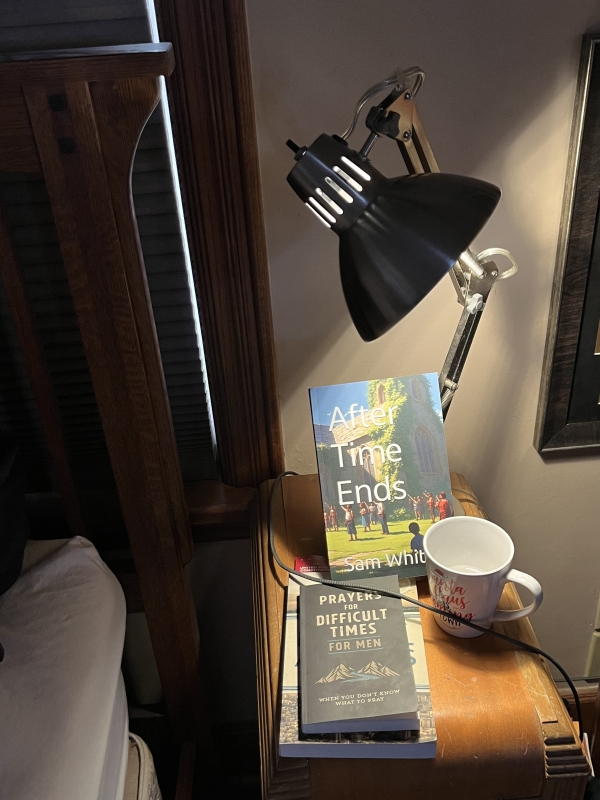
This is where Phil is reading “After Time Ends”. How about you?
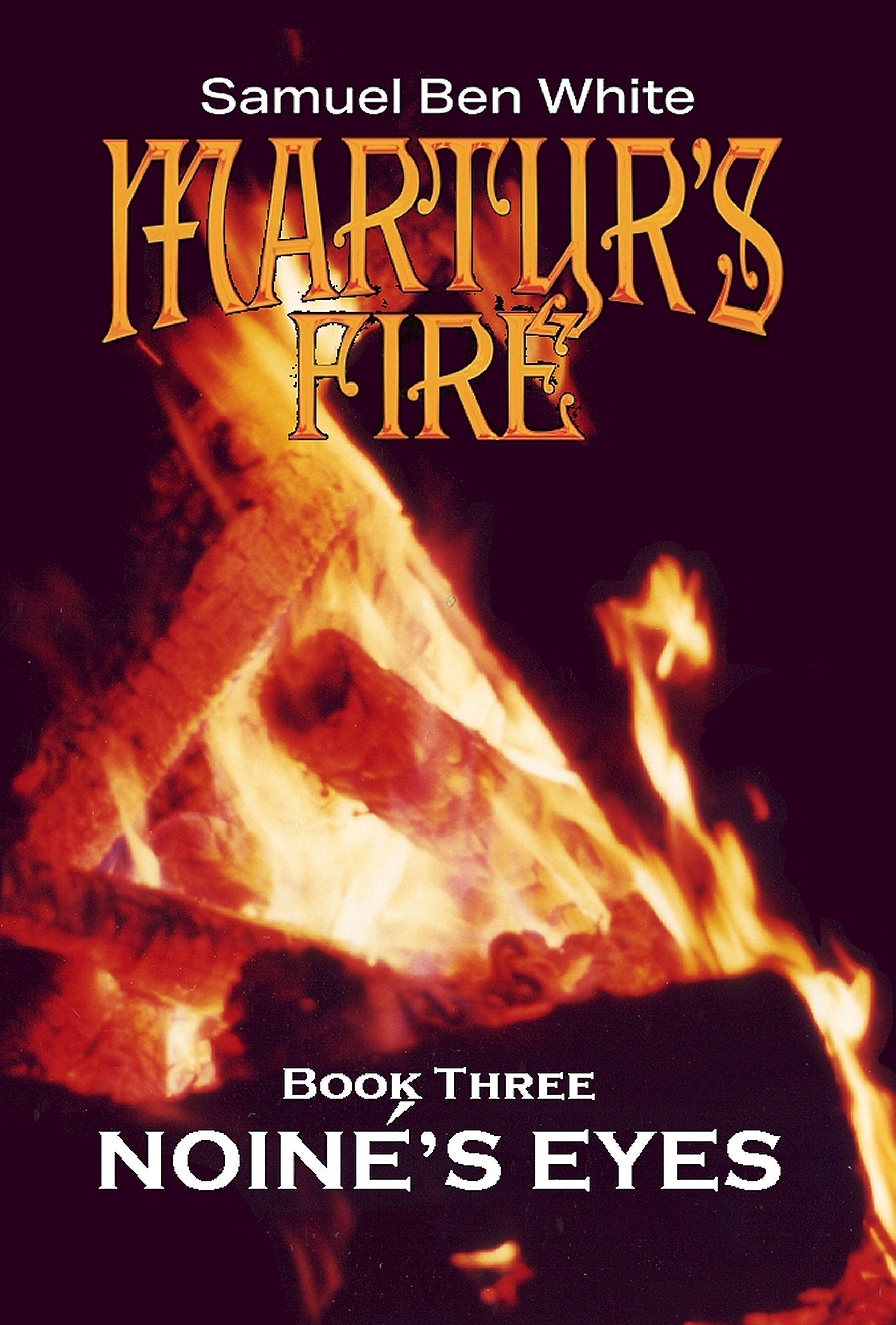
Order your Kindle copy today! Click here. For the paperback, click here!
AD 5252 and all of the western world is at war.
Led by King Vykyant, a coalition of more than a dozen nations has come together to fight an evil on a far-off continent. “We will fight it there to protect our families here.”
But the families at home are not free of danger, for the fight is being waged there, too.
Thousands of soldiers marching, fighting and dying in a foreign land. People at home getting spotty information at best.
A world at war, as told through the eyes of the people on every front line.
Now available for Kindle & paperback. (Due to the length of this novel, it will not be available in hardback.)
Sample Reading
Three thousand years before, the continent had been a land with everything: verdant forests, wide rivers, harsh deserts. There had been cities and towns and beaches and places where men and women went for leisure and many places where they worked. It had been a land of mystery, and legends, and ghosts.
There had been people of education and what was called sophistication, often living just feet from those who didn’t receive those accolades. There had been people in the finest clothes, often living not so far away from people who had the barest rags, then a little further away were people who didn’t know what clothes were for and—had they known—couldn’t have imagined wearing them. Technology had existed side-by-side with stone tools.
When the first of great wars had come, the majority of the continent had remained relatively unscathed. Relative being a relative term, for there had been fights and squabbles, but almost none of the large-scale harm that had affected every other continent on the planet. Some of the survivors from other continents moved to that continent thinking it would always be that way.
When the wars returned—though in the myopic view of the future’s rear view, all the wars were one—the continent was mostly spared, though circumstances made it isolated.
The continent was still rich in many ways, but especially in tyrants and graft. Its resources were plundered and sold, leaving the majority of its population in even more poverty and want than they had been before—and they had been among the planet’s poorest back then. Its great forests were plundered not just for the wood, but for the precious metals that lay beneath, a process that had begun before the wars, then accelerated after even though the booty was just being sold to fellow residents of the continent.
But then came more wars that finally poisoned the rest of the planet. That southern continent was more protected than all the others, or so it seemed at first. Very few military strikes landed there. It was not attacked with the poisons that were levied against practically everywhere else and atmospheric conditions swirled them away. The last of the people who could escape from the other continents came to the southern continent.
They brought their wealth with them—some of which had come originally from that continent, ironically. The richest brought their own security forces with them, setting up little fiefdoms, assuming that to do so was their right even as they ran those who had been on the land for time out of mind off of it. Those so displaced headed to the already crowded cities, making life even harder—or deeper into the jungle.
And then the winds shifted. Not the political winds, but the actual winds, and the poisons everyone thought they had escaped came to the southern continent.
Millions were wiped out in just months’ time.
As in the rest of the world, those who survived, survived in pockets. Perhaps more people survived on the southern continent than on others. Some estimated that while elsewhere in the world ninety percent of the population was wiped out by the wars and their poisons, on the southern continent it was “only” eighty percent. Those who survived quickly stopped burying their dead and just threw them into the rivers or natural ravines. This exacerbated the poison, and the stench.
Technology was lost.
Commerce between the pockets was impossible.
Mankind was reduced to its most primitive state as every waking hour was spent scrabbling for food and shelter. And on that continent, in its pockets, there were more people fighting for the few resources the poisons hadn’t killed. The men and women of those lands became more vicious than in the rest of the world because they had to if they wanted to survive.
A millennium later, as the poisons dissipated and people all over the world began to venture bravely beyond the piece of ground they had known for a thousand years, there was some conflict of course, as is the nature of man. In some places there was cooperation, though, as the people met others who had goods or services they didn’t have themselves. In some cases across the globe rival pockets still spoke a semblance of the same language, but in some they were so divided they couldn’t even sign to one another. There was fighting at times, too.
The southern continent knew nothing of cooperation. For a thousand years and more, all anyone had known was a mad struggle for life amidst death and when they encountered someone they didn’t know, the first thought on every mind was challenge, and murder. Pockets of stronger people conquered pockets of weaker people, though there were no pockets of weak people. The strongest took over, killing or enslaving the weaker until only the very strongest ruled. Tin-pot dictators were overrun by tyrants, and tyrants were squashed by despots. When finally a potentate arose for a time who was over the whole continent, it was with an army of people who were only biologically men, for in reality they were animals.
Like with animals, as the leader began to show weakness, he was slaughtered by a younger, stronger, lieutenant who would then rule until the same fate befell him. And so it went. For two thousand years the plants grew back, deformed and twisted from the lingering effects of the wars, but not so deformed and twisted as the men and women who occupied the lands.
Their languages were guttural and rarely written down. Their thoughts were of conquest and survival and not worth being written. Every thought was toward evil and their own advancement.
It was only natural that the puppet who was the latest to rise to “command” of the whole continent could be easily persuaded to look beyond the continent, to the lands to the north, where it was said there were good lands and weak people who would fall easily before his blade.
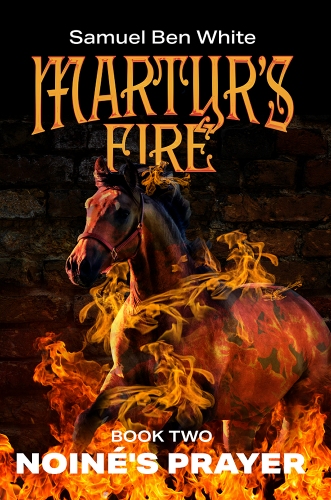
Available now on Kindle and in paperback and hardback!
5233 A.D.
Soldiers sent on a mission of diplomacy from their king are murdered. Was it an ambush by the mysterious enemy to the south? Did the king himself have them murdered? How did the survivors make it back alive, and will they be allowed to stay that way?
Elo has found her nephew and a family beyond her reckoning. They are numerous and friendly and share her faith … and possess technology beyond the dreams of the people on the plains. Yet it is not paradise, for beneath the surface in those cold, snowy mountains is a past no one wants to recall.
And John. He is becoming a man, with a man’s ambitions and desires, but is forever haunted by the mother he never got to know. Even if he wanted to forget her, he is constantly reminded—by seemingly everyone—that he is Noiné’s child … and her prayer.
Sample reading
“Hard to breathe up here, isn’t it?” said the older man to the younger.
The younger, in his youthful pride, had been trying not to admit to that difficulty but since the other had brought it up was less embarrassed to say, “Yes.” He wanted to say more, but at the moment he could not. He stopped and tried to fill his lungs, but was not as successful as he would have liked to have been.
The two sat down on a rock, the summit in sight but not appearing to be that much closer than the last time they had stopped. The younger man told himself he was stopping so often for the sake of the older, but in his heart he knew that he was stopping because he was out of wind.
Why?
He was pretty sure he had climbed mountains this tall before. Had they given him such trouble and he just didn’t remember it?
And how was the older man making it at all?
Maybe it was just the temperature, for it was—if not cold—brisk. And the little bits of wind that blew by seemed like they were taking away what breath he had.
“Not much further,” said the older man, standing up and gesturing towards the summit so tantalizingly close.
As the younger man stood up, he asked himself just how old the older man was. Fifty? Sixty? He had been told that such numbers didn’t mean much, and had met men and women both who were much older than those numbers. They generally didn’t walk so far and climb so high, though, seeming content to just stay near their own front porches.
Still, the older man at times didn’t look all that old. For most of this trip, in fact, he had been the first to set out and the last to stop, taking the steps—even the steep ones—with a spryness to his gait the younger man had to think about to match. On horseback, few could match him.
Yet other times—as when they sat by the fire the night before—the older man could look even older than usual. Had it just been the firelight highlighting the deep lines in the old skin? The younger man didn’t think so, for he had noticed similar appearances at other times.
But did not everyone have such times? Times when they didn’t know (or care) they were being watched and their mind had gone back—back to where? Probably different for each person, he reasoned. Some remembered an old romance, or an old homestead, or a missed opportunity. Many remembered friends who had passed away or perhaps just gone away. In that moment, more cares than usual piled up on the countenance, making the person look older and much more careworn than they were. Or, maybe it was the person seeing who had gone away, leaving behind someone they now wished they couldn’t see.
Was that true of his old friend? He knew to a certain extent it was. The man spoke of many things he had left behind—some of his own volition and some just because he had to, forced by persons or circumstances. Perhaps the man was even younger than his young friend thought but had so many such remembrances that they had worn grooves in his countenance.
His old friend, he thought as he watched the man’s steps eat up the mountain side as if it were nothing, had many cares that might have caused the marks. While the man had never seemed shy about sharing all he knew with his young friend, surely he kept some things to himself. And maybe those things didn’t necessarily wear on him, but led to a pensiveness now and then.
The younger man realized suddenly that, in his reverie, he had allowed the older man to gain on him and quickly began to make up the space, his youthful pride unable to allow anything else.
As they neared the summit of their hike, a sort of bench between two mountain peaks, the younger man began to realize that not all of the giant shapes on the ground were boulders, though they were rocks. Some of them had been carved at one time, but what they had been in the shape of he did not at first know.
Then, he saw what appeared to be a carving of a hand—larger than his own torso—holding on to something. What had it been holding? A sword hilt? A walking stick—such as he used himself?
He was about to ask the question, when he realized that some of the other carven rocks he could see must have been a part of the same statue. A shoed foot here, another hand. Most of a britches-clad leg. A very large rock that might have been a torso, carved to look like someone wearing a fur coat with a prominent collar. And then a third foot.
Then, as they reached the summit, he saw a cleared off space. Not just cleared, though, but smoothed by some sort of concrete or like substance poured between the boulders to make a flat space. There were giant footprints on the flat space, where the statues must have stood, leaving imprints where some of the flat had been pulled up—and one part of a giant carven shoe.
The older man stepped up on the flat space and—rather than looking around at the magnificent alpine vista, looked at the space as if he could … what? See through it to the mountain as it looked once before? Then, he was looking up somewhat, but still appeared to be focused primarily on the detritus of the statues, which stretched out across the tundra to the northwest.
“These statues,” the younger man asked, once he had his breath and was standing near his mentor, “Who were they of, Papa?”
The older man smiled, for the younger had called him that since childhood, and replied, “There is something of a debate about that, Son. There were, it is said, two statues, one of a man and one of a woman. They were perhaps attached—one ancient drawing I have seen shows them holding hands—so one might argue it was a single statue. As to who they were, that is where the debate comes in. It is generally agreed among all historians I have read that the man depicted was a forebear of the mountain people, named Josh.”
“And the woman?”
“That is where the debate is,” the older replied with a smile. “Some say the statue was of his wife, but others say it was of his sister, for both figure prominently in the history of the mountain people. The only agreement is that the man was Josh.”
“You have spoken of him. He was not actually the founder of the family, but he carried them through a hard time, didn’t he?”
The older man smiled and said, “You have a good memory, for I believe it to have been very long since we discussed such things.”
“Yes,” the younger replied, though it was somewhat unclear to which statement he was agreeing, perhaps to both.
“Yet, as I have thought about it, I think the credit should go to Josh. His forebear, John, may have named the family, but it was really Josh who set them aside. And who brought the name of the mountain people not just to those of bloodline, but to all those under his care.”
“Still, I like to think that John was the founder,” said the younger with a smile.
“You would,” the older man replied with a chortle.
“So who built the statues, and who tore them down?”
“There is some debate as to the answer of those questions as well.” He took a deep breath of the thin air, then said, “Look. Just look. We can have questions in a moment.”
The younger man almost bristled as he had as a child, but had learned to express some patience with his mentor’s style, but also to enjoy the brief return to the old words, for how many times had the older man said something so like that while teaching?
Where they stood was spectacular. They were not actually on the summit of the mountain, but something of a saddle between three summits, one which was probably a hundred feet higher than where they stood and the other four times that much—the third summit shorter than both, which had allowed it to be hidden as they approached. Snow still clung to those peaks in little patches. Around them in every direction, they could see peaks and valleys, rivers and lakes, as far as the eye could see. It was a mountain panorama to take one’s breath away if the elevation hadn’t already done so.
It was worth stopping to look at, the younger man admitted to himself. Over there, to the north, some of the peaks still had so much snow it looked like they were still in winter. In the valleys below—in every direction—there were green fields and the pale white trees were spreading their shimmery green leaves. And one could catch a bright sparkle of light reflecting off cascading water from miles away—in some cases from streams that were so narrow the young man could have jumped over them, but they were at just the right angle to catch and reflect the light like a diamond dropped from the stars.
They had stood there like that for many minutes before the older man bade, “Come, let us see if we can find something I was told about that might answer your second question, if not the first.”
It took the younger man some steps before he remembered what his questions had been.
Across the mountain they went, though not straight down, angling to the northwest to follow the path of the debris. Aiming for what appeared at first to be a more ovoid shape than the other pieces they could see, they neared it and the younger man asked, “Is that a head?”
As they got closer, the younger man could see that it was, indeed, a head hewn from rock. While the features had never been intricate, it was clear that it had been the head of the female figure. Her hair had been tied back in a bow, though the hair which emerged from that bow had been broken off at some point. The younger man glanced around and thought he saw a rock that might been the hair—or part of it—but he wasn’t sure.
“Look,” said the older man, “At her face. The smooth cheekbones, the simple nose, the faint smile on her lips.”
“She looks … almost happy laying there,” commented the younger man.
His mentor nodded and then said, “Now, look over here. Just where I was told.” He pointed to another ovoid rock, not far away. They stepped up to it and found another proud face, laying sidewise on the ground, looking pleased. There was a crack in the face’s nose, but otherwise it was in good shape.
“That must be Josh,” said the younger man, to which the older nodded. “So, was the other his wife or his sister?”
“Does it matter?”
“It did to them,” the younger man said with a laugh.
The older man laughed, then said, “I suppose it did. Personally, I think the female statue was of Josh’s wife, whom they name Adaline in the old stories.”
“Like the people who take care of the sick and help doctors?”
“Yes. That order is probably named for your ancestor.”
“I always wondered where that term came from. I’ve heard of Josh, but never Adaline. Wasn’t his sister named Clara?”
“Claire, I believe.”
“So who built the statues and who tore them down?”
The older man nodded, then thought a moment before saying, “It is believed that the mountain people themselves built the statues, descendants of Josh and Adaline—or Josh and Claire, his sister, for she is said to have not only had many children, but to have been just as much of a leader in the early years as her brother. As to when, I have read many scholars and they believe the statues were built about a thousand years after Josh actually lived. They were torn down about a thousand years later, perhaps twelve hundred years later.”
“I do not remember tales of there being wars then,” the younger man injected.
“There are always wars,” said the old man sagely. “But you are thinking as I am. You see, there are many among the mountain people who come to this spot—as something of a pilgrimage—and many hold that the statues were torn down by the people of the plains during one of the wars. But if the timing is correct—whether eight hundred years ago or a thousand—there is no record of warfare between the two peoples just then. In fact, in most stories there was said to have been about five hundred years of peace and relative cooperation during that time as they banded together to protect from an enemy from the north.”
“Who, then, tore the statues down?” pressed the younger man.
“Look at this head.” Then he walked uphill to the first head they had come to and bade, “Now look as well on this head. I want you to notice something very specific about both.”
The younger man walked all about both heads, then stood partway between them—but a little closer to the woman’s head—with his hands on his hips. Finally, he admitted, “I do not know what you want me to see.”
The older man walked closer to the statue of the woman, the head that was twice as long as he was tall, and said, “Imagine you are the enemy. You have come all the way to this spot, across rivers and mountains and past countless enemies. You arrive at the statue of your hated enemy’s forebear. What do you do to such a statue?”
“You tear it down,” the younger man answered, as if speaking the obvious.
“Correct. You tear it down and, then what?”
“Go on to fight the enemy. The people who are your enemy.”
The older man shook his head and said, “Think of what it took to get to this point. You want to triumph over your enemy by casting down his heroes, correct? You want to show your triumph not just to the people of the day, but to anyone who might come back—especially anyone who might come back with the hope of rebuilding the statues.”
After several minutes, the younger man shrugged and—just a little bit petulantly—said, “I do not see what you think I should.”
“If you were a warrior and had chopped off the head of your enemy’s king, what would you do with that head?”
The younger man wanted to bristle, tired of being “taught” but managed to say, “Throw it away?”
“Yes. But if you are like most soldiers throughout history, you wouldn’t just do that. You would use it for a football if it were much smaller, you would throw it in a pond, or perhaps take turns striking it.”
The younger man was trying to figure out what his mentor was driving at while still bristling and telling himself he was too old to be taught this way when it suddenly came to him, “If these statues had been blasted by an enemy, or even pulled down with ropes, the heads would have rolled much further away, or they would have been broken to pieces—the ears and noses chopped off. Foul scribblings carved into the very rock.”
Seeing the older man nodding proudly, the younger man hypothesized, “Whoever took down these statues, respected the heads. They respected the memories of Josh and Adaline—or Claire. Why? Why would they do that?” He paused, waiting for an answer, then said, “They were not enemies of Josh and Claire, or Adaline. They were … who? Mountain people? If so, why would they tear down the statues?”
The older man led the way over to a rock about midway between the two heads—a rock that didn’t appear to have been part of the statues—and motioned for the younger man to sit as he did the same. When seated, he chided, “Though you don’t seem to remember their names, remember what I taught you about Josh and Adaline, and even Claire?” As the young man nodded, he continued, “Does Josh seem like the sort of person who would have wanted a statue in his honor?”
“I can’t claim to know that much about him,” the young man said with a laugh.
The laugh was shared, then the older man said, “Think about who Josh and his sister and his wife—and his sister’s husband—served. And all their children, and the others they gave their name to. Did he not say, ‘You shall have no graven images before me’?”
“But they didn’t worship at these statues, did they?” the younger man challenged. “They were just to honor the forebears, weren’t they?”
“I believe so. Still, I think two things happened over time. While people might not have worshiped these statues, some came here thinking more highly of who they represented than they should have. You know the stories. Josh and Adaline were not perfect. They were leaders, but not saviors—”
“There’s only one of those.”
“Precisely. I think there was a movement among some of the mountain people to think more highly of their founders than they ought. That was the first thing I believe happened. The second thing I believe happened was that some of the descendants of Josh and Adaline realized this so they took the statues down. Yet, they couldn’t bring themselves to despoil them, for they honored their ancestors as well.”
“So they took down the statues, but left the heads intact? Why?”
“You, more than anyone else, should be able to understand.”
The younger man wanted to get angry again, but managed to say, “But I do not.”
The older man smiled warmly and said, “You know all the stories I have told you of your mother. You want her honored, but do you want her worshiped?”
“Well, I—”
“What if someone were to build a statue in honor of your mother and start to worship that statue, or just give it more reverence than what your mother stood for. Would you not try to stop them? To change their minds? To tell them the truth about your mother and who she worshiped?”
“I, um, I suppose.”
“What if you were to rush into the town square and take down the false idol erected to your mother? You tear it down just as you believe she would. Yet, it is carved to look just like her. Could you bring yourself to despoil her face?”
“I—” the younger man started to say one thing, then exhaled what little breath he could gather and nodded, saying, “I think I understand. That’s what happened here?”
“It’s what I think happened here,” said the older man with a smile. “Some of the mountain people still say it was enemies who tore down these statues, and I suppose they could be right though no one knows for sure. It is just my thought that that those who tore down the statues did it to honor Josh and Adaline—or Claire—just as those who built the statues had set out to do.”
After a bit, the younger man said, “That does make sense. I think you’re right.” After a bit, the younger man asked, “I saw a giant hand when we were first approaching the place where the statues stood. It appeared to be holding something, but I do not know what. Do you know what the statue was holding?”
With a shrug the older man replied, “Not for sure. I have seen drawings, though none were made by people who had actually seen the statues. Some were purported to have been made by people who had talked to people who saw the statues, though that is in doubt in most cases. Some say that Josh was holding onto a sword, but I found that doubtful for there is no reliable story of him ever using a sword. There is one prominent story of him using what we would call a percussion weapon—”
“I remember that,” the young man said excitedly. “When he shot the man who had tried to attack his sister.”
“Yes. But whatever was in his hand didn’t look like any sort of percussion weapon I’ve ever seen. It might have been a plow handle or a hoe or some implement like that. I find that most likely, for he was a mighty man of the soil, as most of his descendants are now.”
“Do we know for sure it was Josh’s hand? What if it were Adaline’s, holding onto some sort of medical implement? She was a doctor, wasn’t she?” he asked, the story about her coming back to him. Why had he not remembered her name? he wondered.
“Yes, she was. I have never seen a drawing depicting such, but you could be right.” He smiled and said, “I like to think you are right, that it was her hand, not his. Doctor or farmer, what made Josh and Adaline memorable—or Claire, who was said have been a seamstress as well as a mother—was their faith and their overarching hope in the future. As the world was falling apart around them, they were said to have clung to their faith—the faith you share with them—to see them through.” He patted the younger man on the shoulder and said, “I like that idea. Perhaps she was holding some implement a doctor of her day would use. Bringing healing of body and soul to the people.”
The younger man nodded, then prompted, “You say it’s the faith I share with them. Do you still not share it with us Cyro?”
The older man smiled and replied, “I do, but sometimes I am like some of those people who came to worship at these statues. I forget to worship the God the people depicted worshiped and find myself only honoring your mother.”
“She would not want to be worshiped.”
“I know that,” Cyro said with a wan smile. “On the other hand, the faith she showed me was the most genuine thing I have ever known—save perhaps your faith. I spent many years denying that faith—any faith—and that is a hard habit to rid oneself of.” He stood up suddenly and said, “We will speak of this more. But first, John, let us find a good place to have a fire and a camp for the night for it will be most cold up here after dark.”
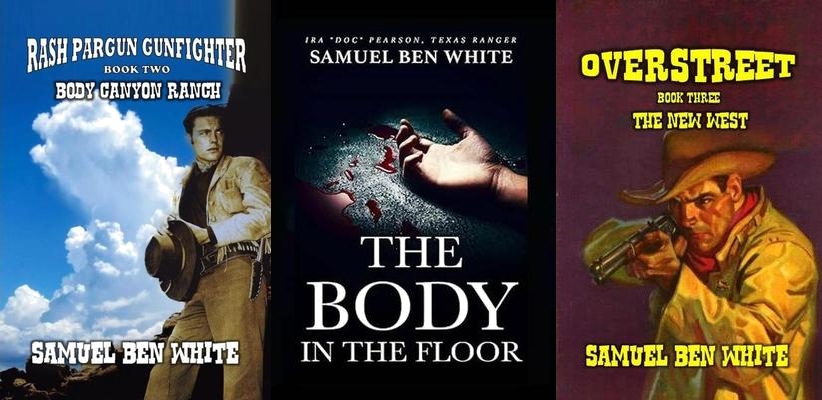
All twelve of Samuel Ben White’s westerns are now available on multiple platforms here! Make sure you order them all!
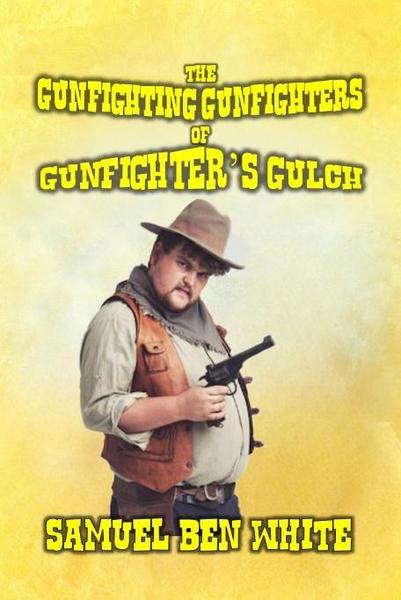
Available now on Apple, Kobo, and many other formats! Coming soon in paperback!
When Portly Ben Rousterman tried to hold up the Third National Bank, he paid for the mistake with his life, and roiled the far west Texas town of Gunfighter’s Gulch.
Into the story with a fierce indifference ride the principals:
All these characters and more in one hilarious night of bullets, dancing, fowl and water as the gunfighting gunfighters collide in Gunfighter’s Gulch.
“At first I was mad at Sam White, when I shot coffee out my nose after he caught me off guard and made me laugh out-loud. I loved the book and I don’t normally read ‘smoke burners’, as I call them. If you want to travel back to the old west, and then laugh when you step out of the saddle, this is your book! WARNING – Do not read while drinking coffee.” —Steve Sederwall, Cold West Investigations
Read a sample chapter …
Chapter One
It was a hot day in Gunfighter’s Gulch, the sun overhead as red as an undersized banana and beating down on man and beast. It hadn’t rained in time out of mind and the east town doctor was beginning to worry that insanity would set in sooner than usual this year.
It was such a day as that that Portly Ben Rousterman left his spotless appaloosa in the corral to the east and walked to the Third National Bank of Gunfighter’s Gulch. Hitching his twin Allen five-shot pistols into a more comfortable position on that part of his body where he once remembered having hips, he stepped up on the boardwalk.
And promptly went through as the heft of his girth cracked the dried wood. With a foul oath his mother had taught him on his lips, he stepped out of the hole and to the door of the bank. Throwing it open, he wedged himself through with much effort and difficulty for not only was it narrow and he wide, it was a revolving door—the only revolving door between Dallas and Los Angeles and, therefore, almost impossible to get parts for.
With an effort, Portly Ben finally shoved his way into the lobby and was told politely by the bank guard, “You might want to try the loading docks in the back when leaving, sir.”
“Obliged,” sneered Portly Ben before pulling out his twin Allens, their maple grips feeling comforting in his big beefy paws, and said, “This is a stick-up. Take me to the vault.”
A woman screamed. Another used that same word Portly Ben had used out on the boardwalk. Several people gasped at the use of such a word in public. A child asked his mother what it meant, to which she replied, “Ask me after the hold-up, please dear one.”
The nearest teller, a man so tall he could actually see over the cage, said, “Good sir, we have no funds in the vault at this time.” Eliciting more use of that same word from earlier from all the people who had come to withdraw various sums so that they might pay their bookies, he elaborated, “If only you had come tomorrow. That’s when the enormous secret gold shipment is due to be inexplicably deposited here.”
While Portly Ben mulled over this information with a strange light in his eyes, the bank guard couldn’t help but think there was something he should have been doing. The other teller, meanwhile, was Lacy Halverson, prettiest woman in the bank—and possibly Gunfighter’s Gulch—and a crack shot. She had jet-blonde hair and an alluring if strictly off-limits body and piercing mismatched eyes. She dreamed of one day going on the stage, and taking that stage to some place where she might find a theater production to watch and then become a part of, where she might spurn many protestations of love and die a romantic but unrequited life.
“Just give me what’s in the vault,” Portly Ben demanded, his voice low and gravelly for he had forgotten to drink water that day, “And no one will get hurt.”
Whipping the ancient LeMat revolver from her cash drawer, where she kept it both for defense of the bank and her person, but also as a conversation piece as there was so rarely money in the drawer, Lacy pointed it at Portly Ben and said, “Kind sir, please either put your guns away or move a step closer for when I shoot you I do not want to hit anyone else.”
Portly Ben was surprised and, as he looked in Lacy’s one beautiful blue eye (the other being brown and only so-so), he saw that he truly could die. He had never thought that before.
Well, he reasoned, that wasn’t exactly true. He supposed he had always known he would die, but he expected it to be from either old age or cliff-diving, possibly hanging. He carried guns, and he had used them, often as firearms, so he knew that man could die by the gun. He just never thought it would be him because so far it never had been.
They stood there like that, in a New Mexican standoff—for the bank was in more than half of the town that was in the New Mexico Territory on account of the Texas side of town having more laws against fraud—until Percy McGoon, a slightly-built man with massive forearms and a taste for spinach said, “If you people don’t mind, I really need to make my deposit and get to work.”
“I don’t mind,” said Portly Ben and waved Percy to go ahead.
“Why does this always have to happen to me?” Percy whined as the very tall cashier—Very Tall Paul Bigman—counted the three dollars Percy was depositing and then made him out a receipt for the majority of the amount. Taking his receipt and vowing in his mind to one day avenge all that had been stolen from him by this bank for years, Percy wished all a good day and left. He thought about informing the sheriff that the bank was being robbed, but he had already been late for work every day that week and didn’t want to try his boss’s patience any further.
In the bank. Portly Ben and Lovely Lacy said in unison, “What’s it going to be, Pal?” and then he chuckled and she tittered at their harmony.
The bank guard happened to glance at the clock just then, saw it was his break time, and so sat down and picked up the nearest copy of Puck and began to read. Chuckling, he kept his daily vow to not think at all about the bank or it’s problems for the next fifteen minutes. He did think about going in the back and getting a cup of coffee, but he hated coffee, so he didn’t.
Portly Ben was a patient man, but he could be pushed past the point of endurance. It came just then and he said, “I’m going to count to three, and if you bankers don’t start handing me sacks of money, I’m going to let loose with these guns and heaven help whoever’s on the other end!”
Those still paying attention were scared, for he sounded like he meant it and they all knew about Allens. Five-barreled guns where the barrels rotated instead of just the chambers, they were notoriously unreliable but, if their triggers were pulled, bullets almost always came out the other end. In the hands of a skilled user, they knew, an Allen could do much random damage and, unlike Portly Ben and living in the west as they did, they knew one and all that they could die that day.
The tall cashier, already bored out of his mind since Percy had left, could only hope that one of the bullets would catch him and end the afternoon sooner rather than later. He sighed with exasperation, but such didn’t trigger Portly Ben’s trigger finger. Tall Paul Bigman would have sighed again, more loudly, if he could have generated the interest in doing so.
He couldn’t, and so just remained silent, wondering if the would-be outlaw would mind terribly if he balanced his drawer, especially now that there was three dollars in it.
“All I want’s what’s in the vault,” Portly Ben demanded. “Just let me by and I’ll go in there and get it myself if it’s too much trouble for you to get it for me.”
Lovely Lacy replied, “The vault is for authorized personnel only. Now you, just turn around and squeeze yourself back through the door and don’t come back.”
Portly Ben was not used to having anything he desired denied him. Things he commanded were always carried out. Who was this remarkably attractive girl to deny him anything, he wondered, and would she go out with me when this is all over? He happened to know there was a barn dance over in Friona the next Friday night and he was going to be there robbing the stagecoach anyway, so maybe—
While no one but the Good Lord ever knows for sure, it is quite possible that the Friona Quilt Store Jamboree and Hog Call was the last thought to pass through Portly Ben’s mind. It is quite possible that his thoughts were more along the lines of, “Wait! That’s a LeMat, the gun of the Confederacy that not only had six revolving chambers but a second barrel bored out to either 16- or 20-guage with which the user could fire a raft of buckshot!”
Accidentally waving his left-hand gun in a more threatening manner than he perhaps intended, he received the full brunt of the 16-gauge in the chest, which spun him around (twice). As, with his last breath and more from autonomic function than intention, he stumbled toward the front door, Lacy fired off the six rounds of .36 caliber bullets, knowing as she did that a .36 didn’t pack the wallop of a .45 and one couldn’t be too careful.
With his dying breath, Portly Ben Rousterman wedged himself into the front door of the Third National Bank of Gunfighter’s Gulch. Portly Ben dropped his two guns, the one from the right hand going off on impact with the floor, its bullet destroying the framed portrait of Aaron Burr which hung over the bank president’s desk for reasons that probably don’t come up in this story.
Someone screamed, several other people said that word, and all of them wondered how they were going to get out with the front door clogged up that way and the loading dock door the guard had mentioned blocked by that old train car.