
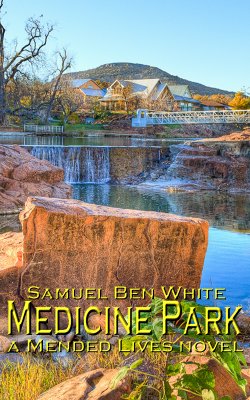
Brad Reynolds comes home to Medicine Park, OK, to take over his father’s old business and try to put his life back together after a divorce. He’s fitting in, he’s meeting great new people, he’s even started attending a Bible study. Brad’s a great guy by everyone’s account. What they don’t know is that he has an addiction. He’s kept it well-hidden so far, but it’s already destroyed his marriage and it will soon destroy his whole life. So Brad tries to bury it, to ignore it, to power his way through it … but it keeps escaping from the box he keeps it in.
(Cover photograph (c) 2012 Derrick Bias)
ON SALE NOW!
What the Readers are saying …
“I really liked it. I had never read a book with that viewpoint of the guy with the sex addiction. It was interesting as he grew in Christ. I thought it was very encouraging as we all have aspects of ourselves we need to put under Christ’s Lordship.” ~KD, LA
And the “sort-of” sequel …
If you would like to read more about Brad, Allie and Angie, be sure and pick up the novel Joyfully Ever After.
…
Sample Chapter
The divorce was final the same day his parents died in the car wreck.
He thought about not even telling Darria, or trying to tell her in such a way as to hurt her. But he didn’t. He just called her and, as she prepared for one of his trademark snide remarks involving either the postal service or how relieved he was to finally be rid of her, he calmly told her he had gotten the papers and his parents had just died.
Darria didn’t know what to say, except that she was really sorry to hear that. She meant it and hoped she could convey her sincerity but knew she had her own reputation for caustic remarks, especially where Brad was concerned. Still, she had always gotten along just fine with the Reynolds and they had even reached out to her recently, as things had begun to go sour in her marriage to their son. She had bristled at the intrusion, but secretly appreciated it, too.
“Well,” he said, “I’ve got to go. I’ve got to go pick up Mike at the airport. Then, we’ll, um, head over to the mountains.”
“Yeah,” she said, nodding at the phone even though he, of course, could not see the motion. Then, she quickly added, “For what it’s worth, I’m really sorry it finalized today—of all days.”
“I’m sorry they had to die today, of all days.” He tried to think of something else to say, then, not even sure if she were still there, told her, “Good bye, Darria. Be seeing you, huh?”
“Yeah. I’m really sorry, Brad.”
“Thanks,” he told her as he hung up.
***
They hugged at the airport, cried a bit, then things got so quiet as they left the airport in Brad’s car that they jumped into as banal a brand of small talk as they could muster before they were even onto I-44. “You have to wonder whose idea it was,” Brad quipped, “To build the Wiley Post Terminal of the Will Rogers Airport on Amelia Earhardt Drive.”
“What do you mean?” Mike asked.
“What do those three people have in common?”
Mike thought a moment, then nodded, “They all died in airplane crashes, didn’t they?”
They ran out of small talk just as they passed Norman, however, and were stuck with silence, again. Suddenly, Brad said, almost to his own surprise, “I’d like the store.”
“What?” Mike responded, completely thrown off guard. His thoughts had already gone to his wife and baby, who were driving down from Colorado and would be joining him (hopefully) the next day. He hadn’t wanted to do it that way, but the fact was they just couldn’t afford three airplane tickets on such short notice but still felt Mike should be there for his brother as soon as possible.
“The bait shop,” Brad explained. “I’d like the bait shop.” Suddenly thinking it through aloud, he offered, “I’ll buy your half from you for whatever you think is fair. I can take what I got from mine and Darria’s house and make you a down payment. For the store and your half of Mom and Dad’s house. I’ll get a loan to cover the rest.”
Realizing how impetuous he was being, he suddenly added, “Unless you want it. I was just thinking that I’ve kind of been wanting out of my job—and out of Oak City—for a while now. But I don’t think that little bait shop makes enough money for us both to live on. So, you can have it, if—”
“No,” Mike replied, just as suddenly. “You take it.” After a moment, “I’m serious. Annette and I really like Aurora. It’s where we want Collin to grow up. It’s home now. Why don’t you just list me as a silent partner in the store and then slowly buy me out? That way you won’t get nailed for all that interest.”
“I wasn’t thinking of anything like that—”
“Why not? It works out for both of us. I get a monthly payment I haven’t been getting and you get the store.” After a moment, Mike asked, “Why do you want it? I don’t remember you showing any interest in it before.”
They were several miles further along before Brad answered, “You grow up in a small town and you can’t wait to get out. Now, I want to go back. I know it won’t be the same. But maybe I can recapture a little bit of what it was . . . once. I’m a grown-up now. As of today, I’m officially divorced—”
***
“I really feel bad about that. Wished there was something I could have done. Wished I had seen it coming.”
“The only people who could have were me and Darria and we waited too long to acknowledge it, and then longer to do something about it. And you didn’t see it because we tried so hard to hide from everyone, including ourselves. I think that’s part of why I want to get out of Oak City. I’ll always associate this place with my marriage. Now I can get out.”
“Do you really think going back to Medicine Park is the right answer? You want to get away? Come back to Aurora with me. You’ve always liked Colorado. You can get a job in Denver. You’d be near family. Lots of accounting jobs there.”
“Uhg. I’ve done accounting, Mike.” He smiled and added, “Maybe I could go to Texas, where cousin Denny lives. Maybe there’s a job in Frognot. I’ve always kind of wanted to live there just so I could have that name on my letterhead.”
***
The funeral home had done a good job, as far as such jobs went. Instead of two people who had been in a car that had gone off a rain-soaked highway, they looked like two people who had just chosen a strange place to take a nap. After a few moments of “viewing,” Mike commented to Brad, “I don’t know about you, but I’m ready to close the lids.”
“Yeah,” Brad nodded anxiously. He motioned to the funeral director, a thin woman with iron grey hair perfectly coiffed She came over and, with the help of a young assistant, closed the caskets. “Remember the line from that cousin in Arizona—I can’t ever remember his name. I just remember being at a funeral for some uncle or other and someone comments about the body looking natural and he said, ‘No he doesn’t. I’ve known Uncle Chuck for twenty years and not once can I remember him getting dressed up in his best suit, coming down to the church, then taking a nap in a box at the front of the room.’”
Mike actually smiled as he said, “I remember that. Uncle Leonard, wasn’t it? The man who died, I mean. Lived in New Mexico somewhere, didn’t he?”
“Las Vegas, it seems like,” Brad nodded. “I just went so I could be with Mom and Dad.”
“Yeah, and I met ya’ll there mainly so I could see everyone. Can’t remember that cousin’s name, though.”
“Private detective, wasn’t he? I remember that just because he was the only private detective I ever met.”
“I think you’re right. We’ll be back in the morning,” Mike told the funeral director suddenly, when he realized the director was still right behind them. The two brothers had already cried on each others shoulders to the point that now they were just drained and ready to leave and the moment’s laughter had been genuine under the relief it had brought. Neither had seen the other cry like that ever, so it left a surreal picture in their minds as they left.
***
Standing in the living room of their parents’ house, dressed now in casual clothes, Annette nearby playing with Collin on the floor, Brad commented, “It just doesn’t seem real. I keep expecting them to come in here. For Mom to try to feed us something.”
Looking around, Mike asked, “Are you sure moving here is the right idea? The fish and tackle shop is one thing, but this house? Sell it and buy another one nearer the shop if you want. You always joked you were going to buy a house in Paradise Valley just because you liked the name. Do that.”
“Naw, this is home. I may have never thought about having the bait shop, but I always dreamed about having this house. Pictured Darria and I having kids and moving here. You know, Mom and Dad always said they would move somewhere when they retired. Figured they’d move near you in Denver and we’d get this place. Maybe telecommute to a job in Oak City or just over in Lawton and drive in one or two days a week.” He sighed and shrugged, “The Darria part’s gone now. I can get the house, now, though.”
Mike bit his lip a moment, then said what he’d been thinking, not just all day but ever since he had heard that his brother was getting divorced, “Are you sure there’s no chance of you and Darria getting back together? You two were so great together—”
“I think she’s got somebody else,” Brad answered. At the looks in his brother and sister in law’s eyes, he quickly explained, “Don’t get the wrong idea. She was never unfaithful. Neither was I, for that matter. Anyway, I heard from a mutual friend that she had met somebody at her work that she was going to go out with as soon as the divorce was final.”
“It’s not like she’s already remarried,” Mike said, ignoring the look from his wife that was trying to tell him to just shut up. “Can’t you work things out?”
“I used to think so. Went to counseling and everything.” Another big shrug as he leaned on the mantel and looked into the low fire. “Didn’t work.” He looked over at Collin and said, “Kids were part of it, you know. Sometimes wonder, if we had been able to have kids . . . “ After a bit, he added, “On the other hand, sure am glad we didn’t put any kids through this. Divorce is hard on kids.”
“Well,” Mike said, stumbling over the words, “I don’t want to bug you about it. But if you, um, get the chance, talk to Darria. Maybe you two just needed some time away.”
Brad was too worn out to argue, so he just nodded and said, “Yeah. Maybe so. That’s what Dad said, too.”
***
“Thanks for coming,” Brad said as they walked away from the graveside service. The minister from the Reynolds’ church had delivered the eulogy and had done quite well. Brad and Mike had both thanked him for the words, and everyone else for coming out on such a cold, if sunny, day.
Darria nodded uncomfortably, then threw her arms around his neck and, sobbing, told him, “I am so sorry for you. And for Mike, too. But I’m really sorry for, for everything happening. Now, of all times.”
“Well, it wasn’t just you,” he told her as he held her close, feeling her for the first time in months. It had a strange familiarity that was surprisingly comforting. “I know the timing was an accident. But I, uh, do thank you for coming here today. It really does mean a lot. Can you come over to the house for a while? There’s a lot more food there than even Mike and I can eat. Give you a chance to see Annette. And Collin, too.”
“He sure is getting big, isn’t he?” Darria commented wistfully. She then let go of the hug, wiped her eyes and said, “I better get back into town, though. I told the office I would try to make it back for the afternoon.”
“Well, don’t go so fast you . . . drive carefully, huh?”
She was prettier than he remembered. Maybe it was the black dress. He had never seen her in black because she had always said it made her look washed out. With her reddish blonde hair and freckled skin, he had always taken her at her word. But now, looking at her, he realized she looked pretty attractive in black. And she had lost weight. She wouldn’t have been able to fit in that dress when they were still together.
But then, he had lost weight, too. He didn’t think it was stress so much as that he just hadn’t eaten as regularly since the split. He was almost back to his college weight. And what with walking every day in the sun, the red had come out in his brown hair and a few freckles had resurfaced that he hadn’t seen in a long time.
People used to say they belonged together but he always figured it was because they were both red haired and fair skinned. He wondered if, that day at the cemetery, they looked like they ought to be together again. He wondered if she were wondering the same thing.
She nodded, then kissed him on the cheek and walked away to her car. He watched her go, not knowing how he should feel. If it were a movie, he knew, he would run after her and catch her in his arms and convince her to stay with him. Or he’d watch her go and cry. But he didn’t feel like doing either. He didn’t feel like doing anything. So he just watched her go.
***
“You sure you don’t want me to hang around for a while?” Mike offered. “I’ve got a couple weeks coming. I could help you move and get settled in at the shop and all.”
“No. Your family needs you with them. I’ll be fine. Old Simms is going to run the shop until I can get out there, and most of my stuff is in storage so it won’t take all that much to move it. Got some friends that can help with that.”
“Well, if you need me, you call, all right? It’s just you and me now, brother.”
“Hey, same here. I mean, if you need anything, you call me. I know how to get to Aurora.” Brad snapped his fingers and said, “Let’s plan on getting together in a couple months. Maybe head into the mountains or something.”
“Sounds great,”
Brad hugged Annette, thanked her for coming, and held a very wriggly Collin one more time, kissing the little boy on the forehead. “I can’t believe how fast you can move, little guy. You’ll be walking by the next time I see you, I bet.”