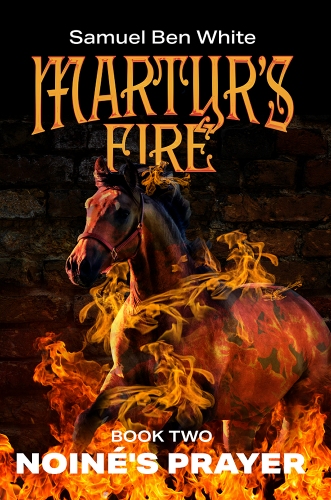
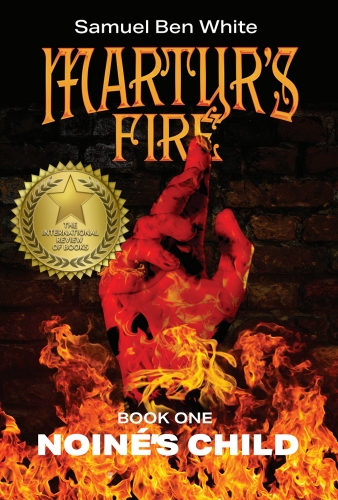
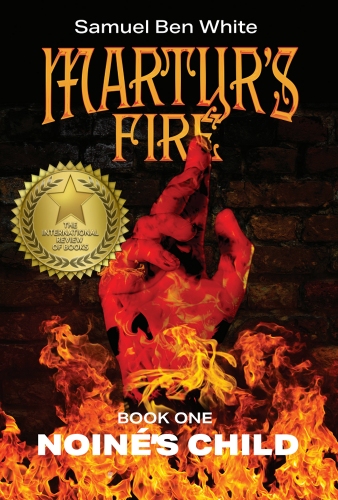
Available now on Kindle and in paperback and hardback!
5233 A.D.
Soldiers sent on a mission of diplomacy from their king are murdered. Was it an ambush by the mysterious enemy to the south? Did the king himself have them murdered? How did the survivors make it back alive, and will they be allowed to stay that way?
Elo has found her nephew and a family beyond her reckoning. They are numerous and friendly and share her faith … and possess technology beyond the dreams of the people on the plains. Yet it is not paradise, for beneath the surface in those cold, snowy mountains is a past no one wants to recall.
And John. He is becoming a man, with a man’s ambitions and desires, but is forever haunted by the mother he never got to know. Even if he wanted to forget her, he is constantly reminded—by seemingly everyone—that he is Noiné’s child … and her prayer.
Sample reading
“Hard to breathe up here, isn’t it?” said the older man to the younger.
The younger, in his youthful pride, had been trying not to admit to that difficulty but since the other had brought it up was less embarrassed to say, “Yes.” He wanted to say more, but at the moment he could not. He stopped and tried to fill his lungs, but was not as successful as he would have liked to have been.
The two sat down on a rock, the summit in sight but not appearing to be that much closer than the last time they had stopped. The younger man told himself he was stopping so often for the sake of the older, but in his heart he knew that he was stopping because he was out of wind.
Why?
He was pretty sure he had climbed mountains this tall before. Had they given him such trouble and he just didn’t remember it?
And how was the older man making it at all?
Maybe it was just the temperature, for it was—if not cold—brisk. And the little bits of wind that blew by seemed like they were taking away what breath he had.
“Not much further,” said the older man, standing up and gesturing towards the summit so tantalizingly close.
As the younger man stood up, he asked himself just how old the older man was. Fifty? Sixty? He had been told that such numbers didn’t mean much, and had met men and women both who were much older than those numbers. They generally didn’t walk so far and climb so high, though, seeming content to just stay near their own front porches.
Still, the older man at times didn’t look all that old. For most of this trip, in fact, he had been the first to set out and the last to stop, taking the steps—even the steep ones—with a spryness to his gait the younger man had to think about to match. On horseback, few could match him.
Yet other times—as when they sat by the fire the night before—the older man could look even older than usual. Had it just been the firelight highlighting the deep lines in the old skin? The younger man didn’t think so, for he had noticed similar appearances at other times.
But did not everyone have such times? Times when they didn’t know (or care) they were being watched and their mind had gone back—back to where? Probably different for each person, he reasoned. Some remembered an old romance, or an old homestead, or a missed opportunity. Many remembered friends who had passed away or perhaps just gone away. In that moment, more cares than usual piled up on the countenance, making the person look older and much more careworn than they were. Or, maybe it was the person seeing who had gone away, leaving behind someone they now wished they couldn’t see.
Was that true of his old friend? He knew to a certain extent it was. The man spoke of many things he had left behind—some of his own volition and some just because he had to, forced by persons or circumstances. Perhaps the man was even younger than his young friend thought but had so many such remembrances that they had worn grooves in his countenance.
His old friend, he thought as he watched the man’s steps eat up the mountain side as if it were nothing, had many cares that might have caused the marks. While the man had never seemed shy about sharing all he knew with his young friend, surely he kept some things to himself. And maybe those things didn’t necessarily wear on him, but led to a pensiveness now and then.
The younger man realized suddenly that, in his reverie, he had allowed the older man to gain on him and quickly began to make up the space, his youthful pride unable to allow anything else.
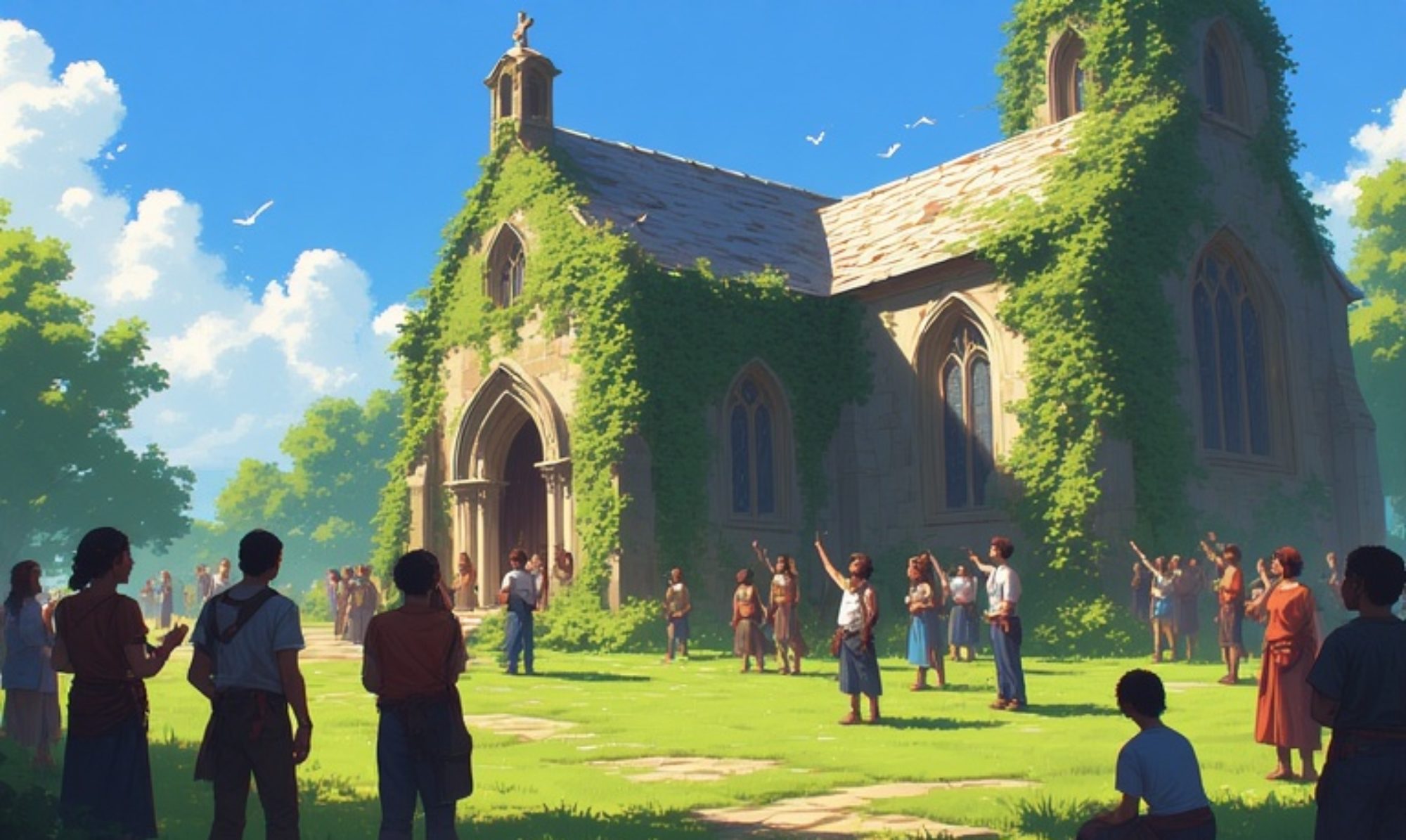
As they neared the summit of their hike, a sort of bench between two mountain peaks, the younger man began to realize that not all of the giant shapes on the ground were boulders, though they were rocks. Some of them had been carved at one time, but what they had been in the shape of he did not at first know.
Then, he saw what appeared to be a carving of a hand—larger than his own torso—holding on to something. What had it been holding? A sword hilt? A walking stick—such as he used himself?
He was about to ask the question, when he realized that some of the other carven rocks he could see must have been a part of the same statue. A shoed foot here, another hand. Most of a britches-clad leg. A very large rock that might have been a torso, carved to look like someone wearing a fur coat with a prominent collar. And then a third foot.
Then, as they reached the summit, he saw a cleared off space. Not just cleared, though, but smoothed by some sort of concrete or like substance poured between the boulders to make a flat space. There were giant footprints on the flat space, where the statues must have stood, leaving imprints where some of the flat had been pulled up—and one part of a giant carven shoe.
The older man stepped up on the flat space and—rather than looking around at the magnificent alpine vista, looked at the space as if he could … what? See through it to the mountain as it looked once before? Then, he was looking up somewhat, but still appeared to be focused primarily on the detritus of the statues, which stretched out across the tundra to the northwest.
“These statues,” the younger man asked, once he had his breath and was standing near his mentor, “Who were they of, Papa?”
The older man smiled, for the younger had called him that since childhood, and replied, “There is something of a debate about that, Son. There were, it is said, two statues, one of a man and one of a woman. They were perhaps attached—one ancient drawing I have seen shows them holding hands—so one might argue it was a single statue. As to who they were, that is where the debate comes in. It is generally agreed among all historians I have read that the man depicted was a forebear of the mountain people, named Josh.”
“And the woman?”
“That is where the debate is,” the older replied with a smile. “Some say the statue was of his wife, but others say it was of his sister, for both figure prominently in the history of the mountain people. The only agreement is that the man was Josh.”
“You have spoken of him. He was not actually the founder of the family, but he carried them through a hard time, didn’t he?”
The older man smiled and said, “You have a good memory, for I believe it to have been very long since we discussed such things.”
“Yes,” the younger replied, though it was somewhat unclear to which statement he was agreeing, perhaps to both.
“Yet, as I have thought about it, I think the credit should go to Josh. His forebear, John, may have named the family, but it was really Josh who set them aside. And who brought the name of the mountain people not just to those of bloodline, but to all those under his care.”
“Still, I like to think that John was the founder,” said the younger with a smile.
“You would,” the older man replied with a chortle.
“So who built the statues, and who tore them down?”
“There is some debate as to the answer of those questions as well.” He took a deep breath of the thin air, then said, “Look. Just look. We can have questions in a moment.”
The younger man almost bristled as he had as a child, but had learned to express some patience with his mentor’s style, but also to enjoy the brief return to the old words, for how many times had the older man said something so like that while teaching?
Where they stood was spectacular. They were not actually on the summit of the mountain, but something of a saddle between three summits, one which was probably a hundred feet higher than where they stood and the other four times that much—the third summit shorter than both, which had allowed it to be hidden as they approached. Snow still clung to those peaks in little patches. Around them in every direction, they could see peaks and valleys, rivers and lakes, as far as the eye could see. It was a mountain panorama to take one’s breath away if the elevation hadn’t already done so.
It was worth stopping to look at, the younger man admitted to himself. Over there, to the north, some of the peaks still had so much snow it looked like they were still in winter. In the valleys below—in every direction—there were green fields and the pale white trees were spreading their shimmery green leaves. And one could catch a bright sparkle of light reflecting off cascading water from miles away—in some cases from streams that were so narrow the young man could have jumped over them, but they were at just the right angle to catch and reflect the light like a diamond dropped from the stars.
They had stood there like that for many minutes before the older man bade, “Come, let us see if we can find something I was told about that might answer your second question, if not the first.”
It took the younger man some steps before he remembered what his questions had been.
Across the mountain they went, though not straight down, angling to the northwest to follow the path of the debris. Aiming for what appeared at first to be a more ovoid shape than the other pieces they could see, they neared it and the younger man asked, “Is that a head?”
As they got closer, the younger man could see that it was, indeed, a head hewn from rock. While the features had never been intricate, it was clear that it had been the head of the female figure. Her hair had been tied back in a bow, though the hair which emerged from that bow had been broken off at some point. The younger man glanced around and thought he saw a rock that might been the hair—or part of it—but he wasn’t sure.
“Look,” said the older man, “At her face. The smooth cheekbones, the simple nose, the faint smile on her lips.”
“She looks … almost happy laying there,” commented the younger man.
His mentor nodded and then said, “Now, look over here. Just where I was told.” He pointed to another ovoid rock, not far away. They stepped up to it and found another proud face, laying sidewise on the ground, looking pleased. There was a crack in the face’s nose, but otherwise it was in good shape.
“That must be Josh,” said the younger man, to which the older nodded. “So, was the other his wife or his sister?”
“Does it matter?”
“It did to them,” the younger man said with a laugh.
The older man laughed, then said, “I suppose it did. Personally, I think the female statue was of Josh’s wife, whom they name Adaline in the old stories.”
“Like the people who take care of the sick and help doctors?”
“Yes. That order is probably named for your ancestor.”
“I always wondered where that term came from. I’ve heard of Josh, but never Adaline. Wasn’t his sister named Clara?”
“Claire, I believe.”
“So who built the statues and who tore them down?”
The older man nodded, then thought a moment before saying, “It is believed that the mountain people themselves built the statues, descendants of Josh and Adaline—or Josh and Claire, his sister, for she is said to have not only had many children, but to have been just as much of a leader in the early years as her brother. As to when, I have read many scholars and they believe the statues were built about a thousand years after Josh actually lived. They were torn down about a thousand years later, perhaps twelve hundred years later.”
“I do not remember tales of there being wars then,” the younger man injected.
“There are always wars,” said the old man sagely. “But you are thinking as I am. You see, there are many among the mountain people who come to this spot—as something of a pilgrimage—and many hold that the statues were torn down by the people of the plains during one of the wars. But if the timing is correct—whether eight hundred years ago or a thousand—there is no record of warfare between the two peoples just then. In fact, in most stories there was said to have been about five hundred years of peace and relative cooperation during that time as they banded together to protect from an enemy from the north.”
“Who, then, tore the statues down?” pressed the younger man.
“Look at this head.” Then he walked uphill to the first head they had come to and bade, “Now look as well on this head. I want you to notice something very specific about both.”
The younger man walked all about both heads, then stood partway between them—but a little closer to the woman’s head—with his hands on his hips. Finally, he admitted, “I do not know what you want me to see.”
The older man walked closer to the statue of the woman, the head that was twice as long as he was tall, and said, “Imagine you are the enemy. You have come all the way to this spot, across rivers and mountains and past countless enemies. You arrive at the statue of your hated enemy’s forebear. What do you do to such a statue?”
“You tear it down,” the younger man answered, as if speaking the obvious.
“Correct. You tear it down and, then what?”
“Go on to fight the enemy. The people who are your enemy.”
The older man shook his head and said, “Think of what it took to get to this point. You want to triumph over your enemy by casting down his heroes, correct? You want to show your triumph not just to the people of the day, but to anyone who might come back—especially anyone who might come back with the hope of rebuilding the statues.”
After several minutes, the younger man shrugged and—just a little bit petulantly—said, “I do not see what you think I should.”
“If you were a warrior and had chopped off the head of your enemy’s king, what would you do with that head?”
The younger man wanted to bristle, tired of being “taught” but managed to say, “Throw it away?”
“Yes. But if you are like most soldiers throughout history, you wouldn’t just do that. You would use it for a football if it were much smaller, you would throw it in a pond, or perhaps take turns striking it.”
The younger man was trying to figure out what his mentor was driving at while still bristling and telling himself he was too old to be taught this way when it suddenly came to him, “If these statues had been blasted by an enemy, or even pulled down with ropes, the heads would have rolled much further away, or they would have been broken to pieces—the ears and noses chopped off. Foul scribblings carved into the very rock.”
Seeing the older man nodding proudly, the younger man hypothesized, “Whoever took down these statues, respected the heads. They respected the memories of Josh and Adaline—or Claire. Why? Why would they do that?” He paused, waiting for an answer, then said, “They were not enemies of Josh and Claire, or Adaline. They were … who? Mountain people? If so, why would they tear down the statues?”
The older man led the way over to a rock about midway between the two heads—a rock that didn’t appear to have been part of the statues—and motioned for the younger man to sit as he did the same. When seated, he chided, “Though you don’t seem to remember their names, remember what I taught you about Josh and Adaline, and even Claire?” As the young man nodded, he continued, “Does Josh seem like the sort of person who would have wanted a statue in his honor?”
“I can’t claim to know that much about him,” the young man said with a laugh.
The laugh was shared, then the older man said, “Think about who Josh and his sister and his wife—and his sister’s husband—served. And all their children, and the others they gave their name to. Did he not say, ‘You shall have no graven images before me’?”
“But they didn’t worship at these statues, did they?” the younger man challenged. “They were just to honor the forebears, weren’t they?”
“I believe so. Still, I think two things happened over time. While people might not have worshiped these statues, some came here thinking more highly of who they represented than they should have. You know the stories. Josh and Adaline were not perfect. They were leaders, but not saviors—”
“There’s only one of those.”
“Precisely. I think there was a movement among some of the mountain people to think more highly of their founders than they ought. That was the first thing I believe happened. The second thing I believe happened was that some of the descendants of Josh and Adaline realized this so they took the statues down. Yet, they couldn’t bring themselves to despoil them, for they honored their ancestors as well.”
“So they took down the statues, but left the heads intact? Why?”
“You, more than anyone else, should be able to understand.”
The younger man wanted to get angry again, but managed to say, “But I do not.”
The older man smiled warmly and said, “You know all the stories I have told you of your mother. You want her honored, but do you want her worshiped?”
“Well, I—”
“What if someone were to build a statue in honor of your mother and start to worship that statue, or just give it more reverence than what your mother stood for. Would you not try to stop them? To change their minds? To tell them the truth about your mother and who she worshiped?”
“I, um, I suppose.”
“What if you were to rush into the town square and take down the false idol erected to your mother? You tear it down just as you believe she would. Yet, it is carved to look just like her. Could you bring yourself to despoil her face?”
“I—” the younger man started to say one thing, then exhaled what little breath he could gather and nodded, saying, “I think I understand. That’s what happened here?”
“It’s what I think happened here,” said the older man with a smile. “Some of the mountain people still say it was enemies who tore down these statues, and I suppose they could be right though no one knows for sure. It is just my thought that that those who tore down the statues did it to honor Josh and Adaline—or Claire—just as those who built the statues had set out to do.”
After a bit, the younger man said, “That does make sense. I think you’re right.” After a bit, the younger man asked, “I saw a giant hand when we were first approaching the place where the statues stood. It appeared to be holding something, but I do not know what. Do you know what the statue was holding?”
With a shrug the older man replied, “Not for sure. I have seen drawings, though none were made by people who had actually seen the statues. Some were purported to have been made by people who had talked to people who saw the statues, though that is in doubt in most cases. Some say that Josh was holding onto a sword, but I found that doubtful for there is no reliable story of him ever using a sword. There is one prominent story of him using what we would call a percussion weapon—”
“I remember that,” the young man said excitedly. “When he shot the man who had tried to attack his sister.”
“Yes. But whatever was in his hand didn’t look like any sort of percussion weapon I’ve ever seen. It might have been a plow handle or a hoe or some implement like that. I find that most likely, for he was a mighty man of the soil, as most of his descendants are now.”
“Do we know for sure it was Josh’s hand? What if it were Adaline’s, holding onto some sort of medical implement? She was a doctor, wasn’t she?” he asked, the story about her coming back to him. Why had he not remembered her name? he wondered.
“Yes, she was. I have never seen a drawing depicting such, but you could be right.” He smiled and said, “I like to think you are right, that it was her hand, not his. Doctor or farmer, what made Josh and Adaline memorable—or Claire, who was said have been a seamstress as well as a mother—was their faith and their overarching hope in the future. As the world was falling apart around them, they were said to have clung to their faith—the faith you share with them—to see them through.” He patted the younger man on the shoulder and said, “I like that idea. Perhaps she was holding some implement a doctor of her day would use. Bringing healing of body and soul to the people.”
The younger man nodded, then prompted, “You say it’s the faith I share with them. Do you still not share it with us Cyro?”
The older man smiled and replied, “I do, but sometimes I am like some of those people who came to worship at these statues. I forget to worship the God the people depicted worshiped and find myself only honoring your mother.”
“She would not want to be worshiped.”
“I know that,” Cyro said with a wan smile. “On the other hand, the faith she showed me was the most genuine thing I have ever known—save perhaps your faith. I spent many years denying that faith—any faith—and that is a hard habit to rid oneself of.” He stood up suddenly and said, “We will speak of this more. But first, John, let us find a good place to have a fire and a camp for the night for it will be most cold up here after dark.”