
Death Among Friends

a Bat & Jody Garrett novel

Bat Garrett goes to the funeral of a friend from high school, only to find that there are some family members of the deceased who think the death wasn’t accidental. Bat begins to look into the death and is confronted by old memories, some ex-girlfriends, and the disturbing idea that–if it was murder–it was committed by someone Bat knew.

Now available on Kindle and paperback!

Sample Chapter

When I got my private investigator’s license I figured my life would be a lot like the lives of those guys who used to show up late at night in the old shows on cable. High speed car chases, fist fights (where I would always win), and beautiful women who find a guy with a spotty income strangely alluring. Occasionally even solving a case.

Why was I so often surprised back in those days when life didn’t imitate art? Or even TV?

What the TV shows were especially bad at portraying was the stakeout. Oh, you would have the obligatory shot of the guy in his car at night, flashing neon in the distance, as he sips coffee from a thermos to set the mood, but considering the shows were only an hour long (minus commercials) they couldn’t show the reality of a stakeout.

Hour after hour, and sometimes night after night, just sitting there. Trying to stay awake and trying not to drink too much coffee ‘cause then you gotta go to the restroom and leave your post. So you just sit there.

And sit there.

And, if you’re me, drinking no coffee at all because you hate even the smell of it so you drink Dr Pepper like it’s going out of style, which still leads to bathroom issues.

Sometimes, you have a client who wants a meticulous log of everything that happens. “12:15Dog barks. 1:17Pizza delivery. Delivery vehicle license number … “ It sounds miserable and tedious—and it is—but at least with those you have something to do.

This was not one of those nights. I was sitting in my car across the street from an all-night diner that served, based on the smell, fried grease. As a side dish, one could order lard straight. But working in the diner was a woman who was being rapidly stalked by middle age and a husband who was convinced she was having an affair with one of her customers.

Now, you may be thinking that my job would be to watch her through the windows and see if she paid anyone any special attention. Not exactly. The husband was pretty sure who the affair was with, so I was supposed to sit there and watch to see if the Assumed One showed up and, especially, if the Waitress Woman were to leave with him.

Five nights down and not only had the Assumed One never showed, the Waitress had treated all of her customers with the same hostile indifference. Most of her customers left looking less than happy, so I couldn’t really see any of them saying something like, “Hey babe, after that rather belligerent service and a sandwich made—apparently—from old shoe leather, there’s nothing I’d like better than to take a hot mama like you out on the town.” Eight and a half hours after she would clock in (with a thirty minute “lunch” in the middle which she smoked away on a bench around the side of the building from the front door) she would leave and go straight home.

If this were a television show, the reason for the whole farce would be that I had been working on another, more important, case and this whole thing had been cooked up as a means of distracting me. In real life, I had taken this under-paying and boring job because there just wasn’t anything else, and hadn’t been for some time. It was a slack time in the P.I. biz, apparently. And being winter, it wasn’t much of a time for painting houses, either (my other listing in the phone book).

With Jody’s paycheck from her job as a speech therapist barely covering necessities, I was taking any job I could get in hopes of making ends meet. Thankfully, our cars were paid for and we didn’t pay much in rent, but you can’t eat an apartment—even the green moldy stuff on the walls that looks almost edible. We were still newlyweds in a lot of ways but, as much as I like old Glenn Miller tunes, his song about being able to live on love was starting to ring hollow.

Another night looked like it was going to drift by with no consequence when, just after three-thirty in the morning, a car that looked like the one I was told Assumed One drove pulled up in front of the diner. I perked up a little, then. I perked up a lot when the Assumed One, Mister Wally Norris himself, got out of the car. Tall, slatternly, with a one of those big droopy mustaches like country stars wore back in the eighties, I positively identified him from a picture I had been given when he stepped into the lights of the diner’s front entranceway.

As he went into the diner, I slipped quietly out of my car and closer to the diner, camera at the ready. Once in a position where I could get some good pictures of pretty much anywhere in the seating section of the diner, I started snapping.

It was a fairly old—let’s say broken-in—SLRand worked beautifully. For daytime shoots I was transitioning to a digital camera, but for nighttime work nothing beat that oldSLRand some 1200 film. Cameras may have gotten simpler to use as time has gone on, but that old camera could practically take the pictures itself even without auto-focus. It eventually developed a light leak I couldn’t get fixed and I sold it to a collector, but I always regretted it later, thinking I should have given it a place of honor on a shelf in my office. But I didn’t have a shelf in those days, let alone an office, and the collector helped me make a rent payment, which is neither here nor there for this story as it was some years later. Months anyway.

So there I was, getting pictures of him walking into the restaurant. And then there’s a picture of the Waitress looking none too pleased to see him. As I’m snapping away, she points toward the door, instructing him to leave. (It’s clear from the body language; I didn’t have to hear what she was saying.) But Assumed One steps right up to her and grabs her by the arm.

He should have grabbed the other arm—the one carrying a customer’s food—because she slammed the tray full of food upside his head. It was a horrible sight, all that Salisbury steak and candied apple slices spreading across the room. My last picture showed him letting go of her arm as he reached for his gravy-covered face, trying to get the apple chunks out of his eyes.

I dropped the camera—trusting the shoulder strap to take care of it—and darted for the diner’s door. By the time I was through the door, Assumed One had cornered Waitress behind the counter and the one customer was a guy who was rooted in place by fear and shouldn’t have been screaming like that in my humble opinion. His screams were soon drowned out by the screams of Assumed One, who had just taken a saucer of hot grease to the kisser.

No, I don’t usually talk like that, but it is a private eye story.

As Assumed One hit the floor on all fours and clawed at his face, the cook called 911 and the Waitress stood over her assailant with the saucer held in a threatening manner. I wouldn’t have thought it could be done, either, if I hadn’t seen it. If she had been holding a Glock with a round in the chamber, her demeanor could have been no more menacing.

Despite graduating from a correspondence college with a degree in private investigations and a long-ago Boy Scout merit badge in First Aid, I wasn’t sure what the protocol was for “hot-grease-in-face”. Still, it seemed like something ought to be done, so I pulled out my gun.

“The cops are already here?” asked the cook in impressed dismay, popping up from wherever he had been hiding.

“Probably just someone else that wants to kill him,” the Waitress grumbled, remarkably calm about the whole thing. Seeing my weaponry, though, she set down the saucer. Then, told me, “Go ahead and shoot him. I’ll gladly testify it was self defense.”

Assumed One, peaking at me from between his fingers with one red eye, just whimpered and made a larger mess on the floor than had been there previously. “I’m not going to shoot you,” I told him.

“More’s the pity,” said the Waitress.

Last at Bat

a Bat Garrett story

A ghost. Bat has to be seeing a ghost. While recuperating in Houston he stumbles across a shopgirl who looks and sounds just like someone he lost a year before. As his friends think he’s going crazy, and even he’s starting to wonder if he watched “Vertigo” one too many times, he tries to piece together the background of the shopgirl. The investigation takes Bat from Houston and Dallas, to Arkansas and Durango (where he meets a young Garison Fitch) and closer to the conclusion that he may not have been the only one set-up by the Home Agency.

Order Today!

Kindle or Paperback

To read more about Bat Garrett, be sure and check out “The Nice Guy“, “The Return of the Nice Guy” and “Up to Bat“. All available on Kindle & in paperback! And, if you want to read this story from Jody’s perspective (as well as find out what happened next), be sure and read “Cheerleader, Gymnast, Flautist, Spy“!


Read a Sample

“What is it we’re going to go look at?” Dave asked as we walked through the mall. I was surprised how few people were there shopping, but I guessed it was because it was a week day.
“Sunglasses. I’m telling you, Dave, these are the ugliest you’ve ever seen. They would have been great for that day in college when we had the ‘Ugliest Outfit’ contest.”
“I didn’t know the Galleria had a gag shop.”
“It’s not intended to be, but these will make you gag.”
As we were nearing the store, I saw a girl walk into the shop ahead of us who just about took my breath away. I stopped dead in my tracks and could feel my heart pounding in my chest like faulty pistons in a Ford Granada. If I had been prone to such things, I think I would have had a heart attack. The quick and unexpected (even to me) stop on the crutches almost made me fall on my face, so I had to take a moment to regain my balance.
“What—what is it?” Dave asked. The look on my face must have scared him. I imagine I went almost completely white—maybe even green.
“That girl that just walked in.”
“So? She was cute; but we’ve seen several of those today. She wasn’t as pretty as Heather, I didn’t think.”
“No. This girl looked like … like someone I used to know.”
“Let’s go see her,” he said. “Maybe it’s her.”
“Couldn’t be.”
“Why not? Houston’s a big city.” He smiled, “Shoot, I bet there’s more than two hundred people in this town. I hit that many cars in the parking lot.”
“But this couldn’t be her, Dave.”
“It’s a small world, Bat.”
“But it’s not the Twilight Zone.”
“What are you talking about?”
“The girl she reminded me of is dead.”

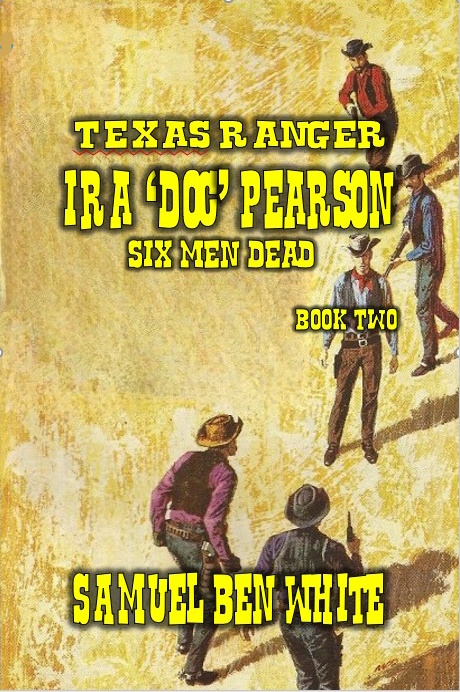
Six Men Dead (an Ira “Doc” Pearson story)

That murder was done is clear to all. But who was murdered? And will anyone be brought to justice or will a whole town look the other way?

Published by Outlaws Publishing and available on ebook (in many formats) and in paperback!

Six men rode into the west Texas town of Rook in December of 1895. Moments later, all six men lay dead in the street, shot to death by the good citizens of the town.

Ira “Doc” Pearson is sent by the Texas Rangers to investigate, expected to just rubber stamp the proceedings for the dead men were known as the Lawrence Gang: wanted in Texas and New Mexico for bank robberies, rustling and murder.

Ira knows, however, that one of the members of the Lawrence Gang was in jail in Lubbock at the time of the massacre. So who was the sixth man who died that day?

Official Texas is satisfied that justice was done, but Ira can’t let it go.

Also available on Audible and iTunes, narrated by Tom Lusty!

Follow the rest of Ira’s story in The Anson-Parker War and Shootout at the Federal Courthouse and The Body in the Floor!

Sample Passage

Prologue

Six men rode into the Texas panhandle town of Rook. By the looks of them, six hard men, five of them on fine horses such as only an outlaw could afford, all wearing guns that had seen some use.

The people of Rook took all this in in a moment, and that was all they took.

Rifles, six-shooters and shot-guns seemed to appear as if by magic from every upstairs window on the dusty street. No signal had been heard or seen.

All fired at once and six men went down. Only two were even able to get their guns out of their holsters, but neither got off an effectual shot before scratching their last sign in the dirt of the street.

No horses were hurt more than a couple grazes, for the men (and maybe some women, if the rumors were true) of the west in general and Rook in particular thought a lot of horse flesh and had taken great care not to hit any of the animals.

All six riders died quickly. Nobody was gut-shot and writhing in the dirt, for the people of Rook were good shots

and toasted each other later in the saloons and each other’s houses that there had been no suffering. Not like the banker these men had made die slowly down in Banderas, or that parson who’d just been in the bank at Dimmit at the wrong time and had taken a month to die.

Nope, just six clean deaths.

One couldn’t say it was just six shots, though. Someone counted up later and found that most of a hundred Rook bullets had struck the six bodies. It was a wonder they hadn’t more than grazed the horses.

No one from Rook had so much as a scratch on them. Maybe some red eyes or sore throats from the smoke of the gunpowder, but nothing more. It had just been a few seconds of red-laced hell and then it was over. Six lay dead and a lot of people across west Texas and eastern New Mexico started sleeping easier again.

The worthies of Rook buried the six bodies in a single grave out at the town cemetery and the Campbellite parson said some words over them. A marker was put up but all it said was, “Lawrence Gang” and, below that, “Put here by the good citizens of Rook on 4 December, 1895“.

Chapter One

Folks took notice

when the stranger rode into town on the sorrel horse of his. It wasn’t quite like the old days, when every stranger who passed through Rook was noted, though, for mor

And this stranger wasn’t an especially striking specimen. A shade over six foot, with short light hair and beat-up clothes—though of tough cloth—nice boots, and a saddle that had seen some miles. Nor did his gun catch anyone’s eye, for while things were starting to get civilized, there were still quite a few men who wore guns, especially if they were traveling for civilization hadn’t completely caught up with the road agents. The stranger’s horse was a good-looking animal, one that looked like it could go all day and night, but it wasn’t a “show horse” for all that. Just a good-looking horse anyone would be proud to have, but not the kind that made people say to themselves, “I want that horse!”e people traveled anymore. On any given day, a dozen strangers might ride through, stopping only for water or a meal, before making their way back onto the road to Hereford or maybe McKeon. Most of the time, they drew no more notice than if a local had ridden through.

What got people’s attention, and set the tongues to wagging and brought the whispers to a dull roar was the silver on the man’s chest, for he wore the badge of a Texas Ranger. The badge was polished and glinted in the bright Texas sun, catching the eye of everyone who even glanced that way.

Soon, Sheriff Montgomery was hustling out of his office and greeting the stranger even as the man was tying his horse to the hitching rail in front of the jail. Extending his hand in a manner that seemed to be forced friendliness over an underlying nervousness, he said, “Howdy. I’m Sheriff Montgomery. I, um, I figured one of you would come.”

“Did you now?” the stranger replied, taking off his riding gloves then taking the sheriff’s hand. “Pearson’s my name. Ira Pearson. I reckon you already realized I’m a Ranger.”

“Uh, yes sir,” said the sheriff, even though he was probably a good fifteen years older than the Ranger. “Won’t you come inside?”

“Thank you,” the Ranger said politely.

Sheriff Montgomery watched with keen interest as the Ranger took off a Stetson that had seen some miles but was well-taken care off. The Ranger brushed some dust off the hat and then hung it on a peg just inside the door. The Sheriff saw then that the Ranger had the most grey eyes he had ever seen. Somehow both piercing and bland at the same time.

“Coffee?” the sheriff offered.

“Don’t mind if I do,” Ira Pearson replied. He took the cup gratefully, then sat in the offered seat. He waited a beat for the sheriff to sit down behind his desk, then said, “You probably know why I’m here.”

“To give the town a medal?” the sheriff tried to joke.

Ira Pearson chuckled, shaking his head. “There are some in Austin who have already suggested that. The citizens of some of your nearby towns would probably go along with that idea. But no, Sheriff,” he said, suddenly becoming more stern, “I don’t think anyone is going to try to argue that the Lawrence Gang didn’t have some retribution coming. However, six men shot down in a street with no provocation does look a lot like murder to the courts.”

“Murder?” the sheriff demanded. “After what they did in Monahans, or to them sheepherders down by—“

The Ranger held up his hand to forestall further talk from the sheriff and said, “We know those things. The whole state knows those things. And I have access to crimes I daresay you haven’t even heard of save in rumor, Sheriff. But there are laws in this state and murder is at the top of the list—even when the person murdered deserved what they got by every known set of rules.”

“So what are you going to do, Ranger?” The last word was said with something less than admiration in its tone.

“My orders are to investigate exactly what happened and turn in a report to my superiors. I can make recommendations, but it will be up to the Attorney General what is to be done ultimately.” He smiled then and asked affably, “May I assume that I will have the full cooperation of this office, Sheriff?”

“Um, uh,” the sheriff fumbled, taken off guard by the sudden friendliness, “Sure. Absolutely.”

“Thank you.” The Ranger reached into a vest pocket, pulled out a little notebook such as most ranchers carried for tallying up stock, and a pencil that was already sharp and said, “For starters, I’d like to hear your account of what transpired on Wednesday of last week.”

The sheriff cleared his throat, looked around for help where there was none, then began, “Well, it really started before last Wednesday.” Steeling his will, he said, “Here’s what happened, Ranger—wait, ain’t you the one they call ‘Doc’ Pearson?”

The Ranger hesitated, chagrin on his face, then replied, “Yes. But I prefer Ira, or Pearson, or Ranger or ‘Hey You’ for that matter.”

“All righty,” the sheriff agreed, wondering what the story might be behind both the nickname and the obvious dislike the wearer had for it. Still, he shrugged then began, “I’m sure you know all about the Lawrence Gang. Well, I know it, too, and I may know more than you think I do. But that’s no never mind. What I do know is that in the last week of November they stuck up a stage over by Lubbock. Shot the driver and the express man. Beat up the passengers—three men and a woman—and left them beside the road. One of the men is still laid up, they tell me.

“From there, they drunk up half the liquor in Littlefield and shot out most of the windows. Beat a bank teller half to death ‘cause he didn’t have but twenty dollars to give them. Y’know, Ranger, they used to just rob a bank now and then. But somethin’ went wrong with that Frank Lawrence up here,” he gestured toward his own head. “I ain’t saying they didn’t deserve jail or death for the robbin’, but here lately they just went plumb crazy.

“After Lubbock, and then being in Littlefield, I didn’t worry none ‘cause I figured they was headin’s away from us. Next thing I know, they’re in Olton, then somebody east of Hart said he thought he saw them on the trail to Tulia. Everybody in this town had heard that, too, Ranger, so they got up the citizen’s committee and started asking what they should do.” He looked furtively toward the door, as if hoping someone would come in and interrupt his proceedings, before continuing, “Now I, um, I told them what we’d have to do was arrest them Lawrences and then get word to you—the Rangers, I mean, not just you personal.

“Sudden like, ever’body in town’s walkin’ on eggshells. Men wearing Colts strapped to their pants that hadn’t been fired in ten years. I was, I tell you, I was worried about a accident—“

“Accident?” Pearson questioned.

“You know how it is,” the sheriff explained, somewhat plaintively. “Ever’body’s on edge and, first thing you know, one fella’s bumped into another in the saloon and all of a sudden ever’body’s firin’ guns and somebody lays dead.”

“And that’s not what you wanted? Dead men in the street?”

“What? No sir!” Sheriff Montgomery objected forcefully. “I never wanted no such of a thing! But I tell ya: when it happened, the people of Rook handled it like men.”

“And how was that?” the Ranger asked calmly.

The sheriff was sweating, even though it was a cold panhandle day outside and the pot-bellied stove was only putting a dent in the chill. He suddenly blurted out, “Well, you remember back a couple years ago when that posse caught up with the Lawrences down hear Odessa, don’t you? Had ‘em chained up and everything. But ol’ Pete Lawrence, he had him a cousin there in Odessa who got a file to ‘em. They slipped out slick as whistles in the night and have been raising—well, you done told me you know what they been doin’.”

He stopped for a moment, formulating his words, then offered, “I told ever’body that we needed to catch them Lawrences legal and hold ‘em tight! I was goin’ to swear in a passel of deputies and we was goin’ to watch over them like new mothers over a baby ‘til you could get here.”

“Wise plan. What happened to it?”

“’It’?”

“The plan. What happened to the plan?”

“Went all to pieces,” the sheriff said with a laugh. Suddenly enjoying himself, he explained, “Word had somehow got out that our bank had took delivery of a large sum of money, so I was on edge anyway. Then, we heard about the Lawrences coming. Then, that morning, Collin Warner—he runs a little dairy operation just south of town—he wakes me up and says he seen a bunch of men hiding out in a draw on his place. He said he seen their fire, then snuck up on ‘em knowin’ nobody honest would be a camped out like that without saying ‘hey’ to the owner. Collin, he used to be in the Army and he injunned his way up there and said he seen Pete and Frank big as life—“

“How’d he know it was them?”

“Wanted posters, I reckon. Ever’body knows—knew—Frank had that scarred-up nose from when that feller bit him down in Abilene. And Pete was so skinny he had to stand twice to cast a shadow. And ol’ Onion Taylor, we all knowed what he looked like on account of the stories told about him. And they was true, let me tell you. Must’a took thirty shots hisself before he went down.”

The Nice Guy (a Bat Garrett novel)

Bat Garrett was just a novice private investigator with big dreams when he was approached by two men from the Home Agency-a secretive government body-to go on a mission. On the mission, his dreams seem to come true as he is surrounded by beautiful women, intrigue and danger. The dream turns into a nightmare when the first woman tries to kill him, the second one turns out to just be a plant and the third woman-the one he has to marry-can’t stand the sight of him. As Bat tries to uncover the secret behind an apparent drug ring and the possibility that he’s just someone’s patsy, he also has to come face to face with the one trial he’s spent his life trying to avoid: growing up.

Order today on Kindle or in paperback!

To read more about Bat (and Jody), be sure and pick up the next book in the series “The Return of the Nice Guy“!

Reading Sample

I was in what was then the only non-smoking pool hall in Dallas-if not in the world-and about to sink the seven ball when someone tapped me on the shoulder. Tapping someone on the shoulder in a pool hall-when they’re setting up for a shot, no less-is not usually a wise move. Even in the higher class establishments, there’s still just a bit of the pool hall mentality lingering in the air. This particular tap hadn’t been one of those light, “excuse me” taps, but a hard, insistent tap.

Thinking it might only be a case of someone accidentally bumping into me, though, I turned around affably and asked, “Excuse me?”

Staring me in the face was a vaguely familiar, unshaven mug of a man. He looked mad enough to chew barbed wire and spit nails. His teeth made me think he might have even tried it once upon a time.

He stood about an inch below my six foot, but he would have made two of me in girth. He wore the outfit of a mechanic and something about those coveralls from “Jimbo’s Transmissions” reinforced the idea that I knew the guy from somewhere. On the other hand, I was relatively sure I had never met him before. I’m pretty sure I would have remembered the smell.

“Your name Garrett?” he asked in a gruff, demanding voice.

“Yeah,” I replied cautiously. I had never had any work done at Jimbo’s Transmissions, so I couldn’t imagine what this guy would want me for.

“You the private detective?”

“Yeah,” again, cautiously.

I noticed the pool cue he was holding in his left hand just as he swung it at me. I ducked just in time and the cue splintered as it smashed into a post just to my right. I took the momentary disorientation he was experiencing as a result of missing me to put the post between us. He recovered quickly and tried to take another swing at me, but it was again blocked by the post. I knew that tactic could only last so long, though, so I looked for my next point of defense.

“You mind telling me what this is all about?” I asked hurriedly, retreating to the far side of the pool table. I held my own cue up as if it were a sword and tried to parry his blows. Fortunately, he wasn’t any better at fencing than me and the blows didn’t land on anything except the table. I was hoping someone from management was watching because I didn’t want to have to pay for the gashes in the felt.

“You know what it’s about!” he shouted, a rage pouring out of him like I hadn’t seen since I rode my bicycle through Mrs. McClarty’s petunia garden in third grade.

“I promise you I don’t! But if you’ll tell me what it is that has you so worked up, I swear I’ll do whatever I can to rectify the situation.”

“I’ll rectify you! You lousy, worm-eaten shutter-bug!”

“Shutterbug?” I mumbled, more to myself than to him. As an errant swing of his pool cue smashed the three-bulb light over the pool table, a light went on in my own head and I suddenly said, “You’re Mister Watkins, aren’t you?”

“Got that right, punk. And you better stay away from me and my wife, you hear?”

“Stay away? Your lawyer hired me!”

“What?” he asked, still swinging but obviously befuddled.

“Isn’t your lawyer Randolph Shertz? Of Shertz and Osborne?”

“Yeah … ” The swings of the pool cue definitely had less power behind them. The last one had only broken one bulb.

“Randolph Shertz hired me to trail your wife and find out who she was seeing. I followed her and took some pictures. This afternoon I’m supposed to deliver them to Shertz and be paid.”

Watkins reached into the pocket of his once-blue coveralls and pulled out a dirty brown envelope. He tossed it across the table to me, then asked, “These the pictures you took?”

Before I even had the envelope open, I replied, “Nobody’s seen the pictures I took, ‘cept me. I just developed them this morning. Well, me and the folks at the one-hour photo place. And my next door neighbor. He saw ‘em because a couple of the pictures were of his cat.”

I pulled some photos out of the envelope and took a look at them. They were pictures of Mister Watkins kissing-making out, really-with a young blonde woman who definitely wasn’t Mrs. Watkins. I had never met the wife of this wonderful couple, but I had followed her enough for four nights to know what she looked like. The woman in these pictures definitely wasn’t the woman I had been following. This woman had a figure while Mrs. Watkins was, basically, round. I looked up from the photos to Mister Watkins and asked, “Who is this?”

“A friend,” he replied, as if suddenly realizing that his whole appearance in the pool hall that afternoon was, at best, ill-conceived.

“Must be a good friend,” I commented.

“You didn’t take those?” he asked, a little bit of hope that I did take them showing through in his voice. He was suddenly realizing that, if I didn’t take them, then someone else entirely knew about his tryst and he had just told me about it for no reason.

“No, not my work. How did you get the idea that I had?”

Watkins was shifting his feet and absently fumbling with the broken end of his pool cue when he finally replied, “I was looking for the checkbook when I stumbled across some of my wife’s files and found that she had been seeing my lawyer. I wondered why. Then, I ran across your name on one of the sheets and it said you were a private eye. When I got them pictures, I figured Shertz must have hired you on her behalf to trail me and find out if I was cheating on my wife.”

“Well, I didn’t take these pictures.” I went over to my jacket, which was hanging on a near-by hat tree, and pulled an envelope out of the righthand pocket. I tossed it to Watkins and said, “These are the pictures I took. See? I have a much better sense of composition and style.”

He pulled out the photos and a strange smile appeared on his face as he flipped through them. I knew what was in those pictures and was wondering what a husband would find amusing about them.

“I’ll be dogged,” he remarked. “So she was cheating on me while I was cheating on her. Who’d’a thought?”

I was puzzled and asked, “You didn’t know your wife was cheating on you?”

“Not a clue,” Watkins replied. He smiled a gapped grin and asked, holding up one of the pictures of his wife, “If you were married to that, would you ever suspect her of cheating?”

“I think I’d rather not answer that.”

Watkins shrugged and muttered something like, “No matter.” He seemed to be taking it awfully calm, but that may have been because he had just been caught with his own coveralls down.

I was talking mostly to myself when I asked, “Then why did Shertz hire me to take photographs of your wife? I don’t get it.”

“Huh?” he looked up from the pictures as if he hadn’t been listening.

“Your wife goes to Shertz to start divorce proceedings. Shertz, it would seem, hires a private detective to catch you in the act of infidelity; a job that is done quite well. So, why would he also hire me to trail his client and catch her cheating?”

“I don’t know. Why?”

“That’s what I’d like to know. It seems like his best bet would have been to make his client come out looking virtuous while you look like a jackrabbit. But, as long as I get paid …” I pointed to the contents of his hands and said, “Can I have my photos back?”

“Uh, sure.” He handed them across the table and picked up the photos that had heated him up and sent him after me in the first place. Then, much to my surprise, he extended his hand across the table and said, “Sorry about trying to brain you with the pool cue.”

“It’s all right,” I told him, shaking his burly hand. “I’d have probably been more upset if you had been successful.”

“I was just all worked up when I thought you were going to blackmail me. I’ve been through that before.”

As much as I would have liked to know what he meant by that, I was already thinking along other lines. My brow furrowed with confusion, I asked, “But you aren’t that upset now that you know she was cheating on you?”

“Well, you know what they say: turnabout is fair play.”

“In bowling, maybe. But this is a marriage you’re talking about.”

“Eh,” he dismissed with a wave of his hand, “It wasn’t much of a marriage.”

The attitude was completely incomprehensible to me, but suddenly, I had a pretty clear idea about why his marriage wasn’t working.

“I guess I better go back to work.” He said it like it was just the most natural thing to do; like this sort of thing happened on all his lunch breaks. “Reckon I ought to give Shertz a call on my coffee break and find out when the divorce proceedings will start.” He laughed good-naturedly and added, “Them lawyers. They sure play both ends against the middle, don’t they?”

He left without further ado. Me, I just stood there with my pictures of Mrs. Watkins and the butcher. I got to thinking that-if I’d had any idea the marriage had such casual views of fidelity-I could have saved myself a lot of trouble. Rather than skulking around and taking pictures from house-tops and rose bushes, I probably could have just asked Mrs. Watkins and her paramour to pose for me. I cast one more glance at the ugly couple-now even more distasteful to me since I knew more of the story-then shoved the pictures into my pocket.