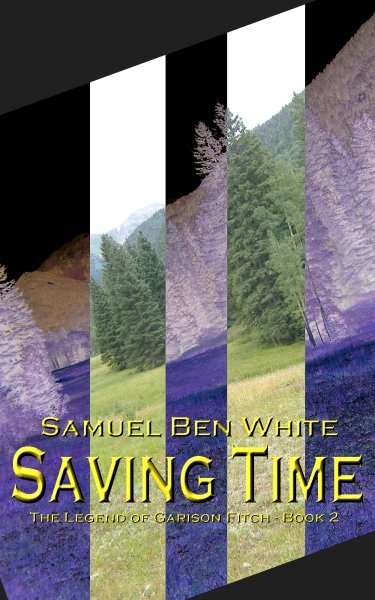
Book Two of The Legend of Garison Fitch
Two years ago Garison Fitch traveled through time and rewrote history. An accident in the eighteenth century created a whole new world, and even gave Garison a wife he had never met before. Now, he’s got a daughter and he’s coming to enjoy this world he created. Until he’s attacked by men masquerading as Indians, and a funeral procession from out of the past enlists his help, and a tree grows from sappling to full-grown in a matter of minutes, threatening his daughter’s very life. Time itself is unraveling and Garison’s trips through time seem to be the cause. Garison must go back in time once again and keep himself from making the original trip that started the problem. But he can’t use his time machine to go back. How does one sew up a rip in time?
Order today in paperback or Kindle
The Legend of Garison Fitch begins in “First Time” and concludes in “i“. Read all three books!
…
Reading Sample
Prologue
June 12, 1897
The concussion rocked the walls of La Plata Canyon far away from the blast site. There, fire and smoke careened out of the hole and added more soot to the already blackened cave mouth. Deep within the mountain, one could hear the rocks reestablishing their equilibrium. It was as if the mountain were alive. To further the illusion, one could hear the mountain rumbling long after the blast, like an awakened grizzly settling back into sleep.
Jeb stood up from behind his barricade and watched as the last of the smoke seeped out of the mine. It looked like a fire-breathing dragon sleeping, snoring smoke through one open nostril. Jeb liked the thought for he remembered fairy tales from his childhood which told that dragons’ bellies were covered with gold and jewels. Jeb grabbed his lantern and pick and prepared to head back into the dragon.
Jeb had been prospecting for over thirty years. He had missed the big strike in California, shown up too late for the one in Alaska, and was just barely in the right century for the Colorado strikes. He had been late for the strike on the Blue, just missed the boom on the Tarryall, and had shown up in La Plata Canyon about twenty years late. And while some might argue he didn’t know it very well, prospecting was the only life he knew.
Not that he hadn’t had a couple moments of glory. For three days once he had been a millionaire–on paper. That had been up near Tincup, or was it Alma? He couldn’t rightly remember. But three ladies depicted on stiff paper had forfeited his millions to a man holding four monarchs depicted on similarly stiff paper. Jeb always held that it had been a blessing–that all that money had encumbered him–but the truth was that he sometimes wished he’d never gotten into that last hand. Jeb’s life could be summed up with the phrase, “If only I’d left earlier.”
On the other hand, he’d never stayed too long. That was something, he guessed.
Down in the bowels of the mine shaft, he set his lantern on a ledge and set about to survey his most recent prospects. He had won the claim in a came of three card monte; which should have tipped him off. If the claim had been worth anything, the dealer (whose winning streak had reached uncanny proportions) would have held onto it. Jeb was beginning to suspect–no, be assured–that the dealer had lost on purpose.
Jeb had found the claim easily enough, having been late for the La Plata Canyon once before in his life. The claim was located near where the Lady of Spain Mine had once stood and that gave Jeb hope. The Lady of Spain had struck a pocket of gold and its owners had been richer than the dreams of avarice–until they hit the other side of the pocket. They blew their fortune trying to reestablish a vein that didn’t exist, and the Lady closed down. Jeb was hoping he might find just enough gold to get him a stake. With that, he could head to South America, or maybe even Alaska again. There was a valley he had seen when he had been there before that he’d been aching to try again.
As the dust settled in the area most recently blasted, Jeb swore. He knew better than to expect the mother lode to just appear before his eyes, but he had hoped for something promising. Anything. The early returns weren’t good.
He began sifting through the rocks, clearing a space to put up some more shoring timbers, when a glint caught his eye. He picked up the rock in question, and–holding it close to his lantern–spied just a hair of gold. He eyed it closely, not wanting to trust even his own sight until he was absolutely sure. This mine had disappointed him before, and he wasn’t going to get his hopes up again.
After roughly an hour of work, he had collected maybe twenty pounds of ore with traces of gold. He had even found where along the wall they had come from, but he hadn’t located the vein. But, even though it would mean putting a bend in his shaft where he hadn’t intended to have one, he figured it would be worth a look-see. The current path of the shaft sure didn’t seem worth sticking to.
The end of the day proved that there was a very thin vein of gold in the new direction, but it wasn’t enough for Jeb to get rich off of. In fact, it was probably just enough to make him poor–what with the expense of digging it out.
As Jeb sat in his shack, picking at the little gold he had found, he wondered if it would be enough. He knew it wouldn’t get him to South America or Alaska–or even California–but then again, it might. He had known men to get a lot further on a lot less.
Word had it there was a greenhorn easterner over in Durango who was buying up old claims. “Speculating” they called it. Jeb had heard that the city dude had bought Shorty Dillon’s worthless mine for far more than Shorty deserved. If the greenhorn were still around, Jeb thought, and if he could convince the man that his claim was worth something. It might mean salting the claim, but all’s fair, right? he thought absently.
The more Jeb thought of the idea of leaving and getting on the trail again, the more he liked it. Jeb decided he needed some supplies, anyway, and might as well head into Durango and see what he could find out. He tossed a crust of bread over to the marmot that often hung around near his door, then turned out the light for sleep.
Jeb awoke to a sound he had never heard before and, just for a moment, figured it must be Satan coming with some hell-spawned machine to take him away. He had done a sight worse than salt a claim in his life, after all. It was a powerful, low, rumbling sound, like the machines at the smelter–only more refined, more steady. To Jeb, that made the sound more ominous.
He sat up in bed and grabbed for his rifle. Slipping on his boots, he stepped outside into the night wearing only his dungarees and flannel underwear. He was shaking in his boots and sweating even though the night was as cool as any in a month. Slowly, he slipped outside.
The noise was coming from some sort of machine, all right. Jeb slipped on his spectacles for a better look–even though they weren’t much help in the moonlight. Whatever it was, it wasn’t much longer than a buck-board, but it was made of metal and glass. It ran on four black wheels with silver centers that gleamed in the moonlight. But what fairly took Jeb’s breath away with fright were its eyes. It had two eyes in front that shined brighter than day, lighting the way ahead of the beast–or machine, or whatever it was.
The beast began to turn in Jeb’s direction and he dove behind the woodpile as the bright lights swept near where he had been. There were trees between he and it that might have blocked him from its sight, but he didn’t want to take chances. It occurred to the back of his mind that he had no idea where the woodpile had come from, but the thought died of loneliness.
The beast rolled a short way through the forest then came to a stop maybe fifty yards from Jeb’s shack. Against his better judgement, he decided to crawl closer and get a better look. If he were going to die or get carted off to Ol’ Scratch’s hideout, he aimed to see what would be carrying him. Holding his breath, he moved toward the machine–creeping through the forest quieter than a cat.
He got close to the beast just as the light in its eyes went out and the fearful rumbling stopped. Then he watched in horrified awe as the sides of the beast opened up–almost as if it had doors built into its rib-cage–and two people got out. Jeb all but stopped breathing as he saw what appeared to be a tall, dark-headed man, reach back into the beast and pull out a blonde-haired little girl. She was little more than a baby. The man said something to the person who had gotten out of the other side of the beast and the reply–though Jeb couldn’t quite make out all the words–sounded as if it came from a woman.
The trio began to walk away from the beast and it was then that Jeb saw they were walking towards a house. It was a great log house, with a light on the porch that didn’t flicker and another light or two inside. Something in Jeb’s brain registered that the lights were coming from those new-fangled “bulbs” he had seen in town, but that wasn’t what occupied his mind. What occupied the parts of Jeb’s mind that hadn’t been completely frozen with fear was the idea that a house was there at all. He had walked that land just the day before and nothing had been there–not even a stick of cut wood. And now there was a house and people and–
Not planning his actions too far in advance, Jeb carefully skirted the fierce beast and walked up to the porch of the house. The yard was carefully cut, there were flower bushes planted all around, and the walkway to the front porch was made of some sort of perfectly laid and cut stone–as if of a single giant slab. All around was evidence that the house had stood for not just hours, but years.
He crept up to a window and saw that the woman somehow made the whole interior of the house light up by touching a little square on the wall. Jeb fell backwards from the window, his hair literally standing on end. What sort of magic was this? When he had caught his breath, his curiosity got the better of him and he peeked in again.
The man and the little girl were nowhere to be seen, but the woman was standing not ten feet away from Jeb. She had dark hair that hung half-way down her back and she was, Jeb thought, the most beautiful woman he had ever seen in his life. He gulped as he looked at her. Not only was she beautiful, she was wearing the least clothes he had ever seen on a woman who wasn’t dancing in a saloon. She wore a blue cotton shirt with no discernable buttons and britches that looked as if they had been cut off at mid thigh, revealing a more shapely pair of legs than he had ever seen before. He swallowed hard again and rubbed his eyes to make sure it wasn’t all an illusion.
The woman bent over a little table and picked up a little black box. She held it before her and, suddenly, a large black box on the other side of the room seemed to spring to life. It glowed with a thousand colors and sound came out of it. Jeb watched in horror as the woman somehow manipulated the big box with the little box. His breath now only a memory, he saw the faces of people who were trapped in the big box. Some were laughing, some were crying, and some seemed to have somehow been drawn. Like moving art.
The box went dark as suddenly as it had lit up and Jeb screamed. It was a heartfelt scream from the bottom of his soul as it escaped his lips. Clutching tightly to his rifle, he fled as fast as his old legs would carry him. Back to the shack he went, just barely remembering to avoid the horrible hell-beast the demon people traveled with. As he skirted it, he prayed it wouldn’t come to life and eat him.
Reaching his shack, he bolted the door, piled whatever he could find in front of it, then sat cowering on the bed with his gun cocked and ready. When he finally fell asleep, it was to visions of the beautiful woman coming to him. She wore next to no clothes and beckoned him with long-nailed fingers and a sultry gaze. He fought against her advances for he knew she had come to take his soul and trap him for all eternity in her box.
When morning came, Jeb was surprised to find himself still alive–and not living in a box. He gathered up what he could carry, including some of the gold, and headed for his mule. He hastily loaded the animal up and started for town.
He cast a glance at where the house had been the night before and found only an empty meadow. Taking an earlier than usual swig from the flask in his pack, he steadied his nerves and decided it was time to get shut of La Plata Canyon. He’d heard a man named Stillwell say the place was haunted, and Jeb was thinking the old prospector had been right. If he could sell his claim to that greenhorn–Wilson, he thought the man’s name wasfine and dandy. If not, he’d just cut his losses and head for Leadville or Georgetown.
He was sure it hadn’t been a dream. The valley was haunted and he wouldn’t spend another night in it. Let someone else deal with the demon woman.
…
Chapter One
With gloved hands, Garison looped the newly strung strand of barbed wire through the come-along. Nodding to Heather to back away a bit, Garison began to work the lever and bring the two strands closer together. He had almost lost an ear one time when a line of barbed wire broke and he didn’t want her near in case the incident repeated itself.
“A hundred years ago,” Garison told her, “We would’ve had to do this all by hand. Working and pulling until we got the new wire tight enough to nail down–then it would still have been far looser than we can get today.”
“But you said the tightness in the wire also contributed to it’s demise.”
“‘Demise’?” he chuckled.
“Breakage, whatever. You knew what I meant.”
He nodded and said, “To an extent. This wire’s a lot stronger than anything we would have been stringing a hundred years ago. My point is, though, with all the things I’ve invented, I’m not sure I’ve ever invented anything just as flat-out practical as this come-along.”
“That’s not true. If you could ever get The Box licensed, that would change the world.”
He winced slightly and reminded her, Please don’t say that. I’ve already changed the world once, remember?”
“That was an accident.” Trying to cheer him up–or at least get the conversation on another track–Heather told him, “If you could license The Box, the world would never know another energy crisis. Besides that, it’d probably just about get rid of smog. And think of all the waste we produce now that The Box could eliminate.”
He nodded, but remarked, “And think of how quickly Garison Fitch would be eliminated.”
“What?”
As he finished cranking and began to tie the two strands of barbed wire together, he explained, “Even if I got the thing licensed, I wouldn’t stand a chance. We’re talking about a self-contained nuclear fusion reactor small enough to fit into the trunk of a compact car but powerful enough to supply all the electricity Denver needs. The oil, gas, and electric companies would never let me make it even if the government licensed it.”
“But all the good it could do–”
“Doesn’t compare to all the money they’re currently making. Almost twenty years ago a guy in El Paso figured out how to make his Lincoln Continental get eighty-five miles to the gallon–with the air conditioning going. It was environmentally safe and easily manufactured.” Garison looked at Heather with a rueful smile and asked, “What happened to that car?”
When she shrugged, Garison told her, “The guy sold the plans for the car to one of the major oil companies for several million dollars so that they could ‘research it’. That was the day it was guaranteed that car would never see the light of day. Oil companies are in the business to make money and a fuel efficient car would kill them. Remember the Tucker automobile? What do you think would happen if I suddenly showed the world that the oil, gas, and electric companies can all be circumvented by an inexpensively produced unit they could install themselves in the back yard?”
Just when Heather was afraid her new track would be more disastrous than the previous one, she decided to ask anyway, “So what happens to The Box? You’re not just going to bury it, are you?”
He shook his head and said, “Not entirely. I applied for a permit to convert our house over to a generator.” He smiled and added, “I’m just not going to tell them that my little generator has more power than the entire La Plata County Electrical Co-Op.”
Heather laughed and Garison thought to himself how much he had come to love that laugh in the last two and a half years. Hers wasn’t a loud laugh–Heather was rarely loud about anything–but it was a laugh that seemed to fill her whole body. Her mouth, her eyes, and–somehow–her entire self laughed together.
Heather Dawson Fitch was an uncommonly beautiful woman. With long, dark hair and the face of an angel, she could have been a model or an actress or–Garison thought–anything she wanted to be. An All-American volleyball player for Southern Methodist during her pre-law years, she had remained athletically active since and, when she had given birth to their first child eighteen months before, she had quickly regained her figure. Now, unless one saw her with her daughter in hand, one might think she had never given birth. With young Sarah sporting the blondest hair imaginable, many who saw Heather guessed her to be watching someone else’s child. However it is that mothers are supposed to look, Heather didn’t strike most people as looking like one.
Garison, however, was an obvious father. Though he, too, sported dark black hair and a matching mustache, he positively doted on little Sarah. A big man who might have appeared incapable of tenderness at first glance, Garison had to be reminded by Heather that Sarah wasn’t made of china. He also had to be reminded not to spoil her, but that lesson often went over his head. Like his first daughter Helen–dead almost two hundred years when Sarah was born–Sarah had quickly learned that her father was tightly wrapped around her stubby little fingers.
Garison looked at Heather standing there by the fence row, grabbing her hammer and preparing to nail the latest strand of wire into place, and winced slightly. He had no doubt that Heather could do the work, but all morning long she had been working far too hard. Each fence staple was hammered in with a vengeance and the next one was attacked in record time. He had tried to get her to take it easy, but she would only slow down for a few minutes before stepping the pace up again.
“I know you hate the idea of ‘man’s work’ and ‘women’s work’,” Garison began, “But I still don’t think this is the kind of work for you. Call me a sexist pig, but this seems like awfully rough work for a woman.”
“Well, sexist pig,” Heather laughed, “I enjoy it. I never got much chance to work with my hands as a child. I like helping you with your wood-working and stuff like this. This stuff, especially, makes me feel like a cowboy or something.”
“Believe me,” he chuckled in assurance, “No one will ever accuse you of being any kind of a boy.”
Garison started to admonish her about working too hard again, but he knew it would do no good. He knew Heather was working so hard because Sarah was staying two nights with her grandparents in Denver and Heather was trying to take her mind off her worry with hard work. Garison knew it wasn’t working because Heather’s work was getting harder and harder. He just hoped he could find some more work for them to do when the fence was done or he was afraid Heather might have a nervous breakdown before having a physical breakdown. He figured a physical breakdown might be easier to recover from.
They were conducting what was a yearly ritual for most of the residents of the La Plata Canyon–and, indeed, almost all of the rural west. While barbed wire could withstand the elements for quite a few years, it couldn’t withstand the sharp hooves of deer and elk. As they jumped the fences, the animals would often clip the top strand with hooves as sharp as any wire cutters. The result was broken top strands that had to either be repaired or replaced all around the property every year. If not for the fact that his barbed wire helped to keep neighboring livestock out, Garison had thought more than once about just letting the wire go. But, like Heather, the work kind of made him feel like a real, old west cowboy, too.
He was about to say something when they heard a car coming from up the canyon. They both looked up, as vehicle traffic in La Plata Canyon was fairly rare. They knew the vehicles of everyone who lived in the canyon and often waved when they saw someone they recognized. Heather had once groaned that they had become true country hicks–looking up at the sound of passing motorists–but the truth was she loved the friendliness after growing up in Dallas’s most haughty suburb.
They looked at each other with interest when they saw that the car going by was an old one. While Garison wasn’t a car buff exactly, he knew enough to spot that the car was from the late 1940s. He was about to remark as such, showing off his limited knowledge of vintage autos, when Heather said, “1947 Hudson and Terraplane. I haven’t seen one of those in years. Looks like it’s in great shape, too.”
“I’d say so,” Garison nodded in more agreement than he really had. He was still marveling at the fact that Heather knew the car.
Heather caught the look on his face and snapped playfully, “What? Did I wound your chauvinistic pride? Don’t think women can be motorheads?”
“No,” he hastily replied, “But in the two and a half years I’ve known you, you’ve never said anything about cars. I mean, what little work we’ve had to have done, I did it or we took it in. I thought you were just into planes.”
“I am,” she laughed. With a chuckle she added, “My brother Hank’s a car freak and I went to just enough old car shows and a few junk yards with him to pick up a little. He had a car like that at one time.” Heather looked down the road where the car had already passed around a bend and added, “Although his was never in that good of shape. He would have liked to have seen that car. Someone’s really been keeping it up.”
At the sound of another car coming from up canyon, Garison looked up. He remarked with surprise, “He’d probably like this one, too.”
Heather turned her gaze in the same direction as Garison’s and asked, “Is there an old car rally up canyon somewhere?”
“Not that I know of. Who would hold an old car rally up there where the road becomes dirt? Not the best way to protect your custom paint job.”
The car in question was a hearse. It had a big Pontiac symbol on the hood and looked to be from the same era as the previous car. And, like the Hudson, it looked to be in excellent condition. Almost new, in fact.
Just as Garison was about to ask what year it was, Heather told him, “By the grill work, I’d say this one’s from about ‘46. That hood looks a little strange, but maybe it’s because it’s a hearse. I’ve never seen one of those before. Not from that era, anyway.”
As they were looking at the hearse, it pulled to a stop in front of them. They watched with interest as a tall, solidly built, middle-aged man got out. He smiled up at them and ascended the short incline between them and the road.
At the fence, he extended his hand and offered, “Stuart Jameson, at your service.”
Garison pulled off his right-hand work glove and took the man’s hand. He suddenly realized the man had the largest hands Garison had ever encountered. The man’s hand wrapped completely around Garison’s own rather large paw almost as if taking an adolescent’s hand. For a brief moment, Garison thought the man could probably touch Heather’s elbow while shaking her hand. Besides just the hands, though, the man was big–probably six-four or better, Garison mused.
“Garison Fitch,” he returned. “And this is my wife, Heather.”
Stuart Jameson nodded and said, “I hate to impose on you like this, but I’m with Holt & Jameson, the funeral parlor in Durango. Anyway, we just interred a young man on his parents’ property and, well, my man hasn’t shown up here with the digging tools. I wonder if I might trouble you to help me, um–I really hate to even ask this. Could you, um, help me fill in the grave?”
He had a deep voice, much like what one would expect the voice of God to sound like. It was deep and sonorous, yet oddly soothing. Every word he said was in the tone of voice one would use when comforting bereaved loved ones. It occurred briefly to Heather to wonder if he talked like that all the time. She guessed that he did since he was talking that way to ask for help filling in a hole.
Heather and Garison shared a puzzled look, then Garison replied, “I guess so.” They picked up their shovels and followed the man to the hearse.
“I’m afraid we’ll have to all squeeze into the front seat,” he apologized.
“No problem,” Heather quickly answered, shuddering as she even thought of riding in the back of the hearse.
Walking to the car, Stuart Jameson was whistling something Garison couldn’t quite place. After a moment, he realized it was “American Patrol”. Odd, he thought, that the man would whistle a tune from the same era as the car.
As they got in and Stuart started the engine, Heather complemented, “This car is in remarkable shape.”
Jameson cast her a somewhat puzzled look, but replied, “Thank you. I only got it a year ago–so it hasn’t seen much use. Ordered it direct from the factory.”
“Doesn’t look like a kit,” Heather mused, drawing another puzzled look from Jameson.
Garison was only listening with half an ear. What he was paying attention to was the fact that the man’s clothing was fantastically out of date. Jameson was wearing a conservative brown suit, but the lapels were too wide, the tie was too short, the pants were cut all wrong and the material was some sort of heavy woolen weave that looked like it would weight fifty pounds. Below the pants the man wore brown leather shoes that were polished but obviously worn. Even in their worn condition, though, Garison couldn’t imagine that they were comfortable. The thought popped in his mind that they were the type of shoe formerly referred to as brogans, but he wasn’t sure.
He was shaken from his study of the man’s attire by a quick turn to the right. Garison looked up in surprise to find that they were taking a dirt road that followed along just outside his northern fence line. He had walked the selfsame road just two days before when checking his fence and it hadn’t been in nearly as good shape. He figured someone must have grated it for the funeral, but was surprised he hadn’t heard the equipment doing it. The sound of machinery often carried well in the La Plata, partly because it was so incongruous.
They pulled up to a little clearing neither Heather nor Garison recognized and got out. At the edge of the clearing, a small man in another outdated suit stood next to an open grave and a pile of dirt. He was tapping his foot and looking impatient, until he saw Heather. She was just dressed in faded (if tight) blue jeans and an old sweat-shirt, but he gulped and watched her legs like he’d never seen such a sight. Heather noticed the look and edged closer to Garison. She was used to men watching her, but this man was looking at her like she was a space alien . . . or a chorus girl.
“If you could just give me a hand,” Jameson said, taking Heather’s shovel and motioning for Garison to join him. Garison nodded and began tossing dirt in on what certainly looked like a casket. They could hear the hollow thump of the dirt on the wood and the sound gave Heather an uneasy feeling. For his part, Garison was noticing that it was a wooden box, and not the fancy metal ones he was used to.
Heather watched for a bit, then opened, “If you don’t mind me asking, who are you burying and why are you burying him here? Him or her. It’s so far from a cemetery and all.”
Jameson first said, “Harris, spell Mister Fitch for a bit, won’t you?” Harris nodded and took the shovel like someone who had never worked one before. He was little help and Garison was thinking Heather could have done a much better job.
Jameson explained, “It is a young man in the grave, Mrs. Fitch. His name is–was–Guy Wilson and, sadly, he was killed in France during the war.”
“What war?” Heather asked suspiciously.
Harris looked up with surprise and spoke for the first time, “World War Two, of course.” He said it like he was talking to someone who had to be a moron.
Heather looked from Harris to the grave and queried incredulously, “And they’re just now bringing his body home for burial?”
Jameson nodded and replied, with practiced sadness, “Things move slowly after such a devastating conflict.”
Taking the shovel back from the slow-working Harris, Garison said, “But this has to be some sort of a record.”
Jameson shrugged and said, “I just hope he’s the last for me. I have buried far too many from this conflict–or arranged memorial services for those whose remains were never recovered. A sad, sad business.”
Heather mumbled, “I don’t think there’s much chance of any more coming home. Not if they haven’t come home by now.”
“Let us hope so,” Jameson nodded. Heather and Garison shared another puzzled look. After all, did he really expect any more bodies from World War II to be found sixty years late?
“So, why here?” Heather reminded them of the second part of her earlier question.
“Ah, yes,” Jameson nodded. It was a warm day and he stopped to remove his coat and wipe the sweat from his brow. It drew both Garison and Heather’s attention that he still wore his tie. He finally told her, “This land is owned by the Wilson family; as you probably know, since you live nearby.”
“Actually, I didn’t,” Garison told him. “I mean, they call it the Wilson place, but no one’s lived here as far back as I can remember.”
Jameson nodded and continued, “The Wilson’s haven’t lived here in, oh, must be ten years by now. The family had lived here for many many years–since Carlton Wilson struck gold here back in the late 1800s, in fact. Guy and his brother John grew up here–in the old house up the road.”
Heather and Garison shared a look that meant, “What old house?”
Jameson looked puzzled by their question, but went on, “But when the boys graduated from high school and left home, Lydia talked Harold–he was Carlton’s grandson, I believe–she talked him into moving to Denver. They haven’t been back until today, I believe. You may have seen their Hudson going down the road ahead of me. I believe Guy had said he wanted to be buried in La Plata Canyon. Boyhood memories of happiness here, I suppose.” He said this in a voice that conveyed infinite sadness and sympathy.
“Interesting,” was all Garison could say. Heather just nodded, confused and bewildered.
When the grave was filled in, Jameson looked at his watch and said, “I can’t imagine what has happened to Phil. It’s not like him to be late. I hope he hasn’t met with any misfortune. He was supposed to be here by three, and here it is almost four.”
Heather looked at her own watch and said, “It’s not even noon, yet.”
Jameson smiled and offered, “Your watch must have stopped.” Showing her his own watch, he said, “I have fifteen ’til four–and my watch is running.”
“So’s mine,” she returned, shaking her watch as if that would change anything.
Garison looked at his own watch and said, “Huh, mine matches Heather’s. You sure yours is right?”
Harris looked at his watch and showed haughtily, “See, a quarter of four.”
Garison shrugged, then put his shovel over his shoulder and said, “Well, we’ll keep an eye out for him in case he shows up later. Folks always have trouble finding our house even when I give them directions. Maybe he just got lost in the canyon. Took the wrong dirt road or something.”
“Perhaps,” Jameson nodded. Harris made a motion that indicated he thought Phil had had to much to drink for lunch, but Jameson shook his head and said, “No, I don’t think so. He’s been dry ever since he came back from the south Pacific.”
“Why was he there?” Heather asked.
“It’s where the Navy sent him,” Jameson replied, wondering if Heather and Garison might possibly be mental. “In fact, I think he was on Iwo Jima.”
“That was a while back,” Heather mumbled, though something about the whole conversation bothered her. It was as if she and Jameson were having two spearate conversations that sort of met in the middle–but didn’t.
Jameson extended his massive hands and shook those of Heather and Garison. He smiled and said, “I certainly appreciate your help, Garison, Mrs. Fitch. Sometime when you’re in Durango, allow me to buy you dinner.”
“That’s not necessary,” Garison shrugged.
“Yeah, we were planning on spending the day digging and working, anyway,” Heather smiled, though still uncomfortable about the whole interchange. “This just took us away from working the fence.”
“Ah, I’ve taken you away from your work,” Jameson apologized.
“That’s fine,” Heather smiled. “No one ever got mad about missing out on stringing barbed wire.”
Jameson nodded with a deep chuckle and reminded, “Well, the offer is still open if ever you’ll take me up on it. Thank you again. Now, can I give you a ride back?”
“No, thank you,” Garison replied. “We can walk back. I want to look at the fence again, anyway. We may have to get a surveyor out here for a couple sections.”
Jameson nodded as they set off.
When they were out of earshot, Harris remarked, “Where’d they get those clothes?”
Jameson shrugged and said, “I have no idea. Mrs. Fitch certainly fit well into those dungarees, didn’t she?”
“It was shameful,” Harris replied snootily.
“Not so shameful that you refused to let your eyes bug out at her every move, I noticed.”
Harris harrumphed and walked to the hearse. Jameson chuckled and followed along behind. He hated to admit it, but Mrs. Fitch certainly had fit well into those jeans. And there was something about that torn patch on her thigh . . . He checked his watch and wondered if his wife were home, yet.
When they were out of earshot, Heather asked, “What did you think of those clothes?”
“Little outdated, weren’t they?” Garison nodded.
Heather, her voice low, agreed, “Very. I don’t know fashion as well I do cars, but I’d guess those suits came from about the same era as the cars.”
“That’s what I was thinking. And I don’t know if you noticed it, but that guy was whistling an old ‘big band’ tune. Granted, music’s eternal, but–” He stopped walking just as she did and asked suspiciously, “Are you thinking now what I’m thinking?”
“I am if you’re thinking about sneaking back, waiting until they’re gone, and finding out what was buried back there.” He nodded and she looked at her watch, suggesting, “Let’s give them a few minutes then slip back.”
They walked quietly through the woods back to the little clearing. They hadn’t heard the car drive away, but they hoped it had. If not, they figured they might spy for a while and see what the two men did alone.
They crept up to their fence and slipped through onto the old fenceline road.
There was no hearse, no funeral director, no Harris, no grave, and no clearing.