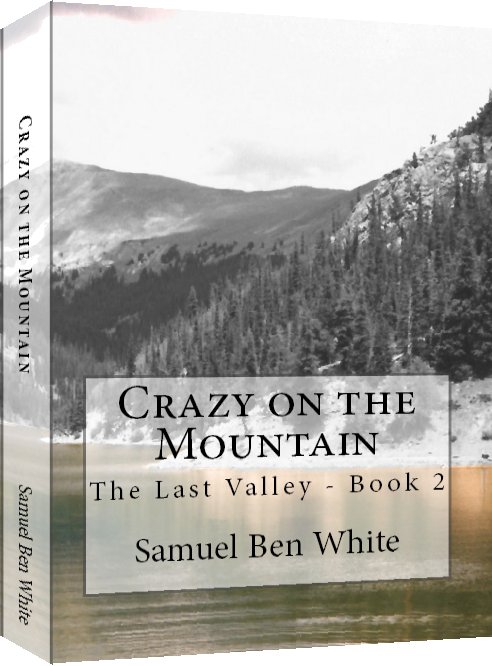
Crazy on the Mountain – The Last Valley – Book 2

Josh Overstreet and his sister Claire have been carving a life out of the ash for more than half a decade, unsure whether anyone yet lives outside the small valley where they have established their town of Overstreet with two dozen others.

Then Deanna Pembleton stumbles into the valley, asking for help for herself and her friends. Claiming they have eked out a life much like that of the people of Overstreet, she begs assistance, which Josh is willing to give. She is, however, clearly unhinged on some level. Could the people she is claiming to want to help just be figments of her imagination?

Against the advice of almost everyone in Overstreet, Josh and Adaline set out to try and take food to Deanna’s people, hoping that people still exist outside “the last valley”.

They never dreamed their valley might not be there for them when they get back.

Be sure and read how this story started in “Ashes to Ashes” and concludes in “Book of Tales“!

Available now on Kindle and paperback.

Sample passage

I happened to ask, “Deanna, how long have you lived in Vail?”

“What? Oh, you might say I’ve lived there all my life.” Adaline and I looked at each other in surprise, for this was not said with the hick voice Deanna had mostly been using of late. It also made us wonder about our earlier thought that she was from Denver. She continued, in a somewhat conspiratorial tone, “My great-grandfather was the first of the family to come to Vail. The story that he told his family was that he had been a banker in Birmingham, Alabama,” the names of the city and state were said with a deep, southern accent. “But the bank had gone bust—through no fault of his own, of course, so he had headed west to seek his fortune. He said he worked several jobs in towns both big and small before landing in Vail, broke and starving, worried about his wife and kids back home for it had been some time since he had been able to send them money.

“But it was ski season and he took a job in a kitchen at one of the hotels. He worked hard and sent money back to his family and, by the end of the ski season, had worked his way up to waiter. Over the summer months, he proved himself invaluable and was made assistant manager of the restaurant, and then manager. At that point, he sent for his wife and kids and was ever so happy to see them. He got his kids—who were teenagers by then—jobs in Vail and they saved their money and, would you believe it, one day they bought the restaurant! Using all of his banking and monetary skills, he was eventually able to buy the building the restaurant was in, and his ‘empire’ was begun!”

Deanna chuckled, then said, still in the refined voice of someone who had grown up on the tonier side of life, “And thus began the Coventry empire of Vail. Pembleton is my married name, of course. I grew up attending the best schools, a member of all Vail’s best clubs, and groomed for a career in hoteliery. Yes, I know that’s not really a word, but my father always said it should be. But, I went off to college and fell in love and got married and, well, the last thing I wanted to do was to come back to Vail for anything other than a visit. Best laid plans of mice and men, right? My father had a stroke when I was just about to turn thirty, so my husband and I came back to watch over the business while he recovered. What was supposed to just be a few weeks in Vail became years, with my own children going to those same schools I did, joining the same clubs, being the same spoiled, rich brat I was. Oh how I wish we had never left Denver. My husband, Paul Pembleton, he rose to great heights in Vail, sat on all the important boards and had chairmanships in all the clubs, but I think he always resented the thought that he had only gotten there because of my family connections. It wasn’t true, of course, but it’s how men think sometimes. You know, I think he actually appreciated the ash cloud, for it allowed us all to go back to square one, with no one being anything more or less than what they could contribute.”

In a sly voice, she continued, “But speaking of square one. When my own grandmother was nearing the end of her life, I went and sat with her for many an hour, listening to her stories of growing up in Alabama, of earlier days in Vail than I had ever known. And one night, when she was strangely lucid,” a phrase that got both mine and Adaline’s attention, for we had both been thinking it in relation to Deanna, “She told me a story. According to her, my great-grandfather hadn’t been an innocent bystander in the failure of that bank, but the main instigator. His father was the actual president of the bank, you see, and my great-grandfather had been manipulating loans in some way that allowed him to pocket a sizable sum on the side. Undeclared, you might say.

“Then, one day, maybe he thought his father was about to get on to him, he withdrew an enormous sum of cash from his personal account, walked out of the bank, and no one knew where he went. Didn’t go home or anything. When my great-grandmother called her father-in-law that evening, he said they should call the police, thinking something nefarious had happened to the up-and-coming young banker. Perhaps a ransom call would come in any moment. It was then, so the story goes, that the bank president first realized what his son had been doing. He called his daughter-in-law and convinced her not to file a missing person’s report, for fear of what the publicity would do to the bank. He did agree, however, to engage the services of a private detective.”

Deanna was still speaking in a normal voice, though it became a little dreamy as she said, “I wondered if it were a private eye like in the movies: snap-brim hat, long trench coat, steel-jawed chin. Anyway, the private eye had little trouble following my great-grandfather—though ‘great’ is probably the wrong word for him,” she said with an ironic chortle. “It seems my progenitor had left a bread-crumb trail of prostitutes visited and affairs started that led all the way to Vail, where he was working as a lift attendant at the ski area while, um, serving a rich lady at night while her husband attended to his … let’s say: board functions.

“When the bank president learned of this, he brought his daughter-in-law and the kids out to Vail for a ski trip, hoping to engender one of those movie moments where the miscreant is surprised by his one true love and repents of his wicked ways. According to my grandmother, it was almost like that. Her father was happy to see his children, but not so happy to see his wife. Still, he stopped the fooling around, for a while, and took his family in. His father got him a respectable job as the manager of one of the local restaurants and my great-grandfather gave all appearances of becoming a respectable citizen again. What he was actually doing, though, was continuing his association with the rich lady. He got money out of her somehow and bought the restaurant. Set his wife up as the general manager, dumped the rich lady for a younger mistress, and made his children managers of other properties he had acquired. By the time I came along, great-grandfather was dead and his true story had been buried longer than he had.” She laughed heartily before adding, “There’s even a picture of him in the museum, all dressed up and looking distinguished, with a little plaque about how he was one of Vail’s leading citizens and top philanthropists. He even gave enough money to one of the local churches that they named the recreation building after him. Can’t you just see some youth minister telling the kids who came out to play volleyball, ‘And this building was named after a notorious sinner, who would have slept with any of your mothers who let him, in Jesus’ name, Amen!’” She cackled with laughter and then slipped back into one of her songs. Adaline and I looked at each other strangely, but continued on without a word. We did discuss later how much of the story we thought was true, but had no way to come to a conclusion. And we still thought Deanna was unhinged at best.

We made it to Vail in less than a week, which really encouraged me—and made Adaline wonder why I had thought it would take three weeks. The thing was, I hadn’t been counting on the Interstate being in such good shape, which it was. There were only a couple places where the ash had slid across it, and neither of them deep. And while Black Gore Creek ran strong in some places, it didn’t cross the highway at any point. As we pulled up in sight of Vail, I was smiling and telling Adaline how surprised everyone would be if we pulled back into town before they even came to look for our signal.

“Where are your people?” I asked Deanna, once we had her attention for she had been in the middle of a rousing rendition of either “Amazing Grace” or “I Fought the Law” (it was hard to tell).

She crawled up to crouch behind the front seat and, pointing, said, “Up yonder. You cain’t see it from here, but it’s the other side of that big white building by the ski slopes. I heared you talking about how the wind blew that gash in the ash—gash in the ash,” she repeated with a laugh, “And we had something just like that. People to the left and right was all dead, but our little gash was just fine. All things considered, I mean.”

“Think we can make it before nightfall,” I asked, for we were still a good five miles out, “Or should we make camp and get there in the morning?”

She looked up at the bright spot of the sun that almost shown through the ash and said, “Let’s see if we can push through. If we can’t, at least we can stay in one of the buildings on the edge of town. We might make’er this evenin’, though. Them’s good horses you got there.” This was a surprising statement, for she had frequently complained when we stopped to water the horses or, worse, gave them a lengthy breather and roll when we came upon that rare meadow of thick grass—or any grass. I couldn’t blame her for being anxious to get to her people, but I did get tired of her complaining—especially as we had been making such good time.

As we pulled closer to the town of Vail, some thunderheads started building to the west. “I hate to say it, Deanna, but we may need to pull up and find shelter.”

I had expected an objection, but she looked at the sky and said, “Them’s buildin’ up to be gully-washers, all right.” She pointed off to the right and said, “They’s an old mechanic’s shop up yonder. You’d be able to pull the horses into the dry.”

With impeccable timing we got the old garage doors open and the horses inside the bay just before a wall of summer rain came through. I enjoyed seeing it, though, for it made me think of the rains we used to have when I was growing up. They would come up on us all of a sudden, pelt you with raindrops the size of golf balls, then pass through as quickly as they had arrived. I could see some sunlight to the west, creating a golden line on the mountains in that direction, which made me think this would be one of those storms. It was, but by the time it had passed through it was too late to go anywhere so we set up camp in the old automotive shop. I was afraid Deanna would be upset by us stopping that close to her goal, but she just curled up on a couch in the manager’s office and went to sleep.

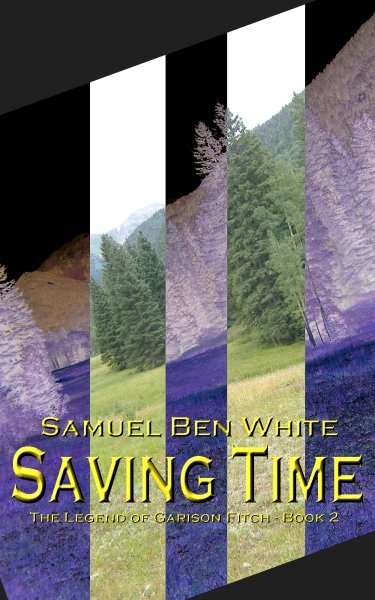
Saving Time – The Legend of Garison Fitch – Book 2

Book Two of The Legend of Garison Fitch

Two years ago Garison Fitch traveled through time and rewrote history. An accident in the eighteenth century created a whole new world, and even gave Garison a wife he had never met before. Now, he’s got a daughter and he’s coming to enjoy this world he created. Until he’s attacked by men masquerading as Indians, and a funeral procession from out of the past enlists his help, and a tree grows from sappling to full-grown in a matter of minutes, threatening his daughter’s very life. Time itself is unraveling and Garison’s trips through time seem to be the cause. Garison must go back in time once again and keep himself from making the original trip that started the problem. But he can’t use his time machine to go back. How does one sew up a rip in time?

Order today in paperback or Kindle

The Legend of Garison Fitch begins in “First Time” and concludes in “i“. Read all three books!

Reading Sample

Prologue

June 12, 1897

The concussion rocked the walls of La Plata Canyon far away from the blast site. There, fire and smoke careened out of the hole and added more soot to the already blackened cave mouth. Deep within the mountain, one could hear the rocks reestablishing their equilibrium. It was as if the mountain were alive. To further the illusion, one could hear the mountain rumbling long after the blast, like an awakened grizzly settling back into sleep.

Jeb stood up from behind his barricade and watched as the last of the smoke seeped out of the mine. It looked like a fire-breathing dragon sleeping, snoring smoke through one open nostril. Jeb liked the thought for he remembered fairy tales from his childhood which told that dragons’ bellies were covered with gold and jewels. Jeb grabbed his lantern and pick and prepared to head back into the dragon.

Jeb had been prospecting for over thirty years. He had missed the big strike in California, shown up too late for the one in Alaska, and was just barely in the right century for the Colorado strikes. He had been late for the strike on the Blue, just missed the boom on the Tarryall, and had shown up in La Plata Canyon about twenty years late. And while some might argue he didn’t know it very well, prospecting was the only life he knew.

Not that he hadn’t had a couple moments of glory. For three days once he had been a millionaire–on paper. That had been up near Tincup, or was it Alma? He couldn’t rightly remember. But three ladies depicted on stiff paper had forfeited his millions to a man holding four monarchs depicted on similarly stiff paper. Jeb always held that it had been a blessing–that all that money had encumbered him–but the truth was that he sometimes wished he’d never gotten into that last hand. Jeb’s life could be summed up with the phrase, “If only I’d left earlier.”

On the other hand, he’d never stayed too long. That was something, he guessed.

Down in the bowels of the mine shaft, he set his lantern on a ledge and set about to survey his most recent prospects. He had won the claim in a came of three card monte; which should have tipped him off. If the claim had been worth anything, the dealer (whose winning streak had reached uncanny proportions) would have held onto it. Jeb was beginning to suspect–no, be assured–that the dealer had lost on purpose.

Jeb had found the claim easily enough, having been late for the La Plata Canyon once before in his life. The claim was located near where the Lady of Spain Mine had once stood and that gave Jeb hope. The Lady of Spain had struck a pocket of gold and its owners had been richer than the dreams of avarice–until they hit the other side of the pocket. They blew their fortune trying to reestablish a vein that didn’t exist, and the Lady closed down. Jeb was hoping he might find just enough gold to get him a stake. With that, he could head to South America, or maybe even Alaska again. There was a valley he had seen when he had been there before that he’d been aching to try again.

As the dust settled in the area most recently blasted, Jeb swore. He knew better than to expect the mother lode to just appear before his eyes, but he had hoped for something promising. Anything. The early returns weren’t good.

He began sifting through the rocks, clearing a space to put up some more shoring timbers, when a glint caught his eye. He picked up the rock in question, and–holding it close to his lantern–spied just a hair of gold. He eyed it closely, not wanting to trust even his own sight until he was absolutely sure. This mine had disappointed him before, and he wasn’t going to get his hopes up again.

After roughly an hour of work, he had collected maybe twenty pounds of ore with traces of gold. He had even found where along the wall they had come from, but he hadn’t located the vein. But, even though it would mean putting a bend in his shaft where he hadn’t intended to have one, he figured it would be worth a look-see. The current path of the shaft sure didn’t seem worth sticking to.

The end of the day proved that there was a very thin vein of gold in the new direction, but it wasn’t enough for Jeb to get rich off of. In fact, it was probably just enough to make him poor–what with the expense of digging it out.

As Jeb sat in his shack, picking at the little gold he had found, he wondered if it would be enough. He knew it wouldn’t get him to South America or Alaska–or even California–but then again, it might. He had known men to get a lot further on a lot less.

Word had it there was a greenhorn easterner over in Durango who was buying up old claims. “Speculating” they called it. Jeb had heard that the city dude had bought Shorty Dillon’s worthless mine for far more than Shorty deserved. If the greenhorn were still around, Jeb thought, and if he could convince the man that his claim was worth something. It might mean salting the claim, but all’s fair, right? he thought absently.

The more Jeb thought of the idea of leaving and getting on the trail again, the more he liked it. Jeb decided he needed some supplies, anyway, and might as well head into Durango and see what he could find out. He tossed a crust of bread over to the marmot that often hung around near his door, then turned out the light for sleep.

Jeb awoke to a sound he had never heard before and, just for a moment, figured it must be Satan coming with some hell-spawned machine to take him away. He had done a sight worse than salt a claim in his life, after all. It was a powerful, low, rumbling sound, like the machines at the smelter–only more refined, more steady. To Jeb, that made the sound more ominous.

He sat up in bed and grabbed for his rifle. Slipping on his boots, he stepped outside into the night wearing only his dungarees and flannel underwear. He was shaking in his boots and sweating even though the night was as cool as any in a month. Slowly, he slipped outside.

The noise was coming from some sort of machine, all right. Jeb slipped on his spectacles for a better look–even though they weren’t much help in the moonlight. Whatever it was, it wasn’t much longer than a buck-board, but it was made of metal and glass. It ran on four black wheels with silver centers that gleamed in the moonlight. But what fairly took Jeb’s breath away with fright were its eyes. It had two eyes in front that shined brighter than day, lighting the way ahead of the beast–or machine, or whatever it was.

The beast began to turn in Jeb’s direction and he dove behind the woodpile as the bright lights swept near where he had been. There were trees between he and it that might have blocked him from its sight, but he didn’t want to take chances. It occurred to the back of his mind that he had no idea where the woodpile had come from, but the thought died of loneliness.

The beast rolled a short way through the forest then came to a stop maybe fifty yards from Jeb’s shack. Against his better judgement, he decided to crawl closer and get a better look. If he were going to die or get carted off to Ol’ Scratch’s hideout, he aimed to see what would be carrying him. Holding his breath, he moved toward the machine–creeping through the forest quieter than a cat.

He got close to the beast just as the light in its eyes went out and the fearful rumbling stopped. Then he watched in horrified awe as the sides of the beast opened up–almost as if it had doors built into its rib-cage–and two people got out. Jeb all but stopped breathing as he saw what appeared to be a tall, dark-headed man, reach back into the beast and pull out a blonde-haired little girl. She was little more than a baby. The man said something to the person who had gotten out of the other side of the beast and the reply–though Jeb couldn’t quite make out all the words–sounded as if it came from a woman.

The trio began to walk away from the beast and it was then that Jeb saw they were walking towards a house. It was a great log house, with a light on the porch that didn’t flicker and another light or two inside. Something in Jeb’s brain registered that the lights were coming from those new-fangled “bulbs” he had seen in town, but that wasn’t what occupied his mind. What occupied the parts of Jeb’s mind that hadn’t been completely frozen with fear was the idea that a house was there at all. He had walked that land just the day before and nothing had been there–not even a stick of cut wood. And now there was a house and people and–

Not planning his actions too far in advance, Jeb carefully skirted the fierce beast and walked up to the porch of the house. The yard was carefully cut, there were flower bushes planted all around, and the walkway to the front porch was made of some sort of perfectly laid and cut stone–as if of a single giant slab. All around was evidence that the house had stood for not just hours, but years.

He crept up to a window and saw that the woman somehow made the whole interior of the house light up by touching a little square on the wall. Jeb fell backwards from the window, his hair literally standing on end. What sort of magic was this? When he had caught his breath, his curiosity got the better of him and he peeked in again.

The man and the little girl were nowhere to be seen, but the woman was standing not ten feet away from Jeb. She had dark hair that hung half-way down her back and she was, Jeb thought, the most beautiful woman he had ever seen in his life. He gulped as he looked at her. Not only was she beautiful, she was wearing the least clothes he had ever seen on a woman who wasn’t dancing in a saloon. She wore a blue cotton shirt with no discernable buttons and britches that looked as if they had been cut off at mid thigh, revealing a more shapely pair of legs than he had ever seen before. He swallowed hard again and rubbed his eyes to make sure it wasn’t all an illusion.

The woman bent over a little table and picked up a little black box. She held it before her and, suddenly, a large black box on the other side of the room seemed to spring to life. It glowed with a thousand colors and sound came out of it. Jeb watched in horror as the woman somehow manipulated the big box with the little box. His breath now only a memory, he saw the faces of people who were trapped in the big box. Some were laughing, some were crying, and some seemed to have somehow been drawn. Like moving art.

The box went dark as suddenly as it had lit up and Jeb screamed. It was a heartfelt scream from the bottom of his soul as it escaped his lips. Clutching tightly to his rifle, he fled as fast as his old legs would carry him. Back to the shack he went, just barely remembering to avoid the horrible hell-beast the demon people traveled with. As he skirted it, he prayed it wouldn’t come to life and eat him.

Reaching his shack, he bolted the door, piled whatever he could find in front of it, then sat cowering on the bed with his gun cocked and ready. When he finally fell asleep, it was to visions of the beautiful woman coming to him. She wore next to no clothes and beckoned him with long-nailed fingers and a sultry gaze. He fought against her advances for he knew she had come to take his soul and trap him for all eternity in her box.

When morning came, Jeb was surprised to find himself still alive–and not living in a box. He gathered up what he could carry, including some of the gold, and headed for his mule. He hastily loaded the animal up and started for town.

He cast a glance at where the house had been the night before and found only an empty meadow. Taking an earlier than usual swig from the flask in his pack, he steadied his nerves and decided it was time to get shut of La Plata Canyon. He’d heard a man named Stillwell say the place was haunted, and Jeb was thinking the old prospector had been right. If he could sell his claim to that greenhorn–Wilson, he thought the man’s name wasfine and dandy. If not, he’d just cut his losses and head for Leadville or Georgetown.

He was sure it hadn’t been a dream. The valley was haunted and he wouldn’t spend another night in it. Let someone else deal with the demon woman.

Chapter One

With gloved hands, Garison looped the newly strung strand of barbed wire through the come-along. Nodding to Heather to back away a bit, Garison began to work the lever and bring the two strands closer together. He had almost lost an ear one time when a line of barbed wire broke and he didn’t want her near in case the incident repeated itself.

“A hundred years ago,” Garison told her, “We would’ve had to do this all by hand. Working and pulling until we got the new wire tight enough to nail down–then it would still have been far looser than we can get today.”

“But you said the tightness in the wire also contributed to it’s demise.”

“‘Demise’?” he chuckled.

“Breakage, whatever. You knew what I meant.”

He nodded and said, “To an extent. This wire’s a lot stronger than anything we would have been stringing a hundred years ago. My point is, though, with all the things I’ve invented, I’m not sure I’ve ever invented anything just as flat-out practical as this come-along.”

“That’s not true. If you could ever get The Box licensed, that would change the world.”

He winced slightly and reminded her, Please don’t say that. I’ve already changed the world once, remember?”

“That was an accident.” Trying to cheer him up–or at least get the conversation on another track–Heather told him, “If you could license The Box, the world would never know another energy crisis. Besides that, it’d probably just about get rid of smog. And think of all the waste we produce now that The Box could eliminate.”

He nodded, but remarked, “And think of how quickly Garison Fitch would be eliminated.”

“What?”

As he finished cranking and began to tie the two strands of barbed wire together, he explained, “Even if I got the thing licensed, I wouldn’t stand a chance. We’re talking about a self-contained nuclear fusion reactor small enough to fit into the trunk of a compact car but powerful enough to supply all the electricity Denver needs. The oil, gas, and electric companies would never let me make it even if the government licensed it.”

“But all the good it could do–”

“Doesn’t compare to all the money they’re currently making. Almost twenty years ago a guy in El Paso figured out how to make his Lincoln Continental get eighty-five miles to the gallon–with the air conditioning going. It was environmentally safe and easily manufactured.” Garison looked at Heather with a rueful smile and asked, “What happened to that car?”

When she shrugged, Garison told her, “The guy sold the plans for the car to one of the major oil companies for several million dollars so that they could ‘research it’. That was the day it was guaranteed that car would never see the light of day. Oil companies are in the business to make money and a fuel efficient car would kill them. Remember the Tucker automobile? What do you think would happen if I suddenly showed the world that the oil, gas, and electric companies can all be circumvented by an inexpensively produced unit they could install themselves in the back yard?”

Just when Heather was afraid her new track would be more disastrous than the previous one, she decided to ask anyway, “So what happens to The Box? You’re not just going to bury it, are you?”

He shook his head and said, “Not entirely. I applied for a permit to convert our house over to a generator.” He smiled and added, “I’m just not going to tell them that my little generator has more power than the entire La Plata County Electrical Co-Op.”

Heather laughed and Garison thought to himself how much he had come to love that laugh in the last two and a half years. Hers wasn’t a loud laugh–Heather was rarely loud about anything–but it was a laugh that seemed to fill her whole body. Her mouth, her eyes, and–somehow–her entire self laughed together.

Heather Dawson Fitch was an uncommonly beautiful woman. With long, dark hair and the face of an angel, she could have been a model or an actress or–Garison thought–anything she wanted to be. An All-American volleyball player for Southern Methodist during her pre-law years, she had remained athletically active since and, when she had given birth to their first child eighteen months before, she had quickly regained her figure. Now, unless one saw her with her daughter in hand, one might think she had never given birth. With young Sarah sporting the blondest hair imaginable, many who saw Heather guessed her to be watching someone else’s child. However it is that mothers are supposed to look, Heather didn’t strike most people as looking like one.

Garison, however, was an obvious father. Though he, too, sported dark black hair and a matching mustache, he positively doted on little Sarah. A big man who might have appeared incapable of tenderness at first glance, Garison had to be reminded by Heather that Sarah wasn’t made of china. He also had to be reminded not to spoil her, but that lesson often went over his head. Like his first daughter Helen–dead almost two hundred years when Sarah was born–Sarah had quickly learned that her father was tightly wrapped around her stubby little fingers.

Garison looked at Heather standing there by the fence row, grabbing her hammer and preparing to nail the latest strand of wire into place, and winced slightly. He had no doubt that Heather could do the work, but all morning long she had been working far too hard. Each fence staple was hammered in with a vengeance and the next one was attacked in record time. He had tried to get her to take it easy, but she would only slow down for a few minutes before stepping the pace up again.

“I know you hate the idea of ‘man’s work’ and ‘women’s work’,” Garison began, “But I still don’t think this is the kind of work for you. Call me a sexist pig, but this seems like awfully rough work for a woman.”

“Well, sexist pig,” Heather laughed, “I enjoy it. I never got much chance to work with my hands as a child. I like helping you with your wood-working and stuff like this. This stuff, especially, makes me feel like a cowboy or something.”

“Believe me,” he chuckled in assurance, “No one will ever accuse you of being any kind of a boy.”

Garison started to admonish her about working too hard again, but he knew it would do no good. He knew Heather was working so hard because Sarah was staying two nights with her grandparents in Denver and Heather was trying to take her mind off her worry with hard work. Garison knew it wasn’t working because Heather’s work was getting harder and harder. He just hoped he could find some more work for them to do when the fence was done or he was afraid Heather might have a nervous breakdown before having a physical breakdown. He figured a physical breakdown might be easier to recover from.

They were conducting what was a yearly ritual for most of the residents of the La Plata Canyon–and, indeed, almost all of the rural west. While barbed wire could withstand the elements for quite a few years, it couldn’t withstand the sharp hooves of deer and elk. As they jumped the fences, the animals would often clip the top strand with hooves as sharp as any wire cutters. The result was broken top strands that had to either be repaired or replaced all around the property every year. If not for the fact that his barbed wire helped to keep neighboring livestock out, Garison had thought more than once about just letting the wire go. But, like Heather, the work kind of made him feel like a real, old west cowboy, too.

He was about to say something when they heard a car coming from up the canyon. They both looked up, as vehicle traffic in La Plata Canyon was fairly rare. They knew the vehicles of everyone who lived in the canyon and often waved when they saw someone they recognized. Heather had once groaned that they had become true country hicks–looking up at the sound of passing motorists–but the truth was she loved the friendliness after growing up in Dallas’s most haughty suburb.

They looked at each other with interest when they saw that the car going by was an old one. While Garison wasn’t a car buff exactly, he knew enough to spot that the car was from the late 1940s. He was about to remark as such, showing off his limited knowledge of vintage autos, when Heather said, “1947 Hudson and Terraplane. I haven’t seen one of those in years. Looks like it’s in great shape, too.”

“I’d say so,” Garison nodded in more agreement than he really had. He was still marveling at the fact that Heather knew the car.

Heather caught the look on his face and snapped playfully, “What? Did I wound your chauvinistic pride? Don’t think women can be motorheads?”

“No,” he hastily replied, “But in the two and a half years I’ve known you, you’ve never said anything about cars. I mean, what little work we’ve had to have done, I did it or we took it in. I thought you were just into planes.”

“I am,” she laughed. With a chuckle she added, “My brother Hank’s a car freak and I went to just enough old car shows and a few junk yards with him to pick up a little. He had a car like that at one time.” Heather looked down the road where the car had already passed around a bend and added, “Although his was never in that good of shape. He would have liked to have seen that car. Someone’s really been keeping it up.”

At the sound of another car coming from up canyon, Garison looked up. He remarked with surprise, “He’d probably like this one, too.”

Heather turned her gaze in the same direction as Garison’s and asked, “Is there an old car rally up canyon somewhere?”

“Not that I know of. Who would hold an old car rally up there where the road becomes dirt? Not the best way to protect your custom paint job.”

The car in question was a hearse. It had a big Pontiac symbol on the hood and looked to be from the same era as the previous car. And, like the Hudson, it looked to be in excellent condition. Almost new, in fact.

Just as Garison was about to ask what year it was, Heather told him, “By the grill work, I’d say this one’s from about ‘46. That hood looks a little strange, but maybe it’s because it’s a hearse. I’ve never seen one of those before. Not from that era, anyway.”

As they were looking at the hearse, it pulled to a stop in front of them. They watched with interest as a tall, solidly built, middle-aged man got out. He smiled up at them and ascended the short incline between them and the road.

At the fence, he extended his hand and offered, “Stuart Jameson, at your service.”

Garison pulled off his right-hand work glove and took the man’s hand. He suddenly realized the man had the largest hands Garison had ever encountered. The man’s hand wrapped completely around Garison’s own rather large paw almost as if taking an adolescent’s hand. For a brief moment, Garison thought the man could probably touch Heather’s elbow while shaking her hand. Besides just the hands, though, the man was big–probably six-four or better, Garison mused.

“Garison Fitch,” he returned. “And this is my wife, Heather.”

Stuart Jameson nodded and said, “I hate to impose on you like this, but I’m with Holt & Jameson, the funeral parlor in Durango. Anyway, we just interred a young man on his parents’ property and, well, my man hasn’t shown up here with the digging tools. I wonder if I might trouble you to help me, um–I really hate to even ask this. Could you, um, help me fill in the grave?”

He had a deep voice, much like what one would expect the voice of God to sound like. It was deep and sonorous, yet oddly soothing. Every word he said was in the tone of voice one would use when comforting bereaved loved ones. It occurred briefly to Heather to wonder if he talked like that all the time. She guessed that he did since he was talking that way to ask for help filling in a hole.

Heather and Garison shared a puzzled look, then Garison replied, “I guess so.” They picked up their shovels and followed the man to the hearse.

“I’m afraid we’ll have to all squeeze into the front seat,” he apologized.

“No problem,” Heather quickly answered, shuddering as she even thought of riding in the back of the hearse.

Walking to the car, Stuart Jameson was whistling something Garison couldn’t quite place. After a moment, he realized it was “American Patrol”. Odd, he thought, that the man would whistle a tune from the same era as the car.

As they got in and Stuart started the engine, Heather complemented, “This car is in remarkable shape.”

Jameson cast her a somewhat puzzled look, but replied, “Thank you. I only got it a year ago–so it hasn’t seen much use. Ordered it direct from the factory.”

“Doesn’t look like a kit,” Heather mused, drawing another puzzled look from Jameson.

Garison was only listening with half an ear. What he was paying attention to was the fact that the man’s clothing was fantastically out of date. Jameson was wearing a conservative brown suit, but the lapels were too wide, the tie was too short, the pants were cut all wrong and the material was some sort of heavy woolen weave that looked like it would weight fifty pounds. Below the pants the man wore brown leather shoes that were polished but obviously worn. Even in their worn condition, though, Garison couldn’t imagine that they were comfortable. The thought popped in his mind that they were the type of shoe formerly referred to as brogans, but he wasn’t sure.

He was shaken from his study of the man’s attire by a quick turn to the right. Garison looked up in surprise to find that they were taking a dirt road that followed along just outside his northern fence line. He had walked the selfsame road just two days before when checking his fence and it hadn’t been in nearly as good shape. He figured someone must have grated it for the funeral, but was surprised he hadn’t heard the equipment doing it. The sound of machinery often carried well in the La Plata, partly because it was so incongruous.

They pulled up to a little clearing neither Heather nor Garison recognized and got out. At the edge of the clearing, a small man in another outdated suit stood next to an open grave and a pile of dirt. He was tapping his foot and looking impatient, until he saw Heather. She was just dressed in faded (if tight) blue jeans and an old sweat-shirt, but he gulped and watched her legs like he’d never seen such a sight. Heather noticed the look and edged closer to Garison. She was used to men watching her, but this man was looking at her like she was a space alien . . . or a chorus girl.

“If you could just give me a hand,” Jameson said, taking Heather’s shovel and motioning for Garison to join him. Garison nodded and began tossing dirt in on what certainly looked like a casket. They could hear the hollow thump of the dirt on the wood and the sound gave Heather an uneasy feeling. For his part, Garison was noticing that it was a wooden box, and not the fancy metal ones he was used to.

Heather watched for a bit, then opened, “If you don’t mind me asking, who are you burying and why are you burying him here? Him or her. It’s so far from a cemetery and all.”

Jameson first said, “Harris, spell Mister Fitch for a bit, won’t you?” Harris nodded and took the shovel like someone who had never worked one before. He was little help and Garison was thinking Heather could have done a much better job.

Jameson explained, “It is a young man in the grave, Mrs. Fitch. His name is–was–Guy Wilson and, sadly, he was killed in France during the war.”

“What war?” Heather asked suspiciously.

Harris looked up with surprise and spoke for the first time, “World War Two, of course.” He said it like he was talking to someone who had to be a moron.

Heather looked from Harris to the grave and queried incredulously, “And they’re just now bringing his body home for burial?”

Jameson nodded and replied, with practiced sadness, “Things move slowly after such a devastating conflict.”

Taking the shovel back from the slow-working Harris, Garison said, “But this has to be some sort of a record.”

Jameson shrugged and said, “I just hope he’s the last for me. I have buried far too many from this conflict–or arranged memorial services for those whose remains were never recovered. A sad, sad business.”

Heather mumbled, “I don’t think there’s much chance of any more coming home. Not if they haven’t come home by now.”

“Let us hope so,” Jameson nodded. Heather and Garison shared another puzzled look. After all, did he really expect any more bodies from World War II to be found sixty years late?

“So, why here?” Heather reminded them of the second part of her earlier question.

“Ah, yes,” Jameson nodded. It was a warm day and he stopped to remove his coat and wipe the sweat from his brow. It drew both Garison and Heather’s attention that he still wore his tie. He finally told her, “This land is owned by the Wilson family; as you probably know, since you live nearby.”

“Actually, I didn’t,” Garison told him. “I mean, they call it the Wilson place, but no one’s lived here as far back as I can remember.”

Jameson nodded and continued, “The Wilson’s haven’t lived here in, oh, must be ten years by now. The family had lived here for many many years–since Carlton Wilson struck gold here back in the late 1800s, in fact. Guy and his brother John grew up here–in the old house up the road.”

Heather and Garison shared a look that meant, “What old house?”

Jameson looked puzzled by their question, but went on, “But when the boys graduated from high school and left home, Lydia talked Harold–he was Carlton’s grandson, I believe–she talked him into moving to Denver. They haven’t been back until today, I believe. You may have seen their Hudson going down the road ahead of me. I believe Guy had said he wanted to be buried in La Plata Canyon. Boyhood memories of happiness here, I suppose.” He said this in a voice that conveyed infinite sadness and sympathy.

“Interesting,” was all Garison could say. Heather just nodded, confused and bewildered.

When the grave was filled in, Jameson looked at his watch and said, “I can’t imagine what has happened to Phil. It’s not like him to be late. I hope he hasn’t met with any misfortune. He was supposed to be here by three, and here it is almost four.”

Heather looked at her own watch and said, “It’s not even noon, yet.”

Jameson smiled and offered, “Your watch must have stopped.” Showing her his own watch, he said, “I have fifteen ’til four–and my watch is running.”

“So’s mine,” she returned, shaking her watch as if that would change anything.

Garison looked at his own watch and said, “Huh, mine matches Heather’s. You sure yours is right?”

Harris looked at his watch and showed haughtily, “See, a quarter of four.”

Garison shrugged, then put his shovel over his shoulder and said, “Well, we’ll keep an eye out for him in case he shows up later. Folks always have trouble finding our house even when I give them directions. Maybe he just got lost in the canyon. Took the wrong dirt road or something.”

“Perhaps,” Jameson nodded. Harris made a motion that indicated he thought Phil had had to much to drink for lunch, but Jameson shook his head and said, “No, I don’t think so. He’s been dry ever since he came back from the south Pacific.”

“Why was he there?” Heather asked.

“It’s where the Navy sent him,” Jameson replied, wondering if Heather and Garison might possibly be mental. “In fact, I think he was on Iwo Jima.”

“That was a while back,” Heather mumbled, though something about the whole conversation bothered her. It was as if she and Jameson were having two spearate conversations that sort of met in the middle–but didn’t.

Jameson extended his massive hands and shook those of Heather and Garison. He smiled and said, “I certainly appreciate your help, Garison, Mrs. Fitch. Sometime when you’re in Durango, allow me to buy you dinner.”

“That’s not necessary,” Garison shrugged.

“Yeah, we were planning on spending the day digging and working, anyway,” Heather smiled, though still uncomfortable about the whole interchange. “This just took us away from working the fence.”

“Ah, I’ve taken you away from your work,” Jameson apologized.

“That’s fine,” Heather smiled. “No one ever got mad about missing out on stringing barbed wire.”

Jameson nodded with a deep chuckle and reminded, “Well, the offer is still open if ever you’ll take me up on it. Thank you again. Now, can I give you a ride back?”

“No, thank you,” Garison replied. “We can walk back. I want to look at the fence again, anyway. We may have to get a surveyor out here for a couple sections.”

Jameson nodded as they set off.

When they were out of earshot, Harris remarked, “Where’d they get those clothes?”

Jameson shrugged and said, “I have no idea. Mrs. Fitch certainly fit well into those dungarees, didn’t she?”

“It was shameful,” Harris replied snootily.

“Not so shameful that you refused to let your eyes bug out at her every move, I noticed.”

Harris harrumphed and walked to the hearse. Jameson chuckled and followed along behind. He hated to admit it, but Mrs. Fitch certainly had fit well into those jeans. And there was something about that torn patch on her thigh . . . He checked his watch and wondered if his wife were home, yet.

When they were out of earshot, Heather asked, “What did you think of those clothes?”

“Little outdated, weren’t they?” Garison nodded.

Heather, her voice low, agreed, “Very. I don’t know fashion as well I do cars, but I’d guess those suits came from about the same era as the cars.”

“That’s what I was thinking. And I don’t know if you noticed it, but that guy was whistling an old ‘big band’ tune. Granted, music’s eternal, but–” He stopped walking just as she did and asked suspiciously, “Are you thinking now what I’m thinking?”

“I am if you’re thinking about sneaking back, waiting until they’re gone, and finding out what was buried back there.” He nodded and she looked at her watch, suggesting, “Let’s give them a few minutes then slip back.”

They walked quietly through the woods back to the little clearing. They hadn’t heard the car drive away, but they hoped it had. If not, they figured they might spy for a while and see what the two men did alone.

They crept up to their fence and slipped through onto the old fenceline road.

There was no hearse, no funeral director, no Harris, no grave, and no clearing.
First Time – The Legend of Garison Fitch – Book 1

What if history didn’t happen that way the first time?

Garison Fitch was a scientist and something of a celebrity in the Soviet Americas in the early 21st century until dropping off the map to pursue his theories in the remote La Plata Canyon.

An experiment with such travel surprised him when he landed him in 1744. There he discovered a primitive world of somewhat suspicious people, but a freedom he had never experienced before–which may have been most frightening of all.

When he tries to rid himself of his time machine by sending it into the future, however, it took him with it. Now, he finds himself back in the twenty-first century where a woman he has never met claims to be his wife and the country he grew up in is gone, replaced by something called “The United States of America”.

Should he live in this new world, or try to travel once more through time and return the world to “normal”? As he becomes convinced he can’t return to the past, he’s not really sure if he can live in this new world he created, either.

Order today on ebook (in many formats) or paperback!

The Legend of Garison Fitch continues in “Saving Time” and concludes in “Lost Time“!

Reading Sample

With a flash of light and a complete absence of noise, Garison found himself swept out of the eighteenth century. He had just begun to have the beginnings of a thought that would have turned into wondering where he was going when the trip ended. In all, he had traveled for a length of time that would have registered on his body as less than a nano-second. To the world, however, the trip took longer. Still, it was not as long as Garison would have guessed it to be.

Garison and the interdimensional machine-come time machine reappeared in his laboratory inColoradoapproximately one point three seconds after it had left. With a pop that signified the nuclear core had just melted all the circuits then collapsed in on itself into a ball of radiation with a half-life of a few millennia, Garison found himself dressed for the seventeen-forties and standing in the early twenty-first century.

He was suddenly assaulted by a woman who threw her arms around him before he could get a good look at her and exclaimed, “It worked Garison! It worked! You were gone and now you’re back!”

There were so many thoughts and so much confusion going through his head that all he could do was stand there limply while she hugged him tighter and tighter, kissed him on the cheek, and went on and on about how proud she was of him and how she just had to congratulate him and how she wanted to hear all about it.

When she had worked her way across his cheek and was on the verge of kissing his mouth, he finally got his wits about him enough to push her away and stand back a pace himself. He backed into a bench and turned to look, momentarily surprised to find a work bench where there wasn’t supposed to be one. He also spotted the tarpaulin under his feet, and kicked it away in anger.

The woman looked at him strangely and asked, “Garison? Is something wrong?”

He looked around the room without answering. It was his lab all right, but it was different. The windows were in the wrong places, but only by a foot or so. The workbenches had been moved and the place was, well, decorated differently. His lab had been strictly utilitarian while this one had curtains on the windows and some sort of wall-paper border half-way up the walls.

But, he told himself, the cameras are in the right place. There were four video cameras, one mounted in each corner of the room, but their lights were showing red instead of green. While the workbenches were in different spots, the tools on them were laid out just as he would have laid them out and there was the right number of workbenches.

Then he looked at the woman. She was beautiful. She stood almost as tall as Garison, probably five-eleven or six foot he estimated. She had shoulder-length black hair, done in loose curls such as the women had worn in the twenty-first century he remembered. She had green eyes like Sarah’s, but was dark complected like someone who spent time out in the sun. Her figure was astounding, and quite shocking in a sweater and form-fitting pants made of, it looked like, the sort of material he had once seen warm-ups made of. On her feet, she wore white leather tennis shoes much like the shoes he had once worn himself.

He looked up at her and noticed that his confused scan of the room somehow troubled her. He looked her over from head to foot once more and asked, “Who are you?”

The look of confusion turned to fright as she stepped forward and started to put a hand to his head, “Are you OK, Garison? Did you hit your head?”

He brushed her hand away angrily and stepped to the side. “No, I didn’t hit my head. I’m fine. Who are you?” In fact, he thought to himself, the concussion symptoms of moments before and the dizziness were completely gone.

She looked as if she still wanted to touch him, but kept her distance. Then, it was as if she were seeing him in a whole new light as she said, “Wait a minute, you’ve changed. How did your hair get so long in two seconds? How did you grow a mustache that quick? And those clothes? Except for that jacket, you look like you’re…from the revolutionary war or something. And you look older.” She looked extremely concerned as she implored, “Garison, what happened?”

He demanded more forcefully, pronouncing each word carefully and distinctly, as if she might not have heard him before, “Who are you?”

“Heather,” she replied, as if it were something he should know. She took a step closer, but he took a step further away, backing down the workbench, keeping one hand on the cabinet as if it would steady him.

“Heather? Heather who? I don’t know a Heather. What kind of name is that, anyway? A plant name?”

“You don’t remember me?” she asked, seeming totally at a loss—and looking genuinely worried.

“Why should I?”

“Heather Fitch,” she told him. “Heather Dawson Fitch.”

“Fitch? You’re not related to me. Just what are you trying to pretend here?”

She reached out to touch him again and again he slapped her hand away, this time with more force. As she brought the hand back, seemingly shocked that the slap had stung, she said, “I’m not just related to you, Garison. I’m your wife.”

“My wife?” he replied with a forced laugh. He stood there and stared at her, wondering what this woman’s game could be. A spy? he wondered. The KGB had been known to use some pretty elaborate schemes to learn information, but he had never heard of one like this. Did they think just sticking a stranger in his lab who claimed to be his wife would make him tell some secret? There had to be more to it.

“All right,” he smiled, “What’s going on? Who put you up to this?”

She reached out again and asked, “What happened to you, Garison?”

He stood there rigidly as her fingers reached out and touched the side of his face very lightly. Did she really think that the touch of a woman would make him break down? He almost smiled as he thought of the futility of her actions. Still, he wondered what the point to her actions were. She seemed to have a point, but he couldn’t imagine what it might be.

She came a little closer and looked intently at him. After a moment, she touched the corner of his right eye and asked with something that sounded like genuine puzzlement, “What are these?”

In spite of himself, he mumbled, “Huh?”

“These lines around your eyes. You never had these before.” She pivoted slightly to look at both sides of his head and said, “And you’ve got gray hair that wasn’t there before you left. How do you turn gray in a couple seconds?”

“I’ve been turning gray for—who are you? Tell me the truth!”

“I’m Heather Fitch. I’m your wife.”

Garison had to give the girl credit for acting. She certainly seemed convinced of her part even if her part were ridiculous. In fact, it actually seemed like she believed what she was saying. Could it have been possible that she had been brain-washed or something into believing what she said? If so, he wondered, what was the point? She had to just be a very good actress, he thought. The whole charade was too stupid to accomplish anything.

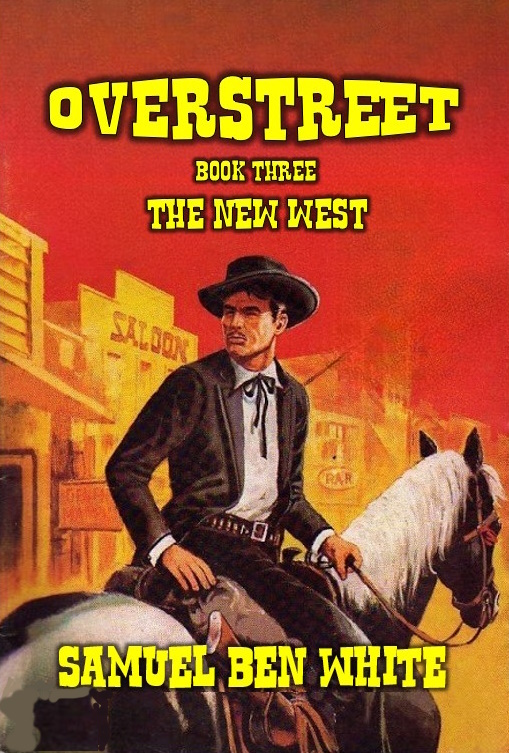
The New West – Overstreet book 3

The conclusion of the John Overstreet saga. The gunfighters are hanging up their guns, a new century is dawning, and a different kind of fight comes to the You’ll See. But one more gunfight is on the horizon for John Overstreet: the last gunfight.

Available in ebook (in many formats, including Apple) and paperback.

Reading Sample

“Aunt Melinda! Aunt Melinda!” Ben shouted as he ran up the road from town. He had run all the way and though he was about out of breath, he was long on enthusiasm and that was making the difference.
Afraid something was wrong, Melinda stepped out on the porch and was relieved that he seemed to be shouting it in a happy way. Still calling her name, he ran up onto the porch and into her arms, panting happily like a dog.
“What is it, Ben?”
He tried to tell her his news, but his wind had finally caught up with him (or left him, depending on how one looked at it) and all he could do was stand there and breathe heavily. He was a blonde-headed boy with his mother’s green eyes and his father’s good looks. A little more stout than his older brother, he was still good-sized for his age and becoming very athletic.
His real passion, though, was art. So he held up a piece of paper and managed, “Read this.”
Melinda took the paper and read, “‘Dear Mister Rathum, We are pleased to inform you that the drawing you submitted has been chosen as a finalist and will be on display in the Denver Museum of Art and is eligible for first prize in The Rocky Mountain News’ Young Artist Competition.’ Oh Ben, this is wonderful!” She gave him a hug, which he barely acknowledged as he took the paper back and read it again.
“Can we go see it? In the museum, I mean?”
“You bet we will!’ Melinda told him with another hug. “We’ll take the whole family. And we’ll be sure and let Jo and Leonard know, too.”
“Can I write them?”
“You sure can.”
“Can I tell Uncle John when he gets in?”
“Certainly.” Melinda laughed and added, “You might want to sit down and breath between now and then, though.”

“Uncle John!” Ben practically screamed as John rode into the ranch yard. “I’m a finalist!”
John got off his horse and, walking it to the Hayloft, asked, “A finalist for what?”
Ben quickly explained the commotion and showed John the paper. John read it and gave Ben a hug. “Aunt Melinda says we can go to Denver and see my picture in the museum.”
“You bet your life we will. Come on, let’s put my horse up, then we’ll go make some plans. Which picture was it?”
“That picture I drew of the Old Homestead with that special pencil you got me for Christmas.”
“That was a good picture.” He tousled Ben’s hair and added playfully, “Must’ve been the pencil.”

“And this drawing,” the tour guide explained, “Was drawn by a member of our very own tour group: Mister Benjamin Rathum of Como. Wave your hand, Ben.”
As Ben shyly stuck up his hand, the group of a couple score people clapped politely and several were heard to remark that it was amazing a child of his age could draw so well. He received several pats on the back and more than one vote of confidence that he would win the prize. Nervous beyond belief, Ben held tightly to John Mac’s hand and just nodded at all the compliments. If anyone noticed that Ben’s blonde hair didn’t seem to fit in with the black-haired family he was traveling with, they were polite enough not to say anything.
Everyone involved, including Ben, thought of him as part of the Overstreet family these days. John Mac followed him around the way Andrew and Emily followed John Mac around and John and Melinda treated him like one of their own. In return, he treated John and Melinda as if they were his parents. Almost from the moment he had come to live with them, there had been a bond of love that was so strong as to be unbelievable. But Ben was a very special boy, one bound to make a mark in the world if in no other way than all the people he would be kind to.
As the tour moved on, Melinda realized that Emily was about to fall asleep where she stood. Melinda whispered to John, “I’m just going to sit in that chair over there and snuggle Emily. She needs a nap and my feet are killing me.”
“We’ll come back and get you before we leave,” John whispered in return.
Melinda sat in a big, surprisingly comfortable chair, and Emily eagerly climbed into her lap. She had chattered on the whole train ride from Como and in the carriage from the train station to the museum and had worn herself out. And while she and Andrew were both giving up their naps as a general rule, Emily could still be persuaded to take one in her mother’s lap now and again.
As she sat there, Melinda found that she was almost tired enough to go to sleep herself. They had gotten up early, then all dressed in their best clothes so they could come straight to the museum, and the long day was suddenly catching up with her. Through half-focused eyes, Melinda absently watched the few other patrons who had elected to tour the museum sans a guide.
There was an elderly couple who talked happily about every picture; a college-aged looking young man who scrutinized every piece of art as if he were a world-renown art critic visiting the Louvre; and a middle-aged woman with fading blonde hair who stopped at every picture, examined the name plate then moved on without seeming to have seen the picture at all.
Melinda found herself watching the woman. She moved slowly, her feet almost dragging, as if she had walked to the museum from a great distance. Melinda had read of people who appeared to be “beaten down by life” and, while she had seen a few such people, this woman was the personification of the idea. Melinda couldn’t see her face, but she could see the slumped shoulders, the tired gait, the hands that reached out to every name plate as if for a life raft.
Melinda began to wonder about the woman and what her story might be. She tried not to stare at the woman—even though she guessed that the woman was oblivious to everything around her—but cast furtive glances her way in an attempt to, somehow, read the woman’s story. Suddenly, Melinda was very awake, but was also thankful that Emily was there. An inveterate people watcher, Melinda had spent many hours watching people while holding one or another of her children on the porch of the Como Hotel or the boardwalk on Rowe Street. She had even done it a few times in Denver and had always enjoyed it immensely for there were so many more people to watch.
The woman was wearing a traveling dress of impeccable style, which would have been incongruous with the picture she put forth except that it was still dusty from travel. In a world where the streets were mostly dirt and carriages mostly open, the dust wasn’t necessarily out-of-place. But the dress was so nice, Melinda realized that what looked odd was that normally someone with a dress like that wouldn’t have stepped out of their railway car without borrowing a brush from one of the porters and giving it a once-over.
The train? Melinda suddenly wondered why she thought this woman had just gotten off a train. She realized, with closer scrutiny, that it wasn’t just dust that clung to the woman’s dress but soot. That fine soot that Melinda had been so careful to brush off her own dress before coming over.
So what would posses a person who seemed so ill at ease with life to hop a train and come to a museum? Maybe, Melinda thought, she’s downtown for something else and stopped by the museum to kill time. There were a few lawyer’s offices nearby and the capitol building wasn’t all that far away.
No. She came to believe as she watched the woman (less and less furtively), that the woman was in the museum for a purpose. There was something in these pictures that she was looking for. What could it be?
No again. As Melinda watched the woman’s movements she realized that the woman was looking not at the pictures but the names. One of these pictures was done by someone that meant something to the woman. A grandchild perhaps? All the pictures in this room were done by children twelve years of age and under and it was unlikely that this woman could have a child in that range.
What is it about a grandchild’s picture that would so enthrall this woman, so entrance her that she would travel across country to see it?
The woman came then to Ben’s picture and stopped. She actually looked at the picture, and then put her hand on the name plate as if it and not the wall behind it were holding her up. She put her other hand to her heart as if to keep it from killing her, and just stared.
Just as Melinda began to shoot various scenarios through her mind to explain these events, she mumbled to herself, “Oh my!”

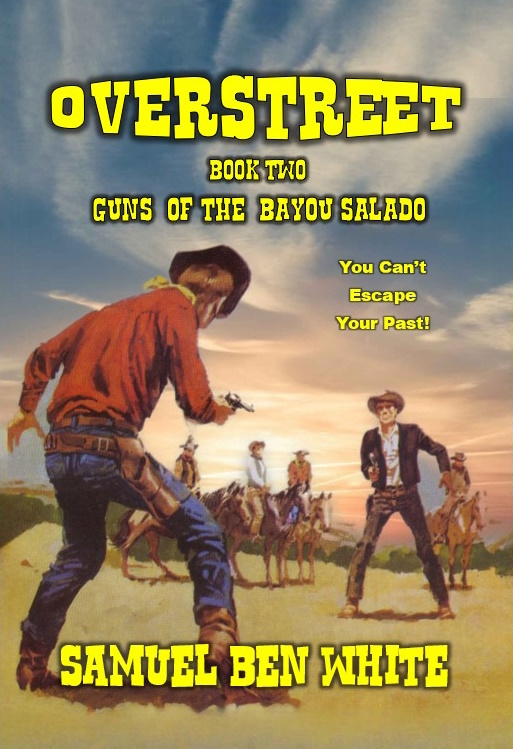
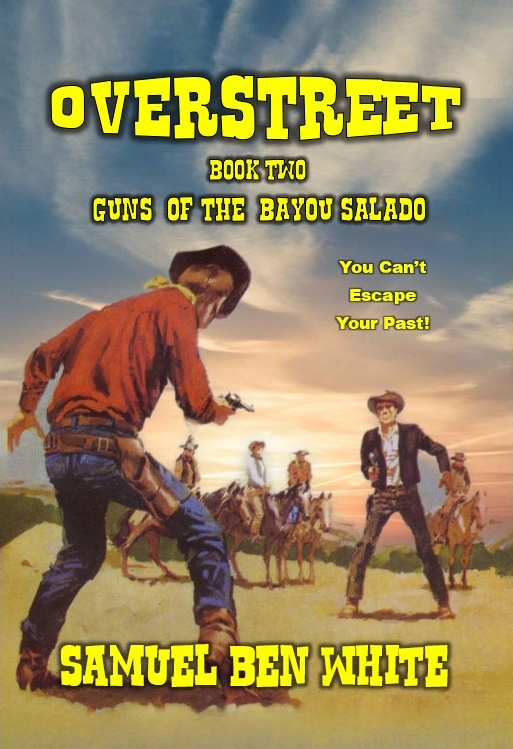
Guns of the Bayou Salado – Overstreet Book 2

Settled in the Colorado mountains and hoping his gunfighting days are over. John finds marriage and family to his liking, but he’s still hounded by the family of the man he killed in Texas.

Available for ebook (in many formats) and paperback.

Sample reading

It was late fall in eighteen eighty-six when Lydia Rathum discovered she was pregnant again. She and her husband David had been trying for two years and had almost begun to think that David Junior wasn’t going to get a sibling. But as the last of the aspen leaves was buried under a mound of snow, Doc Baker told them a new member of the clan would be born the next summer.
In the mean time, it looked like it was going to be a cold, long winter, but the You’ll See was prepared. John had worked out a deal with the Sundown Mining Company to mow hay in some pastures the mine held title to. It worked out well for the mine because it insured someone would be on their property, at least occasionally, and might possibly discourage claim jumpers. This hay, combined with what they had cut off their own eight hundred plus acres, would give the You’ll See more than enough fodder for the winter. John expected to have some left over, even. He thought if he could get ahead, then the next winter the ranch might be able to sell a little hay and make a bit of extra income. It would also foreshadow the produce that would one day be the Bayou Salado’s number one income.
He came out of the bank and instantly buttoned his coat one button higher and pulled the collar up as high as it would go. Comfort had won out over pride several winters before and he wore a fur-lined hat that kept his ears warm and would have gotten him laughed out of his old haunts in Texas. On his hands he wore gloves but the right glove had the fingers cut out even though his heavy coat would pretty much have prevented any sort of fast draw anyway. But, it was a habit more than anything and necessitated keeping that hand in his pocket all day to keep it warm. The upshot was that John became more than a fair hand at doing things left-handed. Beyond that, there were some jobs that were just easier to do with non-gloved fingers and this saved him the time of taking off his glove and then putting it on again later.
He was instantly alert when he heard footsteps coming rapidly up to him and turned to find Claud crunching through the snow. He, too, was dressed for warmth and had a muffler on so that all you could see of him were his eyes peeking out from under the hat brim. All the same, they showed through the gray air with that laughter Claud was always known for.
Claud caught up with John and they made their way to the restaurant of the hotel for a drink of something—anything—warm. Hunched against the snow, they tried to acknowledge the people they passed on the street but everyone was intent on getting to their destination before their respective blood froze. No one had any mind to take their hands out of the warmth of their coat pockets to shake hands—let alone wave. Perhaps it was such as this that caused all southerners to believe that all northerners were unfriendly. And caused all northerners to think all southerners were too gregarious.
There were two hotels in town at that time, the Pacific Hotel and the Como House. The Kelly family and the Coyne family also ran boarding houses, and there were a few other rooms to let about town, but only one building in town served the needs of the lodger and the diner so well as the Pacific Hotel.
The Hotel—as it would be called for as long as it stood—was a large red brick building with rooms on the second floor and a restaurant on the bottom. It stood so close to the railroad tracks that the dishes rattled if the train was going by at any speed but the front window had a breathtaking view of Borias Pass, Silver Heels and Little Baldy—only slightly cluttered by the foreground vision of Como.
The two men stomped the slush off their boots as they entered and hung up their coats and hats near the door. With a keen sense of the weather—or just a good grasp of the obvious—the hotel proprietor had installed about twice as many coat racks as a hotel that size would normally have. Feeling twenty pounds lighter, Claud and John went and sat where they had for years—in Maggie’s section, near the fire.
Annabeth came out and smiled. As she brought them cups and saucers, John asked, “Where’s Maggie?”
Annabeth seemed uncomfortable and looked around for a moment. She had only recently gone back to work at the hotel, and that only on an extremely limited part time basis during the busiest part of the day. She asked, nervously, “You haven’t heard?”
“Heard what?” Claud replied, answering for both of them.
Annabeth, her figure having become quite “motherly” following the birth of her third child, sat down and said, “She left.”
“Left? The restaurant?” Neither cowboy was comprehending.
“Left the state,” Annabeth told them. She rather enjoyed stringing people along in conversations like this. Everyone in town was now used to it and resigned themselves to long, somewhat confusing, conversations whenever talking to Annabeth. If not in the mood for such a thing, it was best just to avoid talking to her. It was said that she had all the makings of a fine politician, had women been encouraged to run. “She went to California.”
“I’ll be,” John mused, shaking his head and wishing Annabeth would bring them some coffee or hot tea.
“That’s all?” Annabeth demanded of him. She was shocked. She had expected her revelation to make a much bigger stir. She had been waiting all day to share the news with John Overstreet. “Don’t you want to know why?”
“It’s her business,” John pointed out. “And she’s a grown lady, so she can go wherever she wants. And in spite of what everyone in this town has thought for the last six years, Maggie isn’t my girl and never has been.”
“But you’ve sat here in her section every time you’ve come in for six years!” Annabeth objected. Everyone in the restaurant was paying close attention to the conversation because, after all, they couldn’t keep from hearing it. And most of them had been waiting for the last six years for John to ask Maggie out on a date, or maybe even marry her. It had never occurred to them that it might not happen. “And you sat by her at church every Sunday through seven different parsons. What were we supposed to think?”
“You’d have thought whatever you wanted to think, that’s what. A few people asked about it over the years—including you, Annabeth—and I always gave you the same story I’m telling now. Maggie was a friend of mine and that’s all,” John told her, trying to sound upset but finding it all amusing. When it was obvious that Annabeth was neither going to leave nor pour coffee John asked, “Why did she go to California?”
Annabeth leaned forward and said, “She got married.”
This did take John by surprise and he exclaimed, “Married? To who?”
“Never thought she’d do it, did you? Thought you could just string her along until you decided to marry her, didn’t you?”
“I thought nothing of the kind! Like I just said, she was a friend and nothing more! I never once thought of marrying her,” John contradicted. “I just want to know who she married!”
Annabeth waited a moment to build the tension, then said, “She married that drummer that comes through with the brushes.”
John said, more to upset Annabeth than anything, “Seemed like a nice fellow the time or two I met him. Sold me two of the best currying brushes I ever owned. I hope this doesn’t mean he won’t be coming back through here again. I could use another one.”
Annabeth threw up her hands in disgust and went to get their drinks. She poured Claud a cup of hot coffee and John took tea. He didn’t particularly care for either drink but he needed something to cut the chill. The drink was a joy if for no other reason than that it warmed up the icy bones in his fingers. He could live with the fact that, to him, all tea tasted like water with dirt in it. Once in Denver he had tried a cup of hot chocolate and had really liked that, but the one time he asked for it in Como he was told that it was a “kid’s drink” in a voice that said very clearly that the cook wasn’t going to bother making some up for an adult.
Claud looked at John and asked, “You really don’t mind that Maggie ran off with someone else?”
John thought a minute, then shook his head, “No I don’t. She was a good friend, and that’s all. I hope she’s found a good man. What I knew of that Fuller guy, he seemed like stable stock. Wonder if she’ll travel with him or if he’ll stay on the road or what?”
Claud poured some of his coffee into the saucer, blew on it to cool it off, then poured it back into the cup. John watched the whole operation and shook his head because the only attractive thing he had ever been able to find about coffee was the heat. So, why order coffee then cool it off?
After taking a few sips, Claud ventured cautiously, “Still waiting for that one woman?”
John merely nodded and continued with his tea. It tasted like dirty branch water, but it was warm and left a good feeling in him as it went down—if a lousy taste in his mouth. After it was done with, he told himself, he’d go over to Carman’s and get a licorice whip to wash the taste away. Of course, just about anything would leave a better after-taste than tea, he mused, and not for the first time. He wondered if they’d serve him just a cup of hot water, but then he figured that wouldn’t taste any good, either.
“You really think she’s out there?” Claud asked in all seriousness.
John nodded again and said, “She’s out there. I just ain’t found her yet. But I will.”
“You sure don’t seem to be doing any searching.”
John turned and smiled at Claud, “What about you?”
“What about me?” Claud was completely off guard.
“What about you? You’re twenty-three years old. That’s marrying age anywhere you go. That’s past marrying age in some places. If you were a woman and unmarried at twenty-three, people’d be calling you a spinster. Why don’t you have a girl?”
Claud shrugged and—after a moment—replied, “She got away.”
“Huh?” John had never heard Claud even mention being interested in a girl. And he had known him since the young cowboy was sixteen. John was sure Claud hadn’t been keeping steady company with anyone since coming to work for the You’ll See and had never mentioned any woman from before then—other than his father’s wives, who he talked about with disgust often.
When Claud didn’t answer, John asked, “Who? I never heard you mention anyone.”
Claud was obviously uncomfortable, but he said, “I never told no one.”
“Did you tell her?”
Claud shook his head and it was obvious that this was what troubled him the most. “When I met her I was too young and unsure of myself. Used to watch her and tell myself I was going to talk to her, tell her how I felt, but I never did. I’d always tell myself there’d be a next time. By the time I thought about saying something, it was too late.”
“Too late?”
“She found someone else,” Claud explained.
It was clear that was all he intended to say on the subject, but John added consolingly, “Well, you know what they say: ‘There’s other fish in the sea.'”
“Not for me,” Claud replied. “Your woman is out there somewhere. I know where mine is, but she’s not for me.” He hastily gulped down the last of his coffee and stood up. “I’m heading back. You coming?”
“Not yet. I need to go by the general store and pick up some things. I’m all out of shaving soap.”
Claud nodded and left. John was curious to know who the woman was but enough of a respecter of persons not to bring it up again. And being that he knew Claud better than anyone around, there wouldn’t be any sense to asking anyone else.
He sat back in his chair and studied on it for a moment. Claud had sat by a woman or two in church over the years; had danced with a few at barn-raisings and socials; and had even called on one or two of the young ladies in town. They had talked about it afterward, but Claud had always seemed profoundly disinterested in most of them. Or had he? Had Claud hidden his feelings about one of them? No, that didn’t make sense. If he had the nerve to ask a girl to a dance, he’d have had the nerve to tell her how he felt.
So what were they talking about? Was Claud still “holding a torch” for someone he knew back when he was fourteen or fifteen? Was that maybe the real reason he had drifted east to Colorado? John had heard that those Mormon men sometimes took young wives. Maybe Claud’s love had married someone else when she was just thirteen or fourteen and he just couldn’t stay around and watch.
Shrugging, John stood up, left a quarter on the table for Annabeth, and walked over to get his wraps and head into the cold.

Niles Carman, a young man who was tall but skinny as a rail, was running the store when John came in. John placed his order and was looking at an old newspaper as the kid filled it. Of course, he wasn’t really a kid anymore but his face looked it even if his height didn’t. John couldn’t believe the little boy he used to know was old enough to be running the store now, but the kid seemed to be doing a good job. And his father was never far away. Probably down at the Allen Saloon, John suspected.
“You hear who’s in town?” Niles called over his shoulder from the back room.
“Nope.”
“Alvis McClory,” Niles proclaimed. He added proudly, “And I met him.”
“You don’t say,” John replied absently. When he had finished the paragraph he was reading, he looked up with more interest and asked, “What’s he doing in Como?”
“Who?” Niles asked, toting up John’s order and not paying much attention to the conversation he had initiated himself.
“McClory!”
“Don’t rightly know. Some folks say he’s speculating in gold or coal or suchlike. My Pa’s thinking maybe he’s up here to meet with Tabor—over at Leadville. Maybe he came here so’s people wouldn’t know about it and make a big deal out of it. Them high-powered people like that stick together, it seems. Others say he’s here just because of his wife.”
“His wife?”
John had heard much about Alvis McClory. Mentioned in the same breath with Silver Dollar Tabor and Jay Gould, he was a high-powered cattle man from Texas who had made money in every venture known to man, it seemed. And rumor had it he was always looking for something new to invest in. John knew how often he was “hit up” by people who wanted the You’ll See to invest in one crackpot scheme or another, so he couldn’t imagine how many lunatics hung around a legitimate baron like Alvis McClory.
No one knew his exact worth, it was said, but it was estimated at several million dollars. He even owned land in Australia, South America and Africa, according to some people. But in all the talk, John had never heard talk of his wife—never even thought to wonder if he had one. Come to think of it, John mused, I never even heard tell of him having family. But then, what did he know about any of the names? He was pretty sure Tabor and Gould were married, but he had no idea of their wives’ names or if they had any kids.
“Yeah,” Niles told him, carrying a bag of items he had put together. “They say she’s been all over the west looking for her brother for nigh onto fifteen years. She ain’t seen him in a long time, I hear.”
“Must be an understanding husband to fund such an endeavor. Fifteen years of travelling is a long time.”
“Oh, they ain’t been married but about seven years. And what does he care about travel? If he sees a place he likes, he can buy it. Lute, over at the masonry, he told me they were in Terlingua looking for her brother and he happened across an abandoned silver mine. McClory bought it and hit pay-dirt a week later.”
“Terlingua?” John mused. “I’ve been there. Punched cattle down that way for a while. It’s part of the Big Bend area. So many holes in the ground it looks like a giant walked through with those spiked boots some of the miners wear. Wonder why Terlingua? Where else have they been?”
“Shoot, you name it and they’ve been there. Sounds like they spent most of their time in Texas looking. ‘Course, that’s where she’s from. You know Texas, don’t you?”
John laughed and said, “I should smile. I grew up there. Probably been everywhere they’ve been—in Texas, anyway. Never got down to The Valley, though. Always wanted to, but the closest I ever got was down in the Big Thicket. Seems like ever’ time I’d think about going to the Valley, something else would come up.”
“Well then, maybe you could help them. They told me where all they had been looking but the names didn’t mean nothing to me. Me never being in Texas in my life, and all. But she seems powerful anxious to find her brother and that Alvis, he dotes on her and would buy her the moon if she asked for it. You help her find her brother, there’d probably be money in it for you—not that you need it,” Niles quickly added with embarrassment.
Curious, John asked again, “Where all did they say they’d been?”
“Said they started in that Big Thicket you just mentioned; I reckon that’s in East Texas from what they said. Said they lost her brother’s trail for a while but got a tip that someone who looked a lot like him was seen down in the Big Bend area. That’s when they went to Terlingua. After that, they say he drifted north and they’ve only heard rumors.”
“That’s odd. I was in those places. If her brother was there, I probably would have met him.” John took a licorice whip from the jar and began to chew on it. Pulling out a few coins to pay for his purchases he wondered, “They think he might have come up here?”
“They aren’t sure.”
“How is it that you know all this, Niles?”
“Oh, they came in here right after they got off the train. Alvis was right where you’re standing—wearing some suspenders with buckles on ’em that I bet were real gold. And his wife was asking my pa a few questions. She’s a right handsome woman, too. Probably forty, but she’s got thick black hair and carries herself like a real lady. I heard her describe what her brother used to look like, but it didn’t sound like anyone I knew—no one particular, anyway. She hadn’t seen him in a long time, o’ course, but she said he used to be a skinny, gangly kid. Said he had mousie brown hair and blue eyes. That could be a lot of people.”
“She give a name?”
“Yeah. But there ain’t nobody in the South Park Valley by that name. Pa said he’d never met anyone by that name, anyway. And I know I never heard of anyone by that name.”
“So what was it?”
Niles shrugged and answered, “James Conley.”
John blanched white and nearly dropped the sack he was holding. He asked Niles quickly, “Where are they, now?”
“Huh?”
“Where’d they go from here?” John demanded sharply.
Niles seemed taken aback by the abrupt change but he finally replied, “Up the street—to Judge Stoner’s house. Him and Alvis got the same friends, or something like that. You know what I said about rich folks. They stick together.”
John put the sack down and started quickly for the door. Niles called out, “Hey! Don’t you want to take these with you?”
“I’ll be back—or send ’em out to the ranch with Claud or Cleave if you see one of them,” John called as he shut the door behind him and took off running through the snow.

John knew it wasn’t a good idea to get worked up in such cold weather because a man’s sweat will freeze and form a thin layer of ice inside his clothing. When that happens, the body’s temperature can start dropping rapidly and the result can be frostbite or pneumonia—often leading to death.
But it was a short distance to the Judge’s house and John was clomping up onto the porch in a matter of seconds, heedless of everything except getting there. His breath was coming fast even before he started running and was coming in great, heaving gasps by the time he was mounting the steps. The porch had been freshly swept, but you wouldn’t have known it after John arrived. He took no notice of the mess he was making and knocked loudly on the door.
After a moment, Stoner opened the door and seemed surprised to see John standing there. Through the screen, Stoner said, “I have company right now, John. Could you come back—”
He never finished because John was pushing his way past and into the living room. Ignoring Stoner’s blustering, John walked into the midst of a fairly formal tea comprised of the McClorys, the Bakers and the Stoners.
Everyone looked up and Mrs. Stoner was about to object to the rude intrusion when John looked Mrs. McClory in the eye and said, “You finally came back, huh? You sure took your sweet time about it!”
All the tea partiers were aghast at his bold entry and insolent behavior—especially coming from a normally respectable young man. All took grave exception and made various blustering noises much like the Judge’s, except Mrs. McClory, that is.
She calmly set her tea cup and saucer aside and rose gracefully. She looked at John for a moment, as if studying him from head to foot, front to back and inside out, then asked softly, “James?”
John shook his head and told her, “I stopped being James Conley fourteen years ago. I buried that little boy in the swamps a long time ago, Clarice.”
Most everyone in the parlor was speechless but Clarice McClory seemed undaunted. She took a step closer and said, “I was afraid you’d feel that way, James.”
“It’s John,” he corrected. “My name is John Overstreet now.” He took a step back and said, “I’ve been John longer than I was James.”
Clarice hung her head for a moment and, when she looked up, there was a tear in her eye. Taking another tentative step, she told him, “You’re right, John. To feel the way you do, I mean.”
“Sure I’m right!” he retorted. “I was an orphan and you—my only blood kin I knew how to locate—you never came when I wrote for you.”
Coming closer, she said, “John, we have a lot to talk out.”
Angrily, he told her, “I have nothing to talk about to you. You ran out on Ma and Pa and then you ran out on me.”
“You’re my brother—”
“No!” John shook his head. “I am not your brother. You lost all right to make that claim fifteen years ago! You were James Conley’s sister but you’re not mine!”
Before she could say anything else, John turned for the door. As he left, he muttered to Judge Stoner, “Sorry to interrupt.”
For possibly the first time in his life, Judge Stoner was speechless.

When morning came the snow had stopped falling but it had left its mark on the land. Everything that hadn’t already been buried was now covered in such a pristine whiteness that John hated to spoil it by walking on it. Still, there were things that needed to be done and he knew he had best be about it. A few moments of walking in the snow had changed his attitude from one of appreciating the beauty to cursing it.
Dressed as warmly as the day before, and covering his face with the scarf Amelia had knitted for him years ago, he set out for the north pasture to help Bob Vernor. The stock tank they had built at the end of a small stream in the north pasture had proved to be a good water source but it was out in the open and not especially deep so it froze over quickly. So John could expect to spend most of the morning chipping a hole through the ice for the horses to drink through. A horse can break a thin layer of ice with its nose, but it will shy away from something as thick as the ice on that pond regularly got. Had they been so inclined—and not needed the ice for more important things—it would have been a good place to go ice skating.
As they were cutting the hole, they looked up to watch the train come by, less than a hundred yards away. It was making pretty good time through the fresh snow in the valley, but Bob remarked, “Bet that’s going to be a long trip over the Pass. They usually get a good half foot more than we do down here—sometimes better than that.”
“I bet,” John replied. He had worked up enough body heat that he had shed the scarf and one layer of clothing. He knew not to shed any more or complications could arise. “I’ve seen ’em stop running in better weather than this.”
“You ever been over the Pass in the winter?”
John nodded and Bob mused, “Something, isn’t it? The way they get that snow-plow engine up there and cut through what looks like an impenetrable wall. They keep the snow plow in that new roundhouse they got down there—””
“‘Impenetrable’?” John laughed, having missed the last part of Bob’s talk after being surprised by the big word.
Bob shrugged sheepishly and replied, “I guess that’s what happens when you have a daughter in college. She uses words I never heard of before—and I’ve been around animals all my life—and went to school myself.”
“What do you mean by that?”
“Well, when she told me she was studying to be a veterinarian I figured I’d know what she was talking about. I mean, I’ve doctored animals and birthed ’em and done just about all you can do with one.”
“Any chance we could get her to come back here?” John asked. “I mean, when she graduates. We sure could use a good vet. The more the coal and gold business dies up here, the more popular cattle and horses are going to be. A veterinarian could pull in a good living up here.”
“I’ve mentioned it to her, but she’s kind of liking the east right now. I think, though, when she tries to find a job she’s going to find out how hard it is for a woman to get a man’s job. Out here, we mostly just care whether a person does a good job or not. Besides, everybody out here already knows her and would be happy to throw her business.” He hesitated, then added, “And there’s still a lot of folks that wouldn’t go to a black veterinarian, even if he was a man.”
“People are stupid,” John commented.
“That’s a bit harsh, ain’t it?”
“Well, I mean,” John thought for a moment, “I mean individuals, they can be pretty smart. But get a bunch of us together and suddenly we’re stupid. There’s a lot of good white men who fought right alongside a black man during the war, but he gets back among a group of white men and forgets everything he learned. Me, I call that stupid.”
“It goes both ways. I know some black folks that think every white man’s a slaver. They’re so convinced that opportunity is never going to come their way, they don’t realize it when it does.”
John nodded and commented, “I figure anybody that can do a job ought to do it. I knew a man back in Presidio that could sew like you wouldn’t believe. Big, husky guy, too. Big ol’ hands. Looked like he ought to be swinging a sledge hammer or managing a big team of horses. But he made pretty quilts—and even dresses. Pulled in a good wage for it, too. I figure a person ought to do what they do best.”
Bob nodded and went back to chipping away at the ice. Just making conversation, he said, “They ever decide what to do about those bodies over to the King No. One Mine?”
“Just leave ’em, I hear,” John shrugged.
“That’s terrible,” Bob remarked, shaking his head. “I don’t care if they was Chinamen, when thirty-five men die in a mine explosion I think something ought to be done about it.”
John pointed out, “Doesn’t make a lot of sense to dig ’em up just to bury ’em again.”
Bob nodded, but added, “Still, I hear they’re planning on going ahead with working the other seven levels this summer. I ain’t a superstitious man by nature, but I’d sure hate to work knowing there was thirty-five men buried. Buried above me. Be like working in someone else’s grave.”
“I know what you mean. I understand that the work’s got to go on, I guess. Does seem like they could put up a marker or something—maybe one that lists all their names.”
“I bet there ain’t anyone in the management that knows all thirty-five names.”
John nodded, then said, “They could find out—”
“If they wanted to,” Bob nodded.
The sound of the train had not completely died away when they heard another sound. It was the sound of bells and it stopped the talk of graves and mine disasters short.
“Little early for Santy Claus, ain’t it?” John quipped.
Bob watched as the source of the sound came from behind the trees. “It’s a sled,” he remarked. It was driving on the right of way and looked to contain two people, a man and a woman.
John knew immediately who they were. When Bob saw that John was upset, he asked who it was. John mumbled something under his breath and replied, “It’s my sister.”
“I didn’t know you had a sister.”
John shrugged and told him, “For a long time I didn’t think I did, either. And now I ain’t sure I want a sister.”
The sleigh pulled up near the pond and Alvis helped his wife down. She was bundled up like an Eskimo and moving about was no easy task. She maintained her characteristic grace, though. To John, the grace just irritated him, and he wasn’t sure he wanted to put voice to why.
“Hello John,” she offered cordially.
With no feeling in his voice, he replied, “Howdy.”
Undaunted, she continued, “John, you didn’t meet my husband yesterday. This is Alvis McClory.”
“Pleased to meet you,” John told him, though he seemed more indifferent than pleased. He introduced Bob and they all shook hands. “I’ve heard a lot about you,” John said to Alvis.
“Good, I hope,” Alvis laughed, an affected laugh but a well-intended one, nonetheless.
Bob excused himself and headed for the barn. The icy breath was only the first clue he saw that made him not want to be around this little family discussion. John’s breath wasn’t as icy as his attitude. Bob knew John well enough to respect his feelings in any matter, but also knew that families had a way of bringing out the best and the worst in any man. Besides, between the snow and the high altitude, he could hear whatever was said from the barn anyway.
Clarice said, trying to put as much warmth into her voice as possible, “We saw one of your hands in town. Cleave, I believe it was. He said you’d be out here.”
“Thanks, Cleave,” John muttered.
Clarice looked around and said with admiration, “This sure is a beautiful place you own, John.” The mountains were covered in snow and it really was a wonderland—especially to someone from the flatlands of Texas.
“Part owner,” John corrected her. “I only own a third.”
Alvis, speaking for the first time, said, “But the people I’ve talked to in town say you’re the driving force behind this ranch. They say without you the You’ll See would have been sold and broken up years ago.”
“I doubt that. Whose to say what might have been?”
“How much land do you have here?” Alvis asked.
“About eight hundred and sixty acres. ‘Course, some of it’s not good for anything because it’s on the side of that mountain, yonder. Couldn’t raise horses there unless they all had shorter legs on one side than the other.”
“You own your own mountain?” Clarice asked in amazement.
“Mostly, yeah. There’s some mining claims on the far side but no body works them anymore. Dry hole, as they say. Odd how one mountain’ll have gold and the one next to it won’t.” He took his pick and began knocking holes in the ice. “So, what did you come out here for?”
“We need to talk,” Clarice replied seriously.
“‘Bout what?”
She sighed heavily, then began, “I need to apologize.”
He looked up at her, then went back to picking away. The hole was actually big enough by now, but he needed something to do. Something other than look at her because she was looking really sincere and he was afraid he would forget what she had done and start believing her.
Continuing, “You never knew why I ran away, did you?” He shook his head, so she continued, “I ran away because of our father.”
John didn’t look up, but the painful memories came back. He remembered their father coming home in a drunken stupor and taking them to task for everything. John himself, or James, rather, had taken more than a few beatings. And he had watched in horror as his father beat their mother.
“I put up with it as long as I could, John. Mother always told me he didn’t mean it and that he would change one day. And when he sobered up, he’d come to me and cry and beg my forgiveness. When I got about fourteen I was big enough to fight him off. Or at least fast enough to get away. And he wasn’t a strong man; he was a weak, sniveling coward. Maybe that’s why he acted like he did. He couldn’t prove himself a man to anyone else, so he did it to us—the only way he knew how.” She shook her head of the line of thought and added, “He laid off me then.
“I moved to Fort Worth when I turned eighteen. Do you remember that? You were so little.”
John nodded and said, “I remember you coming back and visiting Ma and me from time to time. I always thought it was coincidence that you never came while Pa was there.”
She shook her head, “I planned it that way. I couldn’t bear to see him. And I hated the thought of what he was probably doing to you. I tried to talk Mother into leaving, but she never would. She believed she should stay with him no matter what. She always said he didn’t mean it, that he really loved us. I never could convince her otherwise.
“But I made a mistake when I was twenty-five. I came home thinking I was old enough to deal with … Father. But I got there late one night and he was drunk when I got there. He—he had this strange look in his eyes. He started yelling at me, calling me all sorts of foul names, and he hit me. He knocked me down and then jumped on me. I thought he was going to beat me, like he used to, but he was trying to rape me. I cried out but you and Mother weren’t there. He just laughed.”
She paused, short of breath, then continued, “When he tore my blouse, something went off inside my head. I had more strength than I had ever felt before—and, like I said, he wasn’t all that strong. I threw him off and ran. I got on my horse and left.”
“That was the last time I ever saw you, wasn’t it?” John asked. “You came by the Andrews place where Ma and I were staying. I heard you tell Ma something like, ‘He’ll never do that again,’ but I didn’t know what you were talking about. I never saw Pa again. Then Ma went off to Fort Worth for a while and left me with the Andrews. When she came back, she looked old and worn—like she was ten years older than when she left. She died about two weeks after she got back. And I never could find you—or anybody.”
With difficulty, Clarice told him, “We wanted it that way.” Before John could object, she said, “I know now it was wrong. But I didn’t know it at the time. It’s time for you to know the truth. We’ve hidden it from you for too long. I’m surprised you never found out on your own.”
“Found out what?” He was completely surprised that there was, apparently, a secret behind all that had happened. He had just assumed everyone had left him and had been so mad at them that he’d never checked into it.
After another deep breath, Clarice related, “I left the Andrews place that night and caught a train for Houston. Charlie lived there. You never knew him that well, did you?”
John shook his head and tried to remember his older brother. He was two years younger than Clarice, but he ran away from home at the age of ten, two years before John was born. Charlie was just a picture on his mother’s dresser. “I never met him but once,” John told her. “He came by one night when I was about seven. Talked to Ma a while about something, then left again.”
This seemed to make her cry, but she took a moment and composed herself. She told, “I found Charlie working in a buggy shop in Houston. I had heard Ma talk about him being somewhere down there and he wasn’t really hard to find. I told him what had happened and—and I told him what I wanted to do. He hated Father more than I did and the wounds had festered in the years since he left. He blamed Father for everything that had ever gone wrong in his life—and maybe he had a right to. I can’t say anymore. But even at ten years old, he had run away because of Father. It takes a lot for a ten year old to run away and not come back.”
She took another deep breath and said, quickly, as if saying it slow she might not get it out, “John, we went back and killed Father a week later.”
John was shocked, and a little disbelieving. “Ma told me he just went off one day and didn’t come back.”
Clarice shook her head. “That’s what we wanted you to think. We thought you were too young to know all the awful truth. But Charlie and I both shot Father. We used his gun and we each put a bullet in him. Then we went and turned ourselves in.”
“You could have run,” John told her, even though he didn’t agree.
“Yes, we could have. But we decided on the trip from Houston that we wouldn’t. We decided that even prison or hanging would be better than a life with Father. In some weird perception of morality, we decided ahead of time to take our consequences. We were young and foolish. Murder is not a solution. To anything.
“The trial was in Fort Worth. That’s why Mother was gone that long time. It wasn’t much of a trial, since we had already confessed, but they had to decide on sentence. The judge said we had reason to kill our father, but he couldn’t condone murder. He sentenced us both to five years in prison. When the story came out in the papers of what our father had been like, the judge’s decision was a very popular one. Justice with leniency, they said. It was then I found out he was up for reelection. He probably should have given us a lot more time.”
“So you got out, met Mister McClory here some time later, and started looking for me. Is that it?” he said, still a little disbelievingly. It was all too pat.
She nodded. “That’s it. Alvis has been so wonderful.”
“How did you meet?” The side of him that was still wanting her to leave and never come back was doing battle with the side that wanted to have a sister again.
“I was working in a diner in Austin, trying to decide what to do with my life when he came in. Started eating there regularly.”
Alvis added, with a smile, “I asked her out a dozen times before she even gave me the time of day.”
“Even when I went out with him—to a church social there in Austin—I thought about hiding the past from him. I made up a dozen stories in my head that morning before he picked me up. But, I couldn’t. Then the preacher talked about how people need to be honest with each other and I thought he was talking right to me. So right at the social, while we sat there under a live oak, I told him about Father and prison and everything.”
“And it was more than I could handle,” Alvis said, with shame on his face. “I took her home with the intention of never seeing her again. I kept thinking of my family and everything.”
“So what happened?” John asked, genuinely curious.
Alvis smiled at Clarice and said, “I kept thinking about her. I finally decided to swallow my pride and see her again. Family and pride be damned.”
Clarice smiled, “I didn’t even know he felt this way because he was back in the diner on Monday asking me to go out again.”
“It was a long Sunday night,” Alvis laughed, with more than a little embarrassment.
“But we went out and didn’t speak of prison again until after we were married.” She took her husband’s hand, smiled at him, and said, “Not only did he risk his social position by marrying a convicted murderer, but he has used his fortune and influence to help me find you.”
“Why look?” John asked. “After all this time, why look? You must not have even known whether I were alive or not. ‘Specially since I wasn’t going by the name of James Conley, anymore.”
“I had to let you know the truth. And I had to make sure you were all right. I never stopped thinking about you Ja—John. Ma was pretty worn out when you came along. I raised you almost as much as she did. When I left and went to Fort Worth, it was almost like leaving my own baby behind—you’ve got to believe me.” She breathed a sigh of relief and asked, to lighten the mood, “Where did the name come from?”
He laughed and said, “After Ma died, and I couldn’t get a hold of you, I hooked up with a trail drive to Kansas. Up there, I heard singing one Sunday and I asked somebody where the church was. Fellow told me, ‘It’s over a street.’ I got there and the preacher was preaching from the book of John. I decided I didn’t want to be James Conley anymore, so when the preacher asked me what my name was after the service, I just told him John Overstreet. I guess it’s kind of silly, but it’s the only name I feel at home with anymore. Kind of got used to it.”
Alvis laughed and, speaking up for the first time in a while, said, “Ah, the many times I’ve wished for a name other than ‘Alvis.’ Many’s the time I came home from school near tears from the sport my name had been made of.”
“So I guess instead of changing your name, you turned your name into something big, huh?”
“I guess so; though, that was never my intention. I just have a good history of being in the right place at the right time. Some people say there is no such thing as luck—I know differently.”
John turned back to Clarice and asked, “Whatever happened to Charlie?”
She hesitated a moment, then said, “He died last year. Tuberculosis. He lived his last few years in Arizona and it was only the climate out there that allowed him to live as long as he did.” With a smile, she added, “He owned a buggy shop which his sons will take over one day. We hold it in trust for him for now.”
“I’ll have to go look ’em up one day. Nephews,” he laughed with a rueful shake of the head as, after so many years alone, he suddenly had a really big family. He paused, then asked, “Whatever happened to Reuben?”
John just barely remembered Reuben. Five years his senior, Reuben, too, had run away from home at age ten. Even when home, Reuben had been an outdoors type of kid and had rarely been at home. “He would be thirty-one now, wouldn’t he?”
Clarice smiled and said, “You’re not going to believe this, but we just saw him. He manages a hotel in Leadville for Silver Dollar Tabor.”
“Leadville?” John asked with disbelief. “He’s that close? How long has he been there?”
“About eleven years.”
John turned and looked at the majestic mountains around and smiled. He laughed and said, “This is too strange. I’ve been all alone for so long, I don’t know what to do with a family. Now I find that I have a brother, a sister and two nephews.”
“Six nephews, four nieces,” Clarice corrected.
“What?”
“Charlie had two boys. Reuben has three boys and a girl. Alvis and I have one boy and three girls.”
John took a moment to let it soak in, then asked, “Where are they? Your children, I mean?”
“With my mother,” Alvis replied. “They needed to stay in school, so my mother and father are watching them.”
Sheepishly, John requested, “When school’s out, could you bring them out here to see me?” Before they could answer, he said, “Why don’t I just have you and Reuben and Charlie’s family and everybody out here to the ranch next summer?”
“Better yet,” Clarice suggested, “Why don’t we all meet at Reuben’s hotel?”
John looked at Clarice and said, “You know something we have to do, first, though?”
“What?”
He smiled widely and told her, “I’ve got a sister I haven’t seen in fourteen years and I haven’t gotten to kiss her, yet.”
They embraced and it seemed like fourteen years of separation melted away forever.

“So this is where you live?” Clarice asked, trying not to let too much into her voice.
John knew what she was seeing: a simple cabin. He had swept it and picked up anything lying loose, but it wasn’t much to look at. And being winter, it smelled like a shut-up man’s cabin. “This is it,” he told her.
“How will you even a bring a woman here? You do want to bring a woman here, don’t you?”
John smiled and replied, “If you’re asking do I want to get married, the answer is yes. And if your next question is whether I’m seeing someone, the answer is no. I just ain’t met her yet.”
Clarice reached out and touched the few books that sat on a shelf and asked, “Have you read these?”
John stepped over and said, “Just the Bible there. I read a lot, ‘specially in winter, but then I trade off what I’ve finished. I’m about a third of the way through Meriwether Lewis there. Haven’t started on that Dickens or Mister Douglass’s book. My friend Bob loaned me that one, so I reckon I’ll read it next.”
“You were an early reader,” she commented, wistfully but happily. “It provided you something of an escape, didn’t it?”
“I ‘spect so.”
Clarice turned and looked at her little brother, now so much taller than she, and asked, “How did you get here?”
“You must know some of it, or you wouldn’t have followed me to Terlingua and up here.”
“You were in Terlingua?” she asked in surprise. “I have just been everywhere with Arlis. And everywhere we went, I asked about you. I’ve never had any clue I was close to you until you burst into the judge’s parlor the other day.”
“Really? That’s something!”
“Tell me,” she prompted. “Please?”
He smiled again and said, “I’m not reluctant. I’m just trying to remember.” He bade her sit on his lone chair, then took a seat on his bed. He thought back and said, “I stayed with the Andrews until Ma came back. After she died, I heard about some fellows that were rounding up wild cattle down in the big thicket. I made my way there and lied about my age. I don’t know that they believed me, but they were hard enough up for help that they took me on. Learned how to be a cowboy.
“Helped them take a herd up to Kansas. That was when I met that preacher—Peter Oberson was his name. He was trying to start a school there, so I took from him for a while. But then he got fired over something, so we drifted down to Texas. He started preaching at this Campbellite church in Haskell and teaching school on the side. I took from him when I could, but I was hired on with a local ranch run by a fellow named Shook. Took his herd to Dodge when I was just short of fifteen—”
“Seriously?”
John nodded deferentially and said, “I was the only one that knew the trail. Couple of the other hands weren’t no more than twelve. We got back and that church was going some good. Peter, he was forever trying to talk me into going into the ministry. I believed in it all, but just didn’t think that was for me.
“I got a chance to ride with some fellows down to the Big Bend area to take a string of horses to a ranch down there owned by the brother of one of our church members. I went, figuring to just be gone for a couple months or so. Got wounded in a bank hold-up—no, Sis, I wasn’t robbing the bank I was trying to stop the hold-up. That put me out of commission for a couple months, then I rode for a ranch over to Presidio for a while. I was writing letters to Peter, and he was writing back.
“But then one day I got into a scrape in Presidio. The law said I was in the right, but I was just thinking that neck of the woods—which had no woods—was unlucky and decided to head back to Haskell.” He paused, then said, “Got back in time to see Peter just before he died.”
“He died?”
“Consumption. I never knowed he had it. I knew he coughed some, but he would always just say it was allergies. The church near ‘bout fell apart then. I wanted to help, but I didn’t know how. Wound up riding for a ranch about sixty miles north of Haskell. Got into another scrape and headed up here, on account of the man I had killed had him some mean brothers and a father that knew nothing but grudges. Caught on with the You’ll See and been here ever’ since.”
Clarice had looked for the last few minutes as if something were on her mind then she started mumbling, “Terlingua, Presidio, Haskell … are you the Haskell Kid?”
John blushed and finally replied, “Well, yes.”
“Then you’re a gunfighter?” she asked with alarm. “They say you’ve killed twenty men!”
The look of horror on her face made him ashamed even as he said, “Five. I have killed five, and all in defense of either myself or someone else.” He knelt before her and said, “I never set out to be a gunfighter, Sis. I’ve just been … where things were happening.”
“But how—” She put her hands on his shoulders and said, “No. I will not—” She looked down, then back up at him and said, “There will be time, perhaps, someday. For now, I am just going to be thankful I have my brother back.” She pulled him into a hug and whispered, “Both our lives have been darker than maybe they should have been. But, well, that’s what it’s been.”
As he held her, he said, “Someday, maybe we’ll tell each other our stories—in all their detail. Right now, I’m just thankful I have a sister … again.”