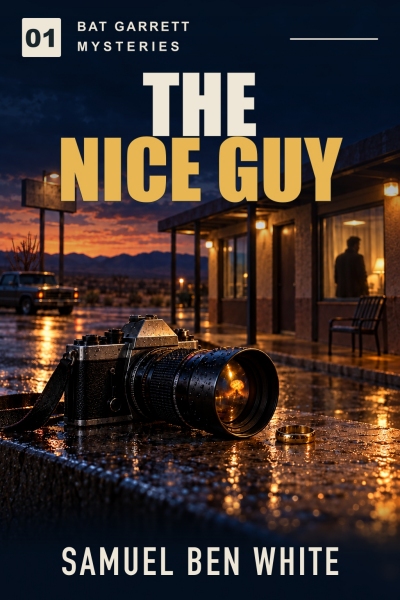
Bat Garrett has spent two years photographing cheating spouses and waiting for a case that matters. Then a secretive government agency sends the young Dallas private eye across the Southwest with reluctant operative Jody Anderson – legally married for cover and unsure whether they can trust each other.
Routine surveillance turns into an explosion, gunfire, missing records, and equipment that fails at suspiciously useful moments. The official reports never match what Bat and Jody witnessed.
Bat wanted to become an agent. To get them both home, he must remain an investigator – and determine whether their target is really the greatest danger in the operation.
Angela Carroll knows who murdered her husband. Texas found him, tried him, convicted him, and put him in prison.
She would still like to know why.
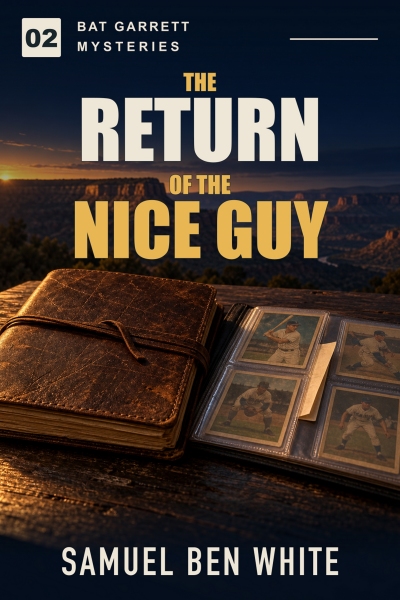
The official motive is robbery. The convicted man claims innocence. Conrad’s former colleagues offer several incompatible versions of the man he was. Bat Garrett accepts the case because unanswered questions rarely improve with age.
Journals with missing pages and a valueless baseball-card album point Bat and Jody toward an old dispute – and records that vanish as soon as they become useful. The courts have finished with the murder. Somebody else has not.
Franklin Gaston has one daughter, a dead wife, a dead brother, and no known enemy. After he is murdered, every part of that family history begins to break apart.
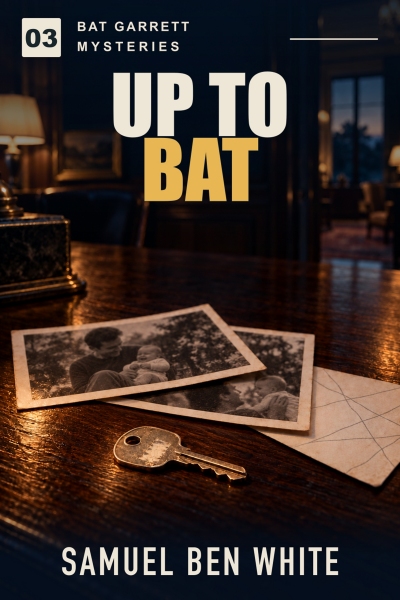
Telephone records reveal another household in Colorado. A bank key hidden beneath a carpet opens a box under an alias. Inside are photographs connecting people who were never supposed to know one another.
Gaston’s daughter wants the truth. Bat Garrett and attorney Heather Dawson follow the pictures through divided families, old loyalties, and a secret somebody has spent years trying to recover. The killer is only one part of the mystery Gaston left behind.
It’s the biggest case Bat’s ever had, but it may cost him more than he’s ever had to give.
Available on Kindle and paperback. Make sure you read the whole Bat Garrett (& Jody) saga, beginning with “The Nice Guy“, followed by “The Return of the Nice Guy“, then this book, then concluded (this arc, anyway) in “Last at Bat”
The woman behind the counter looks exactly like Jody Anderson, down to the scars Bat Garrett watched her acquire.
That should be impossible. Bat saw Jody die. The Houston saleswoman insists she is Janet Alexander, and the records support her – for a while.
Her transcript has no matching yearbook photograph. News archives contain incompatible deaths and returns. A family album appears to have been altered. Then Janet remembers something only Jody could know.
As one life becomes credible, the other looks carefully manufactured. Bat must discover who assembled Janet’s history, how they made it hold together, and why they still need her to believe it.
To read more about Bat Garrett, be sure and check out “The Nice Guy“, “The Return of the Nice Guy” and “Up to Bat“. All available on Kindle & in paperback! And, if you want to read this story from Jody’s perspective (as well as find out what happened next), be sure and read “Cheerleader, Gymnast, Flautist, Spy“!
At the Toltec Mind-Games, competitors race down a mountain and face off across chessboards. Then a snowboard snaps – and someone wants to know whether it were sabotaged.
Bat Garrett’s equipment checks and video review point toward an accident, but a strange note keeps the inquiry open. With Bat’s identity already public, Jody goes undercover among the competitors and groupies.
Then the injured athlete is found dead.
The broken board, private feuds, and carefully managed public personas now carry new weight. Bat and Jody must determine which secrets belong to a crime before rumor and publicity supply a more convenient answer.
Bat Garrett becomes a mail carrier because regular pay and maternity insurance are useful when one’s wife is expecting a baby.
Then a trading post explodes as he arrives to deliver its mail.
Jody recognizes the presumed victims as the people who once kidnapped her, replaced her identity, and disappeared. Bat wants proof they died in the fire. Jody initially wants distance from the subject.
The trail gives neither of them what they want: a stolen car, an empty house, erased records, bodies without reliable identities, and a locket belonging to somebody’s family. Whatever happened at the trading post, Jody’s past has reached Flagstaff.
When a skeleton is found in the remains of the burnt-out courthouse, most folks just treat it as a curiosity. Ira “Doc” Pearson knows it was murder and wonders if the murderer is still around.
Published by Outlaws Publishing and available on ebook (in many formats) and in paperback!
The Van Bent courthouse burns down and a body is found to have been stuffed into the floorboards years before, when the building was built. Ira Pearson is determined to discover the identity of the woman, but Sheriff Wood has little interest in the matter for he has more important matters on his hands–including a numbers runner and big city tough who came to Van Bent for some reason and promptly lost a thumb in an alley fight. Could the back alley fight and the woman in the floor somehow be connected?
Sample passage
“What’s going on, Chief?”
“I just—you need to see, first.”
The chief led the way over to the smoldering remains of the courthouse and to a ladder that had been lowered into the basement. He handed Ira some big, rubber boots, saying, “Put these on. Foller me. It’s safe,” Buckler directed as he descended the ladder.
Ira hesitated, but the man seemed to be going down with no fear. And it did look like everything was safe but soaked, hence the boots, which he put on. He took a breath, then followed the man down the ladder and into the pit that had so recently been the courthouse basement. He was glad of the rubber boots if for no other reason than that they came up to his knees and the piles of muddy ash were at least that deep.
They slogged over to a space almost in the center of the building’s footprint—which seemed surprisingly small to Ira, now that the building was gone—and Buckler knelt down and pointed. “Looky here, Doc.”
Ira bent over and saw instantly what the man was pointing at. “Human hand, ain’t it?” Buckler asked.
“Sure looks like it. Right hand.”
“No chance it’s just a fake of some kind? I seen a human skeleton over to El Paso once made out of plaster. This looks real to me, but I ain’t seen all that many human bones in my day.”
Ira moved in closer and peered at the strange object before him. “My early thought is that it’s real. Is there more?”
“We stopped work when we seen this,” Buckler answered. “If there is, I reckon it extends in under that pile there,” he continued, pointing. “I didn’t want to go no further ‘til we had you here to supervise. Thought you could tell us if this person died in the fire.”
“At an early guess, I’m going to say no. As hot as that fire was, if this were a, um, ‘fresh body’, there would probably still be more signs of flesh. And the burn marks on the bones would be different if flesh were melted off or if it were just bones in the fire.”
Buckler nodded and said, “I git ya, Doc.”
“Chief, you know of any reason there would be a skeleton in the courthouse?”
“None I can think of. Nobody had one in an office or anything—that I know of.”
“And this is on top of some things,” Ira commented, mostly to himself. Realizing he had said it out loud, he explained, “Not like this courthouse was built on top of an old cemetery and this was someone buried here. This person is above the rock of the basement. Any chance this person was stored in the basement?”
“What for?” Buckler asked, almost laughing.
“Who knows? Any old rumor that there was a body in the basement, though?”
“None that I ever heard. An’ I been here since the foundation was laid on this place. Before that, even. I helped to dig the hole.”
“All right,” Ira said, standing up. He looked around, then said, “This person’s dead, so it’s not like we can hurt him—or her—in any way. Still, let’s see if we can dig him out without jostling the bones around any more than we have to.”
“Okey-dokey,” Buckler said. “We’re going to need to brace that west wall, though. It’s bucklin’ a little and liable to collapse on us if we don’t.”
Ira nodded and said, “You get some men on that. You and me, let’s get some shovels and maybe a pry bar and see if we can find out whether there’s more under here than just a hand.” As the fire chief went off to put those instructions into action, Ira looked at the hand and remembered how finding a hand like this had landed his friends the Jameses in all sorts of trouble. He hadn’t been there, but he had heard the story. He also had thought over the years that, if he had been there, he could have kept Polly from spending that year in prison that she hadn’t deserved.
Buckler was soon back and, as three men worked to shore up the west wall, he went to work with Ira at pushing the ash and dirt away from the hand.
Soon, they were seeing a wrist, and then part of a forearm. And then, it seemed as if the arm were reaching out from within a wooden frame. “A casket?” Buckler asked as he looked at the wood.
Ira took up one of the shovels and scraped some of the dirt and ash away, then said, “Look at this, Chief. This isn’t a casket. Not built like that.”
Buckler shoved some of the dirt away himself and said, “That there’s flooring.” As Ira nodded, Buckler commented in worried awe, “This body was inside a floor! Somebody hid a body in the floor.” He reached out and rubbed some ash away from the top, saying, “That’s the tile from the first floor. I’m picturing in my mind and them joists for the first floor was foot-wide beams. Two foot on center.”
“Plenty of room to hide a body,” Ira commented.
Buckler tried to made a joke as he said, “Ain’t nobody goin’ to fit me in a foot-by-two space lessen they squeeze me down a might.” He looked up suddenly and asked, “You don’t reckon it’s a child, do ya, Doc?”
“Based on the size of that hand, I’d say it’s at least someone fifteen years old, or more. Not a big person. Might be a lady.”
Buckler took off his hat, as if at a funeral, and said with reverence, “God be with us.”
Ira raised up, tapped through the mud and ash in a couple places, then said, “Looks like there’s a fair-sized portion of that floor here still intact. Relatively speaking, anyway. Let’s clear it off and get some more pry-bars over here.”
“Think the whole body’s still together?”
“I’d have to say that would be beyond belief, but finding this at all is pretty incredible. And somebody better go fetch Sheriff Wood.”
“After all this time?”
“Whether we can figure out how this person got here I have my doubts, but it’s not likely to have been for benign reasons that someone hid a body in between floorboards. I think the sheriff needs to know.”
Buckler nodded again, then detailed someone to go get the sheriff and the other two men to help them pry the boards apart. It was not easy for the floor had been well made and they were trying to not disturb the bones any more than absolutely necessary.
Sheriff Wood was with them a while later—and quite a crowd had gathered nearby though the volunteer fire department men and Wood’s deputy Chubby were keeping them back—when they finally got the right boards pried up. There were a couple of reverent exclamations, the Catholics present crossed themselves, and Ira was the first to articulate any recognizable words.
“This was a woman,” he said. Though the visage before them was mostly of bones, there was just enough muscle and tendons still clinging to the form to keep the skeleton intact.
“How old, you reckon?” Buckler asked, watching with great curiosity, but also with a clear reluctance as to touching the bones.
Ira shook his head, but leaned closer and said, “I can give a better answer with more study, but her hips make me think she was old enough to have given birth. There was no sign of arthritis in that hand we saw first.” He then pointed and said, mostly to Wood, “Look there, Sheriff. However she came to be between these boards, someone murdered her to get her here.”
Wood looked, as did the other men close by, and could see the crack in the skull Ira was pointing to. Wood, feeling the need to say something, “She was either dead when she was put in here or close to it. Nobody would have lived long after a rap like that.”
Ira nodded in agreement then said, “It’s been a long time, Sheriff. Trail’s going to be colder than a polar bear. But this fire just revealed a murder.”
Louis L’Amour meets Agatha Christie in this mystery set on the Texas plains in the late 1800s. A mysterious woman, part of a human body, and a posse all converge on a lonesome cowboy named Morgan James.
Published by Outlaws Publishing
Available for ebook (in many formats) and in paperback.
Morgan James left McKeon, Texas, ahead of a neck-tie party the esteemed locals were preparing to throw in his honor.
His horse had been tired when he hit McKeon to start with, and after a night of hard riding, it was about done in—and so was Morg. So he stopped at what looked at first glance in the early morning sun like a deserted ranch for water and a rest. It wasn’t so deserted as it looked, for a woman with a haunted look about her lived there. She offered Morg shelter, but there was still something about her that gave him the willies.
The ranch was called the T-Bell and there were those who said that death stalked the T-Bell range. Others said it was the woman who ran it that was being stalked, while still others said she was crazy, or a witch.
And then Morg found the better part of a dead body on the part of the T-Bell range that backed up on Palo Duro Canyon and suddenly all those wild stories he had been hearing didn’t seem half-wild enough.
…
Sample reading
I was never much of a hand with women. Not that I had ever been around many of them I wasn’t related to, but when I was, words flowed about as freely from me as water did in those dried-up creek beds back home. The more I think about it, that’s a pretty good description all the way around ‘cause when rain did come back home, the creeks would suddenly swell up and overflow and cause all kinds of destruction. That’s me, too. Around women, I’d get tongue-tied and couldn’t hardly make a word come out that made sense, but then, sometimes, I couldn’t shut up. I’d talk like a carnival barker and, generally, make a fool of myself. So I had learned, mostly, to be even quieter. When there was a woman around, she didn’t generally take much notice of the quiet, homely man—whether I was standing in the corner (not unusual), or right next to her. What I did know about women-folk, they was more likely to look at and admire a fancy piece of furniture than a guy like me. Looking back now, maybe I wouldn’t have gotten in so much trouble if’n I’d knowed how to talk to women. Or, at least, had knowed how to let them talk to me and still keep my wits about me. You take my pa. Why, he could talk to a woman just as easy as talking to a fella. Just had that easy, friendly, way some men have about them even though I’d say he weren’t no better looking than me. But he could walk into a room and folks would notice, or he’d start yarning and the women folk would be listening as close as the men. Don’t get me wrong: my pa loved my ma and anyone who even hinted that he might have stepped out on her would find themselves on the business end of a punch to the nose, from me or anyone who really knowed my pa. He was just … I heard someone describe him once as “charming” and I think that’s the word that fit best. I think when them moments came where I’d be shooting my mouth off like a wagon wheel in need of grease that, deep down, I was trying to be like Pa. Another thing about Pa was that he sure never would have gotten himself in a fix like the one I was in. The only trouble I ever knowed Pa to have was with the bankers. Not that he was a robber or sharp of any kind, but he was a farmer, and farming’s a chancy thing in Texas. Maybe it is anywhere, but down there in central Texas, when one year you got nothing but rain, then the next nothing but hail, then the year after that all the dust and dirt Oklahoma can spare, why, it just ain’t a stable business to my thinking. But Pa, he loved it. Sometimes I thought he even liked arguing with the banker, ‘cause he sure did it enough. I remember one time when he fell behind on some payment or other and the banker sent out a couple of the toughs from town to “attach” Pa’s best mules. I was just a young’un then, and was wondering what they would attach the mules to, but Pa, he stood right up to them. He was holding a shot-gun like he meant business and told them two men that if the banker wanted Pa’s mules he could come get ‘em hisself. They argued a little, but they didn’t want to argue too much with that scatter gun, so they rode off, saying they would be back with the banker. They showed up the next day, banker with ‘em but looking scared, and Pa hands over the reins to them mules just as calm as you please. Next day, he takes me along with him and we head west, away from town, and over to Old Man Possum’s place. I reckon now that I’m grown that that man’s name wasn’t really Possum, but that’s what everybody called him. My pa made a deal with Possum that afternoon. He traded two weeks worth of me for two weeks worth of Possum’s oxen. It’s hard to say who got the worst deal out of that. I was twelve years old and pretty strong for my age, so I was set to working in Possum’s garden, as he called it. It wasn’t much of one, but it needed weeding and watering—from a can, water drawn from a well that seemed like it must have been halfway to China in depth and as far as possible from the garden and still be on Possum’s place. So I took care of that garden, slept in Possum’s barn, was fed meals that ran mostly to stews with mighty little meat by Possum’s wife (I never had no idea what to call her other than “ma’am”) and did a few other odd jobs around the place. My father, though, he got stuck trying to finish his plowing and planting with a team of oxen that, he said, was more muley than mules. But he got it done, and we worked that farm without mules that summer—and without much talk, for I was some mad at my pa for trading me off like that—but it was a good, rainy year for that time and that place, so we had the best crop we’d ever had. Pa took the money we made, paid off that banker that took the mules, then went thirty miles away and opened up an account with another banker. Pa fixed up to be a pretty fair farmer and had a good eye for dairy cows, so though we was never rich—while I was to home anyway—he generally ran ahead and rarely behind. That other banker, the one Pa went to after the first one, his bank eventually became quite a going concern and I heard he liked to rub it in on that guy Pa had left. When I turned fifteen, though, I lit out. I wasn’t mad at Pa, and he didn’t begrudge my leaving, but a cattle drive from way down south came through our area and the drover asked if I or my pa would like to ride along and make a few dollars as one of the men he had started the drive with was sitting back in Leander with a broken leg. I think Pa hated to see me go, but he had done some yonderin’ when he was about my age, and then he had fought in the war, so he knew what it was like to be a young man who feels the need to get out and test hisself against the world. He shook my hand, slipped me a five dollar gold piece (where it come from I always wondered, for I had sure never known him to have any extra money lying about) then told me to write my ma now and again. I said I would and lit out, nothing to my name but a used Colt, a used-er saddle, a middlin’ horse, and not enough of an idea what I was going to do for it to be considered good or bad. When I rode up on that little farm house, boards old but took care of with white wash next to a barn in similar state, it was fifteen years later and I had a sight of riding behind me, and a lot of years. I was done in and thinking anywhere, no matter how ragged, would be a good place to stop and cool off for a moment. When I saw that it had a pump and a trough, why I thought I was as close to heaven as a body could come on this green earth, which wasn’t much green that year, but that’s not really important to the tale I don’t think. There was an old army canteen at the base of the pump, the lid screwed on tight. I figured that was left by some good Samaritan and that the water in the canteen was so’s anybody who came along could prime the pump. It was a common practice out there in them dry lands, and every man—even the outlaws and ne’er-do-wells—knowed to refill the canteen before riding on. Why even me, riding ahead of a posse like I was, I was already figuring that my first move after getting that pump a-flowing would be to fill that canteen and set it back where it was for the next guy, even if it was them that was hunting me. So when I picked it up and nothing sloshed, I said a word my church-going parents would not have approved of. I apologized to them and the Lord, then reached for the handle on the pump. I took a good look at the water in the trough, then, and saw that it was pretty and clear, not old and scummy like I had been expecting. Fact was, there wasn’t any green at all on that trough, just a little in the grass around the trough where water had been sloshed. Sloshed by who? I wondered, as most western people would have heard me coming for a quarter mile—and seen me for twice that—and been out to greet me or shoo me on my way. I’d seen nobody, though, so I cranked that handle a couple times and water gushed out of there like Moses’s rock. I filled up that canteen out of habit and set it by the pump, then drank some myself and splashed some on my face. That horse I was riding, an old fellow with a blaze across his nose and a faded Spectacle brand on his rump, he was already at work on the water in the trough and looked at me as if to say, “I seen this water was fine right off. What was you waiting on?” It was a dry day, and I drank my fill, but it wasn’t really all that much; I suppose on account of having spent a lot of dry days in my life. So I filled my own canteen, then drank again. With water in my belly, which suddenly felt like too much water when I started to walk away from that pump, I tried to think of what I should do next. Running from that posse seemed like a bad idea the more I done it. They were going to catch me, sooner or later, and even if they didn’t, someone would. And then even though I still thought I wasn’t guilty of what they said, I was guilty of … what was it a sheriff I once knew called it? Escaping justice? Evading arrest? Yeah, that was it. So even if I got shed of that posse this day, they would put out a wanted poster saying I was wanted for evading arrest and there was no way I could deny the fact. If I was to ask my ma and pa, I reckoned they would have told me to go back and face the music. Setting a good bit of store by both justice and the Good Lord, they would have told me that the truth would set me free, or something like that. I didn’t want to doubt the Lord, but I knew the carrying out of justice would be done by men, and I had no cause to trust them. Specially not in a bunch like that. One man, I might could talk to him and set him right, but a whole bunch like that, and with me being a man who had run like he was guilty even if he wasn’t? No, I didn’t have a lot of confidence in justice being did. The short of it was: a local man was dead and I was a stranger. I was pretty sure I hadn’t killed him, but everyone else who might be a suspect was a knowed local, which made it a lot easier to suspect me. Who knows but what I might have thought the same in their place. I told myself then that, if I was ever in such a situation, I’d cool my heels and find out what the facts was before making a decision. Such an idea was fine and dandy, but it still left me out there on the prairie with a posse likely somewhere behind—and not by much. It was then I noticed there was a bit of a garden beyond the house, and some straggly fence guarding a draw further back. I couldn’t see anything being kept in that fence—or kept out by it—but it didn’t look broken down so I was guessing there were cows beyond those barbs. The barn door was half-closed, so I couldn’t tell if there was anything in there. So, I up and hollers, “Hello the house!” like a neighborly westerner should. In the city, they tell me a person would walk right up to a stranger’s door and knock, but all my life I had been told that the best thing to do—the friendly thing to do—was announce yourself before even setting foot on the porch, just in case they didn’t want you to come no further. Most folks wouldn’t begrudge anyone some water, but they lived out there in the middle of nowhere because they wanted to stay in the middle of nobody and didn’t want nobody coming round unexpectedly. And in that country, you could see who was coming. It was flat and there wasn’t hardly a tree in sight, and very little roll to the land except where that draw was. It was the kind of land that made me mindful of a man I worked for during roundup down near what would later be called Sudan. He was a grizzled, grumpy old man who once told me he picked such flat land because when his wife left him, he wanted to watch her go for a week. Where this little farm sat, it was almost that flat. It was deceiving, though, because I had a hunch that draw was just one of the tentacles of the canyon, which one could ride up on all of a sudden. Even without the canyon, flat lands are rarely as flat as they appear and little dips and hollows can hide a lot more than one would think—just ask them that fought the Indians for them lands. For all the flatness, it wasn’t a bad spread. The buildings could use some work, but that well was good water and in that country, water was gold. A man could run some cattle, or maybe grow some crops. I couldn’t see any way a man could get rich off that land, but I was thinking a body could make a living, and I’d seen just enough rich people to make me think the man who made a living was probably better off than the man who was rich. Me, I’d been nothing but a drifting saddle-bum, a good hand on a ranch, but I’d started to think that I wouldn’t mind putting my feet under the same table night after night, plowing my own land or cutting my own hay or riding herd on my own cattle. Fourteen or fifteen years before, I’d have said that would never be for me, but a man changes over time, or I had, anyway. That was sort of why I had been in that town to start with, the one that now wanted me back so badly that they’d sent a posse of men to look for me. I had come there to hunt up a job ‘cause I had heard that the local ranches were hiring for a round-up. It had been in my mind that I could stay in one area for a while and keep my eye out for a likely piece of land that I could buy and develop for myself. My great plan didn’t make it past the first night. I’ve never been much of a drinker, but I was new to town and there’s not a better place to learn what’s going on than a saloon and that town only had two of them. Looking back, I wished I had tried the other one, but I went into one called “Jeb’s” and there was a fair sized crowd already drinking. A faro game was going, as well as some kind of a wheel you could bet on. (I never liked them wheels ‘cause it seemed likely they were weighted and, even if they wasn’t, the odds of winning seemed awfully low. I played faro a few times, and won a little, but my money had always been too hard to come by for me to throw it away like that.) I ordered a drink, leaned against the bar, and surveyed the room. Right about then, one of the guys playing faro, a big, hairy fellow with a too-tight shirt and a scar on the back of his head where the hair didn’t grow, he grabs the faro dealer by the collar and jerks him over the table, calling him a cheat. That faro dealer wasn’t much of a man size-wise, but he was quick with a knife and had this thin-bladed job out and driven deep into the big man’s right arm. The big man hollers and fetched that faro dealer upside the head with his left hand but the faro dealer still wasn’t having any of it and drives that knife into the man’s gullet. From that point on, it was a little hard to say what all happened, but as near as I can remember, one of the big man’s friends took exception to what had transpired and smashes a chair over the faro dealer’s head. The dealer went to his knees, then the man who was spinning that chance wheel comes up with something like an Indian club and brings it down on that friend’s head. Then someone else jumped, then someone else. Before you knew it, everyone in that saloon was throwing punches. Including me. Now, with the clear vision of looking back, what I should have done was skedaddle out of there, even if I had to duck under a table and crawl. But I had been in some fights before and usually gave a good account of myself. Not a big man—just right at six foot—I had the muscles of hard work and had learned a little just from being knocked down here and there. So when a fella crashed into me and spilled that drink all over my best shirt, why naturally I straightened him up and give him an upper-cut to the chin. Somebody else took offense at that, or maybe just wanted in on the fight, and jabbed me in the kidneys. It hurt something fierce, so I took to pounding on the man who I thought had done it. He was standing in the right spot, anyway. From there on, it was just a circus act, with men throwing chairs, punches and each other until the room was a mess and we were, too. Of a sudden, a shotgun blast goes off and we all stop what we’re doing to see the sheriff of that town standing in the doorway, a couple deputies by his side and a scattergun in his hand. Then he tells us we’re going to pay for the damages and anyone who tried to leave the room without putting at least five dollars in the saloon-keeper’s hat was going to jail until such time as he, the sheriff, thought we deserved getting out. Now, I begrudged that five dollars, for I had been planning to send it to my bank, but I figured five dollars was better than a night in jail so I chucked it into the hat and the sheriff let me walk out the door, but not before asking my name. I told him it was Morgan James and he let me go but told me not to leave town right away. My horse was tied up out front, so I hopped up on it and rode him out to a clump of trees I had seen west of town, figuring to bed down there for the night since the few dollars I had hoped to spend on a room were now in my Cindy Lou Fund, as I sometimes thought of it. They weren’t so much trees as just tall scrub, but after checking for snakes they made for a decent place to bed down, and a little off the road. I ground-hitched the horse and lay down. It was just a few minutes after I stretched out that I heard a ruckus coming from town. I wasn’t but a couple hundred feet from the back door of the other saloon and sounds can travel pretty well on a prairie night. Once my ears was attuned, which was mostly a matter of waking up, I heard someone shouting that someone named Buster McKeon was dead, and something about his head being stove in. Someone else said something about him being still on the floor of Jeb’s when the fight was over and how they had thought he was just knocked out until someone felt of him and realized he wasn’t just out, but dead. I was listening good, then, for who doesn’t like to hear a good yarn like that? It was at that moment that I began to wish I had crawled out when that big hairy fella got stabbed in the arm ‘cause my ears caught real clearly someone saying the name, “Morgan James.” Someone else said something about how they all knowed each other so it had to be that stranger who killed this McKeon. Part of my brain said I ought to walk in right then and clear my name, but that part of the brain was stampeded by the rest of me that said I better get out of there because McKeon was the name of the owner of the biggest ranch around. I didn’t know Alexander McKeon or this Buster by sight, but I told myself there was no chance I was getting a job in that town now and I had best put some distance between me and them good folks. As the crowd moved off towards where I had seen the sheriff’s office, getting louder and angrier as they went, I hurriedly and quietly rolled up my blanket, saddled my horse (he wasn’t too happy about that!) and slipped off into the night as fast as I could go without making any noise. There’s always noise, though, and with every one I made, I scrunched my shoulders, waiting to hear someone from town holler, “He went that way!” I didn’t hear any such thing, but I still didn’t relax much even as I prodded the horse to a slightly faster gait as we got a couple hundred yards from town. Most of a day later, after watching over my shoulder and seeing a faint dust cloud that I was sure was a posse on my tail, I arrived at that little, run-down farm. Even though that well water was as good as I had said, I was about to come to the conclusion that no one was home when the front door of that little house opens up and a woman’s voice says, “You’ve had your drink, now move on.” I looked up in surprise and for the first few moments I couldn’t have told you whether she was tall, short, fat, skinny or pretty, because all I could see was that old Sharps .50 she was holding that would have drove a hole through me bigger than my horse if let loose at that distance.
That murder was done is clear to all. But who was murdered? And will anyone be brought to justice or will a whole town look the other way?
Published by Outlaws Publishing and available on ebook (in many formats) andin paperback!
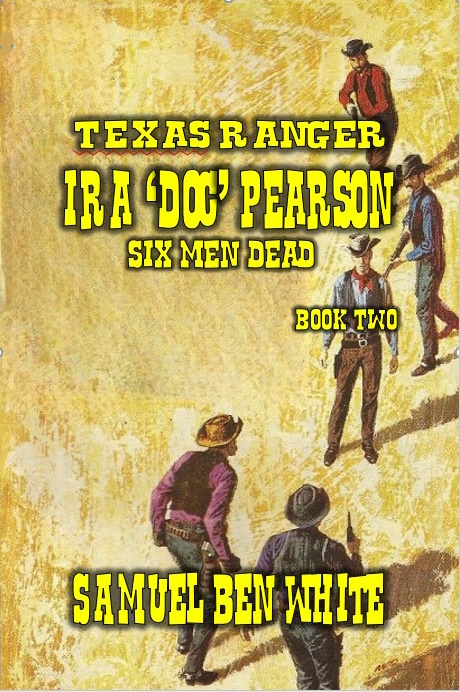
Six men rode into the west Texas town of Rook in December of 1895. Moments later, all six men lay dead in the street, shot to death by the good citizens of the town.
Ira “Doc” Pearson is sent by the Texas Rangers to investigate, expected to just rubber stamp the proceedings for the dead men were known as the Lawrence Gang: wanted in Texas and New Mexico for bank robberies, rustling and murder.
Ira knows, however, that one of the members of the Lawrence Gang was in jail in Lubbock at the time of the massacre. So who was the sixth man who died that day?
Official Texas is satisfied that justice was done, but Ira can’t let it go.
Also available on Audible and iTunes, narrated by Tom Lusty!
Six men rode into the Texas panhandle town of Rook. By the looks of them, six hard men, five of them on fine horses such as only an outlaw could afford, all wearing guns that had seen some use.
The people of Rook took all this in in a moment, and that was all they took.
Rifles, six-shooters and shot-guns seemed to appear as if by magic from every upstairs window on the dusty street. No signal had been heard or seen.
All fired at once and six men went down. Only two were even able to get their guns out of their holsters, but neither got off an effectual shot before scratching their last sign in the dirt of the street.
No horses were hurt more than a couple grazes, for the men (and maybe some women, if the rumors were true) of the west in general and Rook in particular thought a lot of horse flesh and had taken great care not to hit any of the animals.
All six riders died quickly. Nobody was gut-shot and writhing in the dirt, for the people of Rook were good shots
and toasted each other later in the saloons and each other’s houses that there had been no suffering. Not like the banker these men had made die slowly down in Banderas, or that parson who’d just been in the bank at Dimmit at the wrong time and had taken a month to die.
Nope, just six clean deaths.
One couldn’t say it was just six shots, though. Someone counted up later and found that most of a hundred Rook bullets had struck the six bodies. It was a wonder they hadn’t more than grazed the horses.
No one from Rook had so much as a scratch on them. Maybe some red eyes or sore throats from the smoke of the gunpowder, but nothing more. It had just been a few seconds of red-laced hell and then it was over. Six lay dead and a lot of people across west Texas and eastern New Mexico started sleeping easier again.
The worthies of Rook buried the six bodies in a single grave out at the town cemetery and the Campbellite parson said some words over them. A marker was put up but all it said was, “Lawrence Gang” and, below that, “Put here by the good citizens of Rook on 4 December, 1895“.
Chapter One
Folks took notice
when the stranger rode into town on the sorrel horse of his. It wasn’t quite like the old days, when every stranger who passed through Rook was noted, though, for mor
And this stranger wasn’t an especially striking specimen. A shade over six foot, with short light hair and beat-up clothes—though of tough cloth—nice boots, and a saddle that had seen some miles. Nor did his gun catch anyone’s eye, for while things were starting to get civilized, there were still quite a few men who wore guns, especially if they were traveling for civilization hadn’t completely caught up with the road agents. The stranger’s horse was a good-looking animal, one that looked like it could go all day and night, but it wasn’t a “show horse” for all that. Just a good-looking horse anyone would be proud to have, but not the kind that made people say to themselves, “I want that horse!”e people traveled anymore. On any given day, a dozen strangers might ride through, stopping only for water or a meal, before making their way back onto the road to Hereford or maybe McKeon. Most of the time, they drew no more notice than if a local had ridden through.
What got people’s attention, and set the tongues to wagging and brought the whispers to a dull roar was the silver on the man’s chest, for he wore the badge of a Texas Ranger. The badge was polished and glinted in the bright Texas sun, catching the eye of everyone who even glanced that way.
Soon, Sheriff Montgomery was hustling out of his office and greeting the stranger even as the man was tying his horse to the hitching rail in front of the jail. Extending his hand in a manner that seemed to be forced friendliness over an underlying nervousness, he said, “Howdy. I’m Sheriff Montgomery. I, um, I figured one of you would come.”
“Did you now?” the stranger replied, taking off his riding gloves then taking the sheriff’s hand. “Pearson’s my name. Ira Pearson. I reckon you already realized I’m a Ranger.”
“Uh, yes sir,” said the sheriff, even though he was probably a good fifteen years older than the Ranger. “Won’t you come inside?”
“Thank you,” the Ranger said politely.
Sheriff Montgomery watched with keen interest as the Ranger took off a Stetson that had seen some miles but was well-taken care off. The Ranger brushed some dust off the hat and then hung it on a peg just inside the door. The Sheriff saw then that the Ranger had the most grey eyes he had ever seen. Somehow both piercing and bland at the same time.
“Coffee?” the sheriff offered.
“Don’t mind if I do,” Ira Pearson replied. He took the cup gratefully, then sat in the offered seat. He waited a beat for the sheriff to sit down behind his desk, then said, “You probably know why I’m here.”
“To give the town a medal?” the sheriff tried to joke.
Ira Pearson chuckled, shaking his head. “There are some in Austin who have already suggested that. The citizens of some of your nearby towns would probably go along with that idea. But no, Sheriff,” he said, suddenly becoming more stern, “I don’t think anyone is going to try to argue that the Lawrence Gang didn’t have some retribution coming. However, six men shot down in a street with no provocation does look a lot like murder to the courts.”
“Murder?” the sheriff demanded. “After what they did in Monahans, or to them sheepherders down by—“
The Ranger held up his hand to forestall further talk from the sheriff and said, “We know those things. The whole state knows those things. And I have access to crimes I daresay you haven’t even heard of save in rumor, Sheriff. But there are laws in this state and murder is at the top of the list—even when the person murdered deserved what they got by every known set of rules.”
“So what are you going to do, Ranger?” The last word was said with something less than admiration in its tone.
“My orders are to investigate exactly what happened and turn in a report to my superiors. I can make recommendations, but it will be up to the Attorney General what is to be done ultimately.” He smiled then and asked affably, “May I assume that I will have the full cooperation of this office, Sheriff?”
“Um, uh,” the sheriff fumbled, taken off guard by the sudden friendliness, “Sure. Absolutely.”
“Thank you.” The Ranger reached into a vest pocket, pulled out a little notebook such as most ranchers carried for tallying up stock, and a pencil that was already sharp and said, “For starters, I’d like to hear your account of what transpired on Wednesday of last week.”
The sheriff cleared his throat, looked around for help where there was none, then began, “Well, it really started before last Wednesday.” Steeling his will, he said, “Here’s what happened, Ranger—wait, ain’t you the one they call ‘Doc’ Pearson?”
The Ranger hesitated, chagrin on his face, then replied, “Yes. But I prefer Ira, or Pearson, or Ranger or ‘Hey You’ for that matter.”
“All righty,” the sheriff agreed, wondering what the story might be behind both the nickname and the obvious dislike the wearer had for it. Still, he shrugged then began, “I’m sure you know all about the Lawrence Gang. Well, I know it, too, and I may know more than you think I do. But that’s no never mind. What I do know is that in the last week of November they stuck up a stage over by Lubbock. Shot the driver and the express man. Beat up the passengers—three men and a woman—and left them beside the road. One of the men is still laid up, they tell me.
“From there, they drunk up half the liquor in Littlefield and shot out most of the windows. Beat a bank teller half to death ‘cause he didn’t have but twenty dollars to give them. Y’know, Ranger, they used to just rob a bank now and then. But somethin’ went wrong with that Frank Lawrence up here,” he gestured toward his own head. “I ain’t saying they didn’t deserve jail or death for the robbin’, but here lately they just went plumb crazy.
“After Lubbock, and then being in Littlefield, I didn’t worry none ‘cause I figured they was headin’s away from us. Next thing I know, they’re in Olton, then somebody east of Hart said he thought he saw them on the trail to Tulia. Everybody in this town had heard that, too, Ranger, so they got up the citizen’s committee and started asking what they should do.” He looked furtively toward the door, as if hoping someone would come in and interrupt his proceedings, before continuing, “Now I, um, I told them what we’d have to do was arrest them Lawrences and then get word to you—the Rangers, I mean, not just you personal.
“Sudden like, ever’body in town’s walkin’ on eggshells. Men wearing Colts strapped to their pants that hadn’t been fired in ten years. I was, I tell you, I was worried about a accident—“
“Accident?” Pearson questioned.
“You know how it is,” the sheriff explained, somewhat plaintively. “Ever’body’s on edge and, first thing you know, one fella’s bumped into another in the saloon and all of a sudden ever’body’s firin’ guns and somebody lays dead.”
“And that’s not what you wanted? Dead men in the street?”
“What? No sir!” Sheriff Montgomery objected forcefully. “I never wanted no such of a thing! But I tell ya: when it happened, the people of Rook handled it like men.”
“And how was that?” the Ranger asked calmly.
The sheriff was sweating, even though it was a cold panhandle day outside and the pot-bellied stove was only putting a dent in the chill. He suddenly blurted out, “Well, you remember back a couple years ago when that posse caught up with the Lawrences down hear Odessa, don’t you? Had ‘em chained up and everything. But ol’ Pete Lawrence, he had him a cousin there in Odessa who got a file to ‘em. They slipped out slick as whistles in the night and have been raising—well, you done told me you know what they been doin’.”
He stopped for a moment, formulating his words, then offered, “I told ever’body that we needed to catch them Lawrences legal and hold ‘em tight! I was goin’ to swear in a passel of deputies and we was goin’ to watch over them like new mothers over a baby ‘til you could get here.”
“Wise plan. What happened to it?”
“’It’?”
“The plan. What happened to the plan?”
“Went all to pieces,” the sheriff said with a laugh. Suddenly enjoying himself, he explained, “Word had somehow got out that our bank had took delivery of a large sum of money, so I was on edge anyway. Then, we heard about the Lawrences coming. Then, that morning, Collin Warner—he runs a little dairy operation just south of town—he wakes me up and says he seen a bunch of men hiding out in a draw on his place. He said he seen their fire, then snuck up on ‘em knowin’ nobody honest would be a camped out like that without saying ‘hey’ to the owner. Collin, he used to be in the Army and he injunned his way up there and said he seen Pete and Frank big as life—“
“How’d he know it was them?”
“Wanted posters, I reckon. Ever’body knows—knew—Frank had that scarred-up nose from when that feller bit him down in Abilene. And Pete was so skinny he had to stand twice to cast a shadow. And ol’ Onion Taylor, we all knowed what he looked like on account of the stories told about him. And they was true, let me tell you. Must’a took thirty shots hisself before he went down.”