

Medicine Park

Brad Reynolds comes home to Medicine Park, OK, to take over his father’s old business and try to put his life back together after a divorce.  He’s fitting in, he’s meeting great new people, he’s even started attending a Bible study.  Brad’s a great guy by everyone’s account.  What they don’t know is that he has an addiction.  He’s kept it well-hidden so far, but it’s already destroyed his marriage and it will soon destroy his whole life.  So Brad tries to bury it, to ignore it, to power his way through it … but it keeps escaping from the box he keeps it in.

(Cover photograph (c) 2012 Derrick Bias)

ON SALE NOW!

Kindle    paperback

What the Readers are saying …

“I really liked it.  I had never read a book with that viewpoint of the guy with the sex addiction.  It was interesting as he grew in Christ.  I thought it was very encouraging as we all have aspects of ourselves we need to put under Christ’s Lordship.” ~KD, LA

And the “sort-of” sequel …

If you would like to read more about Brad, Allie and Angie, be sure and pick up the novel Joyfully Ever After.

Sample Chapter

The divorce was final the same day his parents died in the car wreck.

He thought about not even telling Darria, or trying to tell her in such a way as to hurt her.  But he didn’t.  He just called her and, as she prepared for one of his trademark snide remarks involving either the postal service or how relieved he was to finally be rid of her, he calmly told her he had gotten the papers and his parents had just died.

Darria didn’t know what to say, except that she was really sorry to hear that.  She meant it and hoped she could convey her sincerity but knew she had her own reputation for caustic remarks, especially where Brad was concerned.  Still, she had always gotten along just fine with the Reynolds and they had even reached out to her recently, as things had begun to go sour in her marriage to their son.  She had bristled at the intrusion, but secretly appreciated it, too.

“Well,” he said, “I’ve got to go.  I’ve got to go pick up Mike at the airport.  Then, we’ll, um, head over to the mountains.”

“Yeah,” she said, nodding at the phone even though he, of course, could not see the motion.  Then, she quickly added, “For what it’s worth, I’m really sorry it finalized today—of all days.”

“I’m sorry they had to die today, of all days.”  He tried to think of something else to say, then, not even sure if she were still there, told her, “Good bye, Darria.  Be seeing you, huh?”

“Yeah.  I’m really sorry, Brad.”

“Thanks,” he told her as he hung up.

***

They hugged at the airport, cried a bit, then things got so quiet as they left the airport in Brad’s car that they jumped into as banal a brand of small talk as they could muster before they were even onto I-44.  “You have to wonder whose idea it was,” Brad quipped, “To build the Wiley Post Terminal of the Will Rogers Airport on Amelia Earhardt Drive.”

“What do you mean?” Mike asked.

“What do those three people have in common?”

Mike thought a moment, then nodded, “They all died in airplane crashes, didn’t they?”

They ran out of small talk just as they passed Norman, however, and were stuck with silence, again.  Suddenly, Brad said, almost to his own surprise, “I’d like the store.”

“What?” Mike responded, completely thrown off guard.  His thoughts had already gone to his wife and baby, who were driving down from Colorado and would be joining him (hopefully) the next day.  He hadn’t wanted to do it that way, but the fact was they just couldn’t afford three airplane tickets on such short notice but still felt Mike should be there for his brother as soon as possible.

“The bait shop,” Brad explained.  “I’d like the bait shop.”  Suddenly thinking it through aloud, he offered, “I’ll buy your half from you for whatever you think is fair.  I can take what I got from mine and Darria’s house and make you a down payment.  For the store and your half of Mom and Dad’s house.  I’ll get a loan to cover the rest.”

Realizing how impetuous he was being, he suddenly added, “Unless you want it.  I was just thinking that I’ve kind of been wanting out of my job—and out of Oak City—for a while now.  But I don’t think that little bait shop makes enough money for us both to live on.  So, you can have it, if—”

“No,” Mike replied, just as suddenly.  “You take it.”  After a moment, “I’m serious.  Annette and I really like Aurora.  It’s where we want Collin to grow up.  It’s home now.  Why don’t you just list me as a silent partner in the store and then slowly buy me out?  That way you won’t get nailed for all that interest.”

“I wasn’t thinking of anything like that—”

“Why not?  It works out for both of us.  I get a monthly payment I haven’t been getting and you get the store.”  After a moment, Mike asked, “Why do you want it?  I don’t remember you showing any interest in it before.”

They were several miles further along before Brad answered, “You grow up in a small town and you can’t wait to get out.  Now, I want to go back.  I know it won’t be the same.  But maybe I can recapture a little bit of what it was . . . once.  I’m a grown-up now.  As of today, I’m officially divorced—”

***

“I really feel bad about that.  Wished there was something I could have done.  Wished I had seen it coming.”

“The only people who could have were me and Darria and we waited too long to acknowledge it, and then longer to do something about it.  And you didn’t see it because we tried so hard to hide from everyone, including ourselves.  I think that’s part of why I want to get out of Oak City.  I’ll always associate this place with my marriage.  Now I can get out.”

“Do you really think going back to Medicine Park is the right answer?  You want to get away?  Come back to Aurora with me.  You’ve always liked Colorado.  You can get a job in Denver.  You’d be near family.  Lots of accounting jobs there.”

“Uhg.  I’ve done accounting, Mike.”  He smiled and added, “Maybe I could go to Texas, where cousin Denny lives.  Maybe there’s a job in Frognot.  I’ve always kind of wanted to live there just so I could have that name on my letterhead.”

***

The funeral home had done a good job, as far as such jobs went.  Instead of two people who had been in a car that had gone off a rain-soaked highway, they looked like two people who had just chosen a strange place to take a nap.  After a few moments of “viewing,” Mike commented to Brad, “I don’t know about you, but I’m ready to close the lids.”

“Yeah,” Brad nodded anxiously.  He motioned to the funeral director, a thin woman with iron grey hair perfectly coiffed   She came over and, with the help of a young assistant, closed the caskets.  “Remember the line from that cousin in Arizona—I can’t ever remember his name.  I just remember being at a funeral for some uncle or other and someone comments about the body looking natural and he said, ‘No he doesn’t.  I’ve known Uncle Chuck for twenty years and not once can I remember him getting dressed up in his best suit, coming down to the church, then taking a nap in a box at the front of the room.’”

Mike actually smiled as he said, “I remember that.  Uncle Leonard, wasn’t it?  The man who died, I mean.  Lived in New Mexico somewhere, didn’t he?”

“Las Vegas, it seems like,” Brad nodded.  “I just went so I could be with Mom and Dad.”

“Yeah, and I met ya’ll there mainly so I could see everyone.  Can’t remember that cousin’s name, though.”

“Private detective, wasn’t he?  I remember that just because he was the only private detective I ever met.”

“I think you’re right.  We’ll be back in the morning,” Mike told the funeral director suddenly, when he realized the director was still right behind them.  The two brothers had already cried on each others shoulders to the point that now they were just drained and ready to leave and the moment’s laughter had been genuine under the relief it had brought.  Neither had seen the other cry like that ever, so it left a surreal picture in their minds as they left.

***

Standing in the living room of their parents’ house, dressed now in casual clothes, Annette nearby playing with Collin on the floor, Brad commented, “It just doesn’t seem real.  I keep expecting them to come in here.  For Mom to try to feed us something.”

Looking around, Mike asked, “Are you sure moving here is the right idea?  The fish and tackle shop is one thing, but this house?  Sell it and buy another one nearer the shop if you want.  You always joked you were going to buy a house in Paradise Valley just because you liked the name.  Do that.”

“Naw, this is home.  I may have never thought about having the bait shop, but I always dreamed about having this house.  Pictured Darria and I having kids and moving here.  You know, Mom and Dad always said they would move somewhere when they retired.  Figured they’d move near you in Denver and we’d get this place.  Maybe telecommute to a job in Oak City or just over in Lawton and drive in one or two days a week.”  He sighed and shrugged, “The Darria part’s gone now.  I can get the house, now, though.”

Mike bit his lip a moment, then said what he’d been thinking, not just all day but ever since he had heard that his brother was getting divorced, “Are you sure there’s no chance of you and Darria getting back together?  You two were so great together—”

“I think she’s got somebody else,” Brad answered.  At the looks in his brother and sister in law’s eyes, he quickly explained, “Don’t get the wrong idea.  She was never unfaithful.  Neither was I, for that matter.  Anyway, I heard from a mutual friend that she had met somebody at her work that she was going to go out with as soon as the divorce was final.”

“It’s not like she’s already remarried,” Mike said, ignoring the look from his wife that was trying to tell him to just shut up.  “Can’t you work things out?”

“I used to think so.  Went to counseling and everything.”  Another big shrug as he leaned on the mantel and looked into the low fire.  “Didn’t work.”  He looked over at Collin and said, “Kids were part of it, you know.  Sometimes wonder, if we had been able to have kids . . . “  After a bit, he added, “On the other hand, sure am glad we didn’t put any kids through this.  Divorce is hard on kids.”

“Well,” Mike said, stumbling over the words, “I don’t want to bug you about it.  But if you, um, get the chance, talk to Darria.  Maybe you two just needed some time away.”

Brad was too worn out to argue, so he just nodded and said, “Yeah.  Maybe so.  That’s what Dad said, too.”

***

“Thanks for coming,” Brad said as they walked away from the graveside service.  The minister from the Reynolds’ church had delivered the eulogy and had done quite well.  Brad and Mike had both thanked him for the words, and everyone else for coming out on such a cold, if sunny, day.

Darria nodded uncomfortably, then threw her arms around his neck and, sobbing, told him, “I am so sorry for you.  And for Mike, too.  But I’m really sorry for, for everything happening.  Now, of all times.”

“Well, it wasn’t just you,” he told her as he held her close, feeling her for the first time in months.  It had a strange familiarity that was surprisingly comforting.  “I know the timing was an accident.  But I, uh, do thank you for coming here today.  It really does mean a lot.  Can you come over to the house for a while?  There’s a lot more food there than even Mike and I can eat.  Give you a chance to see Annette.  And Collin, too.”

“He sure is getting big, isn’t he?” Darria commented wistfully.  She then let go of the hug, wiped her eyes and said, “I better get back into town, though.  I told the office I would try to make it back for the afternoon.”

“Well, don’t go so fast you . . . drive carefully, huh?”

She was prettier than he remembered.  Maybe it was the black dress.  He had never seen her in black because she had always said it made her look washed out.  With her reddish blonde hair and freckled skin, he had always taken her at her word.  But now, looking at her, he realized she looked pretty attractive in black.  And she had lost weight.  She wouldn’t have been able to fit in that dress when they were still together.

But then, he had lost weight, too.  He didn’t think it was stress so much as that he just hadn’t eaten as regularly since the split.  He was almost back to his college weight.  And what with walking every day in the sun, the red had come out in his brown hair and a few freckles had resurfaced that he hadn’t seen in a long time.

People used to say they belonged together but he always figured it was because they were both red haired and fair skinned.  He wondered if, that day at the cemetery, they looked like they ought to be together again.  He wondered if she were wondering the same thing.

She nodded, then kissed him on the cheek and walked away to her car.  He watched her go, not knowing how he should feel.  If it were a movie, he knew, he would run after her and catch her in his arms and convince her to stay with him.  Or he’d watch her go and cry.  But he didn’t feel like doing either.  He didn’t feel like doing anything.  So he just watched her go.

***

“You sure you don’t want me to hang around for a while?” Mike offered.  “I’ve got a couple weeks coming.  I could help you move and get settled in at the shop and all.”

“No.  Your family needs you with them.  I’ll be fine.  Old Simms is going to run the shop until I can get out there, and most of my stuff is in storage so it won’t take all that much to move it.  Got some friends that can help with that.”

“Well, if you need me, you call, all right?  It’s just you and me now, brother.”

“Hey, same here.  I mean, if you need anything, you call me.  I know how to get to Aurora.”  Brad snapped his fingers and said, “Let’s plan on getting together in a couple months.  Maybe head into the mountains or something.”

“Sounds great,”

Brad hugged Annette, thanked her for coming, and held a very wriggly Collin one more time, kissing the little boy on the forehead.  “I can’t believe how fast you can move, little guy.  You’ll be walking by the next time I see you, I bet.”
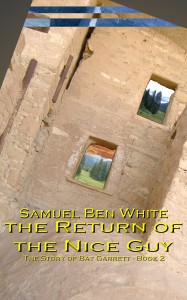
the Return of the Nice Guy

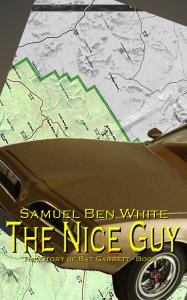
Book 2 of The Story of Bat Garrett

Two years after the murder of a prominent north Texas banker has been solved and the killer put in jail, Dallas private eye Bat Garrett is hired by an attractive widow to find out why her husband was killed.
The police (and everyone else) say it was just a robbery gone bad, but the widow thinks differently.
With Jody Anderson still on crutches from her horrific ordeal in “The Nice Guy” but by his side as always, Bat undertakes a case that leads him through an amateur archaeological society in Dallas and into a centuries old mystery in the ancient ruins of Mesa Verde in southwest Colorado.
Did the unassuming banker uncover something someone else would rather have stayed hidden?

Order Today on Kindle and paperback!


Make sure you read the prequel to this book, “The Nice Guy” and book 3 in the series, “Up to Bat“!

Reading Sample

Without a doubt, that was the best summer, fall and winter I had ever had.

As we have come to expect from the geniuses in government accounting, the Home Agency let me keep the money they had paid me for the job I had done for them back in the spring. It was way more than the job was worth—well, I should probably …

Anyway, I took the money and invested it in a friend who was opening up a baseball card and comic book store in Farmer’s Branch. As investments go, that wasn’t a whole lot better than just piling it up in the back yard and setting fire to it, but it gave me a chance to help out a guy who had been a good friend for a long time—and especially when I had needed one.

My private investigating business was starting to take off, too. I wasn’t getting any glamorous cases, but word had somehow gotten around that I was a pretty good hand at surveillance and so I was getting fairly steady work—some of it even from other investigation firms. I’ve always been a pretty plain guy, so I was a natural at hanging around in the background and watching other people without being observed myself.

Of course, the thing that made that summer, fall and winter better than all previous summers, falls and winters was that I had a girlfriend. A real, honest-to-goodness, she-likes-me-as-much-as-I-like-her girlfriend. I had never really had one of those before. Well, there had been Thalia, but that had been … oh, never mind.
Her name was Jody Anderson and she was the love of my life. The one you know that—even if things were to go sour—she’d always be the one you’d think of as “the one great love.” The kind you’d write songs about if—unlike me—you had rhythm or any sense at all of musical style.

She had shoulder-length hair that was somewhere between auburn and brown, tending to the red in the sunshine. She was petite of build but a perfectly shaped figure for all that. And she had this great little mole just above the left corner of her mouth.

She might not have thought of that summer as a great time, because she spent most of it in the hospital, or in rehab. She had shattered her right leg—above and below the knee—and there was talk on more than one occasion that it might have to be amputated. I think she kept it strictly out of will-power.

She had broken the leg while on the job with me for the Home Agency. She had also been shot, but that—by comparison—was easily dealt with. I mean, by itself, it would have kept her in the hospital for a couple weeks at a minimum. But then she would have been out and rehab would have probably consisted mainly of walking and getting her lungs back in shape. The leg, though, was a process of multiple surgeries and rehab that lasted well past Christmas.

So I say that the government overpaid me, but I doubt that Jody would say the same thing about the remuneration she received. They took care of her medical bills, of course, but no amount of money would be worth that kind of pain and suffering.

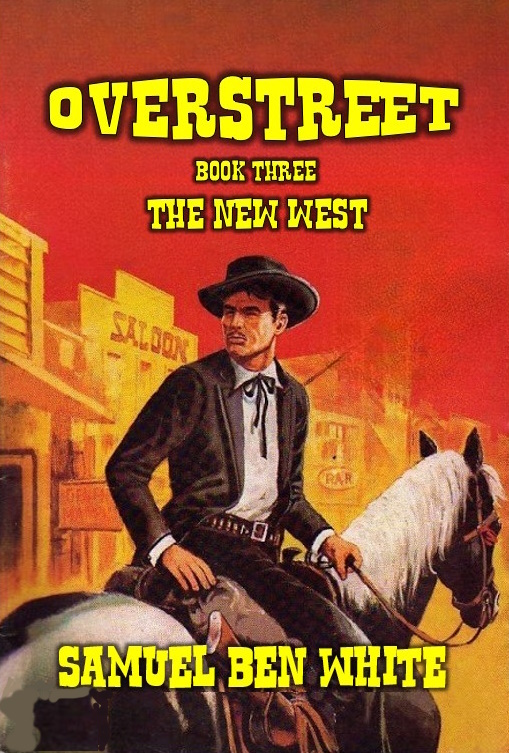
The New West – Overstreet book 3

The conclusion of the John Overstreet saga. The gunfighters are hanging up their guns, a new century is dawning, and a different kind of fight comes to the You’ll See. But one more gunfight is on the horizon for John Overstreet: the last gunfight.

Available in ebook (in many formats, including Apple) and paperback.

Reading Sample

“Aunt Melinda! Aunt Melinda!” Ben shouted as he ran up the road from town. He had run all the way and though he was about out of breath, he was long on enthusiasm and that was making the difference.
Afraid something was wrong, Melinda stepped out on the porch and was relieved that he seemed to be shouting it in a happy way. Still calling her name, he ran up onto the porch and into her arms, panting happily like a dog.
“What is it, Ben?”
He tried to tell her his news, but his wind had finally caught up with him (or left him, depending on how one looked at it) and all he could do was stand there and breathe heavily. He was a blonde-headed boy with his mother’s green eyes and his father’s good looks. A little more stout than his older brother, he was still good-sized for his age and becoming very athletic.
His real passion, though, was art. So he held up a piece of paper and managed, “Read this.”
Melinda took the paper and read, “‘Dear Mister Rathum, We are pleased to inform you that the drawing you submitted has been chosen as a finalist and will be on display in the Denver Museum of Art and is eligible for first prize in The Rocky Mountain News’ Young Artist Competition.’ Oh Ben, this is wonderful!” She gave him a hug, which he barely acknowledged as he took the paper back and read it again.
“Can we go see it? In the museum, I mean?”
“You bet we will!’ Melinda told him with another hug. “We’ll take the whole family. And we’ll be sure and let Jo and Leonard know, too.”
“Can I write them?”
“You sure can.”
“Can I tell Uncle John when he gets in?”
“Certainly.” Melinda laughed and added, “You might want to sit down and breath between now and then, though.”

“Uncle John!” Ben practically screamed as John rode into the ranch yard. “I’m a finalist!”
John got off his horse and, walking it to the Hayloft, asked, “A finalist for what?”
Ben quickly explained the commotion and showed John the paper. John read it and gave Ben a hug. “Aunt Melinda says we can go to Denver and see my picture in the museum.”
“You bet your life we will. Come on, let’s put my horse up, then we’ll go make some plans. Which picture was it?”
“That picture I drew of the Old Homestead with that special pencil you got me for Christmas.”
“That was a good picture.” He tousled Ben’s hair and added playfully, “Must’ve been the pencil.”

“And this drawing,” the tour guide explained, “Was drawn by a member of our very own tour group: Mister Benjamin Rathum of Como. Wave your hand, Ben.”
As Ben shyly stuck up his hand, the group of a couple score people clapped politely and several were heard to remark that it was amazing a child of his age could draw so well. He received several pats on the back and more than one vote of confidence that he would win the prize. Nervous beyond belief, Ben held tightly to John Mac’s hand and just nodded at all the compliments. If anyone noticed that Ben’s blonde hair didn’t seem to fit in with the black-haired family he was traveling with, they were polite enough not to say anything.
Everyone involved, including Ben, thought of him as part of the Overstreet family these days. John Mac followed him around the way Andrew and Emily followed John Mac around and John and Melinda treated him like one of their own. In return, he treated John and Melinda as if they were his parents. Almost from the moment he had come to live with them, there had been a bond of love that was so strong as to be unbelievable. But Ben was a very special boy, one bound to make a mark in the world if in no other way than all the people he would be kind to.
As the tour moved on, Melinda realized that Emily was about to fall asleep where she stood. Melinda whispered to John, “I’m just going to sit in that chair over there and snuggle Emily. She needs a nap and my feet are killing me.”
“We’ll come back and get you before we leave,” John whispered in return.
Melinda sat in a big, surprisingly comfortable chair, and Emily eagerly climbed into her lap. She had chattered on the whole train ride from Como and in the carriage from the train station to the museum and had worn herself out. And while she and Andrew were both giving up their naps as a general rule, Emily could still be persuaded to take one in her mother’s lap now and again.
As she sat there, Melinda found that she was almost tired enough to go to sleep herself. They had gotten up early, then all dressed in their best clothes so they could come straight to the museum, and the long day was suddenly catching up with her. Through half-focused eyes, Melinda absently watched the few other patrons who had elected to tour the museum sans a guide.
There was an elderly couple who talked happily about every picture; a college-aged looking young man who scrutinized every piece of art as if he were a world-renown art critic visiting the Louvre; and a middle-aged woman with fading blonde hair who stopped at every picture, examined the name plate then moved on without seeming to have seen the picture at all.
Melinda found herself watching the woman. She moved slowly, her feet almost dragging, as if she had walked to the museum from a great distance. Melinda had read of people who appeared to be “beaten down by life” and, while she had seen a few such people, this woman was the personification of the idea. Melinda couldn’t see her face, but she could see the slumped shoulders, the tired gait, the hands that reached out to every name plate as if for a life raft.
Melinda began to wonder about the woman and what her story might be. She tried not to stare at the woman—even though she guessed that the woman was oblivious to everything around her—but cast furtive glances her way in an attempt to, somehow, read the woman’s story. Suddenly, Melinda was very awake, but was also thankful that Emily was there. An inveterate people watcher, Melinda had spent many hours watching people while holding one or another of her children on the porch of the Como Hotel or the boardwalk on Rowe Street. She had even done it a few times in Denver and had always enjoyed it immensely for there were so many more people to watch.
The woman was wearing a traveling dress of impeccable style, which would have been incongruous with the picture she put forth except that it was still dusty from travel. In a world where the streets were mostly dirt and carriages mostly open, the dust wasn’t necessarily out-of-place. But the dress was so nice, Melinda realized that what looked odd was that normally someone with a dress like that wouldn’t have stepped out of their railway car without borrowing a brush from one of the porters and giving it a once-over.
The train? Melinda suddenly wondered why she thought this woman had just gotten off a train. She realized, with closer scrutiny, that it wasn’t just dust that clung to the woman’s dress but soot. That fine soot that Melinda had been so careful to brush off her own dress before coming over.
So what would posses a person who seemed so ill at ease with life to hop a train and come to a museum? Maybe, Melinda thought, she’s downtown for something else and stopped by the museum to kill time. There were a few lawyer’s offices nearby and the capitol building wasn’t all that far away.
No. She came to believe as she watched the woman (less and less furtively), that the woman was in the museum for a purpose. There was something in these pictures that she was looking for. What could it be?
No again. As Melinda watched the woman’s movements she realized that the woman was looking not at the pictures but the names. One of these pictures was done by someone that meant something to the woman. A grandchild perhaps? All the pictures in this room were done by children twelve years of age and under and it was unlikely that this woman could have a child in that range.
What is it about a grandchild’s picture that would so enthrall this woman, so entrance her that she would travel across country to see it?
The woman came then to Ben’s picture and stopped. She actually looked at the picture, and then put her hand on the name plate as if it and not the wall behind it were holding her up. She put her other hand to her heart as if to keep it from killing her, and just stared.
Just as Melinda began to shoot various scenarios through her mind to explain these events, she mumbled to herself, “Oh my!”

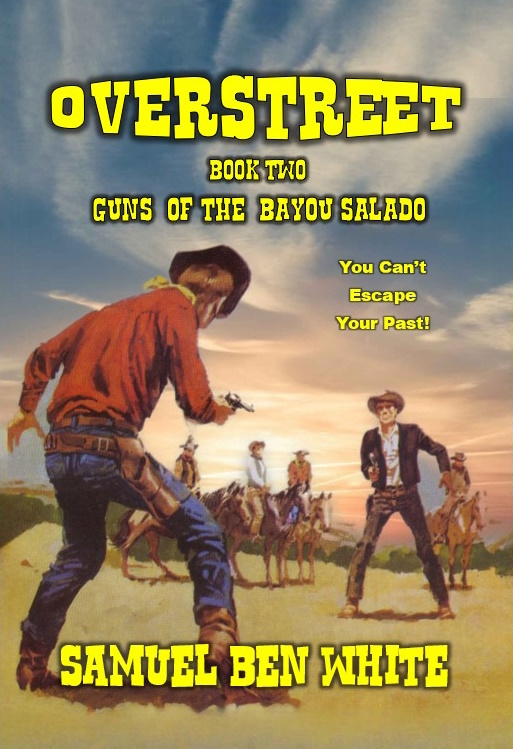
Guns of the Bayou Salado – Overstreet Book 2

Settled in the Colorado mountains and hoping his gunfighting days are over. John finds marriage and family to his liking, but he’s still hounded by the family of the man he killed in Texas.

Available for ebook (in many formats) and paperback.

Sample reading

It was late fall in eighteen eighty-six when Lydia Rathum discovered she was pregnant again. She and her husband David had been trying for two years and had almost begun to think that David Junior wasn’t going to get a sibling. But as the last of the aspen leaves was buried under a mound of snow, Doc Baker told them a new member of the clan would be born the next summer.
In the mean time, it looked like it was going to be a cold, long winter, but the You’ll See was prepared. John had worked out a deal with the Sundown Mining Company to mow hay in some pastures the mine held title to. It worked out well for the mine because it insured someone would be on their property, at least occasionally, and might possibly discourage claim jumpers. This hay, combined with what they had cut off their own eight hundred plus acres, would give the You’ll See more than enough fodder for the winter. John expected to have some left over, even. He thought if he could get ahead, then the next winter the ranch might be able to sell a little hay and make a bit of extra income. It would also foreshadow the produce that would one day be the Bayou Salado’s number one income.
He came out of the bank and instantly buttoned his coat one button higher and pulled the collar up as high as it would go. Comfort had won out over pride several winters before and he wore a fur-lined hat that kept his ears warm and would have gotten him laughed out of his old haunts in Texas. On his hands he wore gloves but the right glove had the fingers cut out even though his heavy coat would pretty much have prevented any sort of fast draw anyway. But, it was a habit more than anything and necessitated keeping that hand in his pocket all day to keep it warm. The upshot was that John became more than a fair hand at doing things left-handed. Beyond that, there were some jobs that were just easier to do with non-gloved fingers and this saved him the time of taking off his glove and then putting it on again later.
He was instantly alert when he heard footsteps coming rapidly up to him and turned to find Claud crunching through the snow. He, too, was dressed for warmth and had a muffler on so that all you could see of him were his eyes peeking out from under the hat brim. All the same, they showed through the gray air with that laughter Claud was always known for.
Claud caught up with John and they made their way to the restaurant of the hotel for a drink of something—anything—warm. Hunched against the snow, they tried to acknowledge the people they passed on the street but everyone was intent on getting to their destination before their respective blood froze. No one had any mind to take their hands out of the warmth of their coat pockets to shake hands—let alone wave. Perhaps it was such as this that caused all southerners to believe that all northerners were unfriendly. And caused all northerners to think all southerners were too gregarious.
There were two hotels in town at that time, the Pacific Hotel and the Como House. The Kelly family and the Coyne family also ran boarding houses, and there were a few other rooms to let about town, but only one building in town served the needs of the lodger and the diner so well as the Pacific Hotel.
The Hotel—as it would be called for as long as it stood—was a large red brick building with rooms on the second floor and a restaurant on the bottom. It stood so close to the railroad tracks that the dishes rattled if the train was going by at any speed but the front window had a breathtaking view of Borias Pass, Silver Heels and Little Baldy—only slightly cluttered by the foreground vision of Como.
The two men stomped the slush off their boots as they entered and hung up their coats and hats near the door. With a keen sense of the weather—or just a good grasp of the obvious—the hotel proprietor had installed about twice as many coat racks as a hotel that size would normally have. Feeling twenty pounds lighter, Claud and John went and sat where they had for years—in Maggie’s section, near the fire.
Annabeth came out and smiled. As she brought them cups and saucers, John asked, “Where’s Maggie?”
Annabeth seemed uncomfortable and looked around for a moment. She had only recently gone back to work at the hotel, and that only on an extremely limited part time basis during the busiest part of the day. She asked, nervously, “You haven’t heard?”
“Heard what?” Claud replied, answering for both of them.
Annabeth, her figure having become quite “motherly” following the birth of her third child, sat down and said, “She left.”
“Left? The restaurant?” Neither cowboy was comprehending.
“Left the state,” Annabeth told them. She rather enjoyed stringing people along in conversations like this. Everyone in town was now used to it and resigned themselves to long, somewhat confusing, conversations whenever talking to Annabeth. If not in the mood for such a thing, it was best just to avoid talking to her. It was said that she had all the makings of a fine politician, had women been encouraged to run. “She went to California.”
“I’ll be,” John mused, shaking his head and wishing Annabeth would bring them some coffee or hot tea.
“That’s all?” Annabeth demanded of him. She was shocked. She had expected her revelation to make a much bigger stir. She had been waiting all day to share the news with John Overstreet. “Don’t you want to know why?”
“It’s her business,” John pointed out. “And she’s a grown lady, so she can go wherever she wants. And in spite of what everyone in this town has thought for the last six years, Maggie isn’t my girl and never has been.”
“But you’ve sat here in her section every time you’ve come in for six years!” Annabeth objected. Everyone in the restaurant was paying close attention to the conversation because, after all, they couldn’t keep from hearing it. And most of them had been waiting for the last six years for John to ask Maggie out on a date, or maybe even marry her. It had never occurred to them that it might not happen. “And you sat by her at church every Sunday through seven different parsons. What were we supposed to think?”
“You’d have thought whatever you wanted to think, that’s what. A few people asked about it over the years—including you, Annabeth—and I always gave you the same story I’m telling now. Maggie was a friend of mine and that’s all,” John told her, trying to sound upset but finding it all amusing. When it was obvious that Annabeth was neither going to leave nor pour coffee John asked, “Why did she go to California?”
Annabeth leaned forward and said, “She got married.”
This did take John by surprise and he exclaimed, “Married? To who?”
“Never thought she’d do it, did you? Thought you could just string her along until you decided to marry her, didn’t you?”
“I thought nothing of the kind! Like I just said, she was a friend and nothing more! I never once thought of marrying her,” John contradicted. “I just want to know who she married!”
Annabeth waited a moment to build the tension, then said, “She married that drummer that comes through with the brushes.”
John said, more to upset Annabeth than anything, “Seemed like a nice fellow the time or two I met him. Sold me two of the best currying brushes I ever owned. I hope this doesn’t mean he won’t be coming back through here again. I could use another one.”
Annabeth threw up her hands in disgust and went to get their drinks. She poured Claud a cup of hot coffee and John took tea. He didn’t particularly care for either drink but he needed something to cut the chill. The drink was a joy if for no other reason than that it warmed up the icy bones in his fingers. He could live with the fact that, to him, all tea tasted like water with dirt in it. Once in Denver he had tried a cup of hot chocolate and had really liked that, but the one time he asked for it in Como he was told that it was a “kid’s drink” in a voice that said very clearly that the cook wasn’t going to bother making some up for an adult.
Claud looked at John and asked, “You really don’t mind that Maggie ran off with someone else?”
John thought a minute, then shook his head, “No I don’t. She was a good friend, and that’s all. I hope she’s found a good man. What I knew of that Fuller guy, he seemed like stable stock. Wonder if she’ll travel with him or if he’ll stay on the road or what?”
Claud poured some of his coffee into the saucer, blew on it to cool it off, then poured it back into the cup. John watched the whole operation and shook his head because the only attractive thing he had ever been able to find about coffee was the heat. So, why order coffee then cool it off?
After taking a few sips, Claud ventured cautiously, “Still waiting for that one woman?”
John merely nodded and continued with his tea. It tasted like dirty branch water, but it was warm and left a good feeling in him as it went down—if a lousy taste in his mouth. After it was done with, he told himself, he’d go over to Carman’s and get a licorice whip to wash the taste away. Of course, just about anything would leave a better after-taste than tea, he mused, and not for the first time. He wondered if they’d serve him just a cup of hot water, but then he figured that wouldn’t taste any good, either.
“You really think she’s out there?” Claud asked in all seriousness.
John nodded again and said, “She’s out there. I just ain’t found her yet. But I will.”
“You sure don’t seem to be doing any searching.”
John turned and smiled at Claud, “What about you?”
“What about me?” Claud was completely off guard.
“What about you? You’re twenty-three years old. That’s marrying age anywhere you go. That’s past marrying age in some places. If you were a woman and unmarried at twenty-three, people’d be calling you a spinster. Why don’t you have a girl?”
Claud shrugged and—after a moment—replied, “She got away.”
“Huh?” John had never heard Claud even mention being interested in a girl. And he had known him since the young cowboy was sixteen. John was sure Claud hadn’t been keeping steady company with anyone since coming to work for the You’ll See and had never mentioned any woman from before then—other than his father’s wives, who he talked about with disgust often.
When Claud didn’t answer, John asked, “Who? I never heard you mention anyone.”
Claud was obviously uncomfortable, but he said, “I never told no one.”
“Did you tell her?”
Claud shook his head and it was obvious that this was what troubled him the most. “When I met her I was too young and unsure of myself. Used to watch her and tell myself I was going to talk to her, tell her how I felt, but I never did. I’d always tell myself there’d be a next time. By the time I thought about saying something, it was too late.”
“Too late?”
“She found someone else,” Claud explained.
It was clear that was all he intended to say on the subject, but John added consolingly, “Well, you know what they say: ‘There’s other fish in the sea.'”
“Not for me,” Claud replied. “Your woman is out there somewhere. I know where mine is, but she’s not for me.” He hastily gulped down the last of his coffee and stood up. “I’m heading back. You coming?”
“Not yet. I need to go by the general store and pick up some things. I’m all out of shaving soap.”
Claud nodded and left. John was curious to know who the woman was but enough of a respecter of persons not to bring it up again. And being that he knew Claud better than anyone around, there wouldn’t be any sense to asking anyone else.
He sat back in his chair and studied on it for a moment. Claud had sat by a woman or two in church over the years; had danced with a few at barn-raisings and socials; and had even called on one or two of the young ladies in town. They had talked about it afterward, but Claud had always seemed profoundly disinterested in most of them. Or had he? Had Claud hidden his feelings about one of them? No, that didn’t make sense. If he had the nerve to ask a girl to a dance, he’d have had the nerve to tell her how he felt.
So what were they talking about? Was Claud still “holding a torch” for someone he knew back when he was fourteen or fifteen? Was that maybe the real reason he had drifted east to Colorado? John had heard that those Mormon men sometimes took young wives. Maybe Claud’s love had married someone else when she was just thirteen or fourteen and he just couldn’t stay around and watch.
Shrugging, John stood up, left a quarter on the table for Annabeth, and walked over to get his wraps and head into the cold.

Niles Carman, a young man who was tall but skinny as a rail, was running the store when John came in. John placed his order and was looking at an old newspaper as the kid filled it. Of course, he wasn’t really a kid anymore but his face looked it even if his height didn’t. John couldn’t believe the little boy he used to know was old enough to be running the store now, but the kid seemed to be doing a good job. And his father was never far away. Probably down at the Allen Saloon, John suspected.
“You hear who’s in town?” Niles called over his shoulder from the back room.
“Nope.”
“Alvis McClory,” Niles proclaimed. He added proudly, “And I met him.”
“You don’t say,” John replied absently. When he had finished the paragraph he was reading, he looked up with more interest and asked, “What’s he doing in Como?”
“Who?” Niles asked, toting up John’s order and not paying much attention to the conversation he had initiated himself.
“McClory!”
“Don’t rightly know. Some folks say he’s speculating in gold or coal or suchlike. My Pa’s thinking maybe he’s up here to meet with Tabor—over at Leadville. Maybe he came here so’s people wouldn’t know about it and make a big deal out of it. Them high-powered people like that stick together, it seems. Others say he’s here just because of his wife.”
“His wife?”
John had heard much about Alvis McClory. Mentioned in the same breath with Silver Dollar Tabor and Jay Gould, he was a high-powered cattle man from Texas who had made money in every venture known to man, it seemed. And rumor had it he was always looking for something new to invest in. John knew how often he was “hit up” by people who wanted the You’ll See to invest in one crackpot scheme or another, so he couldn’t imagine how many lunatics hung around a legitimate baron like Alvis McClory.
No one knew his exact worth, it was said, but it was estimated at several million dollars. He even owned land in Australia, South America and Africa, according to some people. But in all the talk, John had never heard talk of his wife—never even thought to wonder if he had one. Come to think of it, John mused, I never even heard tell of him having family. But then, what did he know about any of the names? He was pretty sure Tabor and Gould were married, but he had no idea of their wives’ names or if they had any kids.
“Yeah,” Niles told him, carrying a bag of items he had put together. “They say she’s been all over the west looking for her brother for nigh onto fifteen years. She ain’t seen him in a long time, I hear.”
“Must be an understanding husband to fund such an endeavor. Fifteen years of travelling is a long time.”
“Oh, they ain’t been married but about seven years. And what does he care about travel? If he sees a place he likes, he can buy it. Lute, over at the masonry, he told me they were in Terlingua looking for her brother and he happened across an abandoned silver mine. McClory bought it and hit pay-dirt a week later.”
“Terlingua?” John mused. “I’ve been there. Punched cattle down that way for a while. It’s part of the Big Bend area. So many holes in the ground it looks like a giant walked through with those spiked boots some of the miners wear. Wonder why Terlingua? Where else have they been?”
“Shoot, you name it and they’ve been there. Sounds like they spent most of their time in Texas looking. ‘Course, that’s where she’s from. You know Texas, don’t you?”
John laughed and said, “I should smile. I grew up there. Probably been everywhere they’ve been—in Texas, anyway. Never got down to The Valley, though. Always wanted to, but the closest I ever got was down in the Big Thicket. Seems like ever’ time I’d think about going to the Valley, something else would come up.”
“Well then, maybe you could help them. They told me where all they had been looking but the names didn’t mean nothing to me. Me never being in Texas in my life, and all. But she seems powerful anxious to find her brother and that Alvis, he dotes on her and would buy her the moon if she asked for it. You help her find her brother, there’d probably be money in it for you—not that you need it,” Niles quickly added with embarrassment.
Curious, John asked again, “Where all did they say they’d been?”
“Said they started in that Big Thicket you just mentioned; I reckon that’s in East Texas from what they said. Said they lost her brother’s trail for a while but got a tip that someone who looked a lot like him was seen down in the Big Bend area. That’s when they went to Terlingua. After that, they say he drifted north and they’ve only heard rumors.”
“That’s odd. I was in those places. If her brother was there, I probably would have met him.” John took a licorice whip from the jar and began to chew on it. Pulling out a few coins to pay for his purchases he wondered, “They think he might have come up here?”
“They aren’t sure.”
“How is it that you know all this, Niles?”
“Oh, they came in here right after they got off the train. Alvis was right where you’re standing—wearing some suspenders with buckles on ’em that I bet were real gold. And his wife was asking my pa a few questions. She’s a right handsome woman, too. Probably forty, but she’s got thick black hair and carries herself like a real lady. I heard her describe what her brother used to look like, but it didn’t sound like anyone I knew—no one particular, anyway. She hadn’t seen him in a long time, o’ course, but she said he used to be a skinny, gangly kid. Said he had mousie brown hair and blue eyes. That could be a lot of people.”
“She give a name?”
“Yeah. But there ain’t nobody in the South Park Valley by that name. Pa said he’d never met anyone by that name, anyway. And I know I never heard of anyone by that name.”
“So what was it?”
Niles shrugged and answered, “James Conley.”
John blanched white and nearly dropped the sack he was holding. He asked Niles quickly, “Where are they, now?”
“Huh?”
“Where’d they go from here?” John demanded sharply.
Niles seemed taken aback by the abrupt change but he finally replied, “Up the street—to Judge Stoner’s house. Him and Alvis got the same friends, or something like that. You know what I said about rich folks. They stick together.”
John put the sack down and started quickly for the door. Niles called out, “Hey! Don’t you want to take these with you?”
“I’ll be back—or send ’em out to the ranch with Claud or Cleave if you see one of them,” John called as he shut the door behind him and took off running through the snow.

John knew it wasn’t a good idea to get worked up in such cold weather because a man’s sweat will freeze and form a thin layer of ice inside his clothing. When that happens, the body’s temperature can start dropping rapidly and the result can be frostbite or pneumonia—often leading to death.
But it was a short distance to the Judge’s house and John was clomping up onto the porch in a matter of seconds, heedless of everything except getting there. His breath was coming fast even before he started running and was coming in great, heaving gasps by the time he was mounting the steps. The porch had been freshly swept, but you wouldn’t have known it after John arrived. He took no notice of the mess he was making and knocked loudly on the door.
After a moment, Stoner opened the door and seemed surprised to see John standing there. Through the screen, Stoner said, “I have company right now, John. Could you come back—”
He never finished because John was pushing his way past and into the living room. Ignoring Stoner’s blustering, John walked into the midst of a fairly formal tea comprised of the McClorys, the Bakers and the Stoners.
Everyone looked up and Mrs. Stoner was about to object to the rude intrusion when John looked Mrs. McClory in the eye and said, “You finally came back, huh? You sure took your sweet time about it!”
All the tea partiers were aghast at his bold entry and insolent behavior—especially coming from a normally respectable young man. All took grave exception and made various blustering noises much like the Judge’s, except Mrs. McClory, that is.
She calmly set her tea cup and saucer aside and rose gracefully. She looked at John for a moment, as if studying him from head to foot, front to back and inside out, then asked softly, “James?”
John shook his head and told her, “I stopped being James Conley fourteen years ago. I buried that little boy in the swamps a long time ago, Clarice.”
Most everyone in the parlor was speechless but Clarice McClory seemed undaunted. She took a step closer and said, “I was afraid you’d feel that way, James.”
“It’s John,” he corrected. “My name is John Overstreet now.” He took a step back and said, “I’ve been John longer than I was James.”
Clarice hung her head for a moment and, when she looked up, there was a tear in her eye. Taking another tentative step, she told him, “You’re right, John. To feel the way you do, I mean.”
“Sure I’m right!” he retorted. “I was an orphan and you—my only blood kin I knew how to locate—you never came when I wrote for you.”
Coming closer, she said, “John, we have a lot to talk out.”
Angrily, he told her, “I have nothing to talk about to you. You ran out on Ma and Pa and then you ran out on me.”
“You’re my brother—”
“No!” John shook his head. “I am not your brother. You lost all right to make that claim fifteen years ago! You were James Conley’s sister but you’re not mine!”
Before she could say anything else, John turned for the door. As he left, he muttered to Judge Stoner, “Sorry to interrupt.”
For possibly the first time in his life, Judge Stoner was speechless.

When morning came the snow had stopped falling but it had left its mark on the land. Everything that hadn’t already been buried was now covered in such a pristine whiteness that John hated to spoil it by walking on it. Still, there were things that needed to be done and he knew he had best be about it. A few moments of walking in the snow had changed his attitude from one of appreciating the beauty to cursing it.
Dressed as warmly as the day before, and covering his face with the scarf Amelia had knitted for him years ago, he set out for the north pasture to help Bob Vernor. The stock tank they had built at the end of a small stream in the north pasture had proved to be a good water source but it was out in the open and not especially deep so it froze over quickly. So John could expect to spend most of the morning chipping a hole through the ice for the horses to drink through. A horse can break a thin layer of ice with its nose, but it will shy away from something as thick as the ice on that pond regularly got. Had they been so inclined—and not needed the ice for more important things—it would have been a good place to go ice skating.
As they were cutting the hole, they looked up to watch the train come by, less than a hundred yards away. It was making pretty good time through the fresh snow in the valley, but Bob remarked, “Bet that’s going to be a long trip over the Pass. They usually get a good half foot more than we do down here—sometimes better than that.”
“I bet,” John replied. He had worked up enough body heat that he had shed the scarf and one layer of clothing. He knew not to shed any more or complications could arise. “I’ve seen ’em stop running in better weather than this.”
“You ever been over the Pass in the winter?”
John nodded and Bob mused, “Something, isn’t it? The way they get that snow-plow engine up there and cut through what looks like an impenetrable wall. They keep the snow plow in that new roundhouse they got down there—””
“‘Impenetrable’?” John laughed, having missed the last part of Bob’s talk after being surprised by the big word.
Bob shrugged sheepishly and replied, “I guess that’s what happens when you have a daughter in college. She uses words I never heard of before—and I’ve been around animals all my life—and went to school myself.”
“What do you mean by that?”
“Well, when she told me she was studying to be a veterinarian I figured I’d know what she was talking about. I mean, I’ve doctored animals and birthed ’em and done just about all you can do with one.”
“Any chance we could get her to come back here?” John asked. “I mean, when she graduates. We sure could use a good vet. The more the coal and gold business dies up here, the more popular cattle and horses are going to be. A veterinarian could pull in a good living up here.”
“I’ve mentioned it to her, but she’s kind of liking the east right now. I think, though, when she tries to find a job she’s going to find out how hard it is for a woman to get a man’s job. Out here, we mostly just care whether a person does a good job or not. Besides, everybody out here already knows her and would be happy to throw her business.” He hesitated, then added, “And there’s still a lot of folks that wouldn’t go to a black veterinarian, even if he was a man.”
“People are stupid,” John commented.
“That’s a bit harsh, ain’t it?”
“Well, I mean,” John thought for a moment, “I mean individuals, they can be pretty smart. But get a bunch of us together and suddenly we’re stupid. There’s a lot of good white men who fought right alongside a black man during the war, but he gets back among a group of white men and forgets everything he learned. Me, I call that stupid.”
“It goes both ways. I know some black folks that think every white man’s a slaver. They’re so convinced that opportunity is never going to come their way, they don’t realize it when it does.”
John nodded and commented, “I figure anybody that can do a job ought to do it. I knew a man back in Presidio that could sew like you wouldn’t believe. Big, husky guy, too. Big ol’ hands. Looked like he ought to be swinging a sledge hammer or managing a big team of horses. But he made pretty quilts—and even dresses. Pulled in a good wage for it, too. I figure a person ought to do what they do best.”
Bob nodded and went back to chipping away at the ice. Just making conversation, he said, “They ever decide what to do about those bodies over to the King No. One Mine?”
“Just leave ’em, I hear,” John shrugged.
“That’s terrible,” Bob remarked, shaking his head. “I don’t care if they was Chinamen, when thirty-five men die in a mine explosion I think something ought to be done about it.”
John pointed out, “Doesn’t make a lot of sense to dig ’em up just to bury ’em again.”
Bob nodded, but added, “Still, I hear they’re planning on going ahead with working the other seven levels this summer. I ain’t a superstitious man by nature, but I’d sure hate to work knowing there was thirty-five men buried. Buried above me. Be like working in someone else’s grave.”
“I know what you mean. I understand that the work’s got to go on, I guess. Does seem like they could put up a marker or something—maybe one that lists all their names.”
“I bet there ain’t anyone in the management that knows all thirty-five names.”
John nodded, then said, “They could find out—”
“If they wanted to,” Bob nodded.
The sound of the train had not completely died away when they heard another sound. It was the sound of bells and it stopped the talk of graves and mine disasters short.
“Little early for Santy Claus, ain’t it?” John quipped.
Bob watched as the source of the sound came from behind the trees. “It’s a sled,” he remarked. It was driving on the right of way and looked to contain two people, a man and a woman.
John knew immediately who they were. When Bob saw that John was upset, he asked who it was. John mumbled something under his breath and replied, “It’s my sister.”
“I didn’t know you had a sister.”
John shrugged and told him, “For a long time I didn’t think I did, either. And now I ain’t sure I want a sister.”
The sleigh pulled up near the pond and Alvis helped his wife down. She was bundled up like an Eskimo and moving about was no easy task. She maintained her characteristic grace, though. To John, the grace just irritated him, and he wasn’t sure he wanted to put voice to why.
“Hello John,” she offered cordially.
With no feeling in his voice, he replied, “Howdy.”
Undaunted, she continued, “John, you didn’t meet my husband yesterday. This is Alvis McClory.”
“Pleased to meet you,” John told him, though he seemed more indifferent than pleased. He introduced Bob and they all shook hands. “I’ve heard a lot about you,” John said to Alvis.
“Good, I hope,” Alvis laughed, an affected laugh but a well-intended one, nonetheless.
Bob excused himself and headed for the barn. The icy breath was only the first clue he saw that made him not want to be around this little family discussion. John’s breath wasn’t as icy as his attitude. Bob knew John well enough to respect his feelings in any matter, but also knew that families had a way of bringing out the best and the worst in any man. Besides, between the snow and the high altitude, he could hear whatever was said from the barn anyway.
Clarice said, trying to put as much warmth into her voice as possible, “We saw one of your hands in town. Cleave, I believe it was. He said you’d be out here.”
“Thanks, Cleave,” John muttered.
Clarice looked around and said with admiration, “This sure is a beautiful place you own, John.” The mountains were covered in snow and it really was a wonderland—especially to someone from the flatlands of Texas.
“Part owner,” John corrected her. “I only own a third.”
Alvis, speaking for the first time, said, “But the people I’ve talked to in town say you’re the driving force behind this ranch. They say without you the You’ll See would have been sold and broken up years ago.”
“I doubt that. Whose to say what might have been?”
“How much land do you have here?” Alvis asked.
“About eight hundred and sixty acres. ‘Course, some of it’s not good for anything because it’s on the side of that mountain, yonder. Couldn’t raise horses there unless they all had shorter legs on one side than the other.”
“You own your own mountain?” Clarice asked in amazement.
“Mostly, yeah. There’s some mining claims on the far side but no body works them anymore. Dry hole, as they say. Odd how one mountain’ll have gold and the one next to it won’t.” He took his pick and began knocking holes in the ice. “So, what did you come out here for?”
“We need to talk,” Clarice replied seriously.
“‘Bout what?”
She sighed heavily, then began, “I need to apologize.”
He looked up at her, then went back to picking away. The hole was actually big enough by now, but he needed something to do. Something other than look at her because she was looking really sincere and he was afraid he would forget what she had done and start believing her.
Continuing, “You never knew why I ran away, did you?” He shook his head, so she continued, “I ran away because of our father.”
John didn’t look up, but the painful memories came back. He remembered their father coming home in a drunken stupor and taking them to task for everything. John himself, or James, rather, had taken more than a few beatings. And he had watched in horror as his father beat their mother.
“I put up with it as long as I could, John. Mother always told me he didn’t mean it and that he would change one day. And when he sobered up, he’d come to me and cry and beg my forgiveness. When I got about fourteen I was big enough to fight him off. Or at least fast enough to get away. And he wasn’t a strong man; he was a weak, sniveling coward. Maybe that’s why he acted like he did. He couldn’t prove himself a man to anyone else, so he did it to us—the only way he knew how.” She shook her head of the line of thought and added, “He laid off me then.
“I moved to Fort Worth when I turned eighteen. Do you remember that? You were so little.”
John nodded and said, “I remember you coming back and visiting Ma and me from time to time. I always thought it was coincidence that you never came while Pa was there.”
She shook her head, “I planned it that way. I couldn’t bear to see him. And I hated the thought of what he was probably doing to you. I tried to talk Mother into leaving, but she never would. She believed she should stay with him no matter what. She always said he didn’t mean it, that he really loved us. I never could convince her otherwise.
“But I made a mistake when I was twenty-five. I came home thinking I was old enough to deal with … Father. But I got there late one night and he was drunk when I got there. He—he had this strange look in his eyes. He started yelling at me, calling me all sorts of foul names, and he hit me. He knocked me down and then jumped on me. I thought he was going to beat me, like he used to, but he was trying to rape me. I cried out but you and Mother weren’t there. He just laughed.”
She paused, short of breath, then continued, “When he tore my blouse, something went off inside my head. I had more strength than I had ever felt before—and, like I said, he wasn’t all that strong. I threw him off and ran. I got on my horse and left.”
“That was the last time I ever saw you, wasn’t it?” John asked. “You came by the Andrews place where Ma and I were staying. I heard you tell Ma something like, ‘He’ll never do that again,’ but I didn’t know what you were talking about. I never saw Pa again. Then Ma went off to Fort Worth for a while and left me with the Andrews. When she came back, she looked old and worn—like she was ten years older than when she left. She died about two weeks after she got back. And I never could find you—or anybody.”
With difficulty, Clarice told him, “We wanted it that way.” Before John could object, she said, “I know now it was wrong. But I didn’t know it at the time. It’s time for you to know the truth. We’ve hidden it from you for too long. I’m surprised you never found out on your own.”
“Found out what?” He was completely surprised that there was, apparently, a secret behind all that had happened. He had just assumed everyone had left him and had been so mad at them that he’d never checked into it.
After another deep breath, Clarice related, “I left the Andrews place that night and caught a train for Houston. Charlie lived there. You never knew him that well, did you?”
John shook his head and tried to remember his older brother. He was two years younger than Clarice, but he ran away from home at the age of ten, two years before John was born. Charlie was just a picture on his mother’s dresser. “I never met him but once,” John told her. “He came by one night when I was about seven. Talked to Ma a while about something, then left again.”
This seemed to make her cry, but she took a moment and composed herself. She told, “I found Charlie working in a buggy shop in Houston. I had heard Ma talk about him being somewhere down there and he wasn’t really hard to find. I told him what had happened and—and I told him what I wanted to do. He hated Father more than I did and the wounds had festered in the years since he left. He blamed Father for everything that had ever gone wrong in his life—and maybe he had a right to. I can’t say anymore. But even at ten years old, he had run away because of Father. It takes a lot for a ten year old to run away and not come back.”
She took another deep breath and said, quickly, as if saying it slow she might not get it out, “John, we went back and killed Father a week later.”
John was shocked, and a little disbelieving. “Ma told me he just went off one day and didn’t come back.”
Clarice shook her head. “That’s what we wanted you to think. We thought you were too young to know all the awful truth. But Charlie and I both shot Father. We used his gun and we each put a bullet in him. Then we went and turned ourselves in.”
“You could have run,” John told her, even though he didn’t agree.
“Yes, we could have. But we decided on the trip from Houston that we wouldn’t. We decided that even prison or hanging would be better than a life with Father. In some weird perception of morality, we decided ahead of time to take our consequences. We were young and foolish. Murder is not a solution. To anything.
“The trial was in Fort Worth. That’s why Mother was gone that long time. It wasn’t much of a trial, since we had already confessed, but they had to decide on sentence. The judge said we had reason to kill our father, but he couldn’t condone murder. He sentenced us both to five years in prison. When the story came out in the papers of what our father had been like, the judge’s decision was a very popular one. Justice with leniency, they said. It was then I found out he was up for reelection. He probably should have given us a lot more time.”
“So you got out, met Mister McClory here some time later, and started looking for me. Is that it?” he said, still a little disbelievingly. It was all too pat.
She nodded. “That’s it. Alvis has been so wonderful.”
“How did you meet?” The side of him that was still wanting her to leave and never come back was doing battle with the side that wanted to have a sister again.
“I was working in a diner in Austin, trying to decide what to do with my life when he came in. Started eating there regularly.”
Alvis added, with a smile, “I asked her out a dozen times before she even gave me the time of day.”
“Even when I went out with him—to a church social there in Austin—I thought about hiding the past from him. I made up a dozen stories in my head that morning before he picked me up. But, I couldn’t. Then the preacher talked about how people need to be honest with each other and I thought he was talking right to me. So right at the social, while we sat there under a live oak, I told him about Father and prison and everything.”
“And it was more than I could handle,” Alvis said, with shame on his face. “I took her home with the intention of never seeing her again. I kept thinking of my family and everything.”
“So what happened?” John asked, genuinely curious.
Alvis smiled at Clarice and said, “I kept thinking about her. I finally decided to swallow my pride and see her again. Family and pride be damned.”
Clarice smiled, “I didn’t even know he felt this way because he was back in the diner on Monday asking me to go out again.”
“It was a long Sunday night,” Alvis laughed, with more than a little embarrassment.
“But we went out and didn’t speak of prison again until after we were married.” She took her husband’s hand, smiled at him, and said, “Not only did he risk his social position by marrying a convicted murderer, but he has used his fortune and influence to help me find you.”
“Why look?” John asked. “After all this time, why look? You must not have even known whether I were alive or not. ‘Specially since I wasn’t going by the name of James Conley, anymore.”
“I had to let you know the truth. And I had to make sure you were all right. I never stopped thinking about you Ja—John. Ma was pretty worn out when you came along. I raised you almost as much as she did. When I left and went to Fort Worth, it was almost like leaving my own baby behind—you’ve got to believe me.” She breathed a sigh of relief and asked, to lighten the mood, “Where did the name come from?”
He laughed and said, “After Ma died, and I couldn’t get a hold of you, I hooked up with a trail drive to Kansas. Up there, I heard singing one Sunday and I asked somebody where the church was. Fellow told me, ‘It’s over a street.’ I got there and the preacher was preaching from the book of John. I decided I didn’t want to be James Conley anymore, so when the preacher asked me what my name was after the service, I just told him John Overstreet. I guess it’s kind of silly, but it’s the only name I feel at home with anymore. Kind of got used to it.”
Alvis laughed and, speaking up for the first time in a while, said, “Ah, the many times I’ve wished for a name other than ‘Alvis.’ Many’s the time I came home from school near tears from the sport my name had been made of.”
“So I guess instead of changing your name, you turned your name into something big, huh?”
“I guess so; though, that was never my intention. I just have a good history of being in the right place at the right time. Some people say there is no such thing as luck—I know differently.”
John turned back to Clarice and asked, “Whatever happened to Charlie?”
She hesitated a moment, then said, “He died last year. Tuberculosis. He lived his last few years in Arizona and it was only the climate out there that allowed him to live as long as he did.” With a smile, she added, “He owned a buggy shop which his sons will take over one day. We hold it in trust for him for now.”
“I’ll have to go look ’em up one day. Nephews,” he laughed with a rueful shake of the head as, after so many years alone, he suddenly had a really big family. He paused, then asked, “Whatever happened to Reuben?”
John just barely remembered Reuben. Five years his senior, Reuben, too, had run away from home at age ten. Even when home, Reuben had been an outdoors type of kid and had rarely been at home. “He would be thirty-one now, wouldn’t he?”
Clarice smiled and said, “You’re not going to believe this, but we just saw him. He manages a hotel in Leadville for Silver Dollar Tabor.”
“Leadville?” John asked with disbelief. “He’s that close? How long has he been there?”
“About eleven years.”
John turned and looked at the majestic mountains around and smiled. He laughed and said, “This is too strange. I’ve been all alone for so long, I don’t know what to do with a family. Now I find that I have a brother, a sister and two nephews.”
“Six nephews, four nieces,” Clarice corrected.
“What?”
“Charlie had two boys. Reuben has three boys and a girl. Alvis and I have one boy and three girls.”
John took a moment to let it soak in, then asked, “Where are they? Your children, I mean?”
“With my mother,” Alvis replied. “They needed to stay in school, so my mother and father are watching them.”
Sheepishly, John requested, “When school’s out, could you bring them out here to see me?” Before they could answer, he said, “Why don’t I just have you and Reuben and Charlie’s family and everybody out here to the ranch next summer?”
“Better yet,” Clarice suggested, “Why don’t we all meet at Reuben’s hotel?”
John looked at Clarice and said, “You know something we have to do, first, though?”
“What?”
He smiled widely and told her, “I’ve got a sister I haven’t seen in fourteen years and I haven’t gotten to kiss her, yet.”
They embraced and it seemed like fourteen years of separation melted away forever.

“So this is where you live?” Clarice asked, trying not to let too much into her voice.
John knew what she was seeing: a simple cabin. He had swept it and picked up anything lying loose, but it wasn’t much to look at. And being winter, it smelled like a shut-up man’s cabin. “This is it,” he told her.
“How will you even a bring a woman here? You do want to bring a woman here, don’t you?”
John smiled and replied, “If you’re asking do I want to get married, the answer is yes. And if your next question is whether I’m seeing someone, the answer is no. I just ain’t met her yet.”
Clarice reached out and touched the few books that sat on a shelf and asked, “Have you read these?”
John stepped over and said, “Just the Bible there. I read a lot, ‘specially in winter, but then I trade off what I’ve finished. I’m about a third of the way through Meriwether Lewis there. Haven’t started on that Dickens or Mister Douglass’s book. My friend Bob loaned me that one, so I reckon I’ll read it next.”
“You were an early reader,” she commented, wistfully but happily. “It provided you something of an escape, didn’t it?”
“I ‘spect so.”
Clarice turned and looked at her little brother, now so much taller than she, and asked, “How did you get here?”
“You must know some of it, or you wouldn’t have followed me to Terlingua and up here.”
“You were in Terlingua?” she asked in surprise. “I have just been everywhere with Arlis. And everywhere we went, I asked about you. I’ve never had any clue I was close to you until you burst into the judge’s parlor the other day.”
“Really? That’s something!”
“Tell me,” she prompted. “Please?”
He smiled again and said, “I’m not reluctant. I’m just trying to remember.” He bade her sit on his lone chair, then took a seat on his bed. He thought back and said, “I stayed with the Andrews until Ma came back. After she died, I heard about some fellows that were rounding up wild cattle down in the big thicket. I made my way there and lied about my age. I don’t know that they believed me, but they were hard enough up for help that they took me on. Learned how to be a cowboy.
“Helped them take a herd up to Kansas. That was when I met that preacher—Peter Oberson was his name. He was trying to start a school there, so I took from him for a while. But then he got fired over something, so we drifted down to Texas. He started preaching at this Campbellite church in Haskell and teaching school on the side. I took from him when I could, but I was hired on with a local ranch run by a fellow named Shook. Took his herd to Dodge when I was just short of fifteen—”
“Seriously?”
John nodded deferentially and said, “I was the only one that knew the trail. Couple of the other hands weren’t no more than twelve. We got back and that church was going some good. Peter, he was forever trying to talk me into going into the ministry. I believed in it all, but just didn’t think that was for me.
“I got a chance to ride with some fellows down to the Big Bend area to take a string of horses to a ranch down there owned by the brother of one of our church members. I went, figuring to just be gone for a couple months or so. Got wounded in a bank hold-up—no, Sis, I wasn’t robbing the bank I was trying to stop the hold-up. That put me out of commission for a couple months, then I rode for a ranch over to Presidio for a while. I was writing letters to Peter, and he was writing back.
“But then one day I got into a scrape in Presidio. The law said I was in the right, but I was just thinking that neck of the woods—which had no woods—was unlucky and decided to head back to Haskell.” He paused, then said, “Got back in time to see Peter just before he died.”
“He died?”
“Consumption. I never knowed he had it. I knew he coughed some, but he would always just say it was allergies. The church near ‘bout fell apart then. I wanted to help, but I didn’t know how. Wound up riding for a ranch about sixty miles north of Haskell. Got into another scrape and headed up here, on account of the man I had killed had him some mean brothers and a father that knew nothing but grudges. Caught on with the You’ll See and been here ever’ since.”
Clarice had looked for the last few minutes as if something were on her mind then she started mumbling, “Terlingua, Presidio, Haskell … are you the Haskell Kid?”
John blushed and finally replied, “Well, yes.”
“Then you’re a gunfighter?” she asked with alarm. “They say you’ve killed twenty men!”
The look of horror on her face made him ashamed even as he said, “Five. I have killed five, and all in defense of either myself or someone else.” He knelt before her and said, “I never set out to be a gunfighter, Sis. I’ve just been … where things were happening.”
“But how—” She put her hands on his shoulders and said, “No. I will not—” She looked down, then back up at him and said, “There will be time, perhaps, someday. For now, I am just going to be thankful I have my brother back.” She pulled him into a hug and whispered, “Both our lives have been darker than maybe they should have been. But, well, that’s what it’s been.”
As he held her, he said, “Someday, maybe we’ll tell each other our stories—in all their detail. Right now, I’m just thankful I have a sister … again.”

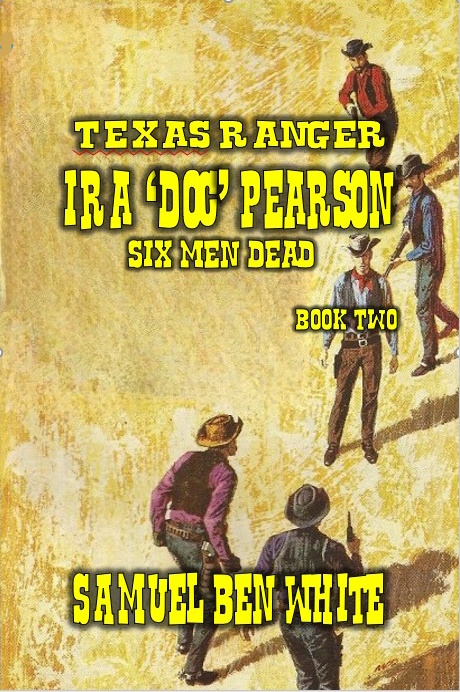
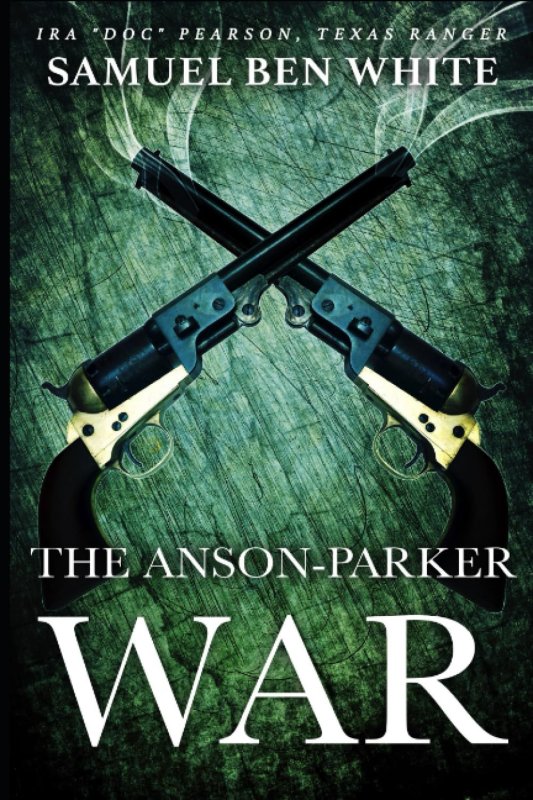
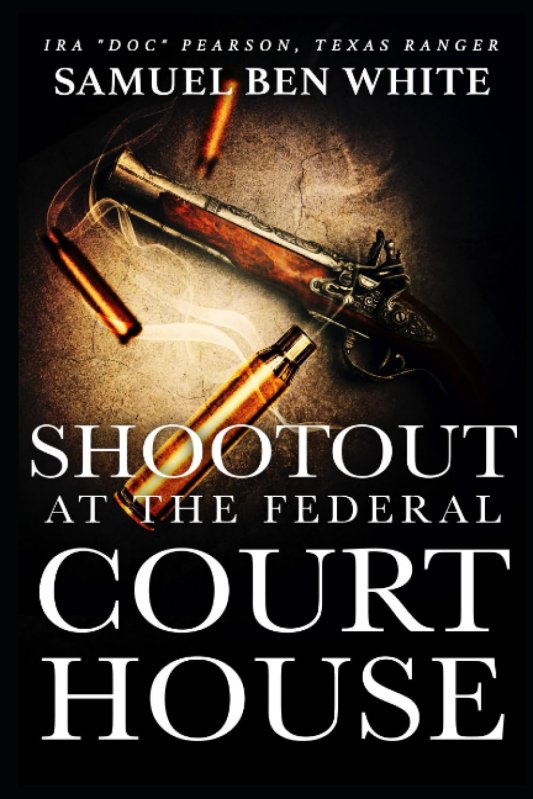
Six Men Dead (an Ira “Doc” Pearson story)

That murder was done is clear to all. But who was murdered? And will anyone be brought to justice or will a whole town look the other way?

Published by Outlaws Publishing and available on ebook (in many formats) and in paperback!

Six men rode into the west Texas town of Rook in December of 1895. Moments later, all six men lay dead in the street, shot to death by the good citizens of the town.

Ira “Doc” Pearson is sent by the Texas Rangers to investigate, expected to just rubber stamp the proceedings for the dead men were known as the Lawrence Gang: wanted in Texas and New Mexico for bank robberies, rustling and murder.

Ira knows, however, that one of the members of the Lawrence Gang was in jail in Lubbock at the time of the massacre. So who was the sixth man who died that day?

Official Texas is satisfied that justice was done, but Ira can’t let it go.

Also available on Audible and iTunes, narrated by Tom Lusty!

Follow the rest of Ira’s story in The Anson-Parker War and Shootout at the Federal Courthouse and The Body in the Floor!

Sample Passage

Prologue

Six men rode into the Texas panhandle town of Rook. By the looks of them, six hard men, five of them on fine horses such as only an outlaw could afford, all wearing guns that had seen some use.

The people of Rook took all this in in a moment, and that was all they took.

Rifles, six-shooters and shot-guns seemed to appear as if by magic from every upstairs window on the dusty street. No signal had been heard or seen.

All fired at once and six men went down. Only two were even able to get their guns out of their holsters, but neither got off an effectual shot before scratching their last sign in the dirt of the street.

No horses were hurt more than a couple grazes, for the men (and maybe some women, if the rumors were true) of the west in general and Rook in particular thought a lot of horse flesh and had taken great care not to hit any of the animals.

All six riders died quickly. Nobody was gut-shot and writhing in the dirt, for the people of Rook were good shots

and toasted each other later in the saloons and each other’s houses that there had been no suffering. Not like the banker these men had made die slowly down in Banderas, or that parson who’d just been in the bank at Dimmit at the wrong time and had taken a month to die.

Nope, just six clean deaths.

One couldn’t say it was just six shots, though. Someone counted up later and found that most of a hundred Rook bullets had struck the six bodies. It was a wonder they hadn’t more than grazed the horses.

No one from Rook had so much as a scratch on them. Maybe some red eyes or sore throats from the smoke of the gunpowder, but nothing more. It had just been a few seconds of red-laced hell and then it was over. Six lay dead and a lot of people across west Texas and eastern New Mexico started sleeping easier again.

The worthies of Rook buried the six bodies in a single grave out at the town cemetery and the Campbellite parson said some words over them. A marker was put up but all it said was, “Lawrence Gang” and, below that, “Put here by the good citizens of Rook on 4 December, 1895“.

Chapter One

Folks took notice

when the stranger rode into town on the sorrel horse of his. It wasn’t quite like the old days, when every stranger who passed through Rook was noted, though, for mor

And this stranger wasn’t an especially striking specimen. A shade over six foot, with short light hair and beat-up clothes—though of tough cloth—nice boots, and a saddle that had seen some miles. Nor did his gun catch anyone’s eye, for while things were starting to get civilized, there were still quite a few men who wore guns, especially if they were traveling for civilization hadn’t completely caught up with the road agents. The stranger’s horse was a good-looking animal, one that looked like it could go all day and night, but it wasn’t a “show horse” for all that. Just a good-looking horse anyone would be proud to have, but not the kind that made people say to themselves, “I want that horse!”e people traveled anymore. On any given day, a dozen strangers might ride through, stopping only for water or a meal, before making their way back onto the road to Hereford or maybe McKeon. Most of the time, they drew no more notice than if a local had ridden through.

What got people’s attention, and set the tongues to wagging and brought the whispers to a dull roar was the silver on the man’s chest, for he wore the badge of a Texas Ranger. The badge was polished and glinted in the bright Texas sun, catching the eye of everyone who even glanced that way.

Soon, Sheriff Montgomery was hustling out of his office and greeting the stranger even as the man was tying his horse to the hitching rail in front of the jail. Extending his hand in a manner that seemed to be forced friendliness over an underlying nervousness, he said, “Howdy. I’m Sheriff Montgomery. I, um, I figured one of you would come.”

“Did you now?” the stranger replied, taking off his riding gloves then taking the sheriff’s hand. “Pearson’s my name. Ira Pearson. I reckon you already realized I’m a Ranger.”

“Uh, yes sir,” said the sheriff, even though he was probably a good fifteen years older than the Ranger. “Won’t you come inside?”

“Thank you,” the Ranger said politely.

Sheriff Montgomery watched with keen interest as the Ranger took off a Stetson that had seen some miles but was well-taken care off. The Ranger brushed some dust off the hat and then hung it on a peg just inside the door. The Sheriff saw then that the Ranger had the most grey eyes he had ever seen. Somehow both piercing and bland at the same time.

“Coffee?” the sheriff offered.

“Don’t mind if I do,” Ira Pearson replied. He took the cup gratefully, then sat in the offered seat. He waited a beat for the sheriff to sit down behind his desk, then said, “You probably know why I’m here.”

“To give the town a medal?” the sheriff tried to joke.

Ira Pearson chuckled, shaking his head. “There are some in Austin who have already suggested that. The citizens of some of your nearby towns would probably go along with that idea. But no, Sheriff,” he said, suddenly becoming more stern, “I don’t think anyone is going to try to argue that the Lawrence Gang didn’t have some retribution coming. However, six men shot down in a street with no provocation does look a lot like murder to the courts.”

“Murder?” the sheriff demanded. “After what they did in Monahans, or to them sheepherders down by—“

The Ranger held up his hand to forestall further talk from the sheriff and said, “We know those things. The whole state knows those things. And I have access to crimes I daresay you haven’t even heard of save in rumor, Sheriff. But there are laws in this state and murder is at the top of the list—even when the person murdered deserved what they got by every known set of rules.”

“So what are you going to do, Ranger?” The last word was said with something less than admiration in its tone.

“My orders are to investigate exactly what happened and turn in a report to my superiors. I can make recommendations, but it will be up to the Attorney General what is to be done ultimately.” He smiled then and asked affably, “May I assume that I will have the full cooperation of this office, Sheriff?”

“Um, uh,” the sheriff fumbled, taken off guard by the sudden friendliness, “Sure. Absolutely.”

“Thank you.” The Ranger reached into a vest pocket, pulled out a little notebook such as most ranchers carried for tallying up stock, and a pencil that was already sharp and said, “For starters, I’d like to hear your account of what transpired on Wednesday of last week.”

The sheriff cleared his throat, looked around for help where there was none, then began, “Well, it really started before last Wednesday.” Steeling his will, he said, “Here’s what happened, Ranger—wait, ain’t you the one they call ‘Doc’ Pearson?”

The Ranger hesitated, chagrin on his face, then replied, “Yes. But I prefer Ira, or Pearson, or Ranger or ‘Hey You’ for that matter.”

“All righty,” the sheriff agreed, wondering what the story might be behind both the nickname and the obvious dislike the wearer had for it. Still, he shrugged then began, “I’m sure you know all about the Lawrence Gang. Well, I know it, too, and I may know more than you think I do. But that’s no never mind. What I do know is that in the last week of November they stuck up a stage over by Lubbock. Shot the driver and the express man. Beat up the passengers—three men and a woman—and left them beside the road. One of the men is still laid up, they tell me.

“From there, they drunk up half the liquor in Littlefield and shot out most of the windows. Beat a bank teller half to death ‘cause he didn’t have but twenty dollars to give them. Y’know, Ranger, they used to just rob a bank now and then. But somethin’ went wrong with that Frank Lawrence up here,” he gestured toward his own head. “I ain’t saying they didn’t deserve jail or death for the robbin’, but here lately they just went plumb crazy.

“After Lubbock, and then being in Littlefield, I didn’t worry none ‘cause I figured they was headin’s away from us. Next thing I know, they’re in Olton, then somebody east of Hart said he thought he saw them on the trail to Tulia. Everybody in this town had heard that, too, Ranger, so they got up the citizen’s committee and started asking what they should do.” He looked furtively toward the door, as if hoping someone would come in and interrupt his proceedings, before continuing, “Now I, um, I told them what we’d have to do was arrest them Lawrences and then get word to you—the Rangers, I mean, not just you personal.

“Sudden like, ever’body in town’s walkin’ on eggshells. Men wearing Colts strapped to their pants that hadn’t been fired in ten years. I was, I tell you, I was worried about a accident—“

“Accident?” Pearson questioned.

“You know how it is,” the sheriff explained, somewhat plaintively. “Ever’body’s on edge and, first thing you know, one fella’s bumped into another in the saloon and all of a sudden ever’body’s firin’ guns and somebody lays dead.”

“And that’s not what you wanted? Dead men in the street?”

“What? No sir!” Sheriff Montgomery objected forcefully. “I never wanted no such of a thing! But I tell ya: when it happened, the people of Rook handled it like men.”

“And how was that?” the Ranger asked calmly.

The sheriff was sweating, even though it was a cold panhandle day outside and the pot-bellied stove was only putting a dent in the chill. He suddenly blurted out, “Well, you remember back a couple years ago when that posse caught up with the Lawrences down hear Odessa, don’t you? Had ‘em chained up and everything. But ol’ Pete Lawrence, he had him a cousin there in Odessa who got a file to ‘em. They slipped out slick as whistles in the night and have been raising—well, you done told me you know what they been doin’.”

He stopped for a moment, formulating his words, then offered, “I told ever’body that we needed to catch them Lawrences legal and hold ‘em tight! I was goin’ to swear in a passel of deputies and we was goin’ to watch over them like new mothers over a baby ‘til you could get here.”

“Wise plan. What happened to it?”

“’It’?”

“The plan. What happened to the plan?”

“Went all to pieces,” the sheriff said with a laugh. Suddenly enjoying himself, he explained, “Word had somehow got out that our bank had took delivery of a large sum of money, so I was on edge anyway. Then, we heard about the Lawrences coming. Then, that morning, Collin Warner—he runs a little dairy operation just south of town—he wakes me up and says he seen a bunch of men hiding out in a draw on his place. He said he seen their fire, then snuck up on ‘em knowin’ nobody honest would be a camped out like that without saying ‘hey’ to the owner. Collin, he used to be in the Army and he injunned his way up there and said he seen Pete and Frank big as life—“

“How’d he know it was them?”

“Wanted posters, I reckon. Ever’body knows—knew—Frank had that scarred-up nose from when that feller bit him down in Abilene. And Pete was so skinny he had to stand twice to cast a shadow. And ol’ Onion Taylor, we all knowed what he looked like on account of the stories told about him. And they was true, let me tell you. Must’a took thirty shots hisself before he went down.”

The Anson-Parker War (an Ira “Doc” Pearson story)

A range war is coming. Texas Ranger Ira Pearson is sent to investigate. But is there someone behind the scenes pulling the strings?

Published by Outlaws Publishing and available for Kindle and in paperback!

Texas Ranger Ira Pearson is sent undercover to Van Bent, a town in far west Texas where rumor has it a range war is brewing. Posing as a doctor–aided by the very training he has tried so hard to distance himself from–Ira is quickly involved in the feud.
As he tries to keep the war from escalating, Ira can’t help but think there is something else going on, that either someone behind the scenes is pulling some strings, or there is just an evil festering beneath the surface of Van Bent.
With a nurse he is training on the job by his side, Ira is tasked with stopping the war and, perhaps more importantly, finally answering the question for himself of whether he was supposed to be a doctor all along.

Sample Chapter

Undercover work? Ira considered as he gathered his things at the hotel. He hadn’t had to do anything like that since he was with the Houston police force a few years before. Not real undercover work, anyway. Occasionally, as a Ranger, he had ridden into a situation with his badge in his pocket and had not announced his presence or true intent until he had the lay of the land, but not true undercover work.

He wondered, of course, what it might be. A dope smuggling ring? There were rumors of cocaine becoming a problem among the silver miners out west. Slavery? It was outlawed but there were a lot of prostitution rings that—in Ira’s estimation—came awfully close to breaking those laws with their “contracts” for the women. It occurred to Ira that he wouldn’t mind breaking up an operation of either of those evils.

Still, why him? There were other Rangers, he knew, that had more experience with drug smuggling. Ira had helped in an operation on the matter a couple years back, but his area of expertise was more along the lines of cattle rustling or kidnapping. Kidnapping? he wondered. There were always rumors of the Comancheros stealing American children and selling them as slaves in Mexico—or kidnapping Mexican children and bringing them to the States as “servants”. Could it be something like that?

Ira knew there was no way he was going to find out until he got to Kerrville and spoke with Billings, but he couldn’t help but speculate in his mind.

McKay had given him a fairly loose timetable, so Ira eschewed the trains and rode Scout cross-country to Kerrville—posting his letter to Rose in the next town down the line. Ira still wasn’t sure where things stood with Rose. Was she “his gal”? Did he want her to be? Nor did he know if she wanted to be his gal—or anything, for that matter. She was a friend, certainly, and probably one of his best friends. But he could not honestly say whether he wanted her to be anything more and was pretty sure she felt the same way. So why, he asked himself, had he bothered to send the letter? Because he cared enough about her that—if he wound up undercover for a long time and unable to write—she wouldn’t think he had forgotten her.

He didn’t dawdle, but nor did he push his horses for he brought along a pack horse he could switch with. All in all, he made pretty good time.

He also didn’t shave, thinking that if he needed to look different from his normal self, a beard and mustache were an easy disguise—which he could shave off if not needed. He wasn’t one of those men who could seemingly grow a fresh beard overnight, but by the time he arrived in Kerrville six days and a hundred and fifty miles later he had a decent start. If nothing else, it had the advantage of drawing no attention his way as he just looked like another long-riding saddle tramp.

The problem, it occurred to him on the six day ride, was his eyes. Some people (especially women) seemed to like his eyes, some people said they were too strange to be attractive (also women), but everyone who met him agreed that Ira had the greyest eyes they had ever seen. He doubted that his eyes were discussed by bandits on the trail, but they were going to be hard to disguise were he to meet anyone he knew. He thought about getting some spectacles with just plain glass for lenses, hoping that might distract from his eyes. It occurred to him that maybe he could get some spectacles with tinted lenses such as people with sensitive eyes sometimes wore, but thought that might draw more attention rather than less.

Ira checked in at the Kerrville Union Hotel and the man at the desk barely looked at him, let alone made eye contact, certain Ira was just a saddle bum and probably thinking they’d have to give the sheets an extra wash after this Walter Moore left. Ira thanked him, saw that his horses were tended to, then went upstairs. The fifty cent bath felt good but it sure increased his desire for a shave.

He had supper in the hotel dining room, an inauspicious room off the inauspicious lobby and was served an even more inauspicious supper. What they had advertised in the menu with some fancy French words was just a medium-sized steak and some green beans. Neither was bad, nor were they the kind of meal Ira would be hankering to return for. Still, they beat his trail cooking.

After checking on his horses he walked around town a bit then headed back to the hotel. He stretched out on the bed after taking off his boots—expecting to be disturbed by a tap on the door at any minute—only to find himself waking up to faint morning light. He was rested, but more than a little chagrined at himself for it didn’t pay a Ranger to sleep too well or two hard.

After splashing some water on his face, he went downstairs and took care of business before heading into the hotel dining room. It turned out they weren’t serving breakfast that day, so he made his way to a little café down the street that was clearly open and put off a smell so charming Ira told himself he would be happy just to stand there and inhale. Inside, he got a breakfast almost too large for one man to eat, but Ira did his best and eventually polished his plate.

He was sitting on a bench later that morning in front of the hotel when a man in a plain, store-bought suit and bowler hat sat nearby. The man asked in a casual but clear manner, “Walter Moore?”

“Who’s asking?” Ira replied, giving the man a better look.

The man asked, “Would you like a cigarette paper?”

Ira was puzzled but replied, “I’m more of a cigar man, if anything.”

The stranger let a little smile creep into his eyes, then said, “I’ll roll you one. But don’t smoke it here. The hotel owner’s kind of picky about such things.”

Based on the number of butts on the wooden porch beneath Ira’s feet the Ranger seriously doubted that assertion, but took the offered cigarette with a “Much obliged.” The stranger nodded, then tipped his hat and stood up, walking away without a backward glance.

Ira stood up a few minutes later, the cigarette in his shirt pocket, and made his way to a little courtyard on the side of the hotel. Making as if he were trying to light the cigarette but fumbling with it, he dropped it on the ground. Grumbling, he bent over to pick it up, unrolling it as he did so. He saw that there was writing on it. Putting the paper in his right front pants pocket, he walked around to the back as if going to the privy.

When he was confident no one was watching, he read the note. “Old blue barn on southeast side of town. Dusk.”

Ira tore up the pieces of the note and dropped them into the privy’s hole. He laughed to himself, “If anyone wants to fish them out of there, more power to ‘em.”

He loafed around town that day, trying to be neither suspicious nor too unobtrusive, and eventually made his way to the southeast side of town. Once there, the barn—which he had located earlier in the daysat off by itself making the approach to it visible, meaning no one was going to sneak up on that barn while there was still light.

Ira dismounted Scout then walked up to the barn, putting his hand to his Colt and made sure the thong was off, then eased inside the old structure. Taking a moment to let his eyes adjust as much as they could, he looked around. He stepped to some old stalls and went to stand in one of them, leaning his left side against a post and keeping his right hand close to the revolver.

He hoped he didn’t jump too much when a voice from the next stall whispered, “How’d you know which stall I was in?” Before Ira could answer, the voice—a man’s—said, “Never mind. You go by Walter Moore now?”

“Yes,” Ira replied succinctly. Then, “Mister Billings?”

“Yes. McKay sent you, right?”

Ira nodded, realized the man couldn’t see the gesture, and so answered, “He did. What’s this all about? And are we supposed to pretend we don’t know each other?”

In a gravelly voice, as one who recently got over the croup, Billings told him,“Not here, per se, but thanks to that business in Rook last year, you and I are known associates. I have a job and it occurred to me from the start that you’re the man for it, but it needs to be kept hush-hush until we know for certain there is something there. Do you still have doctor’s equipment?”

“Yes,” Ira replied, trying to keep the grumble out of his voice but probably not keeping the surprise out. “A few things, like what I’ve used when patching someone up in the field.”

“From now until this is over, if you take this assignment, you’re Walter Moore. I know your record, Pearson. You didn’t just kind of read for medicine with some frontier sawbones; you went as close to medical school as Texas had at the time—and finished with high recommendations from the school in Galveston.”

Ira hesitated, then replied, “Before the college officially opened up. I studied under a man named Gerald Miktam. He was an obstetrician and taught at the old college before they closed it.”

“I’ve met him. Brilliant man. Then you had an education better than most doctors in the state—barring the most recent graduates, of course.”

“Maybe. What’s this all about, Mister Billings?”

There was a long pause, then Billings replied, “Come over here and let’s have a little light.” Ira followed the man into a darker corner of the barn which had probably been a tack room way back when. Billings lit a lantern, but kept the flame low. Still, it allowed them to see each other as they sat in two rickety old chairs by an even shakier table.

Billings produced a map from a satchel and spread it out on the table. “You know anything about Van Bent?”

“Town, isn’t it? Just this side of El Paso?”

“That’s the one. Wait, you weren’t in on that group of Rangers that stopped the Fitzsimmons-Maher fight in El Paso a couple years ago, were you? That was close to Van Bent and you might have been recognized—”

“No. I was hip deep in bringing down those wire cutters west of Lubbock about then.”

“Oh, right. Good work there. Anyway, about Van Bent. Ranching town, little dry land farming. Railroad goes through there, east to west. Started out as just an end-of-the-tracks town, then just about died when the railroad went on. There was talk for a while, though, that a railroad bridge might be built over the Grande and the town perked up a bit. Kind of reached an equilibrium now, you might say.”

“Something going on there that needs a Ranger?”

“Yes. Well, maybe. But it’s something that I think requires a particular Ranger: you.”

“Me? What do I bring to anything that a dozen other Rangers don’t?” When Billings didn’t answer right away, Ira looked into the man’s eyes and saw something like a friendly smirk in the dim light. “What? Oh wait, no. I don’t know what you’ve heard—“

“I’ve heard about how you patched up a couple of our Rangers after that border fight a couple years ago, and how you performed actual surgery last year in Big Spring.” As Ira made a face like a man about to object, Billings said, “And I happen to know, as stated earlier, that you have better medical training than most actual doctors—“

“I don’t think—“

“The average doctor in Texas has less than one year of medical training, and most of them were just apprenticed under another doctor with the same level of training. You’re one of the few who can actually claim to have been to medical school.”

“I didn’t—“ Ira tried to object.

“Haven’t you heard?” Billings said with what was intended to be a friendly smile but was not seen that way by Ira. “The School of Medicine there in Galveston has recognized Doctor Miktam’s students as having a medical degree on par with those their first year graduates received.”

“No. I hadn’t heard that,” Ira told him, a mixture of chagrin and pride battling for supremacy within. “But what does all that have to do with Van Bent, Texas, and needing a Ranger?”

Billings reached into his satchel and pulled out a wanted poster for a man listed, primarily, as Augustus Zamorra, though there were several aliases listed as well. “What do you know about this man?”

Ira looked over the poster and replied, “Mostly just what it says here: wanted for murder and horse thieving—but all on the Mexico side of the border.”

“Anything else?”

“Just trail gossip. Seems like most of his crimes have taken place in Mexico, but every now and then he gets the blame or credit for something that happened on this side of the river. Some people say he’s one of the Comancheros, others say they hate him as much as everyone else. One fella I heard once was trying to say the Comancheros were afraid of this … ‘Gus’. That’s what they call him, isn’t it? ‘Gus Zemore’?”

“Yes. That’s one of the many names he is known by.” Billings rearranged the papers so that the map was on top and explained, “We suspect he’s done more on this side of the border than we’ve tried to let on. Didn’t want the public panicked.”

“Those west Texas boys are more likely to take a pot shot at him than panic.”

Billings nodded, but then added, “I dont doubt it. But we want this Zamorra alive.”

“Why alive?”

“There’s something going on down there. Something that’s got the people of Van Bent and El Paso on edge.”

“And you think if you can catch Zamorra he’ll tell you what it is?”

“Maybe. We’ve caught some small timers, but they’re only from the fringes. They haven’t told us anything—if they know anything.”

Ira asked, “What makes you think Zamorra knows anything? As I recall, he’s never been accused of being part of a gang. He’d be an outsider to any plan, wouldn’t he?”

“Maybe not. We think the whole loner thing is an act, a put-up. We’ve been watching him for some time and he’s a lot closer to the big scores than we at first thought. Never right there, mind you, but a bank or train robbery, a high-profile kidnapping. Zamorra’s almost always nearby. He’s either in on it—“

“Or he knows who is and is trying to catch some of the leavings.”

“That’s what we think.”

“So again,” Ira reiterated, “Why a Ranger? And, more importantly, why me?”

Billingss waited a long minute, then said, “Trouble’s coming to Van Bent. There are two factions that control that town: the Ansons and the Parkers. It’s been just a little feud between families—wait, I don’t want to downplay it too much. There’s been some fist fights but, well, it’s been kept within the families so far. Rumor is, though, that one of the sides is bringing in some hired guns to wipe out the other side—”

“So why not bring in a whole bunch of Rangers like Major Jones did and wipe them out?”

“Believe me: we’ve discussed that. The problem is that, so far, we don’t have enough to go on. Could be the whole thing is just rumor. Not that two families trying to shoot up the other isn’t worth our time, but we got enough egg on our face pulling in Rangers from everywhere just to stop a prize fight. And this being so close to El Paso, that fight would be on everybody’s mind. We need to get the facts, first.”

“Move a garrison there. Let it be known you’re after wire cutters.”

Billings was a moment before answering, “We need someone on the ground, but someone who doesn’t look like a Ranger. So then it occurred to me one day that Van Bent has everything: a school, a couple churches, even a volunteer fire department. Has a sheriff but I have a suspicion that he’s on the payroll of the criminal element.”

“And this has to do with me … how?”

“What Van Bent doesn’t have, is a doctor.”

“Really? It’s not that small is it?”

“More than a thousand people, maybe two. It had a doctor, eastern fellow from what I hear. Wife and family. My guess is that the little woman didn’t care for far west Texas and he left to keep peace in the home. Can’t blame him, really. Anyway, the town council wrote to the state asking for help in finding them a doctor. I came across the request, happened to remember what you did in Big Spring last year, and thought we might have an answer to solve our problem and the town’s.”

“You just didn’t take into account that I am not a doctor anymore. Never was, really.”

“There’s a Doctor Alexander in Big Spring that says different.”

“You’ve talked to him?” ira asked, surprised.

“By telephone,” Billings replied, the telephone still a new enough invention that even those who had used one many times were still proud of the fact.

“But I had no choice. That man was going to die if I didn’t operate.”

Billings smiled, again trying to be friendly and not realizing that the light from the lamp made him look more ghoulish than inviting, “See, that’s where it’s you. If it had been me, that man would have died. I wouldn’t have had the first idea what to do other than maybe hold a bandage over the wound. You may not think of yourself as a doctor, but you know how to be one.”

“What’s your interest in this? This seems a little out of the bailiwick for a state attorney—”

“Deputy attorney general,” Billings corrected. “But you’re right. I’m interested because, well, I got interested in this because I have a sister who lives in Van Bent. She wrote to me about this feud. I know my sister: she doesn’t scare easy and neither does her husband. If she says something’s coming, I believe her.”

“So how does Gus Zemore fit into all this?”

“Honestly? He may not. But down Mexico way he’s been known to fight for pay. If it’s true that one side is bringing in hired guns, I would look for the other side to try to get Gus.” Billings leaned closer, his elbows on the table, and said, “Gus is past forty. You and I know that’s old for an outlaw unless they either get someone else to do their work for them—”

“Or they’re very good at what they do,” Ira completed.

“Either way, we don’t want him in Texas if we can help it. But also, if we could capture him and turn him over to the Mexican authorities, it might build up a little good will between our countries. We’ve got spies in Mexico, but we don’t have an official presence in Van Bent. I told my sister I’d try to change that and Captain McKay thought of you right off. Said you were wasted just tracking down panhandle rustlers and runaway brides.”

Ira was trying furiously to think of objections, coming up with several, but finally said, “You want me to go into Van Bent and pretend to be the doctor?”

“No, I want you to go into Van Bent and be the doctor. If we sent any other Ranger in there to pretend, they’d be discovered as soon as they did something—anything. I want you to go there and be our eyes and ears.”

“For how long? I was undercover once with the Houston police but that was only for a few days. Just long enough to work the docks.”

“So you’ve been an undercover doc before,” Billings laughed. He laughed alone. Answering the question with a more serious voice, he said, “There’s a possibility this could go on for months. A possibility, mind you. But me, I’ve got it in my mind that this is building to something. Something that will hit before summer is over.”

“But you don’t know that for sure?”

“How could we? Unless we knew some gold shipment were coming through or something. No, this is, admittedly, open-ended. But you know how our hot Texas summers work on folks, especially the bad element.” Billings, a good man at reading body language, asked, “What is it about this job that has you so vexed?”

Ira had a few sarcastic comments jump to mind, but decided to go with honesty, “I don’t want to be a doctor. It’s true that I can be one, but I closed that door a long time ago.”

“Maybe it’s time to reopen it.” Billings again tried that winning smile (that worked so well in sunlight) and offered, “You’re what? Thirty-two, thirty-three? Colonel Jack retired from the Rangers at thirty-four. McNelly died at thirty-three. Most Rangers your age are looking for something else to do: ranching, becoming a town peace officer. You’re one of the few who has something they can turn to right away.”

“I think about being a rancher sometimes,” Ira replied, deflecting. “My father’s a rancher. I could take over his spread, or go start my own somewhere.”

“But you don’t want to be a doctor. Why?”

“I have my reasons,” Ira replied, hoping his tone was as insolent in his voice as it was in his head.

Billings waited a long moment before saying, “I know about your wife. It may be time to put that behind you.”

“I have. And part of putting it behind me is putting being a doctor behind me.”

“Are you refusing this assignment?”

“Can I refuse it?” Ira asked with surprise.

“Of course,” Billings told him. “But I think you’re the best man for it. And you’re the only man who could go in as a doctor.”

“Surely someone else could go in as a banker or a lawyer or something. Bartenders hear a lot of the talk.”

“We know. I know. But every one of them is going to be viewed with suspicion. Everyone knows the Rangers don’t have company doctors. So a doctor moves into town, shows himself to be competent, everyone in town will be satisfied that he’s a real doctor.”

Ira leaned back in the chair, thinking of all the objections he could make. He was also thinking that he had thought just what Billings brought up: he was getting older. It wasn’t quite like the early days when most Rangers were in their twenties, but the few who lasted into their thirties (or, rarely, forties) were becoming Captains and administrators, something Ira had never really aspired to. He liked the part of the job where he was operating alone, riding fence lines, checking brands.

He suddenly told Billings, “If I do this, I can’t just ride into Van Bent on the train later this week and set up shop. Besides equipment, I’d need to go apprentice—for lack of a better word—with an actual doctor, somebody like Alexander.”

Billings smiled widely and said, “I was thinking the same thing. Four weeks be enough time?”

“Give me six.”

“Then you’ll accept the assignment?”

Ira hesitated, then said, “For six months. If I don’t have a clear indication of—of some … wrongdoing, I want the freedom to pull out. I’ll even help the town find a new doctor, but I want to be back out on the trail.”

“Accepted,” said Billings, who extended his hand. Ira hesitated the briefest of moments, but then took it. Ira had spent so many years running from being a doctor that he told himself this was a chance to discover what he really thought about it, more than just the one night in Big Spring had previously provided.

“From this moment forward, you are Walter Moore. Get used to signing that name, saying it, and reacting to it.”

“Where will Ira Pearson be?”

“Back east, with a delegation from the state government that’ll be working with congress on issues of horse and cattle theft in the west. Write out a letter to your mother now and then and get it to me. I’ll see that it gets posted from Washington.” He quickly added, “Don’t lie. Don’t write, ‘I’m enjoying the magnolia blossoms’. Just a generic, ‘I’m doing fine. Can’t wait to get back to my usual duties.’ Like that.”

“There’s someone else I might have you post a letter to,” Ira mentioned, almost against his own will.

Billings smiled but didn’t say anything. Turning off the lamp, he gathered his things and stood up. Ira could tell what was going on by the sound. Outside, Billings told him, “I used to be a cowboy, you know that? Rode with three trail herds up to Kansas, once to Wyoming. Twice, I rode with men who used to be doctors. Both of them, they had to leave the profession because they were drunks. And old Holliday was a lunger. You don’t drink, do you?”

“Taste now and again, but no, not a drunk. No consumption, tuberculosis or cancer either, so far as I know. Had a hang nail once.” After a few steps, toward their horses, he added, “Oh, and I got shot in the back once.”

“That’s the kind of thing that would make me want to stop being a Ranger,” Billings commented.

“The thought entered my mind,” Ira admitted. “But I had a matter I was determined to see to completion first.”

“I know of what you speak. That’s long since settled. And you’re still a Ranger—and a good one.”

“The people of Rook might disagree,” Ira chuckled.

“Maybe some of them, but not all.” Billings patted Ira on the shoulder like they were old friends and said, “I’m glad you’re aboard with this. It might be a wild goose chase, but I don’t think so. And every town needs a doctor, right?”

“Right,” Ira replied, as one who doesn’t fully agree. As they reached their horses, surprised to learn they were tied near each other in the thick brush south of the barn, Ira asked, “Where do I go from here? Big Spring?”

“No, you’re known there. Let me send some wires, then I’ll get a message to you as soon as I can. Anybody know you in Dallas or Fort Worth?”

“Maybe. No close friends or associates, though. Rarely ever been east of there.”

Billings snapped his fingers, looked around sharply as if he regretted the sound, then said in a low voice, “I know a doctor in Corsicana. I think he’d do the Rangers a favor—and keep quiet about it, too. Name’s Tobias Charberon. I’ll contact him.”

“Charberon.” Ira swung into his saddle and asked, “Same kind of message as today? Cigarette paper and all?”

“Nothing so clandestine, now that we’ve met. The fellow who brought you the message this morning? I’ll have him take his meals in the hotel you’re staying at these next couple days. Act like you don’t know one another. But, if you see him sitting there with his coffee cup upside down—like he doesn’t want any—that means you can head for Corsicana. If Charberon doesn’t agree, then I’ll get in touch with you in some way and we’ll find another doctor for you to study under.”

“You really think someone’s watching you?”

“Not that I know of, but I don’t think we can take that chance. Any rumor you were seen with me before all this started and word will get back to the criminal element.”

“You that well known?” Ira queried.

“In some circles. In the wrong circles.” Billings looked like he was about to get his horse moving when he suddenly asked, “Are you the man who came up with that system of using dynamite to thwart fence-cutters?”

“Different Ranger, though his name is Ira, too.”

“Darn. I would like to shake that man’s hand. That’s the kind of inventive thinking we need.”

“Doctors rarely use dynamite,” Ira told him.

“Well, you know: applying new solutions to old problems. You men do that, don’t you?”

“I don’t know. I’m not a doctor.”

“But for the next few months, you will be,” Billings reminded him. He sat with his hands crossed on the pommel, looking in Ira’s direction (maybe, in the dim light it was hard for the Ranger to be sure) and said, “You know, back in the days of Captain Hays, there was more than one man who gave up doctoring to be a Ranger for a while. You’ll just be going the other direction.”

“I reckon,” Ira replied.

They shook hands then rode off in their respective directions, Ira surprised at himself for agreeing to the assignment. He told himself it was because he was a man who took the jobs given, but this was the first job given him that caused so much pause.

TimeKeeperS-Restoration

Marianne Whitcomb is happily married to a doctor. She has two sons. The traumas of her past travels through time are mostly behind her.

But then, she makes eye contact with a stranger in the grocery store and he quickly looks away. Where does she know him from? Does she know him? Is it from this time, or another?

The mystery man slips from her mind when she is contacted by Kellie, the biological sister of the other Marianne–the one with almost-identical DNA who now lives several thousand years in the future. Kellie needs a kidney. Marianne remembers her own sister Kellie and finds herself so desperate to have her back that she’ll even take a replica.

And in another millennia, the last dying remnants of the Winauwan empire are planning a stroke that will wipe out not just Edward and Marianne, but all of civilization. They intend to rise from the ashes and the blood and rule. Only one young mother stands in their way.

This is the 3rd book in the series and it’s now available now for Kindle and paperback!

Book 3 in the TimeKeeperS series!!

Book 1: TimeKeeperS, Book 2: TimeKeeperS – Rectification, Book 3: TimeKeeperS – Restoration

Sample reading

Marianne fed a twenty-dollar bill into the register and then waited for her change. She smiled to herself, thinking the machine was probably confused about being fed actual cash.

As she waited, she looked up, absently scanning the people around her. It was a habit long-engrained in her from her work as an investigator—and from even before that, in her “other life”—and rarely brought any results. Oh, she usually spotted friends quicker than they spotted her, but other than that one time a couple years before when she had spotted her client’s wayward husband picking up a pizza, her scans were benign.

This day, though, she caught a man’s eyes at—she believed—the exact moment he had spotted her. She didn’t recognize him at first, but the way he furtively looked away got her attention. It wasn’t just the look of a married man who has been caught ogling a woman. Marianne was no longer an ingénue, and her body showed the effects of two children, but she was still thought attractive—especially by men of that age. Men in their fifties or sixties who told themselves they passed for forty-five or thought a woman in her late thirties would be attracted to a man of their … experience? Maturity?

This man, though, upon seeing Marianne had quickly looked away, and his skin tone had changed, growing darker. As Marianne took her change without even looking at the register, she cast another glance at the man. Mid-sixties, she guessed, with a fringe of dark hair and a few long strands combed over a suntanned pate. A little overweight but not obese. He was wearing casual clothes and his tan covered his arms but there was a hint of a white line right below his shirt—which was just a simple T advertising a local body shop. She told herself immediately that he did not work at the body shop but probably did work outside. Gardner? No, his head would have been either covered with skin cancer or he would be wearing a cap. They made the highway crew wear long-sleeve shirts anymore, so not that job. Maybe, she reasoned, he worked inside but spent his off hours on the golf course. She thought that a more reasonable explanation than boating or fishing, for those guys tended to burn, not tan.

She casually walked out of the store, noticing from the corner of her eye that he made sure not to look directly at her. It was then she realized there was a heavy reflection in one of the windows to the left of the door and he was looking at her that way. When he realized she had noticed him, he quickly turned away. As she watched him walk, she noticed he never moved his left arm, as if it were just limp. She didn’t want to stare too hard, though, so it could have just been a false impression.

“He’s someone who knows a little something about stealth,” Marianne commented to herself lowly. Ex-military? she wondered. A spy? If so, she thought it had been a long time for him as a pro wouldn’t have been spotted at all with that reflection.

The next question in her mind was to wonder if he were always furtive and just the act of making eye contact with anyone had spooked him, or had he been spooked by Marianne? If so, why? A past case? Marianne had a good memory for faces—and usually names—and the man didn’t mean anything to her right away. As she got in her car, she watched him through the mirror and saw him go out to a plain, blue car, probably ten years old, and drive away. She thought about following him, but knew she had no good reason to. She also knew that one of the hardest things for most people to disguise was their walk and she was certain she had never seen this man’s walk before.

So what had spooked him? She knew that the simplest explanation was that, for just a split second, she had reminded him of someone else. Marianne was of average height and build for her age, and while she wore her hair longer than most women of her years, she had been mistaken for other people before. It was part of why she had been such a good investigator: she almost never stood out from the crowd. Knowing that was the most likely explanation didn’t stop her from thinking, though, because the second-most-likely scenario was that she had crossed his path at some point in the past as an investigator. Perhaps he had been one of the clandestine lovers of someone Marianne had been investigating for a divorce case. Maybe he had been on the periphery of a bank investigation and never caught, but should have been.

Something, after all, had spooked him, for it occurred to Marianne as she drove away that his walk had been too casual, the walk of someone who doesn’t want to look nervous while also checking their surroundings with a keen eye. Yet, she didn’t recognize that walk.

She puzzled about the matter all the way home, then got out of the car anxious to see her husband and children. She would have been happy to see them, anyway, but she knew herself and her propensity to dwell on minutia. It was what made her a good investigator, but it was also something of a curse at times. Thus she was hoping that a romp in the yard with the kids would take her mind off of what was probably just an odd moment. Even if the man recognized Marianne from something in the past, it would probably never come up again.

She was momentarily chagrined, then, to find the house empty. She was just about to grumble when she saw the note on the counter. It was from her husband and said the family was at the neighborhood park. Marianne had intended to start supper as soon as she got home, but decided she would rather go be with her family. Not just because it would be fun, but because it would be distracting (she hoped).

Putting the recently-purchased cheese and sour cream in the fridge, she locked the door and set off down the street.

The park was just a couple blocks away and she quickly found her family there. Her two boys waved but took little more notice than that for they were quite busy on the jungle gym, fighting bad guys or slaying dragons or whatever it was they were doing. Her husband, Caleb, gladly came over and gave her a hug and a kiss. “Hope you didn’t mind,” he said as they held hands. “I just didn’t want to be cooped up in the backyard.”

“Don’t mind at all. You realize this means I’m probably not going to fix enchiladas for supper so, if you want some, we’re going to have to go eat at Jose’s,” she replied, quickly adding, “Hint, hint.”

“Sounds good to me,” he told her. As they sat down on a nearby bench, Caleb told her, “I had the weirdest dream last night.”

“You?” she laughed, elbowing him in the ribs. “You never have a dream!”

“That’s part of what makes it so weird. The thing is, I usually just don’t remember dreams. I wake up knowing I just had one, but two seconds after waking I couldn’t tell you what it was about. Anyway, I remember this one—or part of it. I just remember that I was at the hospital and I was walking past the lobby and glanced in at the waiting patients—always curious if any of them are mine, you know? Anyway, out of the corner of my eye I see this … shadow. Like someone peeking at me from around a corner, but I looked and couldn’t see anyone. Just the normal hospital people, anyway.

“It kept happening, though. I’m sure I woke up more than once and then I’d go back to sleep and it would happen again.”

“Did you ever see who it was?” Before he could answer, she posited, “Maybe Batman? Sounds like something he’d do.”

Caleb smiled in response, then said, “I don’t think so. Right before I woke up this morning, I finally got a glimpse of the person. And here’s the really weird part—well, all of it’s weird. Anyway, it wasn’t like he was stalking me or anything. When I finally saw him, it was like we had just been going down opposite hallways but would never cross open spaces at the right time. But then we did, and I got a good look at him.”

“Anyone you know?”

He shook his head as he said, “I don’t think so. I mean, he wasn’t real distinctive. I mean that in two ways. It was a dream, and even when I do dream I rarely see things clearly. It’s like everything’s out of focus. But also, he wasn’t a distinctive person. Just an average-looking person.”

“Okay, now you’re in my wheelhouse,” she laughed. Pretending to hold a notebook and pencil, she queried, “How tall was he? What color hair? Did he walk with a limp?”

Caleb laughed along with her, but then actually searched his memory and said, “He didn’t have hair, I remember that. I mean, he had some along the sides but he was balding. Average build, maybe a little on the heavy side. I think he was older than us. Probably late fifties, maybe early sixties. Dark complex—no, I remember thinking he was just tan, like someone out in the sun a lot.”

“Um,” she asked, trying to keep the surprise out of her voice, “How do you know that?”

“It’s weird that I would notice this, especially in a dream, but I remember seeing that he had a farmer’s tan. He was wearing short sleeves, but there was a white band on his upper arm like he’d been outside a lot but usually wore his sleeves just a little—Honey, are you all right?”

She shook her head as if she’d just come up out of water and said, “What? Yeah. Just fine. This is … this is really strange.”

“What?” he asked, knowing her well enough to know that she meant more than just the fact that he had actually remembered a dream.

“I think I saw that guy today.”

“What guy?”

“The guy from your dream.”

“Oh, come on,” he retorted with a laugh.

“No, I mean it,” she said, then described the encounter at the grocery store.

Caleb finally told her, “Sure, they sound similar, but we both described a man that could be a quarter of the men in this town. Neither one of us got a good look at any distinguishing features, no tattoos or anything.”

“I know,” Marianne said with a nod. She watched their boys play for a bit, then said, “Something about that encounter—and it wasn’t even really an encounter, just a glance. Something about it is just sticking in my mind. More than it should by any logical reasoning.”

Caleb put his arm around his wife’s shoulder and said, “He probably did know you from a case. You’re probably right that he was on the periphery in some way and he’s lived in fear ever since of being roped in. And I know your mind, Honey: you don’t remember him now but sometime tonight, you’re probably going to wake up and remember that you did see him in relation to some client you worked for ten years ago.”

“Yeah, I know,” she agreed with a shrug.

“You’re leaving out another possibility.”

“What?”

He smiled as he squeezed slightly with the arm that was around her, “You always talk like you’re this Plain Jane, but I happen to still be convinced that you’re the prettiest woman in town. It’s very possible you just happened to look up and catch a married man who thought he’d been caught admiring your legs.”

“I doubt that,” she replied with a shrug, though she took his hand.

Caleb decided not to press the point, partly from exasperation at having pressed it so many times before. He truly did think his wife was beautiful, and thought she was more beautiful after almost ten years of marriage than she had been when he first met her. For some reason, though, she had always been convinced that she was no better than average and could blend into anonymity at any time. It frustrated him so that he sometimes had to remind himself not to speak harshly to her about it. He was a doctor, and though he had never studied psychology, he was convinced there was an underlying cause that he had never been able to diagnose. Something from her childhood, perhaps, but something.

As he sat there looking at her profile as she watched their boys, he was reminded all over again just how pretty he found her to be. The long hair, the smile some might have said was a little wide but he had never thought so, the green eyes. And her figure … he smiled to himself because if he started thinking too much about her figure he was going to have to figure out some way to keep the boys occupied while he swept her off to the bedroom.

“Now what are you smiling about?” she asked suspiciously, though with a twinkle in her eye.

Trying to be as innocent as he could, he shrugged and replied, “Oh, just looking at you.”

“I guess that’s better than having you look at me and laugh,” she commented sardonically, though the twinkle was still there.

Cheerleader, Gymnast, Flautist, Spy

Laying in bed with a broken leg, Jody Anderson recalls the events that have brought her to that moment. Adolescent gymnast … college cheerleader … flute player in the band …

Just how did all this land her in a hospital, her medical bills paid by the Treasury Department?

How did she get from a farm in rural, northern Arkansas to the world of being a domestic spy, bullets flying, bones breaking, and romance?

Now available on Kindle and paperback! Now available on AUDIO!!

To read this story from Bat’s perspective, be sure and purchase “The Nice Guy“, “The Return of the Nice Guy“, “Up to Bat” and “Last at Bat“!

What the readers are saying …

“I read it and I loved it! Jody feels like someone I really met. Looking forward to more adventures with her and Bat.” ~KD, LA

“I like that you have given Jody her own novel. A very interesting character and I enjoy the relationship with Bat.” ~MM, TX

Sample Chapters

Prologue

I think my life turned a corner when I was sitting in bed one evening, looking at my leg. I wasn’t looking at the leg in the cast, but at the other one, the one that was—for that moment in time—my “good” leg.

I know some women who are really proud of their legs and other women who are constantly embarrassed by their legs. I don’t believe I have ever been one or the other. I never thought I had the prettiest legs around (or the most athletic, or most shapely), but I never thought they were the worst, either. Physically, I have good qualities and things I’m not thrilled with, but my legs? If asked—and I don’t think anyone ever has—I would probably have just said, “They’re OK.”

I was never quick enough with a glib comment, but if I were, maybe I would have paraphrased Honest Abe and said something like, “They’re long enough to touch the ground.” Or maybe I would have declared, “They get me where I’m going.”

Sitting there in my bed, pillows propping me up from behind and more pillows under what up until so recently had been my “good leg” in that it hadn’t been broken in a long time, my mind began to change. Not just about whether my legs were nice, hot, fat, skinny or ugly, but whether much of what I had held and believed was true.

It started with myself, though. And while I would like to think that I wasn’t so shallow as to be driven entirely by self image, I know my self image was a part of what was wrong with how I thought.

At that moment in time, I had one leg that was in great shape, but broken. The other leg was unbroken, but still a little atrophied from when it had been broken. As I sat there looking at my legs, I realized that the one that appeared to be worse off at the moment might be better off and the one that looked OK actually needed the most work.

As the days went by and I was able to rehabilitate—to force myself to rehabilitate—my focus went entirely to my legs. I was determined that both legs look good—not in a vain, supermodel way I told myself, but in a healthy, in-shape way—and in the process I lost focus on pretty much all else in my life. Still, the idea had crept into my psyche that evening that what appeared right wasn’t necessarily so and, as much effort as I put in to telling myself that truth only applied to my legs, the seed was planted that maybe it described the sum total of me.

To avoid that thought, I threw myself into my work and every workout, every exercise, even what I ate. I read articles on line and in print about the best nutrition for healing a bone break and for building back the muscles after a period of inactivity. I learned exercises I could do at my desk while at work, and more I could do in the evenings while watching TV or whatever. I devoured all the information I could find about the human body and how it heals after trauma …

And ignored pretty much everything I ran across about how the human mind heals after tragedy. I wasn’t interested in the mind. The mind, I told myself, was taking care of itself. It was taking care of itself by looking after the body, by exercising itself with reading and study (about the body, granted), and by putting the trauma of the past behind me.

I told myself I was dealing with the mental and emotional aspect of the tragedy by moving on. “Moving on” meant to me that I never thought of it and quickly changed the subject if anyone else brought it up. It was behind me and wasn’t worth worrying about. The now was what counted, and the future!

The amazing thing about seeds is also the problem with them. As a little girl I used to be fascinated with the way a tree could tear up a sidewalk. Here was this wooden thing that you could damage with an axe (or a bike, if you ran into it, while showing off in front of your sister … or boys), that you could cut up with a saw or burn with fire. And over here you had concrete which didn’t show the least little mark when you crashed your bike into it, that you couldn’t cut with a saw or set fire to. Yet, over time, that tree which had sprung from a tiny little seed—like an acorn—could destroy the sidewalk.

Once the seed got planted in my mind that everything was not as it seemed, it never stopped growing, expanding, working on me. And like the tree whose battle with the sidewalk may take a long time before it can be seen, it was a while until the seed in me grew big enough to no longer be ignored.

In the midst of looking at my legs as if I could will them into better shape or perform some sort of psychic surgery on them, the phone rang. I had a unit right beside my bed, but I didn’t answer it, preferring to let my family be my buffer zone.

A couple moments later, my father stuck his head in the door and said, “It’s him.” His hand was over the mouthpiece, of course.

When I didn’t respond immediately, just gave him a firm countenance that probably looked like I was constipated, he asked, “Shall I tell him you’re busy or to stop calling here or what? How ‘bout I tell him to go jump in the lake?”

I didn’t think of any smart remarks at that moment, saying at the time, “Just tell him I don’t want to talk to him.”

“Think you’ll ever want to talk to him?”

I avoided the subject by looking away and saying, “I’m kind of tired.” I hated lying to my father—or anyone, for that matter—but the seed hadn’t taken root, yet.

As he walked away, I heard my father saying, “She doesn’t feel like talking on the phone just now.” I marveled that my father was more truthful with someone he didn’t like than I was with someone I loved.

Chapter One – Gym

I spent the better part of four years as an only child. I don’t remember those years well, but I do have a few memories of having my parents and my grandparents to myself. I also remember that I spent a lot of time asking my parents for a baby sibling—preferably a sister.

“Be careful what you ask for,” they say.

Caroline Renee Anderson was born a couple months before my fourth birthday and, at the time, I thought I had gotten an early birthday present. She was a real, live, baby doll. The legend in the family is that I couldn’t say her name and called her “Carley”, which is what she was to go by all her life.

I have never been convinced whether I was a “Type A Personality” or a “Type B”, but whatever I am, so is Carley. In fact, whatever I did, Carley did it, too. When we finally got to be adults I came to appreciate what that said about Carley’s feelings for me—or maybe it was just because we spent adulthood in separate states. Until maturity (such as it is), though, Carley and I were constantly at each other’s throats.

No, that’s not true.

We were at each other’s hair. It’s amazing either of us had any hair left by the time we grew up.

The only time we weren’t at each other’s throat/hair, was when we were defending each other. I was horrible to Carley: incredibly bossy, insulting, condescending … but let anyone else give her the least bit of grief and they had me to deal with! She gave back everything I gave—even to coming to my defense against any and all outside agents. There were times when our parents wanted to keep us in separate towns just to have peace in the house, but we would both whine and even cry if we had to sleep apart.

I’m pretty sure we’re the reason our father is bald and Mom is gray.

I could give you a lot of facts about my childhood that would be true but would tell you very little about me or my growing up. I had some great grandparents on my mother’s side but never knew my father’s parents very well—owing to something in his life they were mildly disapproving of. I could tell tales of growing up in northern Arkansas in a rural setting, of chasing fireflies with my sister, of trying to tell people we had seen a bear, of just being a little girl. I went to school, I went to church, I went to camp. It would all be pretty typical, very true, and very unremarkable.

It wouldn’t, however, be about me. In my mind and (probably) in the minds of those who knew me, my life began in the autumn of my eighth year when my mom enrolled me in a six weeks course of gymnastics to see if I liked it. Liked it? I loved it. Gymnastics became my reason for existence.

I was attending a private Christian school back then. Even though neither I nor my family really had much interest in the religious aspect of the school, it had been chosen because it provided the best education in the area and better discipline than the public school. And I didn’t mind the Bible classes, just treated them as an extra Social Studies class.

The gymnastics class was held in the gym of my school, which was more of a bonus than I—as a child—realized, for it meant that my parents didn’t have to ferry me around to too many different places … except matches and competitions and stuff like that.

When I started gymnastics, so did Carley. I didn’t mind too much because we were in different groups and, once home, it gave me someone to talk shop and even practice a bit with who knew what I was doing.

I tried to talk shop to Mom, but she had never been around gymnastics until she enrolled us in that class and was behind the learning curve on the terminology. Looking back, I know now that my mother knew a lot more than I gave her credit for, but at that age I had the usual disdain for age and wisdom. At least, I hope it’s usual and I wasn’t just a stand-alone jerk.

The rule for the gymnastics team was that a C+ average be maintained at all times, but my parents demanded an A average of me if I wanted to continue. So my life revolved around school and gymnastics—and I only paid attention to my school work because it was my ticket to the gym. The teachers thought I was a model student, but I really didn’t give a hang about any of those classes.

Well, maybe speech, once I got to take it. I liked that class—and maybe English—because I have always been fascinated by the power of words. It was just a hobby—with gymnastics as a vocation—but it held my interest more than most other courses. I was good in math and history, but the bug never bit me for either. Music was always somewhat fun, but I never thought I had any special gift for it.

In junior high I was encouraged to go out for cheerleading, but I responded in much the same way as a fine painter might when asked to letter the neighbor’s garden markers. I saw cheerleading as beneath someone of my skills and was—looking back—pretty haughty in my dismissal.

I, I was sure, was on my way to bigger things. There was no doubt in my mind I was going to be an Olympic gymnast. In my more magnanimous moods, I pictured myself and Carley as making theU.S.team together and being on the covers of magazines and cereal boxes. With our auburn hair (inherited from mom before we made hers go the aforementioned grey), I pictured us wearing blue and white outfits and a headline above us that broadcast, “Red, white and blue!” I pictured gold to be included in that color scheme, too.

Superficially, I had some of the makings of a top gymnast. For one, I was never going to be tall, having topped out at5 foot3 by seventh grade and never getting any taller. I had strong legs and great balance. And I had drive.

Off the mats, I was quite the girly-girl, not the least bit of tomboyishness to be seen. I liked having my hair curled and I wore dresses and I never got in fights with anyone (except Carley). I didn’t rough house on the playground. I talked boys with the other girls, but didn’t slug them like the other girls (I’m talking about elementary, here).

Put me on the mats, though, and I was all focus. I did the exercises without complaining, listened to my coaches, and was determined to win every time I went out there. They said I was a fierce competitor, but I think that sounds wrong. I never had it in to hurt anyone else or really to even beat the other girls. I just assumed that if I did what I was capable of, I would win. In my mind, I was never beaten. I lost now and then, but it was always because of my own slip-up, not because someone else did better than I did.

Humility was not one of my strong suits. I probably didn’t even have a humility card in my deck. As least not when it came to gymnastics. I think deep down I knew I had weaknesses in the rest of life, but I didnt really care about those things. If they didn’t contribute to my Olympic dreams, I didn’t think they were worth much of my time.

Every day after school, I was in the gym until they kicked me out. Weekends we were at meets and in the summer I went off to gymnastics camp. I usually went to church camp with kids from school, too, but I spent most of the time with other girls who were interested in gymnastics doing tumbling runs and finding surfaces that could double as balance beams.

What I didn’t realize through all this—and didn’t really catch on to until I was well into adulthood—was that I had pretty much preempted my parents’ life, especially my mother’s. We didn’t take vacations like a normal family, because if I didn’t have a meet, then I had practice. When I didn’t have a meet or practice, which was rare, we were saving up for the next meet or some new piece of equipment I was going to need. For many of those years I harbored a latent grudge against my father because it didn’t seem like he was around, but the reason for that was that he was working extra hours to pay for all this.

Times two.

Carley was just as involved as I was and, considering she started sooner, was probably better than I was (not that I would have admitted it at the time).

If asked, we probably would have told a surveyor we were Christians, but the reality is that we were Gymnasts, for it was our real religion. The fact that we schooled and trained at a Christian private school meant no more to me than if the most convenient place to train had been a Zoroastrian monastery. I was there for the gym and put up with the rest.

Like all gymnasts, I had the occasional injury. Most of them were just minor strains, pulls and sprains, but in sixth grade I did break a bone in my hand that hampered me for several months. The crazy thing was, I could never remember when exactly I broke it. At the end of a practice one day I just mentioned to my mother that my hand hurt, so we put some ice on it, then when it didn’t feel better after a couple days Mom practically had to force me to go to the doctor. He couldn’t put me in a cast, but he wrapped it up that day and gave me strict orders to stay off of it for four weeks. I could still do a lot of things, but being prevented from anything was pure misery for me. Looking back, it probably wasn’t as miserable for me as I made it for my family.

Once healed, I was back at it full tilt. I was winning meets all over northernArkansasand, by my sophomore year of high school, I was already being watched by coaches from several major colleges. While I was still attending the same private school, I was competing in meets both for the school and as an “at large” athlete—a term I found very funny for a girl of 5-3—at competitions that featured mostly public school students.

Sophomore year I won best all-round in the Arkansas Association of Private Schools (AAPS) and placed second in the largest non-school meet in the state. I had worked hard and I was convinced everything was paying off. I had excellent grades—which I didn’t care about except that they kept me tumbling—though I was learning that good grades really impressed the college coaches. I wasn’t above dropping my grade point average into conversation if I thought it would help my gymnastics career.

My right elbow had bothered me some that year, but not a whole lot. Just enough that I was always aware of it, but not so much that I told anyone. Bright, huh? After the all-state meet, I mentioned it to my mom, who quickly got me a doctor’s appointment. In theory, I had some time off before I would be gearing up for my junior year and, if I had to take some time off to let something heal, that was the time.

I figured it was just a mild sprain, maybe stress from all my working out, and thought some time off (which, in my mind, was a couple weeks—max) would help. So I consented to going to the doctor just to humor my mom. The doctor checked me over and seemed to be of an opinion similar to mine, but he sent me in for an x-ray on my arm anyway. It turned out there were some tiny little cartilage chips in my elbow region that were the culprits. He scheduled me for surgery, dad’s insurance paid for it, and I thought my life was over because my elbow was immobilized for four weeks, and then restricted to limited use for four more weeks after that. That meant I was going to just barely make it in time for the beginning of the next season, but I determined that I would work my legs and my left arm during the first four weeks, then follow the instructions to the letter for the right arm. I told myself this would, in the long run, make me a better gymnast.

Carley, meanwhile, was excelling at gymnastics and—at eleven years old—was at or beyond where I had been at eleven. We pushed each other until … well, you might say we pushed each other raw. When we weren’t hugging each other and congratulating each other on a successful routine, we were shouting at each other and, sometimes, even coming to blows. How our parents stayed together with all the stress Carley and I put on them I don’t know to this day.

I spent one of my four weeks of convalescence at church camp, and another at band camp. One of my coaches, back in seventh grade, had said that I needed to find an outlet that had nothing to do with gymnastics. I thought it was a crazy suggestion, but I took everything she said as gospel. I think she tried to steer me into painting, but I had absolutely no artistic talent. At church camp that summer, though, I got to be friends with a girl who played the flute and she taught me a few notes. I decided I liked it and, when I got home, asked the school if I could borrow a flute from the band supplies and then signed up for lessons.

I was only ever a mediocre flute player, but I discovered I liked it. I hadn’t taken it up specifically to drive my parents or sister nuts, but I think I did. I discovered that my favorite way to study for a test was to sit on my bed, with all my notes arrayed before me, and play my flute. Then, when I would go in to the test, I would hum the tunes I’d been playing in my head and the answers would come right to me. In high school, I tried out for the band and eventually made first chair flute. I still say I was mediocre, but I was accurate. What I mean is: there are flute players (as with any instrument) who can really bring a flare to their instrument. I couldn’t necessarily do that, but I could read the music and play it—exactly as written, granted, but I could play it. No improvisational skills whatsoever. This made me a wash at jazz band, but a success for the concert band.

Classes, gymnastics, then an evening playing my flute while I studied. I had so few social skills I was the kid the nerds made fun of.

About the only other thing I ever did was shoot guns. Not that I would have ranked it up there with gymnastics as far as an interest, but my father had started taking me to the gun range when I was twelve. With all the time I invested in gymnastics—which involved myself, my mother, and Carley—I think my father was feeling a little left out. So he determined that he was going to “do something” with each of his girls. Carley he took fishing and me he took shooting.

I did enjoy the time with my father—and in retrospect wished I had paid more attention to him and let him know I appreciated it—but my mind was mostly on gymnastics or school. Still, at least twice a month my father would take me over to the gun club where he had been a member most of his life and he would teach me how to shoot. I was never more than passable with a rifle—for what reason I have no idea—but I could, as my father said, “shoot the lights out of anything” with a pistol.

I came to prefer a “nice little” semi-automatic Ruger he had purchased over all other guns, but was also proficient with an old west style Colt .45 that had belonged to his grandfather. For a brief period I tried to use his .357 Magnum but it was just too much gun for my strength—even as I got older. Balanced on the shooting range table I could fire it accurately, but I could never do well just holding it free and, so, would go back to the Ruger. Some of the other members of the gun club used to try to encourage me to enter some shooting competitions but—as much as I liked to compete in other things—I liked keeping shooting as just a fun activity with my father. My father never pushed me and I got the impression it was because he felt the same way.

Junior year, I did really well in the fall meets and led my school to a state championship in women’s gymnastics. By the spring semester, though, my right arm started hurting again and my left was beginning to mirror it. I tried to tough it out, but I finished up third in the all-round for the AAPS. After I got past the tears—not from the pain, but from losing—I told my mom maybe I needed to go to the doctor sooner so that I would have more time to recover for my senior year. I was sure scholarships were in my future and was still holding out hope for the Olympic team.

I went to the doctor thinking he’d just “scope” my elbows and tell me to lay off things for another eight weeks. I figured I would keep working my legs and maybe even do a second week of band camp—focusing on the marching aspect. I even toyed with the idea of taking the youth minister at our church (we spent so much time there during the week we’d started showing up on Sundays, too) up on the offer to work at church camp but couldn’t figure what I would do with both arms in braces.

For years, I could remember nothing of the week after the visit to the doctor. I was not just in a funk, my world and vision had gone black. I look back and I’m really glad I didn’t wreck my car or take up alcohol or something.

We had gone to the same doctor as the year before, but after looking at the x-rays he had sent us to a specialist in Little Rock. There, after another round of x-rays and anMRI, the doctor came to where my mother and I were sitting in a little room and she pulled up a chair in front of me.

She held out some papers with pictures on them and, circling some little bitty dots that appeared near my elbow, said, “Jody, I’m afraid you have what’s technically called ‘Panners Disease’, though it’s commonly known as ‘Little Leaguer’s elbow’ or ‘tennis elbow.’”

I breathed a sigh of relief and concluded, “So I just rest it and it’ll heal up, right?”

The doctor looked at my mother, then at me, and pointing to the little dots she had circled said, “These are pieces of cartilage, Jody—“

“That’s what I had last year,” I injected, figuring I was about to embark on another 8 week layover in my life plans.

The doctor, a too-early-matronly, middle-aged woman with long hair tied back in a pony tail, shook her head and said, “It’s not that simple. We can clean this up—and I would recommend that you let us do just that—but your right elbow may never be at one hundred percent again. You are one in a million, Jody,” she told me with a forced smile.

“Meaning?”

“Your left elbow is on the same path, which is something almost never seen: for one person to get this in more than one joint. Now, it’s not a guarantee that your left elbow has Panners Disease, but it looks to me like it is heading that way. If we do no surgery, besides the pain, your elbows might start locking up on you.”

The mental imagery of that happening made me cringe—and I noticed my mother having the same reaction. “And what would have to be done to unlock them?”

The doctor hesitated, as if formulating her words, then said somewhat cautiously, “It might never happen. But if it did, the most likely scenario is that you would be doing something in gymnastics where there’s a lot of stress—a routine, for instance—and you would straighten your arm and not be able to bend it.”

“Stuck straight out?” I asked, really recoiling at that imagery.

“I don’t mean straight out. It’s like,” she demonstrated with her own arm, “I hold my arm out and it locks in this position. Then, I can bend it a little, maybe a couple degrees, but that’s it. At that point—see, one of the big problems is that if that happens, a person usually panics. Really, all you’re going to need to do for—say, ninety percent of the time—is just try your best to relax as you bring your elbow back to a completely straight position. Most of the time, you’ll be able to bend it normally again after that.”

“And the other ten percent?” my mother asked, worry thick in her voice.

She smiled comfortingly and said, “More like nine and a half percent. In those cases, the locked up person—you, in this case—would hold the arm out straight and, with the other arm, try to rotate the stuck arm very gently back and forth. A few moments of that and you’ll bend like normal again.”

“And that half a percent?” I asked timidly, worried what horrible thing might be left for the “lucky few”.

The doctor smiled and said, “Honestly? It’s probably less than that. But in those cases, you might need to seek a doctor’s help. That’s rare, though. I once had a patient have this happen to his son and I was able to walk him through unlocking it over the phone.”

“Seriously?” my mother asked, mortified at that idea. (And I wasn’t thrilled.)

“That was his reaction,” the doctor replied with a friendly laugh. “But it was actually very simple and it almost never comes up.”

“So what do we do?” my mother asked, seeing that I was dumbfounded.

The doctor took a deep breath, then said, “I recommend the surgery. And then, I recommend that you give up gymnastics, Miss Anderson.”

The rest of the visit and several days after that are a complete blank for me. Two weeks later, when school was out, I had the surgery on my right arm. I went to church camp and cried and prayed and nothing changed, so after band camp I had the surgery on my left arm and then I went home and threw all my gymnastics stuff in the trash—even the trophies and ribbons. My mother had seen all this and—I was to find out later—had fished it all out of the trash, boxed it up, and presented it to me later (a couple years later) when she heard me lamenting having thrown it away.

I lay in my bed that evening, having already made it clear to my parents that I wanted to be alone. Carley was either slow on the uptake or refused the notices because she came into my room and, without saying a word, lay down on my right side, put her head on my shoulder and cried with me. When we stopped crying we just lay there like that, not a single word spoken until our mom found us laying side by side in the morning—still in the clothes of the day before. I hugged Carley with my good arm, told her she was the best sister ever, and vowed to never fight with her again.

I kept the pledge for almost two whole days.

The Nice Guy (a Bat Garrett novel)

Bat Garrett was just a novice private investigator with big dreams when he was approached by two men from the Home Agency-a secretive government body-to go on a mission. On the mission, his dreams seem to come true as he is surrounded by beautiful women, intrigue and danger. The dream turns into a nightmare when the first woman tries to kill him, the second one turns out to just be a plant and the third woman-the one he has to marry-can’t stand the sight of him. As Bat tries to uncover the secret behind an apparent drug ring and the possibility that he’s just someone’s patsy, he also has to come face to face with the one trial he’s spent his life trying to avoid: growing up.

Order today on Kindle or in paperback!

To read more about Bat (and Jody), be sure and pick up the next book in the series “The Return of the Nice Guy“!

Reading Sample

I was in what was then the only non-smoking pool hall in Dallas-if not in the world-and about to sink the seven ball when someone tapped me on the shoulder. Tapping someone on the shoulder in a pool hall-when they’re setting up for a shot, no less-is not usually a wise move. Even in the higher class establishments, there’s still just a bit of the pool hall mentality lingering in the air. This particular tap hadn’t been one of those light, “excuse me” taps, but a hard, insistent tap.

Thinking it might only be a case of someone accidentally bumping into me, though, I turned around affably and asked, “Excuse me?”

Staring me in the face was a vaguely familiar, unshaven mug of a man. He looked mad enough to chew barbed wire and spit nails. His teeth made me think he might have even tried it once upon a time.

He stood about an inch below my six foot, but he would have made two of me in girth. He wore the outfit of a mechanic and something about those coveralls from “Jimbo’s Transmissions” reinforced the idea that I knew the guy from somewhere. On the other hand, I was relatively sure I had never met him before. I’m pretty sure I would have remembered the smell.

“Your name Garrett?” he asked in a gruff, demanding voice.

“Yeah,” I replied cautiously. I had never had any work done at Jimbo’s Transmissions, so I couldn’t imagine what this guy would want me for.

“You the private detective?”

“Yeah,” again, cautiously.

I noticed the pool cue he was holding in his left hand just as he swung it at me. I ducked just in time and the cue splintered as it smashed into a post just to my right. I took the momentary disorientation he was experiencing as a result of missing me to put the post between us. He recovered quickly and tried to take another swing at me, but it was again blocked by the post. I knew that tactic could only last so long, though, so I looked for my next point of defense.

“You mind telling me what this is all about?” I asked hurriedly, retreating to the far side of the pool table. I held my own cue up as if it were a sword and tried to parry his blows. Fortunately, he wasn’t any better at fencing than me and the blows didn’t land on anything except the table. I was hoping someone from management was watching because I didn’t want to have to pay for the gashes in the felt.

“You know what it’s about!” he shouted, a rage pouring out of him like I hadn’t seen since I rode my bicycle through Mrs. McClarty’s petunia garden in third grade.

“I promise you I don’t! But if you’ll tell me what it is that has you so worked up, I swear I’ll do whatever I can to rectify the situation.”

“I’ll rectify you! You lousy, worm-eaten shutter-bug!”

“Shutterbug?” I mumbled, more to myself than to him. As an errant swing of his pool cue smashed the three-bulb light over the pool table, a light went on in my own head and I suddenly said, “You’re Mister Watkins, aren’t you?”

“Got that right, punk. And you better stay away from me and my wife, you hear?”

“Stay away? Your lawyer hired me!”

“What?” he asked, still swinging but obviously befuddled.

“Isn’t your lawyer Randolph Shertz? Of Shertz and Osborne?”

“Yeah … ” The swings of the pool cue definitely had less power behind them. The last one had only broken one bulb.

“Randolph Shertz hired me to trail your wife and find out who she was seeing. I followed her and took some pictures. This afternoon I’m supposed to deliver them to Shertz and be paid.”

Watkins reached into the pocket of his once-blue coveralls and pulled out a dirty brown envelope. He tossed it across the table to me, then asked, “These the pictures you took?”

Before I even had the envelope open, I replied, “Nobody’s seen the pictures I took, ‘cept me. I just developed them this morning. Well, me and the folks at the one-hour photo place. And my next door neighbor. He saw ‘em because a couple of the pictures were of his cat.”

I pulled some photos out of the envelope and took a look at them. They were pictures of Mister Watkins kissing-making out, really-with a young blonde woman who definitely wasn’t Mrs. Watkins. I had never met the wife of this wonderful couple, but I had followed her enough for four nights to know what she looked like. The woman in these pictures definitely wasn’t the woman I had been following. This woman had a figure while Mrs. Watkins was, basically, round. I looked up from the photos to Mister Watkins and asked, “Who is this?”

“A friend,” he replied, as if suddenly realizing that his whole appearance in the pool hall that afternoon was, at best, ill-conceived.

“Must be a good friend,” I commented.

“You didn’t take those?” he asked, a little bit of hope that I did take them showing through in his voice. He was suddenly realizing that, if I didn’t take them, then someone else entirely knew about his tryst and he had just told me about it for no reason.

“No, not my work. How did you get the idea that I had?”

Watkins was shifting his feet and absently fumbling with the broken end of his pool cue when he finally replied, “I was looking for the checkbook when I stumbled across some of my wife’s files and found that she had been seeing my lawyer. I wondered why. Then, I ran across your name on one of the sheets and it said you were a private eye. When I got them pictures, I figured Shertz must have hired you on her behalf to trail me and find out if I was cheating on my wife.”

“Well, I didn’t take these pictures.” I went over to my jacket, which was hanging on a near-by hat tree, and pulled an envelope out of the righthand pocket. I tossed it to Watkins and said, “These are the pictures I took. See? I have a much better sense of composition and style.”

He pulled out the photos and a strange smile appeared on his face as he flipped through them. I knew what was in those pictures and was wondering what a husband would find amusing about them.

“I’ll be dogged,” he remarked. “So she was cheating on me while I was cheating on her. Who’d’a thought?”

I was puzzled and asked, “You didn’t know your wife was cheating on you?”

“Not a clue,” Watkins replied. He smiled a gapped grin and asked, holding up one of the pictures of his wife, “If you were married to that, would you ever suspect her of cheating?”

“I think I’d rather not answer that.”

Watkins shrugged and muttered something like, “No matter.” He seemed to be taking it awfully calm, but that may have been because he had just been caught with his own coveralls down.

I was talking mostly to myself when I asked, “Then why did Shertz hire me to take photographs of your wife? I don’t get it.”

“Huh?” he looked up from the pictures as if he hadn’t been listening.

“Your wife goes to Shertz to start divorce proceedings. Shertz, it would seem, hires a private detective to catch you in the act of infidelity; a job that is done quite well. So, why would he also hire me to trail his client and catch her cheating?”

“I don’t know. Why?”

“That’s what I’d like to know. It seems like his best bet would have been to make his client come out looking virtuous while you look like a jackrabbit. But, as long as I get paid …” I pointed to the contents of his hands and said, “Can I have my photos back?”

“Uh, sure.” He handed them across the table and picked up the photos that had heated him up and sent him after me in the first place. Then, much to my surprise, he extended his hand across the table and said, “Sorry about trying to brain you with the pool cue.”

“It’s all right,” I told him, shaking his burly hand. “I’d have probably been more upset if you had been successful.”

“I was just all worked up when I thought you were going to blackmail me. I’ve been through that before.”

As much as I would have liked to know what he meant by that, I was already thinking along other lines. My brow furrowed with confusion, I asked, “But you aren’t that upset now that you know she was cheating on you?”

“Well, you know what they say: turnabout is fair play.”

“In bowling, maybe. But this is a marriage you’re talking about.”

“Eh,” he dismissed with a wave of his hand, “It wasn’t much of a marriage.”

The attitude was completely incomprehensible to me, but suddenly, I had a pretty clear idea about why his marriage wasn’t working.

“I guess I better go back to work.” He said it like it was just the most natural thing to do; like this sort of thing happened on all his lunch breaks. “Reckon I ought to give Shertz a call on my coffee break and find out when the divorce proceedings will start.” He laughed good-naturedly and added, “Them lawyers. They sure play both ends against the middle, don’t they?”

He left without further ado. Me, I just stood there with my pictures of Mrs. Watkins and the butcher. I got to thinking that-if I’d had any idea the marriage had such casual views of fidelity-I could have saved myself a lot of trouble. Rather than skulking around and taking pictures from house-tops and rose bushes, I probably could have just asked Mrs. Watkins and her paramour to pose for me. I cast one more glance at the ugly couple-now even more distasteful to me since I knew more of the story-then shoved the pictures into my pocket.

Shoot-Out at the Federal Courthouse

Was it just a simple murder of a man passing through, or is there a larger plot afoot? Ira “Doc” Pearson is on the case, if he can survive it.

Published by Outlaws Publishing and available on ebook (in many formats) and in paperback!

Ira “Doc” Pearson is brought to an almost-dead body found beside the road. Before the man can reveal who his killer was, he expires, leaving Ira to uncover the mystery. And Ira doesn’t even know the identity of the dead man!

Meanwhile, someone is bringing in a lot of toughs to Van Bendt, TX, and the surrounding towns. Someone who has deep enough pockets to keep them paid, under controlled, and even satisfied with imported “working women.” Is someone just reopening one of the nearby gold or silver mines, or setting up a corridor for trafficking stolen goods across the border? Or does someone have imperial designs much bigger than that?

Can Dr. Ira Pearson, former Texas Ranger, uncover and even thwart the plot?

And don’t forget to read Six Men Dead and The Anson Parker War and The Body in the Floor!

Sample Chapter

“He was like that when I found him, Doc.” Wandy Mitchell was squatting near the man who lay in the dirt, his neck at a seemingly impossible angle and a fresh bullet wound in his back. Wandy, himself, was a stout man of middle age, a family man, and known as a decent worker when sober.

The doctor reached out with expert hands and checked for a pulse. To his own surprise, he said, “This man is still alive!”

“I wasn’t sure,” Wandy mumbled. “But I, um, I had heard you should’na move a feller with a neck injury like that.”

“That is correct. Still, this man is alive. See if one of you can fetch me a buckboard. And a plank at least as long as this man is that we can use to put him in the buckboard.”

“Hawthorn has a buckboard,” someone in the small crowd that was gathering commented before the sound of scrambling feet indicated they were rushing to fulfill the doctor’s order.

“I seen a plank over by that barn yonder. C’mon Red, let’s go see is it long enough.” More feet moved out after that.

Erstwhile Texas Ranger Ira Pearson, now the town doctor in Van Bendt, Texas, was kneeling over the body. It did look at first glance as if the man’s neck were broken. If so, Ira wondered, what was the best treatment? He was likely paralyzed from the neck down, and would be for life—whatever life were left to him. Would he be better off living or dead? Ira knew that wasn’t his call to make, but it was a question he couldn’t help but asking.

Still, how was the man alive at all? A broken neck, a bullet wound that if it wasn’t right through the heart or spine could not have missed either by much. If this man lived another minute, it would be a miracle, Ira thought.

“Anyone know this man?” he asked, without looking up. There were several responses, all in the negative. Out of long habit, Ira glanced at the crowd now and then as he examined the man on the ground.

As Ira did his best to make sure the man’s breathing was unobstructed, he gave a quick glance to the man himself. Mid- to late-twenties, Ira guessed. Unremarkable features but with the latest hair style. Large mustache, carefully trimmed and waxed at the ends. His clothes were nice but showed some wear. The jacket he wore was something of an odd cut, shorter on the sides than most local men wore—almost like some of vaqueros from south of the border, but not quite.

The plank was soon there and Ira instructed the men how to position it and the man while Ira held the man’s neck and head as immobile as possible. Shortly after they had him on the plank, Wandy was there with the buckboard. Enlisting even more people—for at least one woman pitched in—they gently moved the man into the buckboard while Ira continued to brace the man’s neck with his own hands. Once the man was in the buckboard, Ira instructed, “Wandy, let’s get this man to my office. Don’t stop for anything, but drive as if you were transporting the baby Jesus himself.”

“Aye-aye,” replied Wandy, starting the buckboard off gently.

To the crowd, Ira said, “I’d appreciate it if some of you would come to my office and help us unload him.” Most of the crowd followed along, on foot, talking lowly as they did. Someone commented that it was like being in a funeral procession for a live person and was quickly shushed.

The man had been found just off the main trail to the north, not so well-traveled as the road to the west that connected the town to El Paso, but with a steady stream of travelers most days. Wandy, from his seat on the wagon, said, “I didn’t see nobody but this feller around, Doc. No horse, neither. How you reckon he got there?”

“Horse probably ran off when the rider was shot,” Ira replied. He was trying to focus on the patient, but his mind kept going to questions along the lines of what Wandy was discussing. “You didn’t see anyone riding off into the distance?”

“Naw, but it was close enough into town that whoever done it could have ducked into or around a building easy enough.”

“There are no powder burns on this man’s clothes,” Ira commented, not really caring whether such information should be disseminated or not. So it could have been a rifle shot from some distance away. Knocks him off his horse and he lands hard, hard on his neck, I mean. It’s a wonder the man is still alive. You check his pockets for any identification, Wandy?”

“Nope. I didn’t touch him. I was riding with Dewey—me and him been doing some work for MacKnight—and we seen this body beside the road. I don’t think Dewey did see him ‘til I pointed him out. When we come closer, I thought about just sending Dewey on to the undertaker. Ain’t that right, Dewey?”

Ira hadn’t realized Dewey was one of the men traveling along until Wandy asked his question. Dewey replied, “That’s right, Doc. I thought o’ coming to the undertaker, too. Couldn’t see no way that man was alive.”

“Did either of you hear a shot?” Ira asked.

“Not me,” Wandy replied, to be echoed by Dewey.

“This man was shot, obviously, and by the amount of blood under him I don’t think it could have been too long before you two showed up. Dewey,” Ira said suddenly, “How do you feel about blood?”

“Huh?”

“Go back to where you found this man and see if you can find the slug. There was blood under him, so the bullet had to have passed all the way through.”

“That’d be the wildest kind of luck, wouldn’t it?” Dewey asked. “I mean, if that bullet passed through this feller, it could be a hunderd feet from the body.”

“Right. Well, get a hold of the Sheriff and Chubby. Maybe they can find it. You’re right: it’d be the wildest kind of luck, but it might help us.”

“I’ll go tell Sheriff Wood,” Dewey said before wheeling his horse in the direction of the Sheriff’s Office. It turned out he needn’t have done so for Ben Wood was waiting for the procession at the doctor’s office.

He, along with the crowd who had walked along, helped Ira get the patient into the doctor’s office and surgery. There, Mina Pearson—Ira’s wife and nurse—was setting out the instruments she anticipated the doctor needing. They got the man onto the operating table, chest up—though with his head still at that odd angle. Ira gave her a thankful nod, thanked the crowd of helpers, then politely ran them out of his surgery. As Ira was washing his hands, Sheriff Wood asked, “Do you know what—”

“I know almost nothing, Sheriff,” Ira replied, hoping not too shortly. “Wandy and Dewey came up on this body—this man—on the northbound trail. They’re the ones you ought to talk to.”

“Right,” Wood responded. An ex-Army officer, he was not used to being brushed off, but he had enough sense to know that—in matters such as this—the doctor needed to put his complete focus on the patient. He wanted to ask more, but turned smartly on his heel and went outside to question the two locals. It was made somewhat difficult by the fact that everyone who helped carry the man—and a few who only walked along—had an opinion they needed to share.

“Who is this?” Mina asked as she began to cut away the man’s coat and vest and shirt.

“No one’s recognized him so far, or admitted they have, anyway,” Ira replied.

“I’ve sure never seen him,” Mina commented in that southern drawl of hers.

The man never woke up before he died.

And Ira Pearson could not figure out how he had lived as long as he did. A broken neck, a shot to the spine. If there were any solace, it was that the man did not appear to have suffered. At least, there were no outward signs of pain or indications that he was even aware of his injuries—or anything.

He was a man of pale skin—that skin which hadn’t been out in the sun, anyway—some sunburned on his face and neck. He wore a western cowboy hat that had seen some wear, but wasn’t worn out. Light brown hair thinning on top, brown eyes. The rounded shape of his head made Ira think of the few men he had met of eastern European descent, but he knew that wasn’t an absolute. Other than that coat, which was differently cut but probably didn’t amount to the category of strange, he was dressed like any other man who might have been riding that part of the range on that day: woolen trousers, shirt and vest off a rack, cowboy boots stamped on the inside as being from the “Boot Top – Odessa”, which might be one place to start. No gun, but fewer and fewer men were wearing them anymore.

There wasn’t much in his pockets. A silver pocket-watch engraved, “With love, Leona,” was the most telling item, though what it told they couldn’t tell right away. A few coins and paper money adding up to seventy-one dollars—not a paltry sum, but if the motive had been robbery the would-be thief had been scared away by the appearance of Wandy and Dewey. A pocket knife of no distinguishing significance. A half-empty packet of smoking tobacco but no sign of a pipe or papers.

Sheriff Wood put out word to the major papers and various law enforcement agencies describing the man and asking for information—no word of his death—but did not carry a lot of hope in the endeavor. There was just a description of his person and his clothes, that he was last seen around far west Texas, and had an acquaintance named Leona. In the meantime, the man was interred in the local cemetery as a “John Doe” and wrapped tightly in oil cloth should the need to exhume him arise. Most of the folks who had helped carry him came to the funeral, as well as the Sheriff, the doctor and his nurse, and a few curiosity seekers who never missed a funeral anyway. The preacher from the church where Ira and Mina attended said the obsequies under a cloudless and hot, west Texas sun.

After the crowd had mostly dispersed, Sheriff Wood asked Ira in a low voice, “You get word to the Rangers?”

“I assumed you had,” Ira replied.

“I did, but, well, I thought they might take more notice if it were to come from you.”

“I can send a wire, but I’m not a Ranger anymore. I think they’re more likely to pay attention to a duly-elected official than me.”

“Maybe.” He took off his hat and ran his hand through his now-thinning hair, then said, “Me and Chubby have both been out there. We sure can’t find any sign of the bullet that killed this fellow. You think it’s important?”

“Probably not. If it were some uncommon caliber and we knew of only one man in town who had a rifle like that—but no. Not likely.”

“The best bet,” Mina injected, “Is that someone will see that notice in the paper and realize it’s their cousin or husband who was out this way and hasn’t checked in.” She shrugged, as if embarrassed, and added, “That’s not exactly a ‘good bet’ is it?”

“You’re right, though,” Wood said. “Me and Chubby’s been all over that area out there the last couple days. No sign of an unclaimed horse that might be that man’s ride, no unexplained tracks nearby—well, I mean, it’s right by a major trail. Lots of tracks, but none suspicious. What would the Rangers do in a case like this?” He quickly defended, “I know how to keep peace and diffuse arguments before they turn into fights, but I must admit I know little of investigations.”

“Keep your ear to the ground. Lot of times, someone saw something that they didn’t know they saw, or they don’t remember it until later.” Ira offered a smile as he patted the sheriff on the shoulder and said, “The fun part is sifting through all the people who remember things they just made up or don’t matter in any way to the situation at hand.”

As they parted ways, Ira was reminded of the strange relationship he had with the Sheriff. Ira was a former and well-thought-of Texas Ranger. Ben Wood was a retired army officer used to command. Ira frequently told anyone listening—and himself—that he had no interest in returning to the Ranger fold, but the town still seemed to think of him as “their Ranger” as much as “their doctor”. This rankled Wood, but the sheriff was also smart enough or wise enough to use a good resource when one was available. So while he would have preferred to take on all such matters alone, he knew the value of having a pipeline to the Rangers handy. He was also becoming enough of a politician to keep up appearances of a good relationship with someone the town liked so much.

When Wood was out of hearing range, Mina asked—though still in a quiet voice, “How would you investigate this, if you were still a Ranger?”

“Mostly, I would do just what he’s doing: send out notices and ask questions. There’s always someone who saw something. A dog that barked when it was thought no one was around. A shirt that went missing off a laundry line. The first thing I would probably do—and Ben may be doing it—is to try and find out how that man got where he was. If he were shot from a horse, what happened to the horse? Even if he walked to that point, where did he walk from? We’re assuming he came in from the north, so I’d start asking people up along that way if they had seen him come by. If he were on horseback, then he must have watered his horse somewhere. Was it at a farm or in a community?”

“It’s a cinch he didn’t walk in from the north, not in this weather. And his boots would be worn to a frazzle.” Mina smiled at his enthusiasm and asked, “Do you wish you were still out there, on the trail as it were?”

Ira smiled and replied, “That’s a bit of a loaded question—or the answer is. That aspect of it, the puzzle and the thinking, I liked that. And I liked being on horseback and seeing new horizons.” He leaned over and gently drew her into a kiss before saying, “But then, I really like working with the world’s prettiest nurse, and coming home to her as my wife. And I like—well, I don’t want it to sound like I like to see someone in pain—but I do like it when someone comes in and they don’t know what’s wrong with them and we figure it out—you, me and the patient. You’re good at asking the right questions, you know.”

“I find that interesting, too. Sometimes, I think you should be in a research hospital, or at least in a big city somewhere, helping a lot more people than you do here.”

“If I did that, we couldn’t delay for a few minutes after a funeral and just talk. Shoot, we probably couldn’t even get away to go to the funeral.” As he started his horse toward the office, he added, “I think I have the distinct advantage over a younger man in that I have learned what’s important to me. I get to help people, I get to ride a horse, and—best of all—I have you.”

“Why Doctor,” she said, exaggerating her Alabama accent, “You do go on, don’t you?” She waved in front of her face as if she were holding a paper fan, such as southern women like her grandmother used to do. She remembered her grandmother, still trying to hold on to the “genteel south” long after everything had changed and the image made her shake her head—not with sadness but with a sort of ironic wistfulness for her grandmother.

“You all right?” Ira asked quickly, noticing the look on her face.

She forced a smile and said, “Mostly. Just a brief vision of the past, is all.”

Mina had never really regretted leaving Alabama, for there had been nothing left for her there except the prospect of trying to hold on to a past she had never experienced. She had made—or been given—a wonderful and fulfilling life out in the dry town of Van Bendt, so different from where she had grown up as to seem like something out of one of the more fantastic pulp stories. Still, she did miss her family at times, just not enough to go back.

“Want to go for a ride?” Ira asked as they were closing up shop for the day, the number of people in Van Bendt in need of doctoring having been unusually low that day.

“Always,” Mina replied with a light laugh. “But why do I get the feeling you have something in mind for this ride?”

“I have no idea, Nurse,” he replied as he put on his hat. Locking the door to the office, they went to where their horses were standing in the little corral adjacent and led them past the gate.

The gate closed and latched, they mounted up and—before they had even taken a dozen steps—Mina asked, “We’re going to go look at the scene of the slaying, aren’t we?”

He gave her a mock scowl and replied, “It’s really not a good idea for a Ranger to be this predictable.”

“Good thing you’re not a Ranger anymore,” she laughed in return. “And honestly, I doubt that anyone knows you as well as me, anyway.”

“That is probably true,” he said as they set out.

“What are you hoping to find?” Before he could answer, she quoted in a voice that loosely approximated his bass, “’I’ll know it if I see it.’” Back in her normal voice she asked, “This is one of those moments, isn’t it?”

“If I didn’t love you so much that could get annoying.”

There was still a spot of blood on the sand, which marked where the John Doe had fallen. Ira was surprised no one had covered it in the two days since the presumed murder, if not with intent to do so but just the milling about of people curious to see the site of a murder.

“We’re all assuming murder,” Ira said as he got off his horse. Mina stayed on hers for two reasons: she knew Ira was apt to mount and dismount frequently during such a pursuit and she really enjoyed riding a horse. Side-saddle (like this day) or astride, she really didn’t care, she just like being horseback.

“What else could it be?”

“Hard to say. Might be some scenario where this was self-defense, though that seems unlikely. About all I can rule out is suicide.” Ira stood there, hands on hips, trying to picture exactly how the body had lain. With that in mind, he reoriented himself slightly, trying to guess where the shot had come from. Talking mostly to himself, he said aloud, “The shot hits him square in the back, and goes through on a pretty straight path. The shooter seems to have been on a level with the victim. Was the victim mounted or walking?”

“If he were mounted,” Mina offered, “That makes it harder to tell where the shot came from, doesn’t it? The horse could have bucked him off, or even if he fell right away there’s no telling whether he slumped off to the side of the horse or went tail-over-teakettle over the horse’s head.”

“Right. Still, let’s pick an idea. Say he falls off to the side of the horse—no, I’m thinking the shot slammed him forward, then the horse bucks him off backward and that’s how he broke his neck. Still,” he looked around and said, “There’s just no indication which direction the bullet came from. Since none of us have ever seen him before—at least, no one has come forward who admits it—we assume that he was heading into Van Bendt. He’s shot in the back. He falls forward,” Ira didn’t go all the way to the ground, but pantomimed what it might have looked like.

Then, he shook his head and said, “That wouldn’t explain the broken neck, I don’t think. I’ve been shot in the back and you just fall forward, you don’t break your neck going down.”

“Unless you hit your head on something.”

“That’s true. But there wasn’t a rock nearby that would explain that or an accompanying bump on the head, and there sure weren’t any tracks to indicate the man had been shot somewhere else and dragged over here. There was enough blood pooled under him—and enough still here now—to make me think he was shot right here.”

“Any chance someone broke his neck somewhere else, then brought him here and shot him?” Mina queried.

“I’d stake everything I know about bullets and anatomy to say that shot came from a longer distance away than someone just standing over the body.” He went over to his saddlebags and pulled out a small spade he had carried in there for time out of mind, going back to his earliest days with the Rangers. He started digging where the blood stain was and soon got below the distance the blood had seeped. As he dug, he chopped up the dirt a bit to make sure he didn’t miss anything withal.

Mina, meanwhile, was walking her horse in a slow, ever-widening circle, to see if she could see anything—though she didn’t know what she was looking for, either. She was several yards away when Ira told her, “I’m not finding a bullet, which is consistent with my theory.”

“How far into the soil can a bullet go after passing through a body?”

“I don’t know for sure, but hard ground like this, and no further than from a man’s hand to the ground, I wouldn’t think it would be very far. I’m sure not seeing any indication at all that a bullet passed through this soil.”

Mina made her way to a clump of rocks and ocotillo, saying as much to herself as Ira, “This would be a good place to hide. Provide a level field of fire—maybe even if John Doe were on horseback.”

“Maybe, but being in among rocks will also echo the sound. I can’t figure our man was shot too long before Wandy and Dewey came along. Why didn’t they hear a shot?”

Mina was still on her horse, peering among the rocks in hopes of seeing a shell but wary about getting down for a cool spot in the shade of a rock would be an excellent hiding place for rattlers as well as snipers. She offered, “How sober were they?”

“Good question, but I don’t remember seeing anything that made me wonder at the time.”

“Smoke’s Livery isn’t too far away. If he’s got a good rhythm going while he beats out a shoe, could that noise drown out the sound of a bullet?”

“Maybe. Like you say: he gets a rhythm going when he’s hammering. If the shooter times his shot to that rhythm, it might be hard to distinguish a gunshot from one of his dings. ‘Specially depending on the distance the listener was away from the shot.”

“Aren’t there things you can put on your gun to make it quieter?”

“Silencers?” Ira called back, for she was several yards away by that time. “They’re not as effective as the stories would make you believe. They can also altar the accuracy of the gun and it sure looked to me like whoever shot our man was an expert marksman.”

Walking around in a widening circle of his own, he commented, “Presumably, someone shoots this man in the back with a rifle. Then runs up and break his neck just to make sure? Then he’s got to get away before Dewey or Wandy see him.”

“Why do you assume it’s a man? Women can pull guns on men as easily as other men.”

He gave her a sardonic smile, for the first time they had met she had been holding a gun on him, then said, “Take a pretty strong woman to break a man’s neck like that. There may be women who could do it, but not many, I wager.”

“Would provide a strong motive, though,” she said as she rode back closer to him. At his puzzled look, she said, “Jealousy. Infidelity. Maybe she pulls the trigger and her lover or husband steps over and snaps his neck just to make sure.”

“You have a scary imagination, Nurse.”

“Comes from being married to a Ranger,” she replied. Then, “Are you sure his neck was broken? I mean, did you actually cut into his neck and find the broken bone—or bones?”

“No, but you saw how he was laying—”

“And he was still breathing. I remember this man that lived near me in Houston. Sweet man, probably in his fifties or so—not really old. Anyway, there was something wrong with his neck and he was always walking around looking like he was watching his feet. If you spoke to him and he wanted to reply, if he wanted to see your face he had to move his whole upper torso. What would cause that?”

“Something wrong with the musculature in his neck, I suppose. I’ve seen that before once. Read about it, too. I suppose that’s possible, ‘specially the way he seemed to be breathing just fine.”

“Man like that, he’s going to have a hard time seeing an attacker.”

“Another good point.” He stopped and looked around again, focusing on the rocks Mina had ridden among, as he said, “Still, someone wanted this man dead, and succeeded. Why? Was it a robbery but the assailant hadn’t counted on Wandy coming up just then? Was there some other reason to want this man dead?”

“There’s always a reason,” she countered. At his surprised look, she said, “You’ve been around long enough to know that if someone gets it in their mind to kill another human bein’, they’ll think of a reason. It may be a weak reason to everyone else, but it works in their mind. And like you and the sheriff were saying: a lot of men have been killed for less than seventy dollars.”

Ira nodded and added, “Or if whoever did it had some reason to think John Doe had more than seventy dollars on him.”

Mina snapped her fingers and asked, “What if he did? We looked closely at the neck so I think we would have seen if there were marks where some sort of valuable necklace had been yanked away. But what if he were wearing a valuable ring, or a bracelet of some sort?”

“A bracelet? On a man?” Ira challenged dubiously.

“Some men do. It’s not common, but some do. Or what about a money belt? How long would it take to pull one of those off?”

“A money belt plus seventy dollars in his pocket?”

“Sure. The seventy might be his own but he’s carrying a large sum for someone else in—say! What if it weren’t money? What if the man had a paper on him of some value? A land deed, or a bank certificate or something like that. If the killer knew where it’s being carried, like in his vest pocket, it might take no time to snatch it and run.”

Ira nodded, saying, “That makes as much sense as anything. Still, they had to be quick. Make the kill, grab the papers, run.”

“Not if it’s a local person,” Mina told him. At another of his puzzled looks, she said, “You were telling me how quickly the crowd gathered. Where’d they come from? You didn’t see them when you rode up but seconds later they’re there. If people can come up that quickly, someone can disappear as quickly, right? Or what if it were someone in the crowd? They perform the murder, hide behind a rock or something when they hear Wandy and Dewey, then when they see the crowd they just act like part of it. That would also give them a chance to see if the sentiments of the crowd are leaning one way or another—or if someone saw something.”

“It would be chancy, but this sure looks like cold-blooded murder and someone that cool might have the nerve to stand in a crowd like that.” He shook his head and said, “I saw everyone in the crowd that day. No strangers, other than the dead man.”

“We don’t know the hearts of our fellow townspeople,” she pointed out.

“You’re getting scary again.”

“Not necessarily. And I’m still not saying that murder is good or justified, but who knows what was in the killer’s mind? Maybe he knew John Doe, or knew of him, and somehow was convinced he had to kill him before he got to town. Maybe it goes back to something a long time ago.”

“John Doe wasn’t that old—”

“He wouldn’t have to be. Maybe he was just the emissary for someone else, or the son of someone our local man knew. Maybe he killed John Doe thinking it was the man he fought with back in the war or even further back.”

Ira nodded again, saying, “You’re right. I mean, I don’t know that your scenario is right, but you’re right that we should come up with as many possibilities as we can think of, based on the facts on hand, then start eliminating them.”

“A diagnosis, then?”

“Exactly, Nurse.”

“Y’know, Doc, other wives get called ‘Honey-Pie’ or ‘Sweetie.’”

“Ah yes, but are those other wives as loved and respected as you are by your husband?”

“All right, I suppose it was your turn to make an excellent point.”