
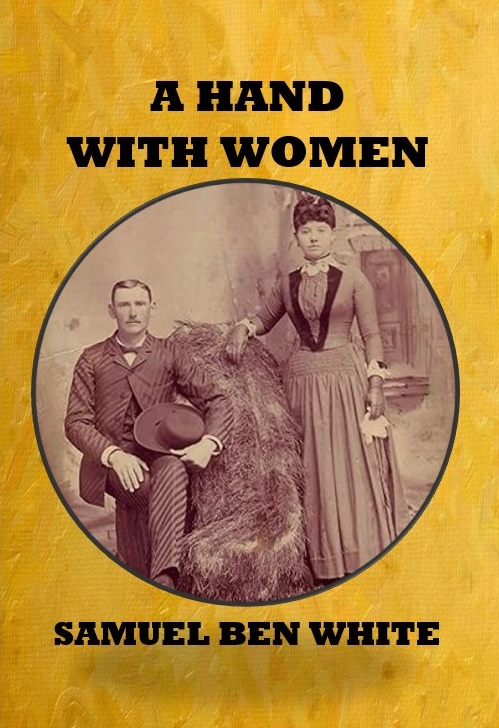
A Hand With Women

Louis L’Amour meets Agatha Christie in this mystery set on the Texas plains in the late 1800s. A mysterious woman, part of a human body, and a posse all converge on a lonesome cowboy named Morgan James.

Published by Outlaws Publishing

Available for ebook (in many formats) and in paperback.

Morgan James left McKeon, Texas, ahead of a neck-tie party the esteemed locals were preparing to throw in his honor.

His horse had been tired when he hit McKeon to start with, and after a night of hard riding, it was about done in—and so was Morg. So he stopped at what looked at first glance in the early morning sun like a deserted ranch for water and a rest. It wasn’t so deserted as it looked, for a woman with a haunted look about her lived there. She offered Morg shelter, but there was still something about her that gave him the willies.

The ranch was called the T-Bell and there were those who said that death stalked the T-Bell range. Others said it was the woman who ran it that was being stalked, while still others said she was crazy, or a witch.

And then Morg found the better part of a dead body on the part of the T-Bell range that backed up on Palo Duro Canyon and suddenly all those wild stories he had been hearing didn’t seem half-wild enough.

Sample reading

I was never much of a hand with women. Not that I had ever been around many of them I wasn’t related to, but when I was, words flowed about as freely from me as water did in those dried-up creek beds back home.
The more I think about it, that’s a pretty good description all the way around ‘cause when rain did come back home, the creeks would suddenly swell up and overflow and cause all kinds of destruction. That’s me, too. Around women, I’d get tongue-tied and couldn’t hardly make a word come out that made sense, but then, sometimes, I couldn’t shut up. I’d talk like a carnival barker and, generally, make a fool of myself.
So I had learned, mostly, to be even quieter. When there was a woman around, she didn’t generally take much notice of the quiet, homely man—whether I was standing in the corner (not unusual), or right next to her. What I did know about women-folk, they was more likely to look at and admire a fancy piece of furniture than a guy like me.
Looking back now, maybe I wouldn’t have gotten in so much trouble if’n I’d knowed how to talk to women. Or, at least, had knowed how to let them talk to me and still keep my wits about me.
You take my pa. Why, he could talk to a woman just as easy as talking to a fella. Just had that easy, friendly, way some men have about them even though I’d say he weren’t no better looking than me. But he could walk into a room and folks would notice, or he’d start yarning and the women folk would be listening as close as the men.
Don’t get me wrong: my pa loved my ma and anyone who even hinted that he might have stepped out on her would find themselves on the business end of a punch to the nose, from me or anyone who really knowed my pa. He was just … I heard someone describe him once as “charming” and I think that’s the word that fit best. I think when them moments came where I’d be shooting my mouth off like a wagon wheel in need of grease that, deep down, I was trying to be like Pa.
Another thing about Pa was that he sure never would have gotten himself in a fix like the one I was in. The only trouble I ever knowed Pa to have was with the bankers. Not that he was a robber or sharp of any kind, but he was a farmer, and farming’s a chancy thing in Texas. Maybe it is anywhere, but down there in central Texas, when one year you got nothing but rain, then the next nothing but hail, then the year after that all the dust and dirt Oklahoma can spare, why, it just ain’t a stable business to my thinking. But Pa, he loved it. Sometimes I thought he even liked arguing with the banker, ‘cause he sure did it enough.
I remember one time when he fell behind on some payment or other and the banker sent out a couple of the toughs from town to “attach” Pa’s best mules. I was just a young’un then, and was wondering what they would attach the mules to, but Pa, he stood right up to them. He was holding a shot-gun like he meant business and told them two men that if the banker wanted Pa’s mules he could come get ‘em hisself. They argued a little, but they didn’t want to argue too much with that scatter gun, so they rode off, saying they would be back with the banker. They showed up the next day, banker with ‘em but looking scared, and Pa hands over the reins to them mules just as calm as you please. Next day, he takes me along with him and we head west, away from town, and over to Old Man Possum’s place. I reckon now that I’m grown that that man’s name wasn’t really Possum, but that’s what everybody called him. My pa made a deal with Possum that afternoon. He traded two weeks worth of me for two weeks worth of Possum’s oxen.
It’s hard to say who got the worst deal out of that. I was twelve years old and pretty strong for my age, so I was set to working in Possum’s garden, as he called it. It wasn’t much of one, but it needed weeding and watering—from a can, water drawn from a well that seemed like it must have been halfway to China in depth and as far as possible from the garden and still be on Possum’s place. So I took care of that garden, slept in Possum’s barn, was fed meals that ran mostly to stews with mighty little meat by Possum’s wife (I never had no idea what to call her other than “ma’am”) and did a few other odd jobs around the place.
My father, though, he got stuck trying to finish his plowing and planting with a team of oxen that, he said, was more muley than mules. But he got it done, and we worked that farm without mules that summer—and without much talk, for I was some mad at my pa for trading me off like that—but it was a good, rainy year for that time and that place, so we had the best crop we’d ever had. Pa took the money we made, paid off that banker that took the mules, then went thirty miles away and opened up an account with another banker. Pa fixed up to be a pretty fair farmer and had a good eye for dairy cows, so though we was never rich—while I was to home anyway—he generally ran ahead and rarely behind. That other banker, the one Pa went to after the first one, his bank eventually became quite a going concern and I heard he liked to rub it in on that guy Pa had left.
When I turned fifteen, though, I lit out. I wasn’t mad at Pa, and he didn’t begrudge my leaving, but a cattle drive from way down south came through our area and the drover asked if I or my pa would like to ride along and make a few dollars as one of the men he had started the drive with was sitting back in Leander with a broken leg. I think Pa hated to see me go, but he had done some yonderin’ when he was about my age, and then he had fought in the war, so he knew what it was like to be a young man who feels the need to get out and test hisself against the world. He shook my hand, slipped me a five dollar gold piece (where it come from I always wondered, for I had sure never known him to have any extra money lying about) then told me to write my ma now and again. I said I would and lit out, nothing to my name but a used Colt, a used-er saddle, a middlin’ horse, and not enough of an idea what I was going to do for it to be considered good or bad.
When I rode up on that little farm house, boards old but took care of with white wash next to a barn in similar state, it was fifteen years later and I had a sight of riding behind me, and a lot of years. I was done in and thinking anywhere, no matter how ragged, would be a good place to stop and cool off for a moment. When I saw that it had a pump and a trough, why I thought I was as close to heaven as a body could come on this green earth, which wasn’t much green that year, but that’s not really important to the tale I don’t think.
There was an old army canteen at the base of the pump, the lid screwed on tight. I figured that was left by some good Samaritan and that the water in the canteen was so’s anybody who came along could prime the pump. It was a common practice out there in them dry lands, and every man—even the outlaws and ne’er-do-wells—knowed to refill the canteen before riding on. Why even me, riding ahead of a posse like I was, I was already figuring that my first move after getting that pump a-flowing would be to fill that canteen and set it back where it was for the next guy, even if it was them that was hunting me. So when I picked it up and nothing sloshed, I said a word my church-going parents would not have approved of. I apologized to them and the Lord, then reached for the handle on the pump. I took a good look at the water in the trough, then, and saw that it was pretty and clear, not old and scummy like I had been expecting. Fact was, there wasn’t any green at all on that trough, just a little in the grass around the trough where water had been sloshed.
Sloshed by who? I wondered, as most western people would have heard me coming for a quarter mile—and seen me for twice that—and been out to greet me or shoo me on my way. I’d seen nobody, though, so I cranked that handle a couple times and water gushed out of there like Moses’s rock. I filled up that canteen out of habit and set it by the pump, then drank some myself and splashed some on my face. That horse I was riding, an old fellow with a blaze across his nose and a faded Spectacle brand on his rump, he was already at work on the water in the trough and looked at me as if to say, “I seen this water was fine right off. What was you waiting on?”
It was a dry day, and I drank my fill, but it wasn’t really all that much; I suppose on account of having spent a lot of dry days in my life. So I filled my own canteen, then drank again.
With water in my belly, which suddenly felt like too much water when I started to walk away from that pump, I tried to think of what I should do next. Running from that posse seemed like a bad idea the more I done it. They were going to catch me, sooner or later, and even if they didn’t, someone would. And then even though I still thought I wasn’t guilty of what they said, I was guilty of … what was it a sheriff I once knew called it? Escaping justice? Evading arrest? Yeah, that was it. So even if I got shed of that posse this day, they would put out a wanted poster saying I was wanted for evading arrest and there was no way I could deny the fact.
If I was to ask my ma and pa, I reckoned they would have told me to go back and face the music. Setting a good bit of store by both justice and the Good Lord, they would have told me that the truth would set me free, or something like that. I didn’t want to doubt the Lord, but I knew the carrying out of justice would be done by men, and I had no cause to trust them. Specially not in a bunch like that. One man, I might could talk to him and set him right, but a whole bunch like that, and with me being a man who had run like he was guilty even if he wasn’t? No, I didn’t have a lot of confidence in justice being did.
The short of it was: a local man was dead and I was a stranger. I was pretty sure I hadn’t killed him, but everyone else who might be a suspect was a knowed local, which made it a lot easier to suspect me. Who knows but what I might have thought the same in their place. I told myself then that, if I was ever in such a situation, I’d cool my heels and find out what the facts was before making a decision. Such an idea was fine and dandy, but it still left me out there on the prairie with a posse likely somewhere behind—and not by much.
It was then I noticed there was a bit of a garden beyond the house, and some straggly fence guarding a draw further back. I couldn’t see anything being kept in that fence—or kept out by it—but it didn’t look broken down so I was guessing there were cows beyond those barbs. The barn door was half-closed, so I couldn’t tell if there was anything in there.
So, I up and hollers, “Hello the house!” like a neighborly westerner should. In the city, they tell me a person would walk right up to a stranger’s door and knock, but all my life I had been told that the best thing to do—the friendly thing to do—was announce yourself before even setting foot on the porch, just in case they didn’t want you to come no further. Most folks wouldn’t begrudge anyone some water, but they lived out there in the middle of nowhere because they wanted to stay in the middle of nobody and didn’t want nobody coming round unexpectedly.
And in that country, you could see who was coming. It was flat and there wasn’t hardly a tree in sight, and very little roll to the land except where that draw was. It was the kind of land that made me mindful of a man I worked for during roundup down near what would later be called Sudan. He was a grizzled, grumpy old man who once told me he picked such flat land because when his wife left him, he wanted to watch her go for a week.
Where this little farm sat, it was almost that flat. It was deceiving, though, because I had a hunch that draw was just one of the tentacles of the canyon, which one could ride up on all of a sudden. Even without the canyon, flat lands are rarely as flat as they appear and little dips and hollows can hide a lot more than one would think—just ask them that fought the Indians for them lands.
For all the flatness, it wasn’t a bad spread. The buildings could use some work, but that well was good water and in that country, water was gold. A man could run some cattle, or maybe grow some crops. I couldn’t see any way a man could get rich off that land, but I was thinking a body could make a living, and I’d seen just enough rich people to make me think the man who made a living was probably better off than the man who was rich. Me, I’d been nothing but a drifting saddle-bum, a good hand on a ranch, but I’d started to think that I wouldn’t mind putting my feet under the same table night after night, plowing my own land or cutting my own hay or riding herd on my own cattle. Fourteen or fifteen years before, I’d have said that would never be for me, but a man changes over time, or I had, anyway.
That was sort of why I had been in that town to start with, the one that now wanted me back so badly that they’d sent a posse of men to look for me. I had come there to hunt up a job ‘cause I had heard that the local ranches were hiring for a round-up. It had been in my mind that I could stay in one area for a while and keep my eye out for a likely piece of land that I could buy and develop for myself. My great plan didn’t make it past the first night.
I’ve never been much of a drinker, but I was new to town and there’s not a better place to learn what’s going on than a saloon and that town only had two of them. Looking back, I wished I had tried the other one, but I went into one called “Jeb’s” and there was a fair sized crowd already drinking. A faro game was going, as well as some kind of a wheel you could bet on. (I never liked them wheels ‘cause it seemed likely they were weighted and, even if they wasn’t, the odds of winning seemed awfully low. I played faro a few times, and won a little, but my money had always been too hard to come by for me to throw it away like that.) I ordered a drink, leaned against the bar, and surveyed the room.
Right about then, one of the guys playing faro, a big, hairy fellow with a too-tight shirt and a scar on the back of his head where the hair didn’t grow, he grabs the faro dealer by the collar and jerks him over the table, calling him a cheat. That faro dealer wasn’t much of a man size-wise, but he was quick with a knife and had this thin-bladed job out and driven deep into the big man’s right arm. The big man hollers and fetched that faro dealer upside the head with his left hand but the faro dealer still wasn’t having any of it and drives that knife into the man’s gullet.
From that point on, it was a little hard to say what all happened, but as near as I can remember, one of the big man’s friends took exception to what had transpired and smashes a chair over the faro dealer’s head. The dealer went to his knees, then the man who was spinning that chance wheel comes up with something like an Indian club and brings it down on that friend’s head. Then someone else jumped, then someone else. Before you knew it, everyone in that saloon was throwing punches.
Including me.
Now, with the clear vision of looking back, what I should have done was skedaddle out of there, even if I had to duck under a table and crawl. But I had been in some fights before and usually gave a good account of myself. Not a big man—just right at six foot—I had the muscles of hard work and had learned a little just from being knocked down here and there. So when a fella crashed into me and spilled that drink all over my best shirt, why naturally I straightened him up and give him an upper-cut to the chin. Somebody else took offense at that, or maybe just wanted in on the fight, and jabbed me in the kidneys. It hurt something fierce, so I took to pounding on the man who I thought had done it. He was standing in the right spot, anyway.
From there on, it was just a circus act, with men throwing chairs, punches and each other until the room was a mess and we were, too. Of a sudden, a shotgun blast goes off and we all stop what we’re doing to see the sheriff of that town standing in the doorway, a couple deputies by his side and a scattergun in his hand. Then he tells us we’re going to pay for the damages and anyone who tried to leave the room without putting at least five dollars in the saloon-keeper’s hat was going to jail until such time as he, the sheriff, thought we deserved getting out. Now, I begrudged that five dollars, for I had been planning to send it to my bank, but I figured five dollars was better than a night in jail so I chucked it into the hat and the sheriff let me walk out the door, but not before asking my name. I told him it was Morgan James and he let me go but told me not to leave town right away.
My horse was tied up out front, so I hopped up on it and rode him out to a clump of trees I had seen west of town, figuring to bed down there for the night since the few dollars I had hoped to spend on a room were now in my Cindy Lou Fund, as I sometimes thought of it. They weren’t so much trees as just tall scrub, but after checking for snakes they made for a decent place to bed down, and a little off the road. I ground-hitched the horse and lay down.
It was just a few minutes after I stretched out that I heard a ruckus coming from town. I wasn’t but a couple hundred feet from the back door of the other saloon and sounds can travel pretty well on a prairie night. Once my ears was attuned, which was mostly a matter of waking up, I heard someone shouting that someone named Buster McKeon was dead, and something about his head being stove in. Someone else said something about him being still on the floor of Jeb’s when the fight was over and how they had thought he was just knocked out until someone felt of him and realized he wasn’t just out, but dead. I was listening good, then, for who doesn’t like to hear a good yarn like that?
It was at that moment that I began to wish I had crawled out when that big hairy fella got stabbed in the arm ‘cause my ears caught real clearly someone saying the name, “Morgan James.” Someone else said something about how they all knowed each other so it had to be that stranger who killed this McKeon.
Part of my brain said I ought to walk in right then and clear my name, but that part of the brain was stampeded by the rest of me that said I better get out of there because McKeon was the name of the owner of the biggest ranch around. I didn’t know Alexander McKeon or this Buster by sight, but I told myself there was no chance I was getting a job in that town now and I had best put some distance between me and them good folks.
As the crowd moved off towards where I had seen the sheriff’s office, getting louder and angrier as they went, I hurriedly and quietly rolled up my blanket, saddled my horse (he wasn’t too happy about that!) and slipped off into the night as fast as I could go without making any noise. There’s always noise, though, and with every one I made, I scrunched my shoulders, waiting to hear someone from town holler, “He went that way!” I didn’t hear any such thing, but I still didn’t relax much even as I prodded the horse to a slightly faster gait as we got a couple hundred yards from town.
Most of a day later, after watching over my shoulder and seeing a faint dust cloud that I was sure was a posse on my tail, I arrived at that little, run-down farm. Even though that well water was as good as I had said, I was about to come to the conclusion that no one was home when the front door of that little house opens up and a woman’s voice says, “You’ve had your drink, now move on.”
I looked up in surprise and for the first few moments I couldn’t have told you whether she was tall, short, fat, skinny or pretty, because all I could see was that old Sharps .50 she was holding that would have drove a hole through me bigger than my horse if let loose at that distance.
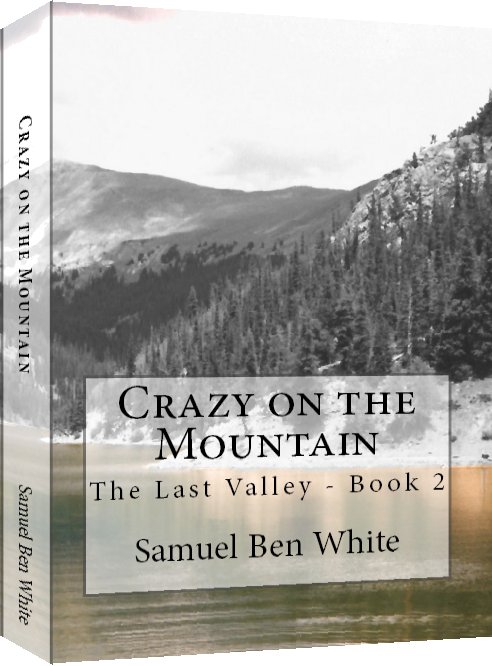
Crazy on the Mountain – The Last Valley – Book 2

Josh Overstreet and his sister Claire have been carving a life out of the ash for more than half a decade, unsure whether anyone yet lives outside the small valley where they have established their town of Overstreet with two dozen others.

Then Deanna Pembleton stumbles into the valley, asking for help for herself and her friends. Claiming they have eked out a life much like that of the people of Overstreet, she begs assistance, which Josh is willing to give. She is, however, clearly unhinged on some level. Could the people she is claiming to want to help just be figments of her imagination?

Against the advice of almost everyone in Overstreet, Josh and Adaline set out to try and take food to Deanna’s people, hoping that people still exist outside “the last valley”.

They never dreamed their valley might not be there for them when they get back.

Be sure and read how this story started in “Ashes to Ashes” and concludes in “Book of Tales“!

Available now on Kindle and paperback.

Sample passage

I happened to ask, “Deanna, how long have you lived in Vail?”

“What? Oh, you might say I’ve lived there all my life.” Adaline and I looked at each other in surprise, for this was not said with the hick voice Deanna had mostly been using of late. It also made us wonder about our earlier thought that she was from Denver. She continued, in a somewhat conspiratorial tone, “My great-grandfather was the first of the family to come to Vail. The story that he told his family was that he had been a banker in Birmingham, Alabama,” the names of the city and state were said with a deep, southern accent. “But the bank had gone bust—through no fault of his own, of course, so he had headed west to seek his fortune. He said he worked several jobs in towns both big and small before landing in Vail, broke and starving, worried about his wife and kids back home for it had been some time since he had been able to send them money.

“But it was ski season and he took a job in a kitchen at one of the hotels. He worked hard and sent money back to his family and, by the end of the ski season, had worked his way up to waiter. Over the summer months, he proved himself invaluable and was made assistant manager of the restaurant, and then manager. At that point, he sent for his wife and kids and was ever so happy to see them. He got his kids—who were teenagers by then—jobs in Vail and they saved their money and, would you believe it, one day they bought the restaurant! Using all of his banking and monetary skills, he was eventually able to buy the building the restaurant was in, and his ‘empire’ was begun!”

Deanna chuckled, then said, still in the refined voice of someone who had grown up on the tonier side of life, “And thus began the Coventry empire of Vail. Pembleton is my married name, of course. I grew up attending the best schools, a member of all Vail’s best clubs, and groomed for a career in hoteliery. Yes, I know that’s not really a word, but my father always said it should be. But, I went off to college and fell in love and got married and, well, the last thing I wanted to do was to come back to Vail for anything other than a visit. Best laid plans of mice and men, right? My father had a stroke when I was just about to turn thirty, so my husband and I came back to watch over the business while he recovered. What was supposed to just be a few weeks in Vail became years, with my own children going to those same schools I did, joining the same clubs, being the same spoiled, rich brat I was. Oh how I wish we had never left Denver. My husband, Paul Pembleton, he rose to great heights in Vail, sat on all the important boards and had chairmanships in all the clubs, but I think he always resented the thought that he had only gotten there because of my family connections. It wasn’t true, of course, but it’s how men think sometimes. You know, I think he actually appreciated the ash cloud, for it allowed us all to go back to square one, with no one being anything more or less than what they could contribute.”

In a sly voice, she continued, “But speaking of square one. When my own grandmother was nearing the end of her life, I went and sat with her for many an hour, listening to her stories of growing up in Alabama, of earlier days in Vail than I had ever known. And one night, when she was strangely lucid,” a phrase that got both mine and Adaline’s attention, for we had both been thinking it in relation to Deanna, “She told me a story. According to her, my great-grandfather hadn’t been an innocent bystander in the failure of that bank, but the main instigator. His father was the actual president of the bank, you see, and my great-grandfather had been manipulating loans in some way that allowed him to pocket a sizable sum on the side. Undeclared, you might say.

“Then, one day, maybe he thought his father was about to get on to him, he withdrew an enormous sum of cash from his personal account, walked out of the bank, and no one knew where he went. Didn’t go home or anything. When my great-grandmother called her father-in-law that evening, he said they should call the police, thinking something nefarious had happened to the up-and-coming young banker. Perhaps a ransom call would come in any moment. It was then, so the story goes, that the bank president first realized what his son had been doing. He called his daughter-in-law and convinced her not to file a missing person’s report, for fear of what the publicity would do to the bank. He did agree, however, to engage the services of a private detective.”

Deanna was still speaking in a normal voice, though it became a little dreamy as she said, “I wondered if it were a private eye like in the movies: snap-brim hat, long trench coat, steel-jawed chin. Anyway, the private eye had little trouble following my great-grandfather—though ‘great’ is probably the wrong word for him,” she said with an ironic chortle. “It seems my progenitor had left a bread-crumb trail of prostitutes visited and affairs started that led all the way to Vail, where he was working as a lift attendant at the ski area while, um, serving a rich lady at night while her husband attended to his … let’s say: board functions.

“When the bank president learned of this, he brought his daughter-in-law and the kids out to Vail for a ski trip, hoping to engender one of those movie moments where the miscreant is surprised by his one true love and repents of his wicked ways. According to my grandmother, it was almost like that. Her father was happy to see his children, but not so happy to see his wife. Still, he stopped the fooling around, for a while, and took his family in. His father got him a respectable job as the manager of one of the local restaurants and my great-grandfather gave all appearances of becoming a respectable citizen again. What he was actually doing, though, was continuing his association with the rich lady. He got money out of her somehow and bought the restaurant. Set his wife up as the general manager, dumped the rich lady for a younger mistress, and made his children managers of other properties he had acquired. By the time I came along, great-grandfather was dead and his true story had been buried longer than he had.” She laughed heartily before adding, “There’s even a picture of him in the museum, all dressed up and looking distinguished, with a little plaque about how he was one of Vail’s leading citizens and top philanthropists. He even gave enough money to one of the local churches that they named the recreation building after him. Can’t you just see some youth minister telling the kids who came out to play volleyball, ‘And this building was named after a notorious sinner, who would have slept with any of your mothers who let him, in Jesus’ name, Amen!’” She cackled with laughter and then slipped back into one of her songs. Adaline and I looked at each other strangely, but continued on without a word. We did discuss later how much of the story we thought was true, but had no way to come to a conclusion. And we still thought Deanna was unhinged at best.

We made it to Vail in less than a week, which really encouraged me—and made Adaline wonder why I had thought it would take three weeks. The thing was, I hadn’t been counting on the Interstate being in such good shape, which it was. There were only a couple places where the ash had slid across it, and neither of them deep. And while Black Gore Creek ran strong in some places, it didn’t cross the highway at any point. As we pulled up in sight of Vail, I was smiling and telling Adaline how surprised everyone would be if we pulled back into town before they even came to look for our signal.

“Where are your people?” I asked Deanna, once we had her attention for she had been in the middle of a rousing rendition of either “Amazing Grace” or “I Fought the Law” (it was hard to tell).

She crawled up to crouch behind the front seat and, pointing, said, “Up yonder. You cain’t see it from here, but it’s the other side of that big white building by the ski slopes. I heared you talking about how the wind blew that gash in the ash—gash in the ash,” she repeated with a laugh, “And we had something just like that. People to the left and right was all dead, but our little gash was just fine. All things considered, I mean.”

“Think we can make it before nightfall,” I asked, for we were still a good five miles out, “Or should we make camp and get there in the morning?”

She looked up at the bright spot of the sun that almost shown through the ash and said, “Let’s see if we can push through. If we can’t, at least we can stay in one of the buildings on the edge of town. We might make’er this evenin’, though. Them’s good horses you got there.” This was a surprising statement, for she had frequently complained when we stopped to water the horses or, worse, gave them a lengthy breather and roll when we came upon that rare meadow of thick grass—or any grass. I couldn’t blame her for being anxious to get to her people, but I did get tired of her complaining—especially as we had been making such good time.

As we pulled closer to the town of Vail, some thunderheads started building to the west. “I hate to say it, Deanna, but we may need to pull up and find shelter.”

I had expected an objection, but she looked at the sky and said, “Them’s buildin’ up to be gully-washers, all right.” She pointed off to the right and said, “They’s an old mechanic’s shop up yonder. You’d be able to pull the horses into the dry.”

With impeccable timing we got the old garage doors open and the horses inside the bay just before a wall of summer rain came through. I enjoyed seeing it, though, for it made me think of the rains we used to have when I was growing up. They would come up on us all of a sudden, pelt you with raindrops the size of golf balls, then pass through as quickly as they had arrived. I could see some sunlight to the west, creating a golden line on the mountains in that direction, which made me think this would be one of those storms. It was, but by the time it had passed through it was too late to go anywhere so we set up camp in the old automotive shop. I was afraid Deanna would be upset by us stopping that close to her goal, but she just curled up on a couch in the manager’s office and went to sleep.

All the Time in Our World

an Edward & Marianne story

by Samuel B. White

Synopsis

Two nervous west Texas teenagers on their first date are suddenly engulfed in a horrific thunderstorm and take shelter in an old barn. When the storm subsides, the barn is gone … and so is everything else, except their bicycles. They ride their bikes on a mysteriously well-maintained road in an otherwise barren land to an ancient castle whose single resident claims to already know them. Edward and Marianne have been whisked thousands of years into the future and their only hope of returning to their own world and time is to follow a mysterious traveler named Marcus and a hulking warrior named Daniel into a battle for the soul of all mankind. Over almost a year’s time and more than a thousand miles of travel, Edward and Marianne are trained “physically and mentally” to put together and lead the army that will fight the battle for the beginning of the end of the world. As Edward is taught to be a general and a sword-fighter and Marianne learns to use a bow and lead as well, they begin to learn that their greatest asset just may be each other.

Order on Kindle or paperback.

And be sure and check out the sequels: Some of the Time and A Thousand Miles Away.

Reading Sample

Prologue

A wide plain baked by sunlight.

The lone figure touches a parched tongue to chapped lips and realizes the action no longer seems to have any effect.

She casts a fearful glance up at the sun. She can’t make out its orb, just a brighter spot in the already glassy sky.

It has moved some since last she looked. Still a long way from the horizon, it promises many hours of blinding light.

Still, she doesn’t look forward to night, for at night she cannot work.

She looks down at the sheaf of papers in her hand. Why is she still working on them at all? What could it possibly matter?

She has asked the question out loud many times, but not this time. She knows why she continues to work. She works because she has to. She can do nothing else.

Is it only days now? She tells herself that people have thought that before. She leafs through the pages and her hazel eye stops briefly on a name. She knows the name. She knows what’s on the paper so well that she feels as if she knows the person the name belonged to. He lived back before the world’s middle age, but she would wager that he wondered if the days were almost spent.

Was he wrong?

Her great-grandmother used to tell her that the ending wasn’t just at the end.

Chapter One

Beneath the canopy of pecan trees lay two young people, a chaste distance apart an observer might reckon them, yet closer were they in their own minds than they had ever been to another. They were in the spring of their lives, and a rare occasion it was for their spring coincided with the calendar’s.

He thought about moving closer, but wondered if he could, for he was possessed of that awkwardness that comes from not knowing where one stands in the eyes of the desired and fearful that the standing was further away than hoped. His hand moved closer to hers, but almost imperceptibly so.

She didn’t perceive it. A young woman of light brown hair which tended to grow lighter in the summer months, she possessed the body of a somewhat younger girl, though her body was starting to portend the curves which would come later. She was the younger sister of a woman who drew men’s attention and had never drawn any herself—or so she would have said—yet she was one of those women upon whom age would smile, making her more attractive as the years went by; which was a process that was moving far too slowly as far as she was concerned.

She didn’t perceive the slight motion of his hand because she was too busy thinking about him. She had known him since grammar school, had been his friend, but had only recently noticed him. As she thought of him, she thought he was a handsome young lad, or—perhaps—that he was becoming handsome. He had sandy brown hair that he wore a bit long for the day and a mostly clear complexion around an intelligent smile. Standing, he was tall and lanky, if not actually skinny, with an athlete’s ease of movement combined with the unexpected bursts of clumsiness so prevalent in men of his age.

The pecan trees provided such a canopy overhead that the sky was only visible in small patches. Mockingbirds chittered in the trees, mocking each other most likely. A frog’s call grated in the air, adding to the soft din of families on picnics, and the ever-present crickets whose noise was an underlying constant. Learned men who studied the sounds of the frog would have studiously debated whether the sound were the sound of the frog searching for a mate or flies, but the more mundane answer was probably that the frog just did not like silence. In the distance, another mockingbird spoke, perhaps mimicking the frog.

Neither frogs nor birds took any notice of the young couple who lay on the thin blanket beneath the pecan trees. Neither did the people who ate their sandwiches from plastic bags or tossed a plastic disk back and forth on the warm and windless west Texas day. Had they looked, they might have noticed that the young man was nervous. Nervous, yet underneath—or perhaps overriding—that emotion, he was ecstatic.

Near the old wooden bridge they lay, the waters of the creek already dry for the year, but the young man smiled because beside him lay the woman he had dreamed of for years.

Neither would be mistaken for movie stars. Walking together they would have drawn little to no notice for they turned heads with neither unbelievable good-looks nor eye-catching ugliness. They were the type of people who were easily overlooked by an appearance-conscious world.

This is the way it’s supposed to be, he thought. Hanging out in one of your favorite places in all the world—at least, the small part of the world he had actually seen—with a girl you were … crazy about.

He didn’t know if he were in love with her. He had been given—and occasionally listened to—all the lectures about love versus infatuation and he knew enough about love to know he didn’t know much about love. And what he knew about love and about himself was enough to know that what he felt probably wasn’t love … at least not yet. It wasn’t exactly infatuation, either, he thought. Infatuation was short-lived and he had known her way too long to be infatuated. He liked her, and she was pretty, and she seemed to like him. Enough to go out with him, anyway, which was a good sign. But was it love? Would it turn into love?

He knew better than to even ask such questions. Asking such questions always led to trouble, he knew, because girls never thought the way guys did and when girls found out a guy was thinking along those lines, they always seemed to be way ahead of him on the idea or way behind and the difference led to crashing problems. So Edward lay back and vowed not to voice what he was thinking—even if he could, which was doubtful, considering how much of it consisted of incomplete sentences.

Still, he felt like he had to say something. Like most teenage boys, he thought that to sit in silence for any great length of time was a mistake. Or maybe he had never thought about it at all. He was just going on instinct and instinct said that if you sat silent around a girl for too long, she’d eventually start thinking about other things (meaning: not him) and that couldn’t be a good thing because soon (of course) she’d be thinking about some other guy and—

“I love it here.”

“Hmm,” Marianne replied.

Marianne was thinking that this really was a beautiful place and she couldn’t believe that she had lived this close to it for so long and had never explored it before. She was also thinking that she enjoyed the company she was sharing it with and wondering if it would be a mistake to tell him so. She knew that if you told a guy you were enjoying the time spent with him, he usually made a logic leap to the idea that you were madly in love with him and, so, were either after him and were someone to be avoided or were ready to set a date.

She knew better than to dare speak what was actually on her mind. She was thinking that it wasn’t just that this was a good date, a better than most date, it was that this had so far been a great date. Not because it was exciting or thrilling or the most romantic thing she had ever heard of, but because she was getting the idea in the back of her mind that she was enjoying herself more with this guy than she had with any other guy in … forever. She was starting to see herself wanting to date this young man on a regular basis but could she tell him that now without completely ruining everything? She doubted it.

So, in spite of what initially seemed a major setback, the day had gone better than either could have predicted.

It had all started a couple weeks previous, towards the end of the school year. Edward had ridden his new twelve-speed to school even though he knew that in the minds of most of the people at O.H. Cooper High School there were only two kinds of people who rode bikes to high school: dwizzles who either weren’t old enough to drive a car or weirdoes who rode a bike for some sort of exercising fun. Exercising was highly touted at Cooper High School among the constituents, and even bicycle riding, but only as a recreational activity, never as an actual mode of transportation.

When he had left home that morning, the idea of biking all the way to school had seemed like a good one. He had been riding out in the country and getting in shape and the five or so miles to the school had not been daunting. As he had drawn closer to the sprawling campus at the end of Sayles Boulevard, though, trepidation had begun to set in. Could he get to a good place to lock his bike up without his friends seeing him? What would they say if they did see him? Many of them knew he rode his bike out in the country—but to school? What sort of humiliation might he be setting himself up for? Was it too late to ride home, hop in the car and get to first hour on time?

He figured the only way to deal with it effectively would be to just brazen his way through it. Pretend like it were something he did every day. Maybe even look disdainfully on everyone who didn’t ride their bikes to school. Yeah, that’d be the way to do it, he thought. Attitude was everything.

So he had pulled up to the bike racks and climbed off like he did it every day and reached for the lock as if that were something he did every day. He remembered all the times back at Jefferson Junior High anyone had forgotten to lock their bikes at the bike rack. Rarely were bikes stolen, but the owner generally came out of class to find his mode of transportation dangling from the branches of the nearest tree. It had never happened to him, but he had seen it more than once and had been everlastingly grateful the one time he realized he hadn’t locked up his bike that no one had caught the oversight.

Out of the corner of his eye, he saw someone else pull up to the bike rack. His first thought was that this was good because it would make it look as if he weren’t the only person riding a bike to school that day. With a rapidity to rival the greatest minds in the world, he instantly jumped to the idea that it could be one of the dwizzles or weirdoes, in which case he didn’t want to be seen riding a bike to school like one of them. Now, the only thing for it was to just walk away and pretend he hadn’t noticed anyone else pull up and make sure that—if anyone were watching—they’d know he was walking away without being aware someone else had pulled up. It was all a part of the high school dance he stepped to every day of his life and these moves and motivations didn’t seem to him as ridiculous as they probably do to the reader.

He slung his backpack full of books he rarely opened over his shoulder and was about to step away when a voice asked, “Edward?”

He thought of a dozen people who could be calling him by name right then and none of the faces which jumped to mind were pleasant ones. Maybe nice enough people, granted, but not the kind of people he wanted to be seen walking away from a bike rack with. This was high school, after all, and in spite of what the psychologists might say, image was everything.

But there was no getting out of it now, so he stopped and casually turned his head, making sure that anyone who might be watching would know for sure that he was doing this casually. His momentary surprise at seeing he was not being addressed by either a dwizzle or a weirdo was quickly overcome by the normal teenage boy fear of being addressed by a girl.

“Hey, Marianne,” he replied, trying to sound casual but afraid his tongue was sticking to his mouth like it usually did when addressing someone—anyone—of the opposite sex. Being the girl, his tongue was only following the lead of his flash-frozen brain.

“I didn’t know you rode a bike to school,” Marianne smiled.

“This is actually the first time I’ve done it since Jefferson.”

“Ever get yours thrown into a tree?”

“No, I missed out on that.”

“At Lincoln they just stole your bike if you left it unlocked. If the police ever found it again, it always seemed to be somewhere out by Phantom.”

“Ever happen to you?”

She gave him something between a smirk and a shrug that indicated it probably had.

Edward and Marianne had gone to elementary school together for fourth and fifth grade back at good ol’ David Crockett Elementary and he had had a crush on her almost since the first day she walked into Mrs. Landers’ class. In the two years of elementary school, he had had the nerve to actually talk to her maybe three times. Then junior high had rolled around and, even though he could see her house from his, he was in the Jefferson district and she went to Lincoln. He had seen her a few times over the next three years—in the neighborhood or at a store—and they always spoke cordially, though never had much to say.

He had just about forgotten his crush on her until high school. He had had plenty of other unrequited loves during middle school, after all. Freshman year he had just seen her at a distance and that had been that, sort of. His old crush for her had been in the back of his mind, but had never really been fertilized.

But sophomore year they had both wound up in Miss Gober’s geometry class and, sitting there day after day, he had fallen for her all over again. He had finally talked to her, and—as part of a group—they had even headed over to the mall or Taco Bueno for lunch a time or two. But he had never once gotten the impression she was the least bit interested in him, so he had never asked any questions that might give him the answers he wanted and sophomore year had ended and that had been that.

Junior year had been little different. They had no classes together, but they had many friends in common and so were found in the same group now and again before school, during lunch, at pep rallies and the like. He had spoken to her a few times, though it would be hard to call any of the encounters a true conversation. For one, it was almost always amidst a group so there was no chance for truly close discussion. He had daydreamed what he might say, but had always found a reason not to say it. Someone else walked up, they were in a crowded place, the earth was orbiting the sun. There was always a reason.

They were seniors now, would be graduating from good ol’ Cooper High in a couple weeks, and here he was finally with a chance to talk to her and a five minute window in which to do it. And it had only taken him nine years. With a sense of melodrama that only a high school kid who thinks every moment in time has led up to the one in which he now occupies, it occurred to him that if he didn’t talk to her now he probably never would. She’d go off to college and he would too and they’d probably never come back to Abilene and … he had to say something.

“You bike?” was all he could come up with.

“Yeah,” she shrugged.

He thought about saying that that explained why she had such great legs, but he didn’t and realized it was probably for the best. Not only was it inaccurate (because he had thought her legs nice for as long as he had known her and that probably had nothing to do with the bike), but he also knew that lines like that only worked in old movies and only served to make the user sound like a letch in real life.

Looking for some way to continue the conversation, it suddenly occurred to him that, living two blocks away from him as she did, she had probably taken the same route he had to get to school. “Pretty long ride from our part of town, huh?”

She shrugged, “I like it, though. Gives me some time to think and plan for the day.”

“Kind of bites going home though, doesn’t it? After a long day here.”

“Not really. In a way, it provides a good wall between school and home. Once I leave here, I’ve got a good half hour to put everything about school behind me. By the time I get home, school’s another world.”

Barely hearing her as he steeled his courage, he asked, “You ever go for long rides? Like out in the country?”

“Not really. I’ve thought I’d like it, but I guess I was worried about being a girl alone and all that.”

“I hadn’t thought about that, but I can’t blame you. What about riding with someone? I mean, well, um, ah, I like to ride out to the State Park and I was, uh, wondering if you’d like to do that, too, sometime. Together, I mean.”

“You know, that might be fun,” she replied cheerily. “The State Park, isn’t that out by Buffalo Gap?”

His heart was beating so hard he figured it probably showed through his shirt and his mouth was as dry as new sandpaper. Untying his tongue, he managed to ask, “Are you free this Saturday?”

“Ah, no,” she replied. Then she quickly added, “My mom and I are going down to look at Texas A&M. We’ve had it scheduled for a couple months.”

He figured his window of opportunity had closed with a resounding thud just then, but she told him, “I could go the next Saturday.”

His heart had almost exploded (as well as his head) just then, but he managed to say something unintelligible that was roughly affirmative and they promised to get together the next week and plan out the trip.

They had peddled the twelve miles out to the State Park with the intention of taking a nice dip in the spring fed pool when they got there. They had arrived to find that the pool was not open yet because, it had been discovered, a pipe had ruptured during the winter and hadn’t been discovered until earlier in the week. Men were hard at work on the problem and a park attendant was assuring everyone who came by that the pool would be open the next week, but that didn’t suit the needs of the people who had driven all the way out to go swimming, let alone those who had bicycled out.

This had been a tremendous blow to Edward. He wasn’t a particularly good swimmer, but he had looked forward to seeing Marianne in her swimsuit. Not that that was the only reason he had asked her on a date like this, he reminded himself, but it had been a looked-for perk.

So they had peddled down to one of the tree-shaded picnic tables and eaten their lunches and tried not to let the other person notice just how close they were to exhaustion. They were both hoping and praying that the other person would not suggest turning around and riding back into town, yet. After lunch, they had spread out the sheet they had brought and—in completely chaste fashion—lay down on it to rest and talk.

It had seemed like a good idea at the time, but as they lay there Edward began to think that he might never be able to get up again. So he sat up and pulled his knees to his chest a time or two to stretch his hamstrings. As he did so, he looked over at Marianne.

She was either asleep or had her eyes closed against the bright Texas sunlight that peeked through the pecan branches overhead. Either way, she couldn’t see him staring at her. Even then, he only took furtive glances, then quickly looked away lest she—like some forest animal—could somehow sense his staring.

He wondered what it was that he had always liked so much about her. There were prettier girls at Cooper. Heck, there had been prettier girls at Crockett. So why had he always had this crush on this particular sandy-haired young woman? Her face was pretty, but she was no model. Her figure was attractive but a little on the slight side. She had really nice legs, but she hadn’t in elementary, so that couldn’t have been it.

Maybe it was her smile. Her mouth might have been considered by some to be a little large, but she had a great smile. And she smiled a lot. Maybe that was it, he thought: maybe it was because Marianne almost always seemed happy. Even in those moments when, like most high school students, she complained about the world around her, there was an air of humor and hyperbole behind all the angst.

Suddenly proving that she was awake and had somehow noticed his stealthy glances, she asked, “What?”

“Hmm?” he asked, shaken from his reverie.

“You keep looking at me funny.” Reaching up a hand to check, she asked, “Do I have something in my hair?”

“No,” he replied, blushing.

“Then what?” she asked, sitting up, stretching her legs much as he had.

“Nothing,” he replied shortly, maybe a little too guiltily. Hoping to quickly change the subject, he asked, “You ready to head back?”

Looking at him as if still hoping to discern what had just been going through his mind, she replied with a laugh, “No. I’m wishing I had brought my mother’s cell phone so I could call her to come pick me up.”

He reached into his backpack and offered her his phone. “I always bring it,” he shrugged. “In case I get caught in a storm or have a wreck or something.”

She pushed the phone away and said, “I was joking. I have one, too. I just hate using it.”

“Really?” he asked, truly surprised. He thought he used his phone less than anyone he knew, but he still never went anywhere without it.

“My mother’s always told me that phones were a replacement for true inti—friendship. I guess her words soaked in on me.”

“Your mom sounds a lot like mine.”

She looked around and commented, “It’s so beautiful here. Like we’re in a whole ‘nother world from Abilene. Are there nature trails and stuff like that here?”

“Yeah. Some good ones.”

“Well, sometime—when I’m in shape—I want to come out here and walk around and take a dip in that pool.” She looked at him with that familiar twinkle in her eyes and said, “But today, I better head back while I can. ‘Cause if I stay here one more minute, I’m going to be here until the paramedics come for me.” She held out her hands and asked, “Help me up? ”

He bounced to his feet as if he were sitting on springs and took her hands in his. As he pulled her up, she grimaced and told him, “I feel like a little old lady.”

As he held her hands for that moment, he thought of all that he wished to tell her. How he had had a crush on her for nine years now. How he had sat out on his back porch looking across the park, just hoping she’d come out on the porch of her house so he could wave hello. How he’d sat there all the way through geometry wanting to ask her out. But all he managed was, “I’ll fold the sheet.

They loaded up their backpacks then and got on their bikes. As she groaned at the first pressure to the peddle, he asked, “You sure you don’t want to call?”

“I’m fine,” she laughed.

“That you are,” he wanted to say, but wisely didn’t.

The little hill getting out of the park was hard on their legs. Even his, for though he often rode far more than twelve miles in a day, it was usually in a straight shot and not with a long idle time in the middle. Once out of the park and onto the highway, though, they both began to feel their legs loosen a bit and the prospect of the ride back was not nearly so grim. It was a beautiful day, after all. Not as hot as usual for that time of year, a little bit of cloud cover, and every now and then a touch of a welcome breeze.

They were about halfway to Buffalo Gap when they felt the gust of wind coming up behind them. Edward turned to call back that that ought to help them get back home a little quicker … and then he saw the cloud.

It was a dark cloud. The darkest he had ever seen. It roiled and billowed like the front edge of an alien invasion from an old 2-D movie. It was filled with lightning and the air was suddenly filled with the roar of thunder and before he could tell Marianne to look out or anything (he wasn’t sure what he could have told her), the cloud had caught up with them and they were being pelted with cold, hard rain drops the size of June bugs.

In a matter of seconds, he could no longer see fifty feet ahead of him and had to look hard to make sure Marianne were still with him. He let her pull up alongside and called out over the noise, “We’ve got to find some place to pull over!”

“You lead, I’ll follow!” she shouted back.

There was a bar ditch beside the road, but he figured that would soon be running brim-full with water. So he peddled on a bit until he found a place to pull off. He saw a shelter through the rain and made for it even though at first glance it was just a darker place in the darkness. The going was tough and the road was a washboard, but he finally pulled into what appeared to be an old barn. It was empty, but the smell of manure was fresh in it, so it wasn’t completely out of use.

Marianne pulled in right behind him, soaked to the skin. Even in the midst of a near crisis, the teenage boy side of his brain remarked that he was getting to see her swimsuit after all, but he quickly swatted the thought away and set about closing the big doors.

He was trying to work up the nerve to suggest they get into the loft, where there might be dry hay, when he turned to find her already climbing the ladder. He scampered up after her and found her sitting against a post, trying to put her hair back into a pony tail. She said something to him, but he couldn’t hear her for the sound of the rain on the metal roof.

Edward came closer and asked, “What?”

“I said, ‘It’s kind of loud in here!’” she laughed.

He sat down beside her and thought about saying something about how he’d always liked the sound of rain on a metal roof but figured saying it would spoil the moment because he would probably rupture a lung getting it out loud enough. He took her hand as he leaned against the railing of the hay mow and she didn’t seem to mind so he figured he was in the midst of the best day of his life.

She leaned up against him and said, loud enough for him to hear, “My legs really didn’t need another stop. If this lets up, I may not get going again.”

He made certain the cell phone was still in the backpack and said, “We’ll call as soon as it’s quiet enough for someone to hear us.”

She laid her head against his shoulder, nodding as she did so, and he decided that this was undoubtedly the best day of his life. To have a girl—not just any girl, but Marianne—fall asleep against his shoulder while sitting in a barn on a rainy day … well, it was just something he contemplated with joy right until he fell asleep, too.

It was a pretty good day for Marianne, too. She had never had a crush on Edward, but over the years she had come to have a fondness for him that she realized she didn’t have for any other guys. Until the day he had asked her out, though, she had never really given any thought to going on a date with him. If asked to name her ten best friends at school, he might have appeared on her list, but if asked to name the ten boys she most wanted to date, he would not have appeared. And now she was thinking he might have just jumped to the top of that second list. She asked herself why. Why did she like him? Why had she never realized it before?

He was tall and a tad gangly, but sort of cute. And she had always enjoyed talking to him on the few occasions she had given it a shot. But, she told herself, she had been sucked into the culture of her time and had spent an embarrassing amount of time swooning or pretending to swoon over the same guys the other girls presumed to pursue.

Marianne and her friends had often made up lists. Sometimes lists of movies or favorite songs, but most often lists about guys. Best hair. Best face. Best derriere—though that was not the word they used. She could not remember Edward being on any of those lists even though, as she glanced at him, she realized he was fairly attractive. To her own embarrassment, she could not remember having suggested him for any of those lists. Was she really as shallow as that?

She hadn’t dated much since turning old enough for her mother to allow her out of the house without an armed guard, but when she had, she had been singularly unimpressed with most of the guys she had gone out with. They were either obsessed with themselves or sex and had quickly grown boring if not outright boorish. Yet here they were in a hayloft and rather than try something, he had held her hand. She realized it might sound silly or juvenile to some, but to her it was incredibly sweet.

So here was a nice guy, who she had somehow always known had liked her, who was rather cute, and she had also known that his character was a level or two above most other guys she knew. Why, then, had she waited until senior year to finally decide she liked him, too? And not just senior year but the last week of senior year?

After agreeing to the date, she had mentioned it to some of her friends. While not met with derision or disdain, none of her friends had been particularly impressed. But, as she had started telling them how much she was looking forward to it, she had slowly come to realize just how true that was. Without exaggeration or hyperbole, she had begun to tell her best friend, Shelinda, about Edward and had started realizing then that she liked him—liked him more than she had ever known.

It was with these thoughts that, much to her own surprise had she given it any consideration, she fell asleep.

She was asleep on him for a few minutes before he realized it.

“Edward,” he heard a nervous and scared voice saying.

“Yeah?” he asked, coming awake but not yet opening his eyes because the sun was so brilliant. The realization that the sun was so bright—when the last he remembered, he was in a darkened barn—made his eyes fly open. Marianne was standing next to him and he jumped to his feet beside her.

There was no barn. No rain. And, as far as he could tell, they weren’t anywhere near Buffalo Gap. The row of palm trees made him think they weren’t even in west Texas anymore.

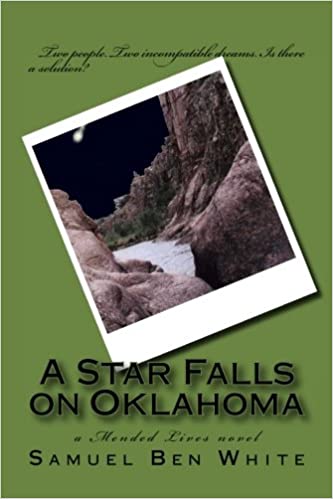
A Star Falls on Oklahoma

a Mended Lives story


Rising star Sonya Kiel suddenly drops off the grid and lands on the doorstep of her cousin Lynette, who lives in western Oklahoma. Telling herself she’s just slumming and slowing down, Sonya finds herself enjoying the bucolic lifestyle … and Lynette’s best friend, a youth minister named Andy Brockton. Her life begins to be pulled in two directions as part of her desires to return to the bright lights and the silver screen, but another (and previously unknown part) wants to leave it all and follow Andy onto the mission field. Her dilemma becomes, literally, a life and death decision for her family.

Order today on Kindle or paperback

Andy and Sonya also appear in the murder mystery “Ghosts of Families Past“, so make sure you read that one, too!

Reading Sample

“I can’t believe I let you talk me into this,” he grumbled as she straightened his tie. “Tell me again how you, a girl from western Oklahoma, have a cousin from England.”

Lynette let go of Andy’s tie and said, “My father’s younger brother was a Rhodes scholar. Smartest member of the Kiel family they say—before me, of course,” she chuckled. “He went to England to attend Oxford and avoid Vietnam and became a stuffy college professor. At forty, he married one of his students and proceeded to have eight children with her before he was fifty.”

“Eight?” Andy asked, though he was afraid of getting distracted from his original objection. “So, which one of the eight are you setting me up with?”

“Number five,” Lynette chuckled. “Or, Sonya, as her family calls her.”

“And she’s how old again?”

“Nineteen. And before you can object again, it’s only a three year difference and she’s very mature for her age.”

“The age is the only thing about this whole deal I’m not objecting to,” Andy quipped as he put on his suitcoat.

“For starters—well, actually, I’m not sure where to start. I’ve only been on one blind date in my life and it was a disaster.”

“Really? When was this?”

As they walked out to her car he said, “Back when I was doing that summer internship in Houston one of the girls in the youth group invited me to go out and play miniature golf with a bunch of her friends. I didn’t realize it was a date until about thirty minutes into it and I started counting heads.”

“‘Counting heads’?”

“Yeah, I realized there was an even number of boys and girls and all but one of the girls was already holding someone’s hand.”

“Was it that bad?” Lynette chided.

“Oh yeah.”

As they got into the car it occurred to Andy that he hadn’t complimented Lynette on how she looked, and she did look nice. The thing was, he and Lynette had known each other since seventh grade and had been best friends since about tenth. They had tried dating a couple times and realized it was like going out with a sibling and had called it off by quick and mutual agreement.

Lynette was pretty, if not a knockout. She was tall and a bit on the thin side, but had a winning smile and green eyes everyone envied. She was very smart, which had intimidated some guys, and it was true that she had a low level of patience for stupidity, but she was his best friend and he wanted the best for her. He thought the guy she was dating now might be the one for her, but he knew her well enough not to hold his breath.

Andy, Lynette thought, was just the type of guy she would like to find—in someone else. He was her intellectual equal, shared many of her interests, and wasn’t too bad looking. A little short for her tastes, but that was mainly because she was taller than average. He had thick, curly black hair that he kept cut too short, and an intriguing face if not actually handsome. His skin was dark but his eyes were atypically shaped and made her think that there might have been some Polynesian blood somewhere in his ancestry. He did have some Native American blood in his veins—Choctaw, to be exact—but it was so far back that it was doubtful if it were a contributing factor to his looks.

The way the evening had gotten started was that Lynette had shown up at his place an hour before, all dressed up, and saying she needed his help. Unwary, he had of course said yes before inquiring what sort of help would be needed. Lynette had then explained that she had tickets to the Wichita Falls Philharmonic Orchestra’s season opening concert for herself and Stephan but that her cousin from England had suddenly arrived unexpectedly and Lynette couldn’t just leave her at home and three was a crowd and so on.

It should probably be explained to the reader that very few inhabitants (i.e. “one”) of Lawton, OK, thought of the opening of the Wichita Falls Philharmonic Orchestra’s season as a big deal. Lynette, though, was an aficionado of classical music, a player of the viola herself, and had not missed an opening in Wichita Falls or Oklahoma City in five years. For four of those years, Andy had accompanied Lynette to the concerts out of friendship and had come to rather appreciate classical music, even if he had yet to buy a classical CD for himself. As a result, he had not been at all upset to find this year that Lynette had talked someone else into going with her to the concert.

Now, most people in Lawton facing a similar circumstance would probably have either called off the concert trip or given the tickets to someone else. This idea had never occurred to Lynette, even after Stephan suggested it. She promptly got online and purchased two more tickets to the concert. She had quickly dressed, then gone to get Andy, knowing if she called him on the phone with the idea of a blind date he might have some way to escape the issue.

So here they were, two well-dressed people on their way to Lynette’s apartment to pick up Lynette’s date and meet

Andy’s. Of course, Lynette knew her, but Andy had never met her, as far as he knew.

“How is it,” Andy asked, as if reading the narrator’s mind, “That I have never met this cousin?”

“You have, actually.” As Lynette sped down Cache Road, she said, “She came and spent a week with me when you and I were fourteen. I remember you came over one day and we all went swimming.”

“Just the three of us or was anyone else there, too?”

“Her sisters, your brother, and the rest of the youth group,” Lynette explained.

“So eight years ago I met an eleven year old girl and you expect me to remember her?”

“No, I don’t expect you to remember her, you just asked if you had ever met her. You’ve seen pictures of her, though.”

“Really?” Seeing all the restaurants they were passing, he asked, “Do I get a supper out of this or am I buying?”

“After the concert,” Lynette answered as she turned off the main road. “We’ll just barely have time to make it there before the overture. And we can go dutch treat if you like.”

“We better,” Andy replied.

As they pulled into the parking lot of the apartment complex where Lynette lived, she turned to Andy and said, “I really do appreciate you doing this. And I’ll explain it all to Carly if you like.”

“I’m not seeing Carly,” he said as they got out of the car. At Lynette’s skeptical glance, he said, “I’ve been out with her twice. I don’t know if there will be a third. And I know for a fact she’s dating other people. Which is perfectly fine with me, by the way.”

“Well, thank you, anyway.”

As they walked up the steps, he said, only half-joking, “I never asked you what she looks like.”

“You going to back out if she’s ugly?” Lynette asked, a laugh in her voice that made him curious what she was concealing.

“No. But I’ll get you back somehow.”

“Don’t worry,” Lynette said as they neared her floor. With an even stranger lilt to her voice, she added, “If she’s not the prettiest woman you have ever been out with, I’ll buy your supper tonight.”

“The world’s cheapest graduate student is offering to buy me supper?” he chided in return. “For the first time today, I’m actually anxious to see her.

Andy opened the door to Lynette’s apartment and let her in. As he followed her in, he saw Stephan sitting on the couch. Stephan looked up from a magazine and smiled. “Hey, Andy. How’s it going?”

Andy came over and shook Stephan’s hand as he sat down. “Not bad. You doing all right?”

“Can’t complain … too much,” he added with a laugh, showing perfect teeth in his dark face. Stephan was a first year assistant coach and biology teacher at Lawton High who loved his job but also found it exasperating at times. He had been introduced to Lynette by one of his fellow teachers, who had attended MacArthur High with Lynette four years before. Their personalities had seemed like oil and water initially (she very Type-A, he exactly not) but the fact that he was more than her intellectual equal—and a shared passion for volleyball—had led to, so far, multiple dates.

“I’ll go see if Sonya’s ready,” Lynette said, disappearing into the back of the apartment. It was a one bedroom affair, with the kitchen, living room and dining area all being the same, but it was a nice place and Lynette had fixed it up pretty well. Her parents still lived in town and would have loved for her to move back in, but the idea was anathema to Lynette, even though she had returned to Lawton after her undergrad work.

When Lynette was out of earshot, Andy leaned close to Stephan and asked in a whisper, “This Sonya, is she as pretty as Lynette says?”

Stephan chuckled, then noticed the look on Andy’s face and asked, “Are you kidding?”

“What do you mean?”

Stephan was about to reply when they heard the bedroom door open and Andy sat back in a more normal and casual position. He looked up (again, casually) to try to take a casual first glance of the cousin. His mouth casually hit the floor.

The Woman Caught

a Mended Lives story

Alexander “Opie” Gates, a young man from west Texas, finds himself being greeted by a woman in a bar in New York City. At first glance, she’s kind of pretty and he likes the attention. But over the evening, he begins to think she is considerably older than she appears and worn down by life. Over the next few days, Opie finds himself drawn to this woman (who proves to be younger than he thought), but then he makes a horrible discovery about her lifestyle. Telling himself he’s emulating Jesus, he continues to be her friend. But then, two things Opie never anticipated happen almost at once: The woman comes to share his faith, and he begins to fall for her. Suddenly, he’s no longer just trying to be understanding and forgiving of a semi-nameless person. He’s trying to be forgiving of someone he wants to fall in love with but he can’t get over the idea that she’s already violated something he holds very dear.

Order today on Kindle!

Reading Sample

Alexander “Opie” Gates sat at the dimly-lit bar of the dimly-lit dive a few blocks from Times Square reading his Bible and sipping on a Sprite. It was an attention-grabbing spectacle and he knew it. It was completely intentional.

He’d got the idea from an old roommate in college. The guy was short of stature and tended to dress like he’d just gotten off a gator-hunting swamp boat, which wasn’t as much of a stretch as one might think. He’d take his Bible—a big, leather-bound job with study notes in the margins and hundreds of handwritten notes on sticky-papers stuffed here and there from Genesis to Revelation—and he’d go to a bar, order something obviously non-alcoholic, and sit and read. He told Opie that, invariably, someone would come over and ask what he was doing, and then Allen would share the gospel with them. The long-term efficacy of such an evangelism approach Opie had always doubted, but he had admired it, nonetheless.

So, with nothing else to do on a night in Manhattan when he couldn’t sleep, he had decided to give it a try. He’d left a note for his host and, wisely or no, had slipped out into the big strange city and found his way to this bar, not so far from his friend’s apartment as the crow flew, but more than half a world from home.

With his red hair and a father who adored “The Andy Griffith Show” to be nick-named “Opie” had almost seemed pre-ordained. When he had read in a book that the kid from the TV show had actually been named after one of the star’s favorite performers, Opie Cates, the name had seemed inevitable. He knew he had been born bald as a bowling ball, so he guessed the only reason he hadn’t been named Opie officially was that they had been waiting to see what color his hair would take.

Now here he sat, clearly a tourist and clearly out of sync with the rest of the bar’s patrons. They seemed a reclusive lot—hiding back in the shadows like rats—and if they paid him any mind at all, it wasn’t for long. He’d only been in the Big Apple for a couple days, but he’d seen enough to know that there wasn’t much that would garner the attention of the locals and a tourist with a Bible barely even registered on the meter.

He’d read a good bit of the middle section of the book of Ezekiel and was thinking about heading back to Rory’s pad when a voice said from beside him, “Is that a Bible?”

He looked up in surprise, answering “Yes” before even seeing who had spoken. He was getting ready to go into his old roommate’s routine when he saw her.

She was a pretty woman, probably in her mid-twenties, just like Opie. She had dark hair and was dressed in tight jeans and a loose-fitting top that showed some cleavage. He caught a glimpse of a tattoo of a rose on her left breast and quickly looked away. Glancing back, making sure he looked only at her face, his second glance made him think she was probably a lot older than him, maybe even pushing forty. But she had expertly applied makeup which created the illusion of a much younger woman.

Suddenly, he felt very sad for her. Probably not the impression she wanted men to take away from her looks, he thought ruefully. If he knew her, he thought, he’d tell her to lose the makeup and just look her age. She might not be as striking, but he was sure she would actually be prettier. He wasn’t about to say such a thing to a complete stranger and any further thoughts were stricken from his mind by the question, “Why?”

“Why what?”

“Why are you sitting in a dump like this and reading your Bible at,” she glanced at the clock over the bar, “Almost midnight?” She tapped a finger against his glass, watched the bubbles move, and added, “And drinking a Sprite?”

He thought back to what his roommate always said in such situations, and suddenly it seemed canned and disingenuous. So he told her the truth, “I couldn’t sleep and I figured if I did this someone would eventually ask me why and I could tell them.”

“So, go ahead and tell me.”

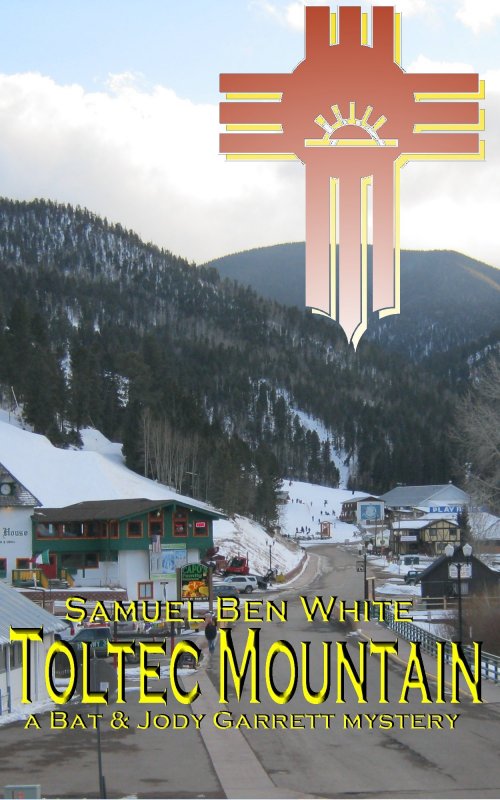
Toltec Mountain

a Bat & Jody Garrett mystery

Dallas private eye Bat Garrett is called in to investigate a snowboarder who crashed in the “Mind Games”, a made-for-TV spectacular being held at Toltec Mountain Ski Area in New Mexico. What looks like just a routine accident–like the many other accidents that have happened on the slopes–becomes more suspicious when the snowboarder is found dead in her hotel room. Soon, there’s another death, and then another. Is someone stalking the “Mind Games”? Can Bat–and his wife, Jody, who is working the case undercover–unravel the mystery before the bodies pile up higher than the snow?

Order it today on Kindle and paperback!

….

Sample Chapter

It was about lunchtime when I found myself sitting on a bench at “ski-Techers”, getting fitted for boots and skis and poles. Ski boots had come a long way since the first time I had put any on, but they still weren’t what I would call “comfortable”. They were, at best, “comfortable for ski boots”. I think it was Dave Barry who first referred to them as “bowling balls melted down to fit your feet” and they still felt like that in a lot of ways. They had more padding in them than they had back when I first tried the sport, so that was an improvement.

As the tech put my boots to the skis, I commented, “I saw that wreck from Monday with that Nitro lady. Looked pretty rough.”

“Uh hmm,” he replied, checking the bindings against some sort of chart.

But then, one of the other techs, who didn’t have anyone to help at the moment, injected, “Pretty wicked, wasn’t it? Almost looked like she slammed that board down on the rail a-purpose, huh?”

“Really?” I asked. “What do you mean?”

“Oh, it just seemed to me that no one would land on a rail like that unless they were trying to. Maybe she’s got some new trick that that was supposed to be the lead-in for, though.”

My tech had finally done whatever it was he was doing and entered into the conversation by saying, “I can’t imagine what that would lead into.” Then he laughed and offered, “Unless maybe the board’s made out of some sort of space-age rubber where you hit it on the rail and ‘sproing!!’ you go bouncing thirty feet into the air!”

Who still uses the term “space-age” I wondered? That was like something out of the sixties. But then, so were the ski techs. Not that they were old enough to have been born in the seventies, even, but I had noticed before that a lot of the ski techs (at every mountain I had been to) wished for a decade they hadn’t experienced except on film.

“But normally,” I mused, “Wouldn’t a landing like that just be kind of jarring? I mean, those snowboards are built to take some punishment, aren’t they?”

“Sure,” said the tech that wasn’t working on my gear, “But she hit it hard. They were showing a close-up of the crash on the sports channel last night and she hit it harder than those two chuckleheads that were trying to break a snowboard on the post office steps yesterday.”

I kept my mouth shut.

When I stepped up to the first lift line at about one o’clock, I was a little nervous, as usual. The first ski run of the year never bothered me, but the first attempt to get on and off the lift did. I hadn’t fallen off a lift in years, but the memory of my first couple times skiing—when getting off the lift was clearly my weak spot—still lingered.

Most of it was alleviated when the guy standing there telling people, “Stop here and look for the chair” said, “You’re that private detective, aren’t you?”

“How’d you know?” I asked.

“My brother works at the hotel,” he replied. Before I could pursue that line of thought further, the chair was whisking myself and a middle-aged stranger up the mountain.

“You’re a private detective, huh?” he asked in the gravelly voice of someone who smokes too much.

“Yes,” I replied, trying not to sound too cautious.

“Must be interesting,” he replied.

“It can—“ was all I got to reply …

Before he started in with, “I run an auto parts store, myself. I tell you, somebody ought to do a TV show about my work.” The rest of the ride was filled up with the glorious and lewd antics of the auto parts world. I had to admit: I was surprised there wasn’t a show about it already.

Those first few minutes were a microcosm of how my afternoon went. On an afternoon where the mountains were covered with television cameras and actual (or cable, anyway) celebrities were to be found everywhere you threw a snowball, everywhere I went people wanted to talk about being a private detective.

At first, it was kind of fun being a celebrity, but it quickly grew old. For one thing, I had always enjoyed a sense of anonymity in relation to my job. Not that this particular case required it, it still seemed strange to be known—“made” in the vernacular.

Which led to some wild speculation about why I was there. There was a rumor that someone was stealing the high-end equipment used by the athletes. Another one said there was somebody stalking one of the skiers. Still another said there was some suspicion of financial impropriety in regards to the Games themselves. A couple other rumors alleged that the indoor games were fixed in some non-specific way.

Of all the people I heard from, no one hit on the real reason I was there, which I found strange as I would have guessed that someone would have heard the story of the video I had watched with Penny and Pete. In a way, though, that made me feel a little better about my diagnosis because I was thinking that, if someone really had sabotaged Nitro’s board, that rumor would have gone around.

When the runs closed at 4 o’clock, I checked in my equipment, switched back to street shoes, and made my way to supper where I was invited to dine with a couple of the athletes from the Men’s Downhill Extreme, which I was to learn was the ski version of the terrain park Nitro had crashed on. In fact, it was held on the same park, just targeted toward some different obstacles.

The topic of conversation at supper was that day’s outdoor activities and some trash talking about the evening’s indoor games. If Nitro’s crash of Monday entered anyone’s thoughts on that Thursday evening, they said nothing about it. The big topic was a killer run put in by Steve “Onionhead” Wachowski. He wasn’t in our group, but the word at our table was that he would have to really blow his Scrabble™ game to not finish the day as the favorite for the D-E. Apparently, some new trick with a name that meant nothing to me had been the kicker. Something like the “Double-Back-Front-Triple-Lutz-Alpaca” … or something to that effect. They tried to describe it to me, but the terms they used were not, as far as I could tell, in any known language, so I just nodded like I understood them and we moved on.

From there, I made my way to a couple other popular hangouts, was greeted cordially on the street by people I had never met before, and managed to learn absolutely nothing about the case. Monday’s crash was ancient history. If there was any news in Toltec that evening, is was either that there was a P.I. in town or Onionhead’s mind-blowing run. No other topics were being discussed anywhere—at least in my presence.

Finally, I found my way into The Dive Bar and the presence of a beautiful, auburn-haired young lady who I happened to know was a year older than me but looked like she fit in with the coeds around her. Sipping her smoothie, she did a good job of pretending to play up to me and, maybe, even making any casual observers think she was slightly tipsy. Unless someone had spiked the smoothie against her will, I knew she was no more tipsy than I was.

When it seemed like enough time had passed that I could credibly pick her up, I invited her to leave with me and she did. Back in my “real life single scene” I had always been too chicken to meet girls in such a setting, let alone try to get one to leave with me (I could rarely work up the nerve to ask out even the girls I met at church!), so it was kind of a thrill to walk out of a crowded bar with the prettiest woman there on my arm.

Still, I was really curious about that hair!

And the tat.

So Many Books

a Mended Lives story

He had never seen so many books in one room. Stacked on rickety shelves from floor to ceiling, they overwhelmed the room, and the visitor. Chris Farmer, investigator for the Bureau of Indian Affairs, suddenly felt like he knew nothing about the person he was trying to help. But he was suddenly curious. Why would someone so young-why would anyone-have so many books? Alyste Smith was a young woman who lived with an abusive step father and longed to escape. The only way she knew how was through books. So she read and read and read, hoping beyond hope that, one day, a hero like the ones in her books would walk through her door and rescue her.

Order today on Kindle!

Reading Sample

I had never really noticed her until I saw the books. Hundreds of books (thousands, I was to learn later) adorned her small room. She had bookshelves she had brought in from somewhere at, I guess, the start of it. Between them she had built other shelves. They would have made Norm Abrams cringe, but they would have warmed the heart of any librarian.

Some shelves were built by putting a board across cinder blocks, then more cinder blocks, then another board and so on up to the ceiling. In some cases, where cinder blocks or other bricks couldn’t be found, larger books were used to hold the shelves above off the books below. Here and there an ineffectual nail had been driven into a board to secure that board to the side of another shelf or to the wall itself. The whole business showed a profound lack of engineering knowledge but would have made even Rube Goldberg envious.

How the whole mess stood and hadn’t collapsed and killed her years before I have no idea. My own experience with dismantling it all brought a few paper avalanches that threatened to take my own life, but I’ll have to get back to that later.

“You’ve read all these?” I asked in dubious wonder as I looked at the books that lined the walls from floor to ceiling, making the little eight by ten room about seven by eight and a half. If she could have figured out a way to attach a bookshelf to the back of the door, I was sure she would have.

“Uh-huh,” she nodded. Then, in the apparent need for accuracy, she amended, “Everything but these two shelves. I haven’t read them, yet. But I will.” Pulling back the covers on the bed, she revealed a weathered paperback and, picking it up, said, “And this one. I haven’t finished it, yet. I …can I take it with me?”

“Yeah,” I told her, still looking in awe at the walls-which I couldn’t see, but assumed they were back there-somewhere-behind the books.

I knew there were more important and pressing matters, but I couldn’t help stepping closer to the books for a moment. There was no discernible theme in the volumes chosen. I saw a few romance novels, of the kind I would have stereotyped a young woman in her position to read. But I saw much more. There were psychology textbooks and biographies of famous people, from Teddy Roosevelt to Tacitus, and books by Twain, L’Amour and Kafka. There was a shelf of books by CS Lewis, just above a shelf of books by Tolkien (having never read either, I had no idea of the significance of this paring). I saw books on horticulture and agriculture and books of poetry by people with names I couldn’t read, let alone pronounce.

“All of them?” I asked again, though not necessarily meaning it to be out loud.

“All of them,” she confirmed.

“Do you have a favorite?”

I happened to be looking at her at that moment and realized from the look that flew fleetingly across her face that I had asked her a question akin to asking a mother which of her children were her favorite. When her composure was regained, she replied, “Probably whichever book is in my hands at the moment you ask.”

I pointed to the book that she had picked up off the bed and asked, smiling and trying to make it sound friendly, “So right now it’s that one?”

She looked down at it, a slight grimace at the corner of her mouth, then back at me and replied, “No. Not this one. It’s not that good.”

“So why read it?”

There was just the slightest hesitation before she answered, “Because I started it.”

For the first time, I took a look at this remarkable person who had, up until that very moment, just been a part of another complicated if strangely routine and boring case.

The way he looked at the books intrigued me.

Not many people had seen my collection of books, but some had. All the others had had pretty much the same reaction, though. Wondering why I had so many books, why I wanted so many books, or complete incredulity at my claim to have read them all.

People my age were the worst. The couple times I had met people my age who claimed to be readers, when they saw all my books, they usually looked at me like they thought I was crazy. Most of them, I would find out (if given the chance, most were gone after a glimpse into my room), read more than the average teenager, but they only read one thing. All romance books, or all mystery novels or all books on a single subject. That, to me, sounded like eating the same thing meal after meal, year after year. I like pizza, but I have to eat some other things now and then, you know?

So when he looked at the books with amazement, I thought I had found a soul mate. I was so surprised later to find he wasn’t a reader. Oh, he knew how, of course. He had just never known why anyone would do it on purpose. What struck me, though, was that he didn’t dismiss my reading. And when he found out just how many books I had, he didn’t renege on his offer to carry them all out. For the first time since my mother died, someone saw my books and didn’t treat me like a freak.

On the other hand, I have never been able to understand people who don’t read, or don’t love reading. I love reading. Even when my life was going well, I loved reading.

Last at Bat

a Bat Garrett story

A ghost. Bat has to be seeing a ghost. While recuperating in Houston he stumbles across a shopgirl who looks and sounds just like someone he lost a year before. As his friends think he’s going crazy, and even he’s starting to wonder if he watched “Vertigo” one too many times, he tries to piece together the background of the shopgirl. The investigation takes Bat from Houston and Dallas, to Arkansas and Durango (where he meets a young Garison Fitch) and closer to the conclusion that he may not have been the only one set-up by the Home Agency.

Order Today!

Kindle or Paperback

To read more about Bat Garrett, be sure and check out “The Nice Guy“, “The Return of the Nice Guy” and “Up to Bat“. All available on Kindle & in paperback! And, if you want to read this story from Jody’s perspective (as well as find out what happened next), be sure and read “Cheerleader, Gymnast, Flautist, Spy“!


Read a Sample

“What is it we’re going to go look at?” Dave asked as we walked through the mall. I was surprised how few people were there shopping, but I guessed it was because it was a week day.
“Sunglasses. I’m telling you, Dave, these are the ugliest you’ve ever seen. They would have been great for that day in college when we had the ‘Ugliest Outfit’ contest.”
“I didn’t know the Galleria had a gag shop.”
“It’s not intended to be, but these will make you gag.”
As we were nearing the store, I saw a girl walk into the shop ahead of us who just about took my breath away. I stopped dead in my tracks and could feel my heart pounding in my chest like faulty pistons in a Ford Granada. If I had been prone to such things, I think I would have had a heart attack. The quick and unexpected (even to me) stop on the crutches almost made me fall on my face, so I had to take a moment to regain my balance.
“What—what is it?” Dave asked. The look on my face must have scared him. I imagine I went almost completely white—maybe even green.
“That girl that just walked in.”
“So? She was cute; but we’ve seen several of those today. She wasn’t as pretty as Heather, I didn’t think.”
“No. This girl looked like … like someone I used to know.”
“Let’s go see her,” he said. “Maybe it’s her.”
“Couldn’t be.”
“Why not? Houston’s a big city.” He smiled, “Shoot, I bet there’s more than two hundred people in this town. I hit that many cars in the parking lot.”
“But this couldn’t be her, Dave.”
“It’s a small world, Bat.”
“But it’s not the Twilight Zone.”
“What are you talking about?”
“The girl she reminded me of is dead.”

Joyfully Ever After

a Mended Lives novel

Sean Clarke moves to the town of his dreams, to a house he loves, to a life he’s always wanted.  There he meets and falls in love with Angie. a beautiful young woman.  Sean’s family is happy for him, but they are waiting: for that moment when Sean discovers something he doesn’t like about another perfect woman and dumps her.

A novel of self-discovery, about finding out that the things that irritate us most about the faults of other people are when they mirror our own.

Available on Kindle!

To read more about Brad, Allie and Angie, make sure you read the novel Mended Lives!  To read how Joe and Ellen met, check out Hating God – a love story!

Sample Passage

He let go of her to hold the picture in both hands.  He was looking at it, but he wasn’t seeing it.  He wasn’t seeing anything.  His mind was gone and it didn’t show any signs of coming back any time soon.

“I’m sorry,” she finally said, when she didn’t think he would ever speak again.  “I never meant to hide this—to hide anything—from you.  But I was so ashamed—”

“You should be!” he blurted out.

“I know, I—”

He jumped to his feet and demanded, “What else are you going to tell me, Angie?  When am I going to start meeting all these guys you slept with?  What about the millions who saw you nude?  When are more of them going to show up and start asking me if I’ve seen what they’ve seen?  When, huh?”

She stood up in front of him and tried to reach out to him.  “I wish I could take back all those pictures, Sean.  I do.  But I can’t.  What can I do?”

“You could leave.”

“Sean!”

“What do you expect me to say?  ‘Hey great!  All the men of England have already seen my fiancé naked but I haven’t!’  Just leave, please.”

He picked up the folder, stuck the picture back in it (but not before seeing that there were other similar pictures in it and actually letting one slip out unnoticed that slid under the rocking chair), and thrusting the folder at her demanded, “Take these with you.”

“Sean—”

“Please, go.”

“Can I come back?”

He took a deep breath and replied, through clinched teeth, “I’ll get back to you on that.”

“Sean—”

He stepped around her and opened the front door.  Gently but firmly, he pushed her outside and closed the door behind her.

She turned around to face the door, but heard the unmistakable sound of the deadbolt being thrown.  She thought about knocking but didn’t think it was the right time.  She sat down on the front porch steps, put her head on her knees, and started crying.

It was almost half an hour later that she got up, smoothed out her dress with her hands and, taking the folder, walked back to the café.  Inside, the cook asked if she were all right, to which she nodded but didn’t answer out loud.  She just put on her apron, then put on her customer face, and went out to deal with the public.  She was relieved that the British couple was gone.

She looked around, though, at the crowd now there and wondered if any of them had ever seen her ads for Sutley’s, or Liverpool football, or any of the other ads she had done?  What about just the magazine layouts?  She remembered when she used to pat herself on the back because she had never done full-frontal, but now it didn’t seem like such a big deal.  “Partly evil is still evil,” she muttered to herself.  Then, noticing that a customer had overheard, she smiled, said, “Excuse me,” and took his order.

After that order, though, she went back and relieved the cook.  Not only did she want to be away from the general public, working with food had long been a way to calm down and think.  She did so, now.

Medicine Park

Brad Reynolds comes home to Medicine Park, OK, to take over his father’s old business and try to put his life back together after a divorce.  He’s fitting in, he’s meeting great new people, he’s even started attending a Bible study.  Brad’s a great guy by everyone’s account.  What they don’t know is that he has an addiction.  He’s kept it well-hidden so far, but it’s already destroyed his marriage and it will soon destroy his whole life.  So Brad tries to bury it, to ignore it, to power his way through it … but it keeps escaping from the box he keeps it in.

(Cover photograph (c) 2012 Derrick Bias)

ON SALE NOW!

Kindle    paperback

What the Readers are saying …

“I really liked it.  I had never read a book with that viewpoint of the guy with the sex addiction.  It was interesting as he grew in Christ.  I thought it was very encouraging as we all have aspects of ourselves we need to put under Christ’s Lordship.” ~KD, LA

And the “sort-of” sequel …

If you would like to read more about Brad, Allie and Angie, be sure and pick up the novel Joyfully Ever After.

Sample Chapter

The divorce was final the same day his parents died in the car wreck.

He thought about not even telling Darria, or trying to tell her in such a way as to hurt her.  But he didn’t.  He just called her and, as she prepared for one of his trademark snide remarks involving either the postal service or how relieved he was to finally be rid of her, he calmly told her he had gotten the papers and his parents had just died.

Darria didn’t know what to say, except that she was really sorry to hear that.  She meant it and hoped she could convey her sincerity but knew she had her own reputation for caustic remarks, especially where Brad was concerned.  Still, she had always gotten along just fine with the Reynolds and they had even reached out to her recently, as things had begun to go sour in her marriage to their son.  She had bristled at the intrusion, but secretly appreciated it, too.

“Well,” he said, “I’ve got to go.  I’ve got to go pick up Mike at the airport.  Then, we’ll, um, head over to the mountains.”

“Yeah,” she said, nodding at the phone even though he, of course, could not see the motion.  Then, she quickly added, “For what it’s worth, I’m really sorry it finalized today—of all days.”

“I’m sorry they had to die today, of all days.”  He tried to think of something else to say, then, not even sure if she were still there, told her, “Good bye, Darria.  Be seeing you, huh?”

“Yeah.  I’m really sorry, Brad.”

“Thanks,” he told her as he hung up.

***

They hugged at the airport, cried a bit, then things got so quiet as they left the airport in Brad’s car that they jumped into as banal a brand of small talk as they could muster before they were even onto I-44.  “You have to wonder whose idea it was,” Brad quipped, “To build the Wiley Post Terminal of the Will Rogers Airport on Amelia Earhardt Drive.”

“What do you mean?” Mike asked.

“What do those three people have in common?”

Mike thought a moment, then nodded, “They all died in airplane crashes, didn’t they?”

They ran out of small talk just as they passed Norman, however, and were stuck with silence, again.  Suddenly, Brad said, almost to his own surprise, “I’d like the store.”

“What?” Mike responded, completely thrown off guard.  His thoughts had already gone to his wife and baby, who were driving down from Colorado and would be joining him (hopefully) the next day.  He hadn’t wanted to do it that way, but the fact was they just couldn’t afford three airplane tickets on such short notice but still felt Mike should be there for his brother as soon as possible.

“The bait shop,” Brad explained.  “I’d like the bait shop.”  Suddenly thinking it through aloud, he offered, “I’ll buy your half from you for whatever you think is fair.  I can take what I got from mine and Darria’s house and make you a down payment.  For the store and your half of Mom and Dad’s house.  I’ll get a loan to cover the rest.”

Realizing how impetuous he was being, he suddenly added, “Unless you want it.  I was just thinking that I’ve kind of been wanting out of my job—and out of Oak City—for a while now.  But I don’t think that little bait shop makes enough money for us both to live on.  So, you can have it, if—”

“No,” Mike replied, just as suddenly.  “You take it.”  After a moment, “I’m serious.  Annette and I really like Aurora.  It’s where we want Collin to grow up.  It’s home now.  Why don’t you just list me as a silent partner in the store and then slowly buy me out?  That way you won’t get nailed for all that interest.”

“I wasn’t thinking of anything like that—”

“Why not?  It works out for both of us.  I get a monthly payment I haven’t been getting and you get the store.”  After a moment, Mike asked, “Why do you want it?  I don’t remember you showing any interest in it before.”

They were several miles further along before Brad answered, “You grow up in a small town and you can’t wait to get out.  Now, I want to go back.  I know it won’t be the same.  But maybe I can recapture a little bit of what it was . . . once.  I’m a grown-up now.  As of today, I’m officially divorced—”

***

“I really feel bad about that.  Wished there was something I could have done.  Wished I had seen it coming.”

“The only people who could have were me and Darria and we waited too long to acknowledge it, and then longer to do something about it.  And you didn’t see it because we tried so hard to hide from everyone, including ourselves.  I think that’s part of why I want to get out of Oak City.  I’ll always associate this place with my marriage.  Now I can get out.”

“Do you really think going back to Medicine Park is the right answer?  You want to get away?  Come back to Aurora with me.  You’ve always liked Colorado.  You can get a job in Denver.  You’d be near family.  Lots of accounting jobs there.”

“Uhg.  I’ve done accounting, Mike.”  He smiled and added, “Maybe I could go to Texas, where cousin Denny lives.  Maybe there’s a job in Frognot.  I’ve always kind of wanted to live there just so I could have that name on my letterhead.”

***

The funeral home had done a good job, as far as such jobs went.  Instead of two people who had been in a car that had gone off a rain-soaked highway, they looked like two people who had just chosen a strange place to take a nap.  After a few moments of “viewing,” Mike commented to Brad, “I don’t know about you, but I’m ready to close the lids.”

“Yeah,” Brad nodded anxiously.  He motioned to the funeral director, a thin woman with iron grey hair perfectly coiffed   She came over and, with the help of a young assistant, closed the caskets.  “Remember the line from that cousin in Arizona—I can’t ever remember his name.  I just remember being at a funeral for some uncle or other and someone comments about the body looking natural and he said, ‘No he doesn’t.  I’ve known Uncle Chuck for twenty years and not once can I remember him getting dressed up in his best suit, coming down to the church, then taking a nap in a box at the front of the room.’”

Mike actually smiled as he said, “I remember that.  Uncle Leonard, wasn’t it?  The man who died, I mean.  Lived in New Mexico somewhere, didn’t he?”

“Las Vegas, it seems like,” Brad nodded.  “I just went so I could be with Mom and Dad.”

“Yeah, and I met ya’ll there mainly so I could see everyone.  Can’t remember that cousin’s name, though.”

“Private detective, wasn’t he?  I remember that just because he was the only private detective I ever met.”

“I think you’re right.  We’ll be back in the morning,” Mike told the funeral director suddenly, when he realized the director was still right behind them.  The two brothers had already cried on each others shoulders to the point that now they were just drained and ready to leave and the moment’s laughter had been genuine under the relief it had brought.  Neither had seen the other cry like that ever, so it left a surreal picture in their minds as they left.

***

Standing in the living room of their parents’ house, dressed now in casual clothes, Annette nearby playing with Collin on the floor, Brad commented, “It just doesn’t seem real.  I keep expecting them to come in here.  For Mom to try to feed us something.”

Looking around, Mike asked, “Are you sure moving here is the right idea?  The fish and tackle shop is one thing, but this house?  Sell it and buy another one nearer the shop if you want.  You always joked you were going to buy a house in Paradise Valley just because you liked the name.  Do that.”

“Naw, this is home.  I may have never thought about having the bait shop, but I always dreamed about having this house.  Pictured Darria and I having kids and moving here.  You know, Mom and Dad always said they would move somewhere when they retired.  Figured they’d move near you in Denver and we’d get this place.  Maybe telecommute to a job in Oak City or just over in Lawton and drive in one or two days a week.”  He sighed and shrugged, “The Darria part’s gone now.  I can get the house, now, though.”

Mike bit his lip a moment, then said what he’d been thinking, not just all day but ever since he had heard that his brother was getting divorced, “Are you sure there’s no chance of you and Darria getting back together?  You two were so great together—”

“I think she’s got somebody else,” Brad answered.  At the looks in his brother and sister in law’s eyes, he quickly explained, “Don’t get the wrong idea.  She was never unfaithful.  Neither was I, for that matter.  Anyway, I heard from a mutual friend that she had met somebody at her work that she was going to go out with as soon as the divorce was final.”

“It’s not like she’s already remarried,” Mike said, ignoring the look from his wife that was trying to tell him to just shut up.  “Can’t you work things out?”

“I used to think so.  Went to counseling and everything.”  Another big shrug as he leaned on the mantel and looked into the low fire.  “Didn’t work.”  He looked over at Collin and said, “Kids were part of it, you know.  Sometimes wonder, if we had been able to have kids . . . “  After a bit, he added, “On the other hand, sure am glad we didn’t put any kids through this.  Divorce is hard on kids.”

“Well,” Mike said, stumbling over the words, “I don’t want to bug you about it.  But if you, um, get the chance, talk to Darria.  Maybe you two just needed some time away.”

Brad was too worn out to argue, so he just nodded and said, “Yeah.  Maybe so.  That’s what Dad said, too.”

***

“Thanks for coming,” Brad said as they walked away from the graveside service.  The minister from the Reynolds’ church had delivered the eulogy and had done quite well.  Brad and Mike had both thanked him for the words, and everyone else for coming out on such a cold, if sunny, day.

Darria nodded uncomfortably, then threw her arms around his neck and, sobbing, told him, “I am so sorry for you.  And for Mike, too.  But I’m really sorry for, for everything happening.  Now, of all times.”

“Well, it wasn’t just you,” he told her as he held her close, feeling her for the first time in months.  It had a strange familiarity that was surprisingly comforting.  “I know the timing was an accident.  But I, uh, do thank you for coming here today.  It really does mean a lot.  Can you come over to the house for a while?  There’s a lot more food there than even Mike and I can eat.  Give you a chance to see Annette.  And Collin, too.”

“He sure is getting big, isn’t he?” Darria commented wistfully.  She then let go of the hug, wiped her eyes and said, “I better get back into town, though.  I told the office I would try to make it back for the afternoon.”

“Well, don’t go so fast you . . . drive carefully, huh?”

She was prettier than he remembered.  Maybe it was the black dress.  He had never seen her in black because she had always said it made her look washed out.  With her reddish blonde hair and freckled skin, he had always taken her at her word.  But now, looking at her, he realized she looked pretty attractive in black.  And she had lost weight.  She wouldn’t have been able to fit in that dress when they were still together.

But then, he had lost weight, too.  He didn’t think it was stress so much as that he just hadn’t eaten as regularly since the split.  He was almost back to his college weight.  And what with walking every day in the sun, the red had come out in his brown hair and a few freckles had resurfaced that he hadn’t seen in a long time.

People used to say they belonged together but he always figured it was because they were both red haired and fair skinned.  He wondered if, that day at the cemetery, they looked like they ought to be together again.  He wondered if she were wondering the same thing.

She nodded, then kissed him on the cheek and walked away to her car.  He watched her go, not knowing how he should feel.  If it were a movie, he knew, he would run after her and catch her in his arms and convince her to stay with him.  Or he’d watch her go and cry.  But he didn’t feel like doing either.  He didn’t feel like doing anything.  So he just watched her go.

***

“You sure you don’t want me to hang around for a while?” Mike offered.  “I’ve got a couple weeks coming.  I could help you move and get settled in at the shop and all.”

“No.  Your family needs you with them.  I’ll be fine.  Old Simms is going to run the shop until I can get out there, and most of my stuff is in storage so it won’t take all that much to move it.  Got some friends that can help with that.”

“Well, if you need me, you call, all right?  It’s just you and me now, brother.”

“Hey, same here.  I mean, if you need anything, you call me.  I know how to get to Aurora.”  Brad snapped his fingers and said, “Let’s plan on getting together in a couple months.  Maybe head into the mountains or something.”

“Sounds great,”

Brad hugged Annette, thanked her for coming, and held a very wriggly Collin one more time, kissing the little boy on the forehead.  “I can’t believe how fast you can move, little guy.  You’ll be walking by the next time I see you, I bet.”