Toltec Mountain

The Mind Games have come to town, but is someone stalking the competitors?

the Bat Garrett Mysteries – book 7 (of 8)

At the Toltec Mind-Games, competitors race down a mountain and face off across chessboards. Then a snowboard snaps – and someone wants to know whether it were sabotaged.

Bat Garrett’s equipment checks and video review point toward an accident, but a strange note keeps the inquiry open. With Bat’s identity already public, Jody goes undercover among the competitors and groupies.

Then the injured athlete is found dead.

The broken board, private feuds, and carefully managed public personas now carry new weight. Bat and Jody must determine which secrets belong to a crime before rumor and publicity supply a more convenient answer.

Order it today on Kindle and paperback!

Sample reading from The Nice Guy (Bat Garrett book 1)

Sample Chapter from Toltec Mountain

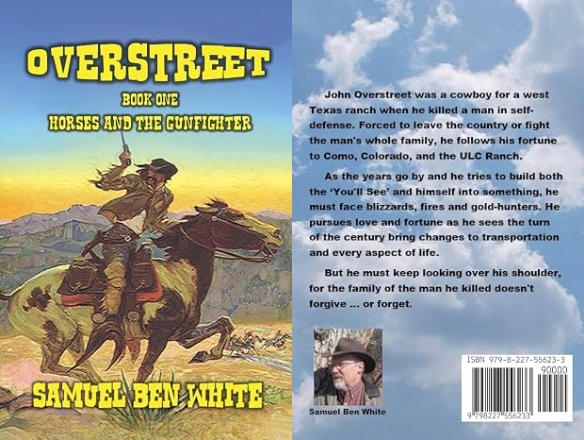
Overstreet (the series)

John Overstreet was a cowboy for a west Texas ranch when he killed a man in self-defense and was forced to leave the country or fight the man’s whole family. He follows his fortune to Como, Colorado, and the ULC Ranch. As the years go by and he tries to build both the You’ll See and himself into something, he must face blizzards, fires and gold-hunters. He pursues love and fortune as he sees the turn of the century bring changes to transportation and every aspect of life. But he must keep looking over his shoulder, for the family of the man he killed doesn’t forget … or forgive.

Available in paperback for just $21.69 for volume 1!! Or check out the whole trilogy here! (You’ll have to scroll down a bit and, even though the page says the books are “in progress” they are all finished and available.)

…

Reading Sample

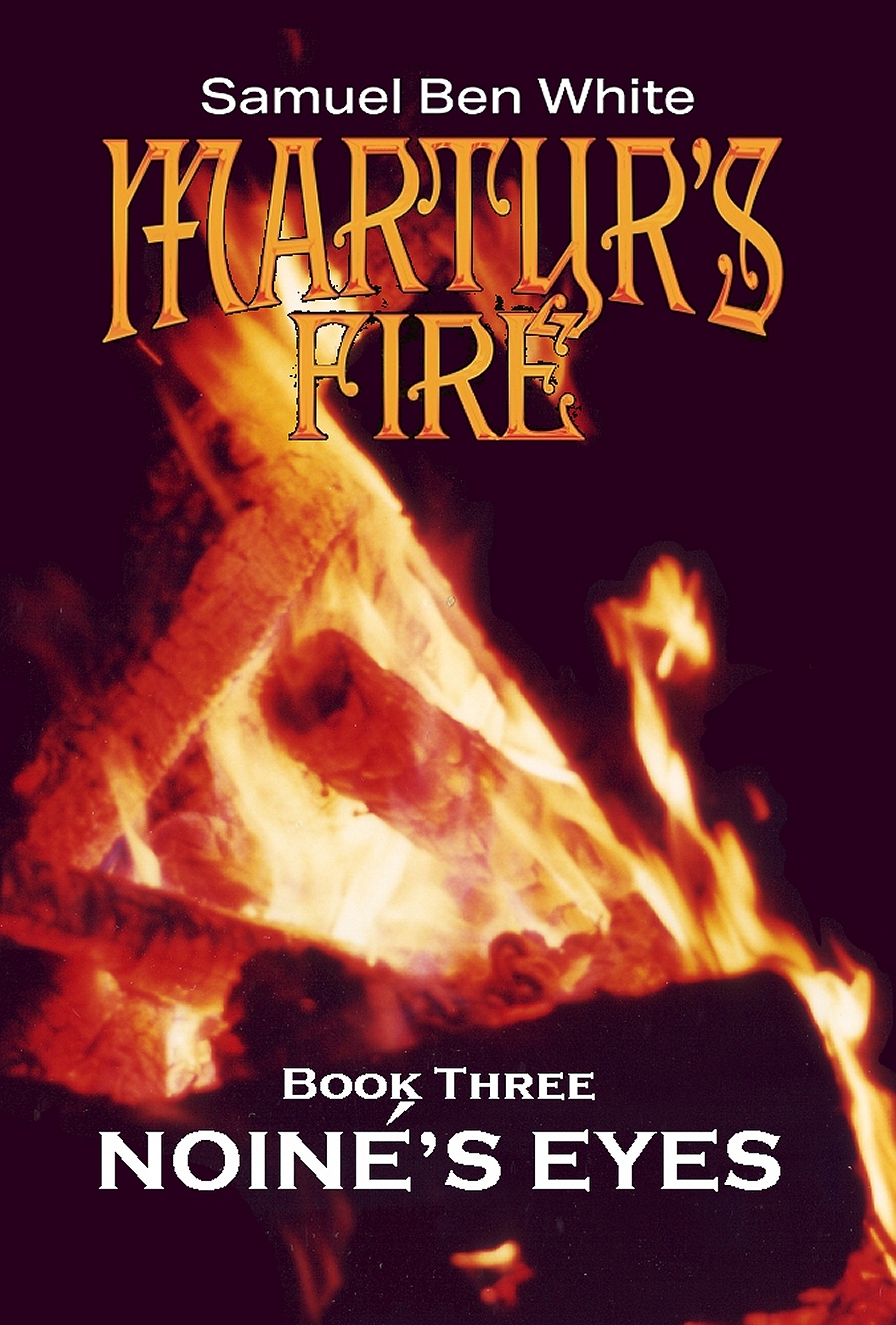
Noiné’s Eyes – Martyr’s Fire – Book 3 available now!

Order your Kindle copy today! Click here. For the paperback, click here!

AD 5252 and all of the western world is at war.
Led by King Vykyant, a coalition of more than a dozen nations has come together to fight an evil on a far-off continent. “We will fight it there to protect our families here.”
But the families at home are not free of danger, for the fight is being waged there, too.
Thousands of soldiers marching, fighting and dying in a foreign land. People at home getting spotty information at best.
A world at war, as told through the eyes of the people on every front line.

Now available for Kindle & paperback. (Due to the length of this novel, it will not be available in hardback.)

Sample Reading

Three thousand years before, the continent had been a land with everything: verdant forests, wide rivers, harsh deserts. There had been cities and towns and beaches and places where men and women went for leisure and many places where they worked. It had been a land of mystery, and legends, and ghosts.

There had been people of education and what was called sophistication, often living just feet from those who didn’t receive those accolades. There had been people in the finest clothes, often living not so far away from people who had the barest rags, then a little further away were people who didn’t know what clothes were for and—had they known—couldn’t have imagined wearing them. Technology had existed side-by-side with stone tools.

When the first of great wars had come, the majority of the continent had remained relatively unscathed. Relative being a relative term, for there had been fights and squabbles, but almost none of the large-scale harm that had affected every other continent on the planet. Some of the survivors from other continents moved to that continent thinking it would always be that way.

When the wars returned—though in the myopic view of the future’s rear view, all the wars were one—the continent was mostly spared, though circumstances made it isolated.

The continent was still rich in many ways, but especially in tyrants and graft. Its resources were plundered and sold, leaving the majority of its population in even more poverty and want than they had been before—and they had been among the planet’s poorest back then. Its great forests were plundered not just for the wood, but for the precious metals that lay beneath, a process that had begun before the wars, then accelerated after even though the booty was just being sold to fellow residents of the continent.

But then came more wars that finally poisoned the rest of the planet. That southern continent was more protected than all the others, or so it seemed at first. Very few military strikes landed there. It was not attacked with the poisons that were levied against practically everywhere else and atmospheric conditions swirled them away. The last of the people who could escape from the other continents came to the southern continent.

They brought their wealth with them—some of which had come originally from that continent, ironically. The richest brought their own security forces with them, setting up little fiefdoms, assuming that to do so was their right even as they ran those who had been on the land for time out of mind off of it. Those so displaced headed to the already crowded cities, making life even harder—or deeper into the jungle.

And then the winds shifted. Not the political winds, but the actual winds, and the poisons everyone thought they had escaped came to the southern continent.

Millions were wiped out in just months’ time.

As in the rest of the world, those who survived, survived in pockets. Perhaps more people survived on the southern continent than on others. Some estimated that while elsewhere in the world ninety percent of the population was wiped out by the wars and their poisons, on the southern continent it was “only” eighty percent. Those who survived quickly stopped burying their dead and just threw them into the rivers or natural ravines. This exacerbated the poison, and the stench.

Technology was lost.

Commerce between the pockets was impossible.

Mankind was reduced to its most primitive state as every waking hour was spent scrabbling for food and shelter. And on that continent, in its pockets, there were more people fighting for the few resources the poisons hadn’t killed. The men and women of those lands became more vicious than in the rest of the world because they had to if they wanted to survive.

A millennium later, as the poisons dissipated and people all over the world began to venture bravely beyond the piece of ground they had known for a thousand years, there was some conflict of course, as is the nature of man. In some places there was cooperation, though, as the people met others who had goods or services they didn’t have themselves. In some cases across the globe rival pockets still spoke a semblance of the same language, but in some they were so divided they couldn’t even sign to one another. There was fighting at times, too.

The southern continent knew nothing of cooperation. For a thousand years and more, all anyone had known was a mad struggle for life amidst death and when they encountered someone they didn’t know, the first thought on every mind was challenge, and murder. Pockets of stronger people conquered pockets of weaker people, though there were no pockets of weak people. The strongest took over, killing or enslaving the weaker until only the very strongest ruled. Tin-pot dictators were overrun by tyrants, and tyrants were squashed by despots. When finally a potentate arose for a time who was over the whole continent, it was with an army of people who were only biologically men, for in reality they were animals.

Like with animals, as the leader began to show weakness, he was slaughtered by a younger, stronger, lieutenant who would then rule until the same fate befell him. And so it went. For two thousand years the plants grew back, deformed and twisted from the lingering effects of the wars, but not so deformed and twisted as the men and women who occupied the lands.

Their languages were guttural and rarely written down. Their thoughts were of conquest and survival and not worth being written. Every thought was toward evil and their own advancement.

It was only natural that the puppet who was the latest to rise to “command” of the whole continent could be easily persuaded to look beyond the continent, to the lands to the north, where it was said there were good lands and weak people who would fall easily before his blade.

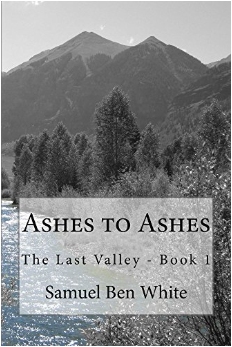
Ashes to Ashes – The Last Valley – Book 1

Ash.

Siblings Josh and Claire were out with a detail of locals trying to replant the Selkirk area following the previous summer’s fire when the ash hit. They had seen a lot of ash, but not like this. This was a wall two miles high that swept through and buried everything. Everything.

Some said it had to be the result of a volcanic eruption. As far as anyone can tell, the two-score people who have made their way to the valley are the last people left alive in the world. Everyone is trying to survive, but Josh is determined to thrive.

With Claire by his side, he begins to rally the people to not just claim a life in the ash, but to build a new community. With death all around them, and continuing to come their way, Josh begins to wonder if he can keep everyone going long enough to build something new. Even if he can keep their hopes up, how long can they push back against the ash?

From the ash arises a new town, a new way of life, and hope.

Be sure to read the rest of the story in “Crazy on the Mountain” and “Book of Tales“!

Available now for Kindle and paperback.

…

Sample passage

You can only live in panic so long. Eventually, you have a nervous breakdown or you wear out. Claire and I just wore out. It had been about six o’clock in the evening when the wall of ash descended on us and minute after minute, then hour after hour, of sitting in a darkened pick-up truck, clinging to your sibling for dear life, while outside the wind moans and nothing is visible takes its toll. Throw in that we were already tired from an afternoon of work and, somewhere in there, we fell asleep. Or my brain shut off, which was a lot like sleep.

I remember having the momentary thought that I probably wouldn’t wake up. I pictured the ash covering the truck until every crack was full and the air was used up. I fell asleep picturing our parents crying one day as they got word from the Forestry Service or someone like that, saying that a pick-up with the remains of their two youngest was found buried under a mountain of ash. I look back now and am a little surprised that I fell asleep under those conditions, but at the time there just wasn’t anything else to do.

“Josh,” a voice whispered in my ear. I hoped it was my mother, waking me up in my own bed, the events of the day before just a dream.

“Josh,” repeated Claire, a little more loudly. “I can see.”

“Hmm?” I asked, trying to wake up and realizing just how uncomfortable sleeping upright in a pick-up truck can be. I finally got my eyes to open and realized Claire was right: we could see, if dimly.

The wind was still blowing a hefty breeze, but the cloud of ash had dispersed enough that we could actually see a little of what was outside. It was a weird light, though, and it took me a few more moments before I realized that what I could see was because the moon had broken through a gap in the clouds—whether clouds of water vapor or of ash I couldn’t tell at that moment in time.

As my brain came into focus with my eyes, I realized that part of why we could see—even by the light of a not-full moon—was because the moonlight was reflecting off the light-gray coat of ash that covered everything. It wasn’t quite like moonlight on snow, but it was a little brighter than if it had just been shining on the dirt. “Wonder what time it is?” I mumbled.

“Middle of the night, looks like,” Claire responded. “We must have slept several hours.”

“I’m just glad to wake up,” I told her. She cast me a strange look, but didn’t ask me to explain.

“Think we can drive home now?”

“Maybe. I can see the road, anyway. Wonder if we ought to check and see if everyone made it to safety, though?”

Claire looked like she was about to say something in response to that, then pursed her lips and nodded, saying, “You’re right.” She pulled a flashlight out of the glove box and checked to make sure it worked. She started to reach for the door, then gave me an ironic smile as she gestured with the flashlight, “Why didn’t we remember this earlier?”

“Just geniuses, I guess,” I replied with a shrug.

The wind was blowing, yet not really high like it had been when I had gone after the bottled water. Still, as soon as we were outside and next to each other, Claire took my hand as she swept the area with the flashlight in her other hand. If memory served, the last time she had held my hand for anything other than a family prayer was when we were both pre-school age and Mom had made us hold hands while we crossed the street. It was a strange sensation and not particularly comforting to me, but maybe it was to her. Just as I thought that, she gave my hand a reassuring squeeze, then let go.

The ash beneath our feet stirred up with each step, making us cough even though the makeshift bandanas were still in place, and then making us go slower so as not to stir so much up. It wasn’t deep—perhaps no more than a half-inch to an inch in most places—but it was pervasive. The wind kept ash in the air, but another glance up at the moon showed me that we were in a sort of trough where “new ash” (like new snow) didn’t seem to be falling. The ash in the air seemed to have just been stirred up from the ground or been blown off the ridge that hung above us to the west. To the north and south, on either side of the gash in the sky, it looked like the ash still roiled.

We walked nervously over to where the flashlight showed us a lump under the ash. Claire held back a step but curiosity forced me to close the distance and kneel down, even though the shape beneath the ash was pretty clear. I reached out gingerly and brushed the ash away, hoping I would startle whoever it was awake.

The body was cold beneath the ash.

“Can you tell who it is?” Claire asked, coming a half-step closer.

“Annie Meyers,” I replied, then wishing I had a way to cover her face back up with a blanket, or the ash. A muffled sob escaped Claire’s lips.

“If we had … “ Claire mumbled.

“Yeah. If we had known, and if we could have found her, and if we could have brought her into the truck—“

“You don’t care that she’s—she’s dead?”

“Of course I care. And I will spend the rest of my life telling myself I should have seen her and picked her up but I’ll also spend my life knowing there’s nothing I can do to change the past.”

“Why are you so cold?”

I stood up and responded angrily, “Cold? Claire, look around you. There are at least three other lumps in the ash about the same size as this one was. I’m not cold, I’m … I’m scared to death!” I was a little surprised at my ability to say it out loud, but once having said it, I knew it was true.

She came over and, putting an arm around me, offered, “Maybe someone else made it to a vehicle.” I nodded and we began to gently step towards the nearest vehicle, an old van owned by Mister Glass.

I pounded on the side of the van and was both startled and relieved to hear a response. The side door of the van slid open and Mister Glass stuck his ash-covered and bespectacled face out into the wind. “Josh? And Claire. How have you survived this long?”

“We were in our truck,” I replied. Claire shined the light into van as I asked, “Did anyone else make it through with you?”

“There are five of us,” Mister Glass replied, stepping outside and looking up in apparent surprise at the moon. “I think the others are asleep, but I haven’t slept a wink. Anyone else make it?”

“We don’t know, yet. We know that, um, Mrs. Meyers didn’t.”

Mister Glass swore lowly, then said, “I got a couple lights. Let’s see if we can find anyone else.”

Howard Glass was a semi-retired electrician from Kansas who had come to the mountains with his wife a decade before. She had died of cancer a couple years after they arrived. He always talked about going back to Kansas, but he also talked about how much he loved the mountains. When he lost his house to one of the fires, we all figured that would be his signal to head back to the flatlands. Instead, he had lived in a trailer while rebuilding and spent many weekends helping with one of the valley’s replanting projects. He still spoke fondly of Kansas, but never mentioned going back there anymore.

Mister Glass picked up one flashlight from the floor of the van, gave his other to Aunt Jenny, and then we began to walk to the other vehicles that had been parked along the road. We spread out a little, but stayed within sight of each other’s lights. Personally, I kept a hand on Claire’s shoulder, telling myself it was for her comfort and safety but knowing it was mostly for my own peace of mind.

The other lumps were just that: lumps, which was an extreme relief. It seemed that everyone from our work party except Annie Meyers had made it into a vehicle. While some people were still having trouble breathing, they were all still alive. As word went around, people began to point fingers in regards to Annie Meyers. Why hadn’t anyone helped her to a car? Why hadn’t anyone looked for her?

“Wait,” Claire interrupted. “How did Annie get here?” Several people grumbled in reply, but Claire stood firm and asked, “All of the rest of us scrambled for the vehicle we came in, right? Who did Annie ride with to get here?”

At varying speeds, we all came to the idea that Claire’s question was a good one. We didn’t immediately have an answer until someone declared, “The Roxons!” As several people, me included, said something interrogative as to what the speaker meant, he (Freddy Wilson) said, “The Roxons were working with us earlier today. Were they still here when the storm hit or had they already left?”

Everyone spoke but no one could remember when the Roxon brothers left, whether Annie might have come with them, or whether she was friendly enough to have ridden with them in the first place. A couple people said they thought they had heard a car moving along the dirt road in the early moments of the storm, but they weren’t for certain and other people were sure they hadn’t heard a vehicle. Someone said, loudly, that it would be just like the Roxon brothers to run off and leave poor Annie to die as they took care of their own skin. Others argued that the Roxons wouldn’t have done that. I stayed silent, remembering how my own moment of selfish panic had only been thwarted by the happy accident of my sister beating me to the truck. I said a prayer of thanks in my mind that I had found her, for if I hadn’t, she might have suffered Annie Meyers’ fate.

Someone said something about how it must be one whale of a forest fire, to be interrupted by Danica Frowley, who said in a tone that brooked no argument, “This is volcanic” as she rubbed (apparently) ash between her fingers.

Someone objected, “We don’t have volcanoes around here!”

Danica happened to be looking at me as she said, “I didn’t say it was around here. It could have come from a hundred miles away, or a thousand. But no forest fire is going to produce this amount of ash—look at the places we’ve been working these last couple years. Somewhere, maybe Capulin down in New Mexico or Krakatoa in Hawaii or one of the Alaskan volcanoes or—somewhere, a volcano blew.”

“This came from the west,” Mister Glass pointed out. “Does that mean it was Alaska?”

“There are volcanoes all along the Pacific rim,” Danica told him. Danica Frowley was a banker from nearby Fairplay who loved to hike in the woods. In her mid-thirties and fairly attractive with her flawless dark skin and lithe frame, I had heard more than one person wonder why she had never married. I had gotten to know her a little on these weekend work parties, but not well enough to have any sort of answer for that question. I had a guess that she was married to her work, but that might have just been nothing more than a guess. “And just because we saw the ash coming from the west doesn’t mean the volcano is in that direction. Did you see how high that wall of ash was? I think it came from the west, too, but at that altitude, the winds can blow differently than—“ She shook her head and said, “That’s neither here nor there. I can’t tell you where the volcano is, but I can tell you this much ash has to be volcanic.”

Since she seemed to know what she was talking about, and as none of us had any better ideas (and agreed with her assessment that this level of ash was beyond any of the fires we had seen in past years), we all turned to her as our authority. “How bad?” Claire asked, receiving nods of agreement from many of us.

Danica thought a moment, then replied, “Depends on where this happened. If we’re right and this came from the west—probably from the Pacific Rim—if it can blow up there and hit us with ash here … then I would think we’ve got to be talking a death toll in the millions.” As we all mouthed the words—twenty-plus of us standing around her—Danica continued, “Seattle, San Francisco, if they were closer to the blast they might be leveled now. And if this set off the San Andreas … “

Aunt Jenny looked at her watch and said, “We felt that first quake at about five-fifty, our time. It was probably, what? Better part of an hour before the wall of ash hit. Then, it was almost five hours before the ash let up enough for us to get out of the vehicles. Does that tell us anything?”

Danica answered, “I have a cousin who’s a geologist. It might mean something to him. I have no idea how far or fast a wall of ash like that could travel. And if there’s a weak spot in the earth’s crust, that might not be the only volcano—others could open up or it might just be the one. Either way, I don’t think this is a good thing.”

“Well,” I said, speaking for the first time in a while and finding the nerve to do so I knew not where, “It seems to me that the thing for us to do now is try to get back to town or to our homes. See if there’s power there and if anyone’s hurt.”

Several people agreed, but someone asked, “What about Annie? Do we just leave her here?”

“Somebody help me get her into the back of my truck. I can take her at least as far as Como.”

“And then what?” Claire objected. “Put her in the barn until someone claims her?”

“It’s either that or leave her out here,” I replied. Did I mention that, as brother and sister, we were often very skilled at pushing each other’s buttons? In the past, we had just been better at keeping it off public display. Of course, we had never had one of these discussions over a dead body before, either.

Claire, in an overly-logical voice I had come to hate over the years, said, “We can either take her into town and bury her or fire up the front end loader over there and bury her now. Either way, the salient point is that she’s dead.” That last word was said with pointed irony that deserves its own special typeface.

“We’ll take her in the truck,” I pronounced somewhat imperiously. “She was Catholic. We can take her to the Catholic Church in Como. Probably people gathering there right now, trying to figure out what to do next.”

Claire clearly wanted to object, but she didn’t interfere when a couple ladies wrapped Annie Meyers in an old blanket and then myself and Freddy loaded her into the back of the pick-up truck. It suddenly registered on me that I was going to be driving around with a dead body in the back of the truck and I wasn’t crazy about the idea but I wasn’t going to tell my sister that. What I said to her was, “Come on. Sooner we can get to the church, the sooner we can get her out of the truck.”

Claire said nothing in response, but got into the cab and slammed the door.

I was relieved when the engine fired up, though I had no reason to think it wouldn’t. I turned on the headlights, but that actually reduced the visibility due to the ash still in the air. I turned off the headlights and switched on the fog lamps and that helped some. I looked in my rearview and saw several other vehicles turning on their lights. I was glad I had parked with the truck pointing down canyon as I watched people behind me do three point turns on the narrow dirt road.

“Why aren’t we moving?” Claire asked, none too happily.

“Just making sure everyone can get their wheels going,” I replied as I slipped our truck into drive.

As we moved out slowly, Claire surprised me by saying, “I’m sorry I argued back there, Josh. I just—I just—I don’t know. I just get a feeling way down in my stomach that Annie’s not the only one who died here this evening and, well, maybe if I can deny she did, maybe no one else did, either.”

“Yeah. I understand.” I looked over at my sister in the glow of the dash-lights before us and headlights behind us and asked, “You think Miss Frowley’s right? Millions dead?”

“Dear God, I hope not,” my sister replied quietly.

At the mouth of the valley, where it opened out onto the larger South Park Valley near the site of what had been the town of Peabody back in the gold rush days, there was less ash. As if the valley we had been in were a large pipe that had blown the ash away from its entrance. But then, as we passed onto the grounds where once had stood the other mining town of Hamilton, the ash started getting thicker. By the edge of Como—itself once a prominent mining town but by this time a burg with an official population of less than fifty people—the ash was six inches deep and, like snow, drifted higher in some places. I was only going about five miles an hour—at the beginning due to visibility but then because the traction was so miserable. I had driven that old truck in snow storms and on ice, but driving on that ash was the least in control I had ever felt in a vehicle. Only a mile down the road and I could already feel the ache in my shoulders from the tense way in which I gripped the wheel.

And then someone started honking their horn and flashing their lights behind us. I came to a stop, panicking for a moment as it seemed like we were just going to keep sliding indefinitely, and then got out. Mister Glass had been right behind me in that old conversion van of his and he was getting out as well. We had started out from the Selkirk with six vehicles in our caravan and now there were only five. “What happened to Miss Frowley and her bunch?” I asked, as if Mister Glass could somehow know more than I did under the circumstance. Rather than snap back pithily, he just shrugged and we started working our way down the line.

At the last car, driven by Freddy, we were told, “I just looked up and Miss Frowley wasn’t behind me. I didn’t see her go off the side or anything.” Freddy was getting out of the car as he said this and began walking back down along the road.

Mister Glass had had the presence of mind to grab one of his flashlights and began to sweep the road and the ditches to either side. We had only gone a couple hundred yards when we found Miss Frowley and the three people with her gathered around her car, the hood up. As we came up closer she said, “I tried honking, but I wasn’t sure if anyone had heard me.”

“What happened?” Freddy asked her.

“Just died on me. I can’t get it started back up.”

Freddy motioned for her to get into the car, then said, “Try again.”

The car made a chugging noise, but wouldn’t engage. Freddy opened up the air intake, took out the filter, and looked at it in the light of Glass’s flashlight. “Full of ash,” Freddy commented, banging the filter against the engine block. Putting it back in place, he motioned for Danica to start the car again. She did, and it came on, but still sounded sluggish.

“This is going to be a problem,” Freddy commented sardonically, to be punctuated by the sound of one of the cars ahead of us honking wildly. As we three set out at a run, Miss Frowley’s passengers jumped in her car and followed us.

The third car in the caravan had been driven by Wlllard Guthrie, who was now standing beside his car and peering under the hood. “Just died. Acts like it’s not getting gas.”

“It’s not getting air,” Freddy told him, and us. “And who knows? The gas line may be clogging up, too.” He looked around and said, “There’s a good chance none of us are going to make it very far this night.”

“Well, let’s go while we can,” Mister Glass said, then we could hear his van dying from where we were. At that moment, Danica pulled up even with the convoy only to have her car die again.
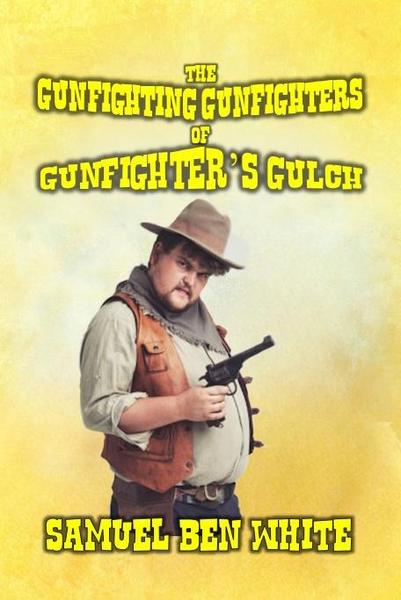
The Gunfighting Gunfighters of Gunfighter’s Gulch

Available now on Apple, Kobo, and many other formats! Coming soon in paperback!

When Portly Ben Rousterman tried to hold up the Third National Bank, he paid for the mistake with his life, and roiled the far west Texas town of Gunfighter’s Gulch.

Into the story with a fierce indifference ride the principals:

  • Raccoon Jack Carter, big game hunter with an oversized personality and a powerful thirst for avenging his fallen brother.
  • Sheriff Darren, the overweight, poor-on-the shoot sheriff with the massive wife must contain the trouble before it gets out of hand.
  • Hiram C. Cort, president of the Third National Bank who has ambition, drive and plans—all of which may be thwarted by an infestation of owls.
  • And lovely Lacy Halverson, the prettiest girl in Gunfighter’s Gulch, under a constant barrage of marriage proposals, and maybe the only one who really knows what happened to Portly Ben.

All these characters and more in one hilarious night of bullets, dancing, fowl and water as the gunfighting gunfighters collide in Gunfighter’s Gulch.

“At first I was mad at Sam White, when I shot coffee out my nose after he caught me off guard and made me laugh out-loud.   I loved the book and I don’t normally read ‘smoke burners’, as I call them. If you want to travel back to the old west, and then laugh when you step out of the saddle, this is your book! WARNING – Do not read while drinking coffee.” —Steve Sederwall, Cold West Investigations

Read a sample chapter …

Chapter One

It was a hot day in Gunfighter’s Gulch, the sun overhead as red as an undersized banana and beating down on man and beast. It hadn’t rained in time out of mind and the east town doctor was beginning to worry that insanity would set in sooner than usual this year.

It was such a day as that that Portly Ben Rousterman left his spotless appaloosa in the corral to the east and walked to the Third National Bank of Gunfighter’s Gulch. Hitching his twin Allen five-shot pistols into a more comfortable position on that part of his body where he once remembered having hips, he stepped up on the boardwalk.

And promptly went through as the heft of his girth cracked the dried wood. With a foul oath his mother had taught him on his lips, he stepped out of the hole and to the door of the bank. Throwing it open, he wedged himself through with much effort and difficulty for not only was it narrow and he wide, it was a revolving door—the only revolving door between Dallas and Los Angeles and, therefore, almost impossible to get parts for.

With an effort, Portly Ben finally shoved his way into the lobby and was told politely by the bank guard, “You might want to try the loading docks in the back when leaving, sir.”

“Obliged,” sneered Portly Ben before pulling out his twin Allens, their maple grips feeling comforting in his big beefy paws, and said, “This is a stick-up. Take me to the vault.”

A woman screamed. Another used that same word Portly Ben had used out on the boardwalk. Several people gasped at the use of such a word in public. A child asked his mother what it meant, to which she replied, “Ask me after the hold-up, please dear one.”

The nearest teller, a man so tall he could actually see over the cage, said, “Good sir, we have no funds in the vault at this time.” Eliciting more use of that same word from earlier from all the people who had come to withdraw various sums so that they might pay their bookies, he elaborated, “If only you had come tomorrow. That’s when the enormous secret gold shipment is due to be inexplicably deposited here.”

While Portly Ben mulled over this information with a strange light in his eyes, the bank guard couldn’t help but think there was something he should have been doing. The other teller, meanwhile, was Lacy Halverson, prettiest woman in the bank—and possibly Gunfighter’s Gulch—and a crack shot.  She had jet-blonde hair and an alluring if strictly off-limits body and piercing mismatched eyes. She dreamed of one day going on the stage, and taking that stage to some place where she might find a theater production to watch and then become a part of, where she might spurn many protestations of love and die a romantic but unrequited life.

“Just give me what’s in the vault,” Portly Ben demanded, his voice low and gravelly for he had forgotten to drink water that day, “And no one will get hurt.”

Whipping the ancient LeMat revolver from her cash drawer, where she kept it both for defense of the bank and her person, but also as a conversation piece as there was so rarely money in the drawer, Lacy pointed it at Portly Ben and said, “Kind sir, please either put your guns away or move a step closer for when I shoot you I do not want to hit anyone else.”

Portly Ben was surprised and, as he looked in Lacy’s one beautiful blue eye (the other being brown and only so-so), he saw that he truly could die. He had never thought that before.

Well, he reasoned, that wasn’t exactly true. He supposed he had always known he would die, but he expected it to be from either old age or cliff-diving, possibly hanging. He carried guns, and he had used them, often as firearms, so he knew that man could die by the gun. He just never thought it would be him because so far it never had been.

They stood there like that, in a New Mexican standoff—for the bank was in more than half of the town that was in the New Mexico Territory on account of the Texas side of town having more laws against fraud—until Percy McGoon, a slightly-built man with massive forearms and a taste for spinach said, “If you people don’t mind, I really need to make my deposit and get to work.”

“I don’t mind,” said Portly Ben and waved Percy to go ahead.

“Why does this always have to happen to me?” Percy whined as the very tall cashier—Very Tall Paul Bigman—counted the three dollars Percy was depositing and then made him out a receipt for the majority of the amount. Taking his receipt and vowing in his mind to one day avenge all that had been stolen from him by this bank for years, Percy wished all a good day and left. He thought about informing the sheriff that the bank was being robbed, but he had already been late for work every day that week and didn’t want to try his boss’s patience any further.

In the bank. Portly Ben and Lovely Lacy said in unison, “What’s it going to be, Pal?” and then he chuckled and she tittered at their harmony.

The bank guard happened to glance at the clock just then, saw it was his break time, and so sat down and picked up the nearest copy of Puck and began to read. Chuckling, he kept his daily vow to not think at all about the bank or it’s problems for the next fifteen minutes. He did think about going in the back and getting a cup of coffee, but he hated coffee, so he didn’t.

Portly Ben was a patient man, but he could be pushed past the point of endurance. It came just then and he said, “I’m going to count to three, and if you bankers don’t start handing me sacks of money, I’m going to let loose with these guns and heaven help whoever’s on the other end!”

Those still paying attention were scared, for he sounded like he meant it and they all knew about Allens. Five-barreled guns where the barrels rotated instead of just the chambers, they were notoriously unreliable but, if their triggers were pulled, bullets almost always came out the other end. In the hands of a skilled user, they knew, an Allen could do much random damage and, unlike Portly Ben and living in the west as they did, they knew one and all that they could die that day.

The tall cashier, already bored out of his mind since Percy had left, could only hope that one of the bullets would catch him and end the afternoon sooner rather than later. He sighed with exasperation, but such didn’t trigger Portly Ben’s trigger finger. Tall Paul Bigman would have sighed again, more loudly, if he could have generated the interest in doing so.

He couldn’t, and so just remained silent, wondering if the would-be outlaw would mind terribly if he balanced his drawer, especially now that there was three dollars in it.

“All I want’s what’s in the vault,” Portly Ben demanded. “Just let me by and I’ll go in there and get it myself if it’s too much trouble for you to get it for me.”

Lovely Lacy replied, “The vault is for authorized personnel only. Now you, just turn around and squeeze yourself back through the door and don’t come back.”

Portly Ben was not used to having anything he desired denied him. Things he commanded were always carried out. Who was this remarkably attractive girl to deny him anything, he wondered, and would she go out with me when this is all over? He happened to know there was a barn dance over in Friona the next Friday night and he was going to be there robbing the stagecoach anyway, so maybe—

While no one but the Good Lord ever knows for sure, it is quite possible that the Friona Quilt Store Jamboree and Hog Call was the last thought to pass through Portly Ben’s mind. It is quite possible that his thoughts were more along the lines of, “Wait! That’s a LeMat, the gun of the Confederacy that not only had six revolving chambers but a second barrel bored out to either 16- or 20-guage with which the user could fire a raft of buckshot!”

Accidentally waving his left-hand gun in a more threatening manner than he perhaps intended, he received the full brunt of the 16-gauge in the chest, which spun him around (twice). As, with his last breath and more from autonomic function than intention, he stumbled toward the front door, Lacy fired off the six rounds of .36 caliber bullets, knowing as she did that a .36 didn’t pack the wallop of a .45 and one couldn’t be too careful.

With his dying breath, Portly Ben Rousterman wedged himself into the front door of the Third National Bank of Gunfighter’s Gulch. Portly Ben dropped his two guns, the one from the right hand going off on impact with the floor, its bullet destroying the framed portrait of Aaron Burr which hung over the bank president’s desk for reasons that probably don’t come up in this story.

Someone screamed, several other people said that word, and all of them wondered how they were going to get out with the front door clogged up that way and the loading dock door the guard had mentioned blocked by that old train car.

The Body in the Floor

When a skeleton is found in the remains of the burnt-out courthouse, most folks just treat it as a curiosity. Ira “Doc” Pearson knows it was murder and wonders if the murderer is still around.

Published by Outlaws Publishing and available on ebook (in many formats) and in paperback!

See all of the Ira “Doc” Pearson novels here!

The Van Bent courthouse burns down and a body is found to have been stuffed into the floorboards years before, when the building was built. Ira Pearson is determined to discover the identity of the woman, but Sheriff Wood has little interest in the matter for he has more important matters on his hands–including a numbers runner and big city tough who came to Van Bent for some reason and promptly lost a thumb in an alley fight. Could the back alley fight and the woman in the floor somehow be connected?

Sample passage

“What’s going on, Chief?”

“I just—you need to see, first.”

The chief led the way over to the smoldering remains of the courthouse and to a ladder that had been lowered into the basement. He handed Ira some big, rubber boots, saying, “Put these on. Foller me. It’s safe,” Buckler directed as he descended the ladder.

Ira hesitated, but the man seemed to be going down with no fear. And it did look like everything was safe but soaked, hence the boots, which he put on. He took a breath, then followed the man down the ladder and into the pit that had so recently been the courthouse basement. He was glad of the rubber boots if for no other reason than that they came up to his knees and the piles of muddy ash were at least that deep.

They slogged over to a space almost in the center of the building’s footprint—which seemed surprisingly small to Ira, now that the building was gone—and Buckler knelt down and pointed. “Looky here, Doc.”

Ira bent over and saw instantly what the man was pointing at. “Human hand, ain’t it?” Buckler asked.

“Sure looks like it. Right hand.”

“No chance it’s just a fake of some kind? I seen a human skeleton over to El Paso once made out of plaster. This looks real to me, but I ain’t seen all that many human bones in my day.”

Ira moved in closer and peered at the strange object before him. “My early thought is that it’s real. Is there more?”

“We stopped work when we seen this,” Buckler answered. “If there is, I reckon it extends in under that pile there,” he continued, pointing. “I didn’t want to go no further ‘til we had you here to supervise. Thought you could tell us if this person died in the fire.”

“At an early guess, I’m going to say no. As hot as that fire was, if this were a, um, ‘fresh body’, there would probably still be more signs of flesh. And the burn marks on the bones would be different if flesh were melted off or if it were just bones in the fire.”

Buckler nodded and said, “I git ya, Doc.”

“Chief, you know of any reason there would be a skeleton in the courthouse?”

“None I can think of. Nobody had one in an office or anything—that I know of.”

“And this is on top of some things,” Ira commented, mostly to himself. Realizing he had said it out loud, he explained, “Not like this courthouse was built on top of an old cemetery and this was someone buried here. This person is above the rock of the basement. Any chance this person was stored in the basement?”

“What for?” Buckler asked, almost laughing.

“Who knows? Any old rumor that there was a body in the basement, though?”

“None that I ever heard. An’ I been here since the foundation was laid on this place. Before that, even. I helped to dig the hole.”

“All right,” Ira said, standing up. He looked around, then said, “This person’s dead, so it’s not like we can hurt him—or her—in any way. Still, let’s see if we can dig him out without jostling the bones around any more than we have to.”

“Okey-dokey,” Buckler said. “We’re going to need to brace that west wall, though. It’s bucklin’ a little and liable to collapse on us if we don’t.”

Ira nodded and said, “You get some men on that. You and me, let’s get some shovels and maybe a pry bar and see if we can find out whether there’s more under here than just a hand.” As the fire chief went off to put those instructions into action, Ira looked at the hand and remembered how finding a hand like this had landed his friends the Jameses in all sorts of trouble. He hadn’t been there, but he had heard the story. He also had thought over the years that, if he had been there, he could have kept Polly from spending that year in prison that she hadn’t deserved.

Buckler was soon back and, as three men worked to shore up the west wall, he went to work with Ira at pushing the ash and dirt away from the hand.

Soon, they were seeing a wrist, and then part of a forearm. And then, it seemed as if the arm were reaching out from within a wooden frame. “A casket?” Buckler asked as he looked at the wood.

Ira took up one of the shovels and scraped some of the dirt and ash away, then said, “Look at this, Chief. This isn’t a casket. Not built like that.”

Buckler shoved some of the dirt away himself and said, “That there’s flooring.” As Ira nodded, Buckler commented in worried awe, “This body was inside a floor! Somebody hid a body in the floor.” He reached out and rubbed some ash away from the top, saying, “That’s the tile from the first floor. I’m picturing in my mind and them joists for the first floor was foot-wide beams. Two foot on center.”

“Plenty of room to hide a body,” Ira commented.

Buckler tried to made a joke as he said, “Ain’t nobody goin’ to fit me in a foot-by-two space lessen they squeeze me down a might.” He looked up suddenly and asked, “You don’t reckon it’s a child, do ya, Doc?”

“Based on the size of that hand, I’d say it’s at least someone fifteen years old, or more. Not a big person. Might be a lady.”

Buckler took off his hat, as if at a funeral, and said with reverence, “God be with us.”

Ira raised up, tapped through the mud and ash in a couple places, then said, “Looks like there’s a fair-sized portion of that floor here still intact. Relatively speaking, anyway. Let’s clear it off and get some more pry-bars over here.”

“Think the whole body’s still together?”

“I’d have to say that would be beyond belief, but finding this at all is pretty incredible. And somebody better go fetch Sheriff Wood.”

“After all this time?”

“Whether we can figure out how this person got here I have my doubts, but it’s not likely to have been for benign reasons that someone hid a body in between floorboards. I think the sheriff needs to know.”

Buckler nodded again, then detailed someone to go get the sheriff and the other two men to help them pry the boards apart. It was not easy for the floor had been well made and they were trying to not disturb the bones any more than absolutely necessary.

Sheriff Wood was with them a while later—and quite a crowd had gathered nearby though the volunteer fire department men and Wood’s deputy Chubby were keeping them back—when they finally got the right boards pried up. There were a couple of reverent exclamations, the Catholics present crossed themselves, and Ira was the first to articulate any recognizable words.

“This was a woman,” he said. Though the visage before them was mostly of bones, there was just enough muscle and tendons still clinging to the form to keep the skeleton intact.

“How old, you reckon?” Buckler asked, watching with great curiosity, but also with a clear reluctance as to touching the bones.

Ira shook his head, but leaned closer and said, “I can give a better answer with more study, but her hips make me think she was old enough to have given birth. There was no sign of arthritis in that hand we saw first.” He then pointed and said, mostly to Wood, “Look there, Sheriff. However she came to be between these boards, someone murdered her to get her here.”

Wood looked, as did the other men close by, and could see the crack in the skull Ira was pointing to. Wood, feeling the need to say something, “She was either dead when she was put in here or close to it. Nobody would have lived long after a rap like that.”

Ira nodded in agreement then said, “It’s been a long time, Sheriff. Trail’s going to be colder than a polar bear. But this fire just revealed a murder.”

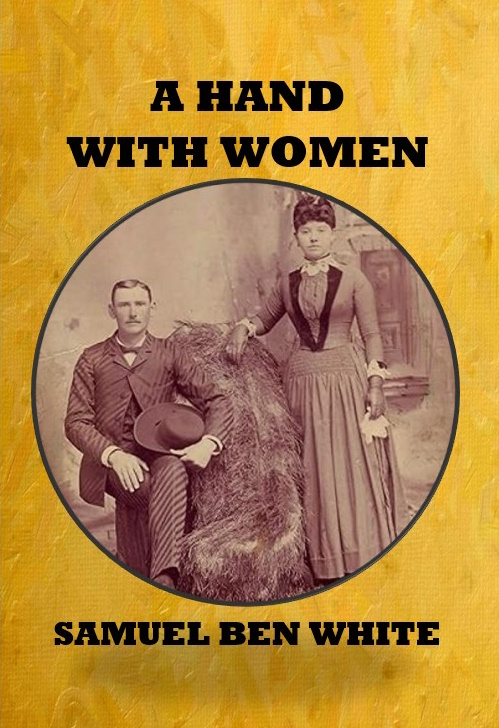
A Hand With Women

Louis L’Amour meets Agatha Christie in this mystery set on the Texas plains in the late 1800s. A mysterious woman, part of a human body, and a posse all converge on a lonesome cowboy named Morgan James.

Published by Outlaws Publishing

Available for ebook (in many formats) and in paperback.

Morgan James left McKeon, Texas, ahead of a neck-tie party the esteemed locals were preparing to throw in his honor.

His horse had been tired when he hit McKeon to start with, and after a night of hard riding, it was about done in—and so was Morg. So he stopped at what looked at first glance in the early morning sun like a deserted ranch for water and a rest. It wasn’t so deserted as it looked, for a woman with a haunted look about her lived there. She offered Morg shelter, but there was still something about her that gave him the willies.

The ranch was called the T-Bell and there were those who said that death stalked the T-Bell range. Others said it was the woman who ran it that was being stalked, while still others said she was crazy, or a witch.

And then Morg found the better part of a dead body on the part of the T-Bell range that backed up on Palo Duro Canyon and suddenly all those wild stories he had been hearing didn’t seem half-wild enough.

…

Sample reading

I was never much of a hand with women. Not that I had ever been around many of them I wasn’t related to, but when I was, words flowed about as freely from me as water did in those dried-up creek beds back home.
The more I think about it, that’s a pretty good description all the way around ‘cause when rain did come back home, the creeks would suddenly swell up and overflow and cause all kinds of destruction. That’s me, too. Around women, I’d get tongue-tied and couldn’t hardly make a word come out that made sense, but then, sometimes, I couldn’t shut up. I’d talk like a carnival barker and, generally, make a fool of myself.
So I had learned, mostly, to be even quieter. When there was a woman around, she didn’t generally take much notice of the quiet, homely man—whether I was standing in the corner (not unusual), or right next to her. What I did know about women-folk, they was more likely to look at and admire a fancy piece of furniture than a guy like me.
Looking back now, maybe I wouldn’t have gotten in so much trouble if’n I’d knowed how to talk to women. Or, at least, had knowed how to let them talk to me and still keep my wits about me.
You take my pa. Why, he could talk to a woman just as easy as talking to a fella. Just had that easy, friendly, way some men have about them even though I’d say he weren’t no better looking than me. But he could walk into a room and folks would notice, or he’d start yarning and the women folk would be listening as close as the men.
Don’t get me wrong: my pa loved my ma and anyone who even hinted that he might have stepped out on her would find themselves on the business end of a punch to the nose, from me or anyone who really knowed my pa. He was just … I heard someone describe him once as “charming” and I think that’s the word that fit best. I think when them moments came where I’d be shooting my mouth off like a wagon wheel in need of grease that, deep down, I was trying to be like Pa.
Another thing about Pa was that he sure never would have gotten himself in a fix like the one I was in. The only trouble I ever knowed Pa to have was with the bankers. Not that he was a robber or sharp of any kind, but he was a farmer, and farming’s a chancy thing in Texas. Maybe it is anywhere, but down there in central Texas, when one year you got nothing but rain, then the next nothing but hail, then the year after that all the dust and dirt Oklahoma can spare, why, it just ain’t a stable business to my thinking. But Pa, he loved it. Sometimes I thought he even liked arguing with the banker, ‘cause he sure did it enough.
I remember one time when he fell behind on some payment or other and the banker sent out a couple of the toughs from town to “attach” Pa’s best mules. I was just a young’un then, and was wondering what they would attach the mules to, but Pa, he stood right up to them. He was holding a shot-gun like he meant business and told them two men that if the banker wanted Pa’s mules he could come get ‘em hisself. They argued a little, but they didn’t want to argue too much with that scatter gun, so they rode off, saying they would be back with the banker. They showed up the next day, banker with ‘em but looking scared, and Pa hands over the reins to them mules just as calm as you please. Next day, he takes me along with him and we head west, away from town, and over to Old Man Possum’s place. I reckon now that I’m grown that that man’s name wasn’t really Possum, but that’s what everybody called him. My pa made a deal with Possum that afternoon. He traded two weeks worth of me for two weeks worth of Possum’s oxen.
It’s hard to say who got the worst deal out of that. I was twelve years old and pretty strong for my age, so I was set to working in Possum’s garden, as he called it. It wasn’t much of one, but it needed weeding and watering—from a can, water drawn from a well that seemed like it must have been halfway to China in depth and as far as possible from the garden and still be on Possum’s place. So I took care of that garden, slept in Possum’s barn, was fed meals that ran mostly to stews with mighty little meat by Possum’s wife (I never had no idea what to call her other than “ma’am”) and did a few other odd jobs around the place.
My father, though, he got stuck trying to finish his plowing and planting with a team of oxen that, he said, was more muley than mules. But he got it done, and we worked that farm without mules that summer—and without much talk, for I was some mad at my pa for trading me off like that—but it was a good, rainy year for that time and that place, so we had the best crop we’d ever had. Pa took the money we made, paid off that banker that took the mules, then went thirty miles away and opened up an account with another banker. Pa fixed up to be a pretty fair farmer and had a good eye for dairy cows, so though we was never rich—while I was to home anyway—he generally ran ahead and rarely behind. That other banker, the one Pa went to after the first one, his bank eventually became quite a going concern and I heard he liked to rub it in on that guy Pa had left.
When I turned fifteen, though, I lit out. I wasn’t mad at Pa, and he didn’t begrudge my leaving, but a cattle drive from way down south came through our area and the drover asked if I or my pa would like to ride along and make a few dollars as one of the men he had started the drive with was sitting back in Leander with a broken leg. I think Pa hated to see me go, but he had done some yonderin’ when he was about my age, and then he had fought in the war, so he knew what it was like to be a young man who feels the need to get out and test hisself against the world. He shook my hand, slipped me a five dollar gold piece (where it come from I always wondered, for I had sure never known him to have any extra money lying about) then told me to write my ma now and again. I said I would and lit out, nothing to my name but a used Colt, a used-er saddle, a middlin’ horse, and not enough of an idea what I was going to do for it to be considered good or bad.
When I rode up on that little farm house, boards old but took care of with white wash next to a barn in similar state, it was fifteen years later and I had a sight of riding behind me, and a lot of years. I was done in and thinking anywhere, no matter how ragged, would be a good place to stop and cool off for a moment. When I saw that it had a pump and a trough, why I thought I was as close to heaven as a body could come on this green earth, which wasn’t much green that year, but that’s not really important to the tale I don’t think.
There was an old army canteen at the base of the pump, the lid screwed on tight. I figured that was left by some good Samaritan and that the water in the canteen was so’s anybody who came along could prime the pump. It was a common practice out there in them dry lands, and every man—even the outlaws and ne’er-do-wells—knowed to refill the canteen before riding on. Why even me, riding ahead of a posse like I was, I was already figuring that my first move after getting that pump a-flowing would be to fill that canteen and set it back where it was for the next guy, even if it was them that was hunting me. So when I picked it up and nothing sloshed, I said a word my church-going parents would not have approved of. I apologized to them and the Lord, then reached for the handle on the pump. I took a good look at the water in the trough, then, and saw that it was pretty and clear, not old and scummy like I had been expecting. Fact was, there wasn’t any green at all on that trough, just a little in the grass around the trough where water had been sloshed.
Sloshed by who? I wondered, as most western people would have heard me coming for a quarter mile—and seen me for twice that—and been out to greet me or shoo me on my way. I’d seen nobody, though, so I cranked that handle a couple times and water gushed out of there like Moses’s rock. I filled up that canteen out of habit and set it by the pump, then drank some myself and splashed some on my face. That horse I was riding, an old fellow with a blaze across his nose and a faded Spectacle brand on his rump, he was already at work on the water in the trough and looked at me as if to say, “I seen this water was fine right off. What was you waiting on?”
It was a dry day, and I drank my fill, but it wasn’t really all that much; I suppose on account of having spent a lot of dry days in my life. So I filled my own canteen, then drank again.
With water in my belly, which suddenly felt like too much water when I started to walk away from that pump, I tried to think of what I should do next. Running from that posse seemed like a bad idea the more I done it. They were going to catch me, sooner or later, and even if they didn’t, someone would. And then even though I still thought I wasn’t guilty of what they said, I was guilty of … what was it a sheriff I once knew called it? Escaping justice? Evading arrest? Yeah, that was it. So even if I got shed of that posse this day, they would put out a wanted poster saying I was wanted for evading arrest and there was no way I could deny the fact.
If I was to ask my ma and pa, I reckoned they would have told me to go back and face the music. Setting a good bit of store by both justice and the Good Lord, they would have told me that the truth would set me free, or something like that. I didn’t want to doubt the Lord, but I knew the carrying out of justice would be done by men, and I had no cause to trust them. Specially not in a bunch like that. One man, I might could talk to him and set him right, but a whole bunch like that, and with me being a man who had run like he was guilty even if he wasn’t? No, I didn’t have a lot of confidence in justice being did.
The short of it was: a local man was dead and I was a stranger. I was pretty sure I hadn’t killed him, but everyone else who might be a suspect was a knowed local, which made it a lot easier to suspect me. Who knows but what I might have thought the same in their place. I told myself then that, if I was ever in such a situation, I’d cool my heels and find out what the facts was before making a decision. Such an idea was fine and dandy, but it still left me out there on the prairie with a posse likely somewhere behind—and not by much.
It was then I noticed there was a bit of a garden beyond the house, and some straggly fence guarding a draw further back. I couldn’t see anything being kept in that fence—or kept out by it—but it didn’t look broken down so I was guessing there were cows beyond those barbs. The barn door was half-closed, so I couldn’t tell if there was anything in there.
So, I up and hollers, “Hello the house!” like a neighborly westerner should. In the city, they tell me a person would walk right up to a stranger’s door and knock, but all my life I had been told that the best thing to do—the friendly thing to do—was announce yourself before even setting foot on the porch, just in case they didn’t want you to come no further. Most folks wouldn’t begrudge anyone some water, but they lived out there in the middle of nowhere because they wanted to stay in the middle of nobody and didn’t want nobody coming round unexpectedly.
And in that country, you could see who was coming. It was flat and there wasn’t hardly a tree in sight, and very little roll to the land except where that draw was. It was the kind of land that made me mindful of a man I worked for during roundup down near what would later be called Sudan. He was a grizzled, grumpy old man who once told me he picked such flat land because when his wife left him, he wanted to watch her go for a week.
Where this little farm sat, it was almost that flat. It was deceiving, though, because I had a hunch that draw was just one of the tentacles of the canyon, which one could ride up on all of a sudden. Even without the canyon, flat lands are rarely as flat as they appear and little dips and hollows can hide a lot more than one would think—just ask them that fought the Indians for them lands.
For all the flatness, it wasn’t a bad spread. The buildings could use some work, but that well was good water and in that country, water was gold. A man could run some cattle, or maybe grow some crops. I couldn’t see any way a man could get rich off that land, but I was thinking a body could make a living, and I’d seen just enough rich people to make me think the man who made a living was probably better off than the man who was rich. Me, I’d been nothing but a drifting saddle-bum, a good hand on a ranch, but I’d started to think that I wouldn’t mind putting my feet under the same table night after night, plowing my own land or cutting my own hay or riding herd on my own cattle. Fourteen or fifteen years before, I’d have said that would never be for me, but a man changes over time, or I had, anyway.
That was sort of why I had been in that town to start with, the one that now wanted me back so badly that they’d sent a posse of men to look for me. I had come there to hunt up a job ‘cause I had heard that the local ranches were hiring for a round-up. It had been in my mind that I could stay in one area for a while and keep my eye out for a likely piece of land that I could buy and develop for myself. My great plan didn’t make it past the first night.
I’ve never been much of a drinker, but I was new to town and there’s not a better place to learn what’s going on than a saloon and that town only had two of them. Looking back, I wished I had tried the other one, but I went into one called “Jeb’s” and there was a fair sized crowd already drinking. A faro game was going, as well as some kind of a wheel you could bet on. (I never liked them wheels ‘cause it seemed likely they were weighted and, even if they wasn’t, the odds of winning seemed awfully low. I played faro a few times, and won a little, but my money had always been too hard to come by for me to throw it away like that.) I ordered a drink, leaned against the bar, and surveyed the room.
Right about then, one of the guys playing faro, a big, hairy fellow with a too-tight shirt and a scar on the back of his head where the hair didn’t grow, he grabs the faro dealer by the collar and jerks him over the table, calling him a cheat. That faro dealer wasn’t much of a man size-wise, but he was quick with a knife and had this thin-bladed job out and driven deep into the big man’s right arm. The big man hollers and fetched that faro dealer upside the head with his left hand but the faro dealer still wasn’t having any of it and drives that knife into the man’s gullet.
From that point on, it was a little hard to say what all happened, but as near as I can remember, one of the big man’s friends took exception to what had transpired and smashes a chair over the faro dealer’s head. The dealer went to his knees, then the man who was spinning that chance wheel comes up with something like an Indian club and brings it down on that friend’s head. Then someone else jumped, then someone else. Before you knew it, everyone in that saloon was throwing punches.
Including me.
Now, with the clear vision of looking back, what I should have done was skedaddle out of there, even if I had to duck under a table and crawl. But I had been in some fights before and usually gave a good account of myself. Not a big man—just right at six foot—I had the muscles of hard work and had learned a little just from being knocked down here and there. So when a fella crashed into me and spilled that drink all over my best shirt, why naturally I straightened him up and give him an upper-cut to the chin. Somebody else took offense at that, or maybe just wanted in on the fight, and jabbed me in the kidneys. It hurt something fierce, so I took to pounding on the man who I thought had done it. He was standing in the right spot, anyway.
From there on, it was just a circus act, with men throwing chairs, punches and each other until the room was a mess and we were, too. Of a sudden, a shotgun blast goes off and we all stop what we’re doing to see the sheriff of that town standing in the doorway, a couple deputies by his side and a scattergun in his hand. Then he tells us we’re going to pay for the damages and anyone who tried to leave the room without putting at least five dollars in the saloon-keeper’s hat was going to jail until such time as he, the sheriff, thought we deserved getting out. Now, I begrudged that five dollars, for I had been planning to send it to my bank, but I figured five dollars was better than a night in jail so I chucked it into the hat and the sheriff let me walk out the door, but not before asking my name. I told him it was Morgan James and he let me go but told me not to leave town right away.
My horse was tied up out front, so I hopped up on it and rode him out to a clump of trees I had seen west of town, figuring to bed down there for the night since the few dollars I had hoped to spend on a room were now in my Cindy Lou Fund, as I sometimes thought of it. They weren’t so much trees as just tall scrub, but after checking for snakes they made for a decent place to bed down, and a little off the road. I ground-hitched the horse and lay down.
It was just a few minutes after I stretched out that I heard a ruckus coming from town. I wasn’t but a couple hundred feet from the back door of the other saloon and sounds can travel pretty well on a prairie night. Once my ears was attuned, which was mostly a matter of waking up, I heard someone shouting that someone named Buster McKeon was dead, and something about his head being stove in. Someone else said something about him being still on the floor of Jeb’s when the fight was over and how they had thought he was just knocked out until someone felt of him and realized he wasn’t just out, but dead. I was listening good, then, for who doesn’t like to hear a good yarn like that?
It was at that moment that I began to wish I had crawled out when that big hairy fella got stabbed in the arm ‘cause my ears caught real clearly someone saying the name, “Morgan James.” Someone else said something about how they all knowed each other so it had to be that stranger who killed this McKeon.
Part of my brain said I ought to walk in right then and clear my name, but that part of the brain was stampeded by the rest of me that said I better get out of there because McKeon was the name of the owner of the biggest ranch around. I didn’t know Alexander McKeon or this Buster by sight, but I told myself there was no chance I was getting a job in that town now and I had best put some distance between me and them good folks.
As the crowd moved off towards where I had seen the sheriff’s office, getting louder and angrier as they went, I hurriedly and quietly rolled up my blanket, saddled my horse (he wasn’t too happy about that!) and slipped off into the night as fast as I could go without making any noise. There’s always noise, though, and with every one I made, I scrunched my shoulders, waiting to hear someone from town holler, “He went that way!” I didn’t hear any such thing, but I still didn’t relax much even as I prodded the horse to a slightly faster gait as we got a couple hundred yards from town.
Most of a day later, after watching over my shoulder and seeing a faint dust cloud that I was sure was a posse on my tail, I arrived at that little, run-down farm. Even though that well water was as good as I had said, I was about to come to the conclusion that no one was home when the front door of that little house opens up and a woman’s voice says, “You’ve had your drink, now move on.”
I looked up in surprise and for the first few moments I couldn’t have told you whether she was tall, short, fat, skinny or pretty, because all I could see was that old Sharps .50 she was holding that would have drove a hole through me bigger than my horse if let loose at that distance.

A Thousand Miles Away

Edward Garrett finds himself washed up on the shore of a foreign land, shipwrecked! As he tries to find his way home, he becomes involved with The People, a friendly—but reserved—people who live along the coast and are being harassed by brigands from the mountains known as the Brazee.

Thinking that Marcus has brought him here for just this reason, Edward agrees to lead a posse into the mountains to try and retrieve four teenage girls who were captured by the Brazee. Edward’s greatest desire is to leave, to go find his beloved Marianne and let her know he didn’t die in the great battle by the river. In the process of freeing the girls, however, he is shot and lands in a Brazee prison. There, he is forced into gladiatorial games where the only way to freedom … is death. A futuristic fantasy in the tradition of Louis L’Amour.

Order today for Kindle or Paperback

And don’t forget the two prequels to this novel: “All the Time in Our World” and “Some of the Time“!

Reading Sample

Running up the stairs of the tallest parapet of the grotesque castle that overlooked the river we in my day called the Mississippi, I was bleeding from a few minor cuts and my skin was bruised in many places, but I had never felt more alive. Nor had I felt more joyful.

Ahead of me ran Marcus, carrying his sword and with a light step as one who is running for pleasurable exercise. One might even say he carried the sword casually, though Marcus did nothing casually. All he did was carefully planned and meticulously executed. If Marcus had stopped to admire the sunset, anyone watching would have just assumed that was what he had always intended to do at that moment, for those who knew him knew that none of his steps, moves or halts were in waste.

Holding my own sword in my right hand, it’s blade still flecked with black blood for I had had no opportunity to clean it, my mind went back briefly to how we had come to be there. I say briefly for it was just a matter of steps, but the mind works in overdrive when in battle and a million thoughts may rush through a mind in their completeness in less time than it has taken me now to write this sentence.

We had crossed the great plains that I had once known as the land of Oklahoma with relative ease, though it hadn’t seemed so at the time. The logistics of moving such a great force of such disparate abilities and technologies had been one of the problems. The skirmishes we had fought against advance scouts of the Enemy had been another difficulty, though as we looked back later those battles had been like swatting mosquitoes.

As we had crossed into what had been known in my time as Arkansas and Missouri it seemed as if every valley and each forest held a new host of enemies lying in wait to ambush us. We had excellent scouts of our own, but it soon became obvious that it was not a position that promised a long lifespan. Though, as we went further, experience taught our scouts much and those who made it to the river with us were woodsmen indeed.

We came to the river fully six months after setting out on this excursion. We had been joined by additional members of the Gund Nation, as well as more Overstreets (who proved to be the best scouts for they could move through the forest more quietly than the wind itself) and even a large contingent of warriors from a people known as the T’rah’mra, who lived far to the southwest of Green River, along the sea coast. Somehow Marcus had gotten word to them and though they had set out before us it was some time before they could catch up to us. They were a people who were mighty in the skills of boat building and their service when we got to the river was immeasurable.

Still six days from the river, we had been met by a most surprising delegation. Eight men and five women—all taller than my six foot and appearing to me made of whipcord and muscle dressed in clothing that looked like something the Polynesians of my day might have enjoyed—arrived at our camp, also saying they had been summoned by Marcus. How they had received said summons none were ever clear, but Marcus greeted them warmly and assured us he had called for them. They were a people who called themselves a name which meant “Land of Wet Ground” but they were known in rumor and legend to the Gund as the Treemors.

They were somewhat darker of skin than I, but not so dark as the Cherokee or the T’rah’mra and, as I say, they were all tall. Some of them approached seven foot, though most were around six and a half. I was to find out later that they came from the deep woods that I once knew as Georgia and Northern Florida. Even with their bright clothing, they could disappear into a forest almost as well and quickly as an Overstreet.

The delegation of thirteen—a number of some significance in their reckoning—brought us the welcome news that they had a force of some hundred thousands amassed on the far side of the river, not twenty miles from the Enemy’s castle. They were the most advanced of the surface-dwelling people and maintained a primitive radio communication among their people. It was subject to disruption and had a limited range, but they assured me that they could and would work in concert with us when the time came to attack.

That time was soon. We knew the Enemy was aware of our presence and we were also certain he knew why we were coming, for he was not a being who welcomed casual visitors. While we hoped that we could maintain some element of surprise as to the “how-to’s” and “where-fore’s” of our attack, we knew that our only real hope lie in the justness of our cause. More than that, of course, was that Marcus was on our side and he had never been defeated—nor would he ever be we were sure.

I split our forces into three main divisions, though two of the divisions were—numerically—vastly superior. The smaller division—which was itself bifurcated—was our demolitions team. Half of them were to work their way to the western shore of the river and, on signal, begin to bombard the city with bombs my good friend Lomar would have relished to handle. The other half, meanwhile, had taken themselves up river approximately two hundred miles, to an ancient dam on the river that created what Marcus said was the largest inland, manmade, lake in the history of the world, larger even than the Lochs he, Marianne, Daniel and I had marveled at many years ago on our first journey. Upon reaching the dam, they would set charges and—from a safe distance—blow them and release the water of the lake.

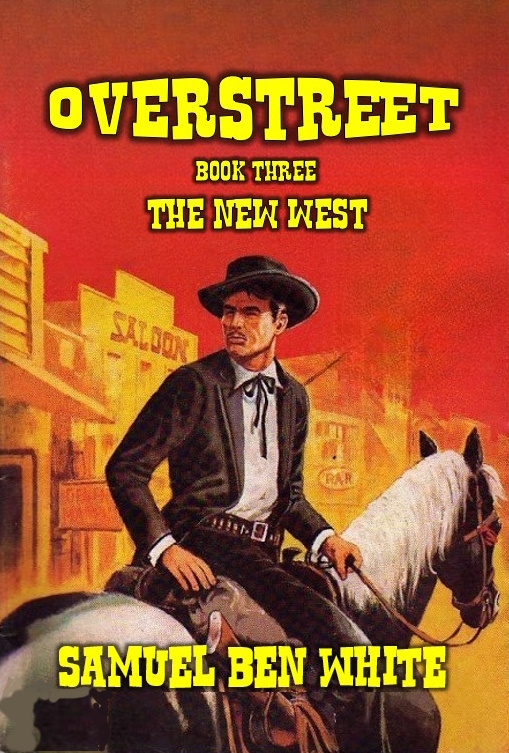
The New West – Overstreet book 3

The conclusion of the John Overstreet saga. The gunfighters are hanging up their guns, a new century is dawning, and a different kind of fight comes to the You’ll See. But one more gunfight is on the horizon for John Overstreet: the last gunfight.

Available in ebook (in many formats, including Apple) and paperback.

…

Reading Sample

“Aunt Melinda! Aunt Melinda!” Ben shouted as he ran up the road from town. He had run all the way and though he was about out of breath, he was long on enthusiasm and that was making the difference.
Afraid something was wrong, Melinda stepped out on the porch and was relieved that he seemed to be shouting it in a happy way. Still calling her name, he ran up onto the porch and into her arms, panting happily like a dog.
“What is it, Ben?”
He tried to tell her his news, but his wind had finally caught up with him (or left him, depending on how one looked at it) and all he could do was stand there and breathe heavily. He was a blonde-headed boy with his mother’s green eyes and his father’s good looks. A little more stout than his older brother, he was still good-sized for his age and becoming very athletic.
His real passion, though, was art. So he held up a piece of paper and managed, “Read this.”
Melinda took the paper and read, “‘Dear Mister Rathum, We are pleased to inform you that the drawing you submitted has been chosen as a finalist and will be on display in the Denver Museum of Art and is eligible for first prize in The Rocky Mountain News’ Young Artist Competition.’ Oh Ben, this is wonderful!” She gave him a hug, which he barely acknowledged as he took the paper back and read it again.
“Can we go see it? In the museum, I mean?”
“You bet we will!’ Melinda told him with another hug. “We’ll take the whole family. And we’ll be sure and let Jo and Leonard know, too.”
“Can I write them?”
“You sure can.”
“Can I tell Uncle John when he gets in?”
“Certainly.” Melinda laughed and added, “You might want to sit down and breath between now and then, though.”

“Uncle John!” Ben practically screamed as John rode into the ranch yard. “I’m a finalist!”
John got off his horse and, walking it to the Hayloft, asked, “A finalist for what?”
Ben quickly explained the commotion and showed John the paper. John read it and gave Ben a hug. “Aunt Melinda says we can go to Denver and see my picture in the museum.”
“You bet your life we will. Come on, let’s put my horse up, then we’ll go make some plans. Which picture was it?”
“That picture I drew of the Old Homestead with that special pencil you got me for Christmas.”
“That was a good picture.” He tousled Ben’s hair and added playfully, “Must’ve been the pencil.”

“And this drawing,” the tour guide explained, “Was drawn by a member of our very own tour group: Mister Benjamin Rathum of Como. Wave your hand, Ben.”
As Ben shyly stuck up his hand, the group of a couple score people clapped politely and several were heard to remark that it was amazing a child of his age could draw so well. He received several pats on the back and more than one vote of confidence that he would win the prize. Nervous beyond belief, Ben held tightly to John Mac’s hand and just nodded at all the compliments. If anyone noticed that Ben’s blonde hair didn’t seem to fit in with the black-haired family he was traveling with, they were polite enough not to say anything.
Everyone involved, including Ben, thought of him as part of the Overstreet family these days. John Mac followed him around the way Andrew and Emily followed John Mac around and John and Melinda treated him like one of their own. In return, he treated John and Melinda as if they were his parents. Almost from the moment he had come to live with them, there had been a bond of love that was so strong as to be unbelievable. But Ben was a very special boy, one bound to make a mark in the world if in no other way than all the people he would be kind to.
As the tour moved on, Melinda realized that Emily was about to fall asleep where she stood. Melinda whispered to John, “I’m just going to sit in that chair over there and snuggle Emily. She needs a nap and my feet are killing me.”
“We’ll come back and get you before we leave,” John whispered in return.
Melinda sat in a big, surprisingly comfortable chair, and Emily eagerly climbed into her lap. She had chattered on the whole train ride from Como and in the carriage from the train station to the museum and had worn herself out. And while she and Andrew were both giving up their naps as a general rule, Emily could still be persuaded to take one in her mother’s lap now and again.
As she sat there, Melinda found that she was almost tired enough to go to sleep herself. They had gotten up early, then all dressed in their best clothes so they could come straight to the museum, and the long day was suddenly catching up with her. Through half-focused eyes, Melinda absently watched the few other patrons who had elected to tour the museum sans a guide.
There was an elderly couple who talked happily about every picture; a college-aged looking young man who scrutinized every piece of art as if he were a world-renown art critic visiting the Louvre; and a middle-aged woman with fading blonde hair who stopped at every picture, examined the name plate then moved on without seeming to have seen the picture at all.
Melinda found herself watching the woman. She moved slowly, her feet almost dragging, as if she had walked to the museum from a great distance. Melinda had read of people who appeared to be “beaten down by life” and, while she had seen a few such people, this woman was the personification of the idea. Melinda couldn’t see her face, but she could see the slumped shoulders, the tired gait, the hands that reached out to every name plate as if for a life raft.
Melinda began to wonder about the woman and what her story might be. She tried not to stare at the woman—even though she guessed that the woman was oblivious to everything around her—but cast furtive glances her way in an attempt to, somehow, read the woman’s story. Suddenly, Melinda was very awake, but was also thankful that Emily was there. An inveterate people watcher, Melinda had spent many hours watching people while holding one or another of her children on the porch of the Como Hotel or the boardwalk on Rowe Street. She had even done it a few times in Denver and had always enjoyed it immensely for there were so many more people to watch.
The woman was wearing a traveling dress of impeccable style, which would have been incongruous with the picture she put forth except that it was still dusty from travel. In a world where the streets were mostly dirt and carriages mostly open, the dust wasn’t necessarily out-of-place. But the dress was so nice, Melinda realized that what looked odd was that normally someone with a dress like that wouldn’t have stepped out of their railway car without borrowing a brush from one of the porters and giving it a once-over.
The train? Melinda suddenly wondered why she thought this woman had just gotten off a train. She realized, with closer scrutiny, that it wasn’t just dust that clung to the woman’s dress but soot. That fine soot that Melinda had been so careful to brush off her own dress before coming over.
So what would posses a person who seemed so ill at ease with life to hop a train and come to a museum? Maybe, Melinda thought, she’s downtown for something else and stopped by the museum to kill time. There were a few lawyer’s offices nearby and the capitol building wasn’t all that far away.
No. She came to believe as she watched the woman (less and less furtively), that the woman was in the museum for a purpose. There was something in these pictures that she was looking for. What could it be?
No again. As Melinda watched the woman’s movements she realized that the woman was looking not at the pictures but the names. One of these pictures was done by someone that meant something to the woman. A grandchild perhaps? All the pictures in this room were done by children twelve years of age and under and it was unlikely that this woman could have a child in that range.
What is it about a grandchild’s picture that would so enthrall this woman, so entrance her that she would travel across country to see it?
The woman came then to Ben’s picture and stopped. She actually looked at the picture, and then put her hand on the name plate as if it and not the wall behind it were holding her up. She put her other hand to her heart as if to keep it from killing her, and just stared.
Just as Melinda began to shoot various scenarios through her mind to explain these events, she mumbled to herself, “Oh my!”