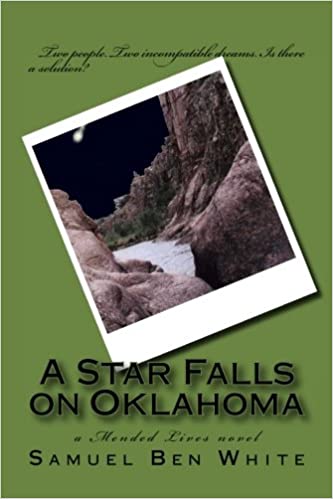
A Star Falls on Oklahoma

a Mended Lives story


Rising star Sonya Kiel suddenly drops off the grid and lands on the doorstep of her cousin Lynette, who lives in western Oklahoma. Telling herself she’s just slumming and slowing down, Sonya finds herself enjoying the bucolic lifestyle … and Lynette’s best friend, a youth minister named Andy Brockton. Her life begins to be pulled in two directions as part of her desires to return to the bright lights and the silver screen, but another (and previously unknown part) wants to leave it all and follow Andy onto the mission field. Her dilemma becomes, literally, a life and death decision for her family.

Order today on Kindle or paperback

Andy and Sonya also appear in the murder mystery “Ghosts of Families Past“, so make sure you read that one, too!

Reading Sample

“I can’t believe I let you talk me into this,” he grumbled as she straightened his tie. “Tell me again how you, a girl from western Oklahoma, have a cousin from England.”

Lynette let go of Andy’s tie and said, “My father’s younger brother was a Rhodes scholar. Smartest member of the Kiel family they say—before me, of course,” she chuckled. “He went to England to attend Oxford and avoid Vietnam and became a stuffy college professor. At forty, he married one of his students and proceeded to have eight children with her before he was fifty.”

“Eight?” Andy asked, though he was afraid of getting distracted from his original objection. “So, which one of the eight are you setting me up with?”

“Number five,” Lynette chuckled. “Or, Sonya, as her family calls her.”

“And she’s how old again?”

“Nineteen. And before you can object again, it’s only a three year difference and she’s very mature for her age.”

“The age is the only thing about this whole deal I’m not objecting to,” Andy quipped as he put on his suitcoat.

“For starters—well, actually, I’m not sure where to start. I’ve only been on one blind date in my life and it was a disaster.”

“Really? When was this?”

As they walked out to her car he said, “Back when I was doing that summer internship in Houston one of the girls in the youth group invited me to go out and play miniature golf with a bunch of her friends. I didn’t realize it was a date until about thirty minutes into it and I started counting heads.”

“‘Counting heads’?”

“Yeah, I realized there was an even number of boys and girls and all but one of the girls was already holding someone’s hand.”

“Was it that bad?” Lynette chided.

“Oh yeah.”

As they got into the car it occurred to Andy that he hadn’t complimented Lynette on how she looked, and she did look nice. The thing was, he and Lynette had known each other since seventh grade and had been best friends since about tenth. They had tried dating a couple times and realized it was like going out with a sibling and had called it off by quick and mutual agreement.

Lynette was pretty, if not a knockout. She was tall and a bit on the thin side, but had a winning smile and green eyes everyone envied. She was very smart, which had intimidated some guys, and it was true that she had a low level of patience for stupidity, but she was his best friend and he wanted the best for her. He thought the guy she was dating now might be the one for her, but he knew her well enough not to hold his breath.

Andy, Lynette thought, was just the type of guy she would like to find—in someone else. He was her intellectual equal, shared many of her interests, and wasn’t too bad looking. A little short for her tastes, but that was mainly because she was taller than average. He had thick, curly black hair that he kept cut too short, and an intriguing face if not actually handsome. His skin was dark but his eyes were atypically shaped and made her think that there might have been some Polynesian blood somewhere in his ancestry. He did have some Native American blood in his veins—Choctaw, to be exact—but it was so far back that it was doubtful if it were a contributing factor to his looks.

The way the evening had gotten started was that Lynette had shown up at his place an hour before, all dressed up, and saying she needed his help. Unwary, he had of course said yes before inquiring what sort of help would be needed. Lynette had then explained that she had tickets to the Wichita Falls Philharmonic Orchestra’s season opening concert for herself and Stephan but that her cousin from England had suddenly arrived unexpectedly and Lynette couldn’t just leave her at home and three was a crowd and so on.

It should probably be explained to the reader that very few inhabitants (i.e. “one”) of Lawton, OK, thought of the opening of the Wichita Falls Philharmonic Orchestra’s season as a big deal. Lynette, though, was an aficionado of classical music, a player of the viola herself, and had not missed an opening in Wichita Falls or Oklahoma City in five years. For four of those years, Andy had accompanied Lynette to the concerts out of friendship and had come to rather appreciate classical music, even if he had yet to buy a classical CD for himself. As a result, he had not been at all upset to find this year that Lynette had talked someone else into going with her to the concert.

Now, most people in Lawton facing a similar circumstance would probably have either called off the concert trip or given the tickets to someone else. This idea had never occurred to Lynette, even after Stephan suggested it. She promptly got online and purchased two more tickets to the concert. She had quickly dressed, then gone to get Andy, knowing if she called him on the phone with the idea of a blind date he might have some way to escape the issue.

So here they were, two well-dressed people on their way to Lynette’s apartment to pick up Lynette’s date and meet

Andy’s. Of course, Lynette knew her, but Andy had never met her, as far as he knew.

“How is it,” Andy asked, as if reading the narrator’s mind, “That I have never met this cousin?”

“You have, actually.” As Lynette sped down Cache Road, she said, “She came and spent a week with me when you and I were fourteen. I remember you came over one day and we all went swimming.”

“Just the three of us or was anyone else there, too?”

“Her sisters, your brother, and the rest of the youth group,” Lynette explained.

“So eight years ago I met an eleven year old girl and you expect me to remember her?”

“No, I don’t expect you to remember her, you just asked if you had ever met her. You’ve seen pictures of her, though.”

“Really?” Seeing all the restaurants they were passing, he asked, “Do I get a supper out of this or am I buying?”

“After the concert,” Lynette answered as she turned off the main road. “We’ll just barely have time to make it there before the overture. And we can go dutch treat if you like.”

“We better,” Andy replied.

As they pulled into the parking lot of the apartment complex where Lynette lived, she turned to Andy and said, “I really do appreciate you doing this. And I’ll explain it all to Carly if you like.”

“I’m not seeing Carly,” he said as they got out of the car. At Lynette’s skeptical glance, he said, “I’ve been out with her twice. I don’t know if there will be a third. And I know for a fact she’s dating other people. Which is perfectly fine with me, by the way.”

“Well, thank you, anyway.”

As they walked up the steps, he said, only half-joking, “I never asked you what she looks like.”

“You going to back out if she’s ugly?” Lynette asked, a laugh in her voice that made him curious what she was concealing.

“No. But I’ll get you back somehow.”

“Don’t worry,” Lynette said as they neared her floor. With an even stranger lilt to her voice, she added, “If she’s not the prettiest woman you have ever been out with, I’ll buy your supper tonight.”

“The world’s cheapest graduate student is offering to buy me supper?” he chided in return. “For the first time today, I’m actually anxious to see her.

Andy opened the door to Lynette’s apartment and let her in. As he followed her in, he saw Stephan sitting on the couch. Stephan looked up from a magazine and smiled. “Hey, Andy. How’s it going?”

Andy came over and shook Stephan’s hand as he sat down. “Not bad. You doing all right?”

“Can’t complain … too much,” he added with a laugh, showing perfect teeth in his dark face. Stephan was a first year assistant coach and biology teacher at Lawton High who loved his job but also found it exasperating at times. He had been introduced to Lynette by one of his fellow teachers, who had attended MacArthur High with Lynette four years before. Their personalities had seemed like oil and water initially (she very Type-A, he exactly not) but the fact that he was more than her intellectual equal—and a shared passion for volleyball—had led to, so far, multiple dates.

“I’ll go see if Sonya’s ready,” Lynette said, disappearing into the back of the apartment. It was a one bedroom affair, with the kitchen, living room and dining area all being the same, but it was a nice place and Lynette had fixed it up pretty well. Her parents still lived in town and would have loved for her to move back in, but the idea was anathema to Lynette, even though she had returned to Lawton after her undergrad work.

When Lynette was out of earshot, Andy leaned close to Stephan and asked in a whisper, “This Sonya, is she as pretty as Lynette says?”

Stephan chuckled, then noticed the look on Andy’s face and asked, “Are you kidding?”

“What do you mean?”

Stephan was about to reply when they heard the bedroom door open and Andy sat back in a more normal and casual position. He looked up (again, casually) to try to take a casual first glance of the cousin. His mouth casually hit the floor.

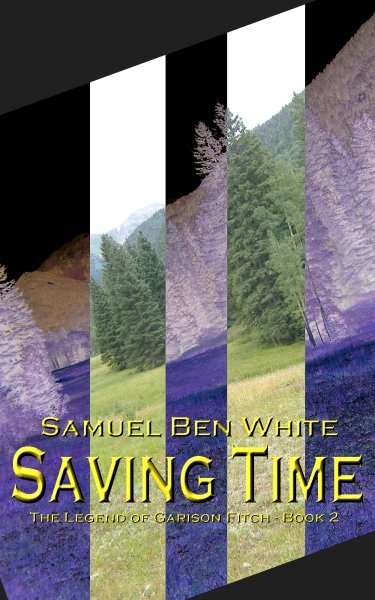
Saving Time – The Legend of Garison Fitch – Book 2

Book Two of The Legend of Garison Fitch

Two years ago Garison Fitch traveled through time and rewrote history. An accident in the eighteenth century created a whole new world, and even gave Garison a wife he had never met before. Now, he’s got a daughter and he’s coming to enjoy this world he created. Until he’s attacked by men masquerading as Indians, and a funeral procession from out of the past enlists his help, and a tree grows from sappling to full-grown in a matter of minutes, threatening his daughter’s very life. Time itself is unraveling and Garison’s trips through time seem to be the cause. Garison must go back in time once again and keep himself from making the original trip that started the problem. But he can’t use his time machine to go back. How does one sew up a rip in time?

Order today in paperback or Kindle

The Legend of Garison Fitch begins in “First Time” and concludes in “i“. Read all three books!

Reading Sample

Prologue

June 12, 1897

The concussion rocked the walls of La Plata Canyon far away from the blast site. There, fire and smoke careened out of the hole and added more soot to the already blackened cave mouth. Deep within the mountain, one could hear the rocks reestablishing their equilibrium. It was as if the mountain were alive. To further the illusion, one could hear the mountain rumbling long after the blast, like an awakened grizzly settling back into sleep.

Jeb stood up from behind his barricade and watched as the last of the smoke seeped out of the mine. It looked like a fire-breathing dragon sleeping, snoring smoke through one open nostril. Jeb liked the thought for he remembered fairy tales from his childhood which told that dragons’ bellies were covered with gold and jewels. Jeb grabbed his lantern and pick and prepared to head back into the dragon.

Jeb had been prospecting for over thirty years. He had missed the big strike in California, shown up too late for the one in Alaska, and was just barely in the right century for the Colorado strikes. He had been late for the strike on the Blue, just missed the boom on the Tarryall, and had shown up in La Plata Canyon about twenty years late. And while some might argue he didn’t know it very well, prospecting was the only life he knew.

Not that he hadn’t had a couple moments of glory. For three days once he had been a millionaire–on paper. That had been up near Tincup, or was it Alma? He couldn’t rightly remember. But three ladies depicted on stiff paper had forfeited his millions to a man holding four monarchs depicted on similarly stiff paper. Jeb always held that it had been a blessing–that all that money had encumbered him–but the truth was that he sometimes wished he’d never gotten into that last hand. Jeb’s life could be summed up with the phrase, “If only I’d left earlier.”

On the other hand, he’d never stayed too long. That was something, he guessed.

Down in the bowels of the mine shaft, he set his lantern on a ledge and set about to survey his most recent prospects. He had won the claim in a came of three card monte; which should have tipped him off. If the claim had been worth anything, the dealer (whose winning streak had reached uncanny proportions) would have held onto it. Jeb was beginning to suspect–no, be assured–that the dealer had lost on purpose.

Jeb had found the claim easily enough, having been late for the La Plata Canyon once before in his life. The claim was located near where the Lady of Spain Mine had once stood and that gave Jeb hope. The Lady of Spain had struck a pocket of gold and its owners had been richer than the dreams of avarice–until they hit the other side of the pocket. They blew their fortune trying to reestablish a vein that didn’t exist, and the Lady closed down. Jeb was hoping he might find just enough gold to get him a stake. With that, he could head to South America, or maybe even Alaska again. There was a valley he had seen when he had been there before that he’d been aching to try again.

As the dust settled in the area most recently blasted, Jeb swore. He knew better than to expect the mother lode to just appear before his eyes, but he had hoped for something promising. Anything. The early returns weren’t good.

He began sifting through the rocks, clearing a space to put up some more shoring timbers, when a glint caught his eye. He picked up the rock in question, and–holding it close to his lantern–spied just a hair of gold. He eyed it closely, not wanting to trust even his own sight until he was absolutely sure. This mine had disappointed him before, and he wasn’t going to get his hopes up again.

After roughly an hour of work, he had collected maybe twenty pounds of ore with traces of gold. He had even found where along the wall they had come from, but he hadn’t located the vein. But, even though it would mean putting a bend in his shaft where he hadn’t intended to have one, he figured it would be worth a look-see. The current path of the shaft sure didn’t seem worth sticking to.

The end of the day proved that there was a very thin vein of gold in the new direction, but it wasn’t enough for Jeb to get rich off of. In fact, it was probably just enough to make him poor–what with the expense of digging it out.

As Jeb sat in his shack, picking at the little gold he had found, he wondered if it would be enough. He knew it wouldn’t get him to South America or Alaska–or even California–but then again, it might. He had known men to get a lot further on a lot less.

Word had it there was a greenhorn easterner over in Durango who was buying up old claims. “Speculating” they called it. Jeb had heard that the city dude had bought Shorty Dillon’s worthless mine for far more than Shorty deserved. If the greenhorn were still around, Jeb thought, and if he could convince the man that his claim was worth something. It might mean salting the claim, but all’s fair, right? he thought absently.

The more Jeb thought of the idea of leaving and getting on the trail again, the more he liked it. Jeb decided he needed some supplies, anyway, and might as well head into Durango and see what he could find out. He tossed a crust of bread over to the marmot that often hung around near his door, then turned out the light for sleep.

Jeb awoke to a sound he had never heard before and, just for a moment, figured it must be Satan coming with some hell-spawned machine to take him away. He had done a sight worse than salt a claim in his life, after all. It was a powerful, low, rumbling sound, like the machines at the smelter–only more refined, more steady. To Jeb, that made the sound more ominous.

He sat up in bed and grabbed for his rifle. Slipping on his boots, he stepped outside into the night wearing only his dungarees and flannel underwear. He was shaking in his boots and sweating even though the night was as cool as any in a month. Slowly, he slipped outside.

The noise was coming from some sort of machine, all right. Jeb slipped on his spectacles for a better look–even though they weren’t much help in the moonlight. Whatever it was, it wasn’t much longer than a buck-board, but it was made of metal and glass. It ran on four black wheels with silver centers that gleamed in the moonlight. But what fairly took Jeb’s breath away with fright were its eyes. It had two eyes in front that shined brighter than day, lighting the way ahead of the beast–or machine, or whatever it was.

The beast began to turn in Jeb’s direction and he dove behind the woodpile as the bright lights swept near where he had been. There were trees between he and it that might have blocked him from its sight, but he didn’t want to take chances. It occurred to the back of his mind that he had no idea where the woodpile had come from, but the thought died of loneliness.

The beast rolled a short way through the forest then came to a stop maybe fifty yards from Jeb’s shack. Against his better judgement, he decided to crawl closer and get a better look. If he were going to die or get carted off to Ol’ Scratch’s hideout, he aimed to see what would be carrying him. Holding his breath, he moved toward the machine–creeping through the forest quieter than a cat.

He got close to the beast just as the light in its eyes went out and the fearful rumbling stopped. Then he watched in horrified awe as the sides of the beast opened up–almost as if it had doors built into its rib-cage–and two people got out. Jeb all but stopped breathing as he saw what appeared to be a tall, dark-headed man, reach back into the beast and pull out a blonde-haired little girl. She was little more than a baby. The man said something to the person who had gotten out of the other side of the beast and the reply–though Jeb couldn’t quite make out all the words–sounded as if it came from a woman.

The trio began to walk away from the beast and it was then that Jeb saw they were walking towards a house. It was a great log house, with a light on the porch that didn’t flicker and another light or two inside. Something in Jeb’s brain registered that the lights were coming from those new-fangled “bulbs” he had seen in town, but that wasn’t what occupied his mind. What occupied the parts of Jeb’s mind that hadn’t been completely frozen with fear was the idea that a house was there at all. He had walked that land just the day before and nothing had been there–not even a stick of cut wood. And now there was a house and people and–

Not planning his actions too far in advance, Jeb carefully skirted the fierce beast and walked up to the porch of the house. The yard was carefully cut, there were flower bushes planted all around, and the walkway to the front porch was made of some sort of perfectly laid and cut stone–as if of a single giant slab. All around was evidence that the house had stood for not just hours, but years.

He crept up to a window and saw that the woman somehow made the whole interior of the house light up by touching a little square on the wall. Jeb fell backwards from the window, his hair literally standing on end. What sort of magic was this? When he had caught his breath, his curiosity got the better of him and he peeked in again.

The man and the little girl were nowhere to be seen, but the woman was standing not ten feet away from Jeb. She had dark hair that hung half-way down her back and she was, Jeb thought, the most beautiful woman he had ever seen in his life. He gulped as he looked at her. Not only was she beautiful, she was wearing the least clothes he had ever seen on a woman who wasn’t dancing in a saloon. She wore a blue cotton shirt with no discernable buttons and britches that looked as if they had been cut off at mid thigh, revealing a more shapely pair of legs than he had ever seen before. He swallowed hard again and rubbed his eyes to make sure it wasn’t all an illusion.

The woman bent over a little table and picked up a little black box. She held it before her and, suddenly, a large black box on the other side of the room seemed to spring to life. It glowed with a thousand colors and sound came out of it. Jeb watched in horror as the woman somehow manipulated the big box with the little box. His breath now only a memory, he saw the faces of people who were trapped in the big box. Some were laughing, some were crying, and some seemed to have somehow been drawn. Like moving art.

The box went dark as suddenly as it had lit up and Jeb screamed. It was a heartfelt scream from the bottom of his soul as it escaped his lips. Clutching tightly to his rifle, he fled as fast as his old legs would carry him. Back to the shack he went, just barely remembering to avoid the horrible hell-beast the demon people traveled with. As he skirted it, he prayed it wouldn’t come to life and eat him.

Reaching his shack, he bolted the door, piled whatever he could find in front of it, then sat cowering on the bed with his gun cocked and ready. When he finally fell asleep, it was to visions of the beautiful woman coming to him. She wore next to no clothes and beckoned him with long-nailed fingers and a sultry gaze. He fought against her advances for he knew she had come to take his soul and trap him for all eternity in her box.

When morning came, Jeb was surprised to find himself still alive–and not living in a box. He gathered up what he could carry, including some of the gold, and headed for his mule. He hastily loaded the animal up and started for town.

He cast a glance at where the house had been the night before and found only an empty meadow. Taking an earlier than usual swig from the flask in his pack, he steadied his nerves and decided it was time to get shut of La Plata Canyon. He’d heard a man named Stillwell say the place was haunted, and Jeb was thinking the old prospector had been right. If he could sell his claim to that greenhorn–Wilson, he thought the man’s name wasfine and dandy. If not, he’d just cut his losses and head for Leadville or Georgetown.

He was sure it hadn’t been a dream. The valley was haunted and he wouldn’t spend another night in it. Let someone else deal with the demon woman.

Chapter One

With gloved hands, Garison looped the newly strung strand of barbed wire through the come-along. Nodding to Heather to back away a bit, Garison began to work the lever and bring the two strands closer together. He had almost lost an ear one time when a line of barbed wire broke and he didn’t want her near in case the incident repeated itself.

“A hundred years ago,” Garison told her, “We would’ve had to do this all by hand. Working and pulling until we got the new wire tight enough to nail down–then it would still have been far looser than we can get today.”

“But you said the tightness in the wire also contributed to it’s demise.”

“‘Demise’?” he chuckled.

“Breakage, whatever. You knew what I meant.”

He nodded and said, “To an extent. This wire’s a lot stronger than anything we would have been stringing a hundred years ago. My point is, though, with all the things I’ve invented, I’m not sure I’ve ever invented anything just as flat-out practical as this come-along.”

“That’s not true. If you could ever get The Box licensed, that would change the world.”

He winced slightly and reminded her, Please don’t say that. I’ve already changed the world once, remember?”

“That was an accident.” Trying to cheer him up–or at least get the conversation on another track–Heather told him, “If you could license The Box, the world would never know another energy crisis. Besides that, it’d probably just about get rid of smog. And think of all the waste we produce now that The Box could eliminate.”

He nodded, but remarked, “And think of how quickly Garison Fitch would be eliminated.”

“What?”

As he finished cranking and began to tie the two strands of barbed wire together, he explained, “Even if I got the thing licensed, I wouldn’t stand a chance. We’re talking about a self-contained nuclear fusion reactor small enough to fit into the trunk of a compact car but powerful enough to supply all the electricity Denver needs. The oil, gas, and electric companies would never let me make it even if the government licensed it.”

“But all the good it could do–”

“Doesn’t compare to all the money they’re currently making. Almost twenty years ago a guy in El Paso figured out how to make his Lincoln Continental get eighty-five miles to the gallon–with the air conditioning going. It was environmentally safe and easily manufactured.” Garison looked at Heather with a rueful smile and asked, “What happened to that car?”

When she shrugged, Garison told her, “The guy sold the plans for the car to one of the major oil companies for several million dollars so that they could ‘research it’. That was the day it was guaranteed that car would never see the light of day. Oil companies are in the business to make money and a fuel efficient car would kill them. Remember the Tucker automobile? What do you think would happen if I suddenly showed the world that the oil, gas, and electric companies can all be circumvented by an inexpensively produced unit they could install themselves in the back yard?”

Just when Heather was afraid her new track would be more disastrous than the previous one, she decided to ask anyway, “So what happens to The Box? You’re not just going to bury it, are you?”

He shook his head and said, “Not entirely. I applied for a permit to convert our house over to a generator.” He smiled and added, “I’m just not going to tell them that my little generator has more power than the entire La Plata County Electrical Co-Op.”

Heather laughed and Garison thought to himself how much he had come to love that laugh in the last two and a half years. Hers wasn’t a loud laugh–Heather was rarely loud about anything–but it was a laugh that seemed to fill her whole body. Her mouth, her eyes, and–somehow–her entire self laughed together.

Heather Dawson Fitch was an uncommonly beautiful woman. With long, dark hair and the face of an angel, she could have been a model or an actress or–Garison thought–anything she wanted to be. An All-American volleyball player for Southern Methodist during her pre-law years, she had remained athletically active since and, when she had given birth to their first child eighteen months before, she had quickly regained her figure. Now, unless one saw her with her daughter in hand, one might think she had never given birth. With young Sarah sporting the blondest hair imaginable, many who saw Heather guessed her to be watching someone else’s child. However it is that mothers are supposed to look, Heather didn’t strike most people as looking like one.

Garison, however, was an obvious father. Though he, too, sported dark black hair and a matching mustache, he positively doted on little Sarah. A big man who might have appeared incapable of tenderness at first glance, Garison had to be reminded by Heather that Sarah wasn’t made of china. He also had to be reminded not to spoil her, but that lesson often went over his head. Like his first daughter Helen–dead almost two hundred years when Sarah was born–Sarah had quickly learned that her father was tightly wrapped around her stubby little fingers.

Garison looked at Heather standing there by the fence row, grabbing her hammer and preparing to nail the latest strand of wire into place, and winced slightly. He had no doubt that Heather could do the work, but all morning long she had been working far too hard. Each fence staple was hammered in with a vengeance and the next one was attacked in record time. He had tried to get her to take it easy, but she would only slow down for a few minutes before stepping the pace up again.

“I know you hate the idea of ‘man’s work’ and ‘women’s work’,” Garison began, “But I still don’t think this is the kind of work for you. Call me a sexist pig, but this seems like awfully rough work for a woman.”

“Well, sexist pig,” Heather laughed, “I enjoy it. I never got much chance to work with my hands as a child. I like helping you with your wood-working and stuff like this. This stuff, especially, makes me feel like a cowboy or something.”

“Believe me,” he chuckled in assurance, “No one will ever accuse you of being any kind of a boy.”

Garison started to admonish her about working too hard again, but he knew it would do no good. He knew Heather was working so hard because Sarah was staying two nights with her grandparents in Denver and Heather was trying to take her mind off her worry with hard work. Garison knew it wasn’t working because Heather’s work was getting harder and harder. He just hoped he could find some more work for them to do when the fence was done or he was afraid Heather might have a nervous breakdown before having a physical breakdown. He figured a physical breakdown might be easier to recover from.

They were conducting what was a yearly ritual for most of the residents of the La Plata Canyon–and, indeed, almost all of the rural west. While barbed wire could withstand the elements for quite a few years, it couldn’t withstand the sharp hooves of deer and elk. As they jumped the fences, the animals would often clip the top strand with hooves as sharp as any wire cutters. The result was broken top strands that had to either be repaired or replaced all around the property every year. If not for the fact that his barbed wire helped to keep neighboring livestock out, Garison had thought more than once about just letting the wire go. But, like Heather, the work kind of made him feel like a real, old west cowboy, too.

He was about to say something when they heard a car coming from up the canyon. They both looked up, as vehicle traffic in La Plata Canyon was fairly rare. They knew the vehicles of everyone who lived in the canyon and often waved when they saw someone they recognized. Heather had once groaned that they had become true country hicks–looking up at the sound of passing motorists–but the truth was she loved the friendliness after growing up in Dallas’s most haughty suburb.

They looked at each other with interest when they saw that the car going by was an old one. While Garison wasn’t a car buff exactly, he knew enough to spot that the car was from the late 1940s. He was about to remark as such, showing off his limited knowledge of vintage autos, when Heather said, “1947 Hudson and Terraplane. I haven’t seen one of those in years. Looks like it’s in great shape, too.”

“I’d say so,” Garison nodded in more agreement than he really had. He was still marveling at the fact that Heather knew the car.

Heather caught the look on his face and snapped playfully, “What? Did I wound your chauvinistic pride? Don’t think women can be motorheads?”

“No,” he hastily replied, “But in the two and a half years I’ve known you, you’ve never said anything about cars. I mean, what little work we’ve had to have done, I did it or we took it in. I thought you were just into planes.”

“I am,” she laughed. With a chuckle she added, “My brother Hank’s a car freak and I went to just enough old car shows and a few junk yards with him to pick up a little. He had a car like that at one time.” Heather looked down the road where the car had already passed around a bend and added, “Although his was never in that good of shape. He would have liked to have seen that car. Someone’s really been keeping it up.”

At the sound of another car coming from up canyon, Garison looked up. He remarked with surprise, “He’d probably like this one, too.”

Heather turned her gaze in the same direction as Garison’s and asked, “Is there an old car rally up canyon somewhere?”

“Not that I know of. Who would hold an old car rally up there where the road becomes dirt? Not the best way to protect your custom paint job.”

The car in question was a hearse. It had a big Pontiac symbol on the hood and looked to be from the same era as the previous car. And, like the Hudson, it looked to be in excellent condition. Almost new, in fact.

Just as Garison was about to ask what year it was, Heather told him, “By the grill work, I’d say this one’s from about ‘46. That hood looks a little strange, but maybe it’s because it’s a hearse. I’ve never seen one of those before. Not from that era, anyway.”

As they were looking at the hearse, it pulled to a stop in front of them. They watched with interest as a tall, solidly built, middle-aged man got out. He smiled up at them and ascended the short incline between them and the road.

At the fence, he extended his hand and offered, “Stuart Jameson, at your service.”

Garison pulled off his right-hand work glove and took the man’s hand. He suddenly realized the man had the largest hands Garison had ever encountered. The man’s hand wrapped completely around Garison’s own rather large paw almost as if taking an adolescent’s hand. For a brief moment, Garison thought the man could probably touch Heather’s elbow while shaking her hand. Besides just the hands, though, the man was big–probably six-four or better, Garison mused.

“Garison Fitch,” he returned. “And this is my wife, Heather.”

Stuart Jameson nodded and said, “I hate to impose on you like this, but I’m with Holt & Jameson, the funeral parlor in Durango. Anyway, we just interred a young man on his parents’ property and, well, my man hasn’t shown up here with the digging tools. I wonder if I might trouble you to help me, um–I really hate to even ask this. Could you, um, help me fill in the grave?”

He had a deep voice, much like what one would expect the voice of God to sound like. It was deep and sonorous, yet oddly soothing. Every word he said was in the tone of voice one would use when comforting bereaved loved ones. It occurred briefly to Heather to wonder if he talked like that all the time. She guessed that he did since he was talking that way to ask for help filling in a hole.

Heather and Garison shared a puzzled look, then Garison replied, “I guess so.” They picked up their shovels and followed the man to the hearse.

“I’m afraid we’ll have to all squeeze into the front seat,” he apologized.

“No problem,” Heather quickly answered, shuddering as she even thought of riding in the back of the hearse.

Walking to the car, Stuart Jameson was whistling something Garison couldn’t quite place. After a moment, he realized it was “American Patrol”. Odd, he thought, that the man would whistle a tune from the same era as the car.

As they got in and Stuart started the engine, Heather complemented, “This car is in remarkable shape.”

Jameson cast her a somewhat puzzled look, but replied, “Thank you. I only got it a year ago–so it hasn’t seen much use. Ordered it direct from the factory.”

“Doesn’t look like a kit,” Heather mused, drawing another puzzled look from Jameson.

Garison was only listening with half an ear. What he was paying attention to was the fact that the man’s clothing was fantastically out of date. Jameson was wearing a conservative brown suit, but the lapels were too wide, the tie was too short, the pants were cut all wrong and the material was some sort of heavy woolen weave that looked like it would weight fifty pounds. Below the pants the man wore brown leather shoes that were polished but obviously worn. Even in their worn condition, though, Garison couldn’t imagine that they were comfortable. The thought popped in his mind that they were the type of shoe formerly referred to as brogans, but he wasn’t sure.

He was shaken from his study of the man’s attire by a quick turn to the right. Garison looked up in surprise to find that they were taking a dirt road that followed along just outside his northern fence line. He had walked the selfsame road just two days before when checking his fence and it hadn’t been in nearly as good shape. He figured someone must have grated it for the funeral, but was surprised he hadn’t heard the equipment doing it. The sound of machinery often carried well in the La Plata, partly because it was so incongruous.

They pulled up to a little clearing neither Heather nor Garison recognized and got out. At the edge of the clearing, a small man in another outdated suit stood next to an open grave and a pile of dirt. He was tapping his foot and looking impatient, until he saw Heather. She was just dressed in faded (if tight) blue jeans and an old sweat-shirt, but he gulped and watched her legs like he’d never seen such a sight. Heather noticed the look and edged closer to Garison. She was used to men watching her, but this man was looking at her like she was a space alien . . . or a chorus girl.

“If you could just give me a hand,” Jameson said, taking Heather’s shovel and motioning for Garison to join him. Garison nodded and began tossing dirt in on what certainly looked like a casket. They could hear the hollow thump of the dirt on the wood and the sound gave Heather an uneasy feeling. For his part, Garison was noticing that it was a wooden box, and not the fancy metal ones he was used to.

Heather watched for a bit, then opened, “If you don’t mind me asking, who are you burying and why are you burying him here? Him or her. It’s so far from a cemetery and all.”

Jameson first said, “Harris, spell Mister Fitch for a bit, won’t you?” Harris nodded and took the shovel like someone who had never worked one before. He was little help and Garison was thinking Heather could have done a much better job.

Jameson explained, “It is a young man in the grave, Mrs. Fitch. His name is–was–Guy Wilson and, sadly, he was killed in France during the war.”

“What war?” Heather asked suspiciously.

Harris looked up with surprise and spoke for the first time, “World War Two, of course.” He said it like he was talking to someone who had to be a moron.

Heather looked from Harris to the grave and queried incredulously, “And they’re just now bringing his body home for burial?”

Jameson nodded and replied, with practiced sadness, “Things move slowly after such a devastating conflict.”

Taking the shovel back from the slow-working Harris, Garison said, “But this has to be some sort of a record.”

Jameson shrugged and said, “I just hope he’s the last for me. I have buried far too many from this conflict–or arranged memorial services for those whose remains were never recovered. A sad, sad business.”

Heather mumbled, “I don’t think there’s much chance of any more coming home. Not if they haven’t come home by now.”

“Let us hope so,” Jameson nodded. Heather and Garison shared another puzzled look. After all, did he really expect any more bodies from World War II to be found sixty years late?

“So, why here?” Heather reminded them of the second part of her earlier question.

“Ah, yes,” Jameson nodded. It was a warm day and he stopped to remove his coat and wipe the sweat from his brow. It drew both Garison and Heather’s attention that he still wore his tie. He finally told her, “This land is owned by the Wilson family; as you probably know, since you live nearby.”

“Actually, I didn’t,” Garison told him. “I mean, they call it the Wilson place, but no one’s lived here as far back as I can remember.”

Jameson nodded and continued, “The Wilson’s haven’t lived here in, oh, must be ten years by now. The family had lived here for many many years–since Carlton Wilson struck gold here back in the late 1800s, in fact. Guy and his brother John grew up here–in the old house up the road.”

Heather and Garison shared a look that meant, “What old house?”

Jameson looked puzzled by their question, but went on, “But when the boys graduated from high school and left home, Lydia talked Harold–he was Carlton’s grandson, I believe–she talked him into moving to Denver. They haven’t been back until today, I believe. You may have seen their Hudson going down the road ahead of me. I believe Guy had said he wanted to be buried in La Plata Canyon. Boyhood memories of happiness here, I suppose.” He said this in a voice that conveyed infinite sadness and sympathy.

“Interesting,” was all Garison could say. Heather just nodded, confused and bewildered.

When the grave was filled in, Jameson looked at his watch and said, “I can’t imagine what has happened to Phil. It’s not like him to be late. I hope he hasn’t met with any misfortune. He was supposed to be here by three, and here it is almost four.”

Heather looked at her own watch and said, “It’s not even noon, yet.”

Jameson smiled and offered, “Your watch must have stopped.” Showing her his own watch, he said, “I have fifteen ’til four–and my watch is running.”

“So’s mine,” she returned, shaking her watch as if that would change anything.

Garison looked at his own watch and said, “Huh, mine matches Heather’s. You sure yours is right?”

Harris looked at his watch and showed haughtily, “See, a quarter of four.”

Garison shrugged, then put his shovel over his shoulder and said, “Well, we’ll keep an eye out for him in case he shows up later. Folks always have trouble finding our house even when I give them directions. Maybe he just got lost in the canyon. Took the wrong dirt road or something.”

“Perhaps,” Jameson nodded. Harris made a motion that indicated he thought Phil had had to much to drink for lunch, but Jameson shook his head and said, “No, I don’t think so. He’s been dry ever since he came back from the south Pacific.”

“Why was he there?” Heather asked.

“It’s where the Navy sent him,” Jameson replied, wondering if Heather and Garison might possibly be mental. “In fact, I think he was on Iwo Jima.”

“That was a while back,” Heather mumbled, though something about the whole conversation bothered her. It was as if she and Jameson were having two spearate conversations that sort of met in the middle–but didn’t.

Jameson extended his massive hands and shook those of Heather and Garison. He smiled and said, “I certainly appreciate your help, Garison, Mrs. Fitch. Sometime when you’re in Durango, allow me to buy you dinner.”

“That’s not necessary,” Garison shrugged.

“Yeah, we were planning on spending the day digging and working, anyway,” Heather smiled, though still uncomfortable about the whole interchange. “This just took us away from working the fence.”

“Ah, I’ve taken you away from your work,” Jameson apologized.

“That’s fine,” Heather smiled. “No one ever got mad about missing out on stringing barbed wire.”

Jameson nodded with a deep chuckle and reminded, “Well, the offer is still open if ever you’ll take me up on it. Thank you again. Now, can I give you a ride back?”

“No, thank you,” Garison replied. “We can walk back. I want to look at the fence again, anyway. We may have to get a surveyor out here for a couple sections.”

Jameson nodded as they set off.

When they were out of earshot, Harris remarked, “Where’d they get those clothes?”

Jameson shrugged and said, “I have no idea. Mrs. Fitch certainly fit well into those dungarees, didn’t she?”

“It was shameful,” Harris replied snootily.

“Not so shameful that you refused to let your eyes bug out at her every move, I noticed.”

Harris harrumphed and walked to the hearse. Jameson chuckled and followed along behind. He hated to admit it, but Mrs. Fitch certainly had fit well into those jeans. And there was something about that torn patch on her thigh . . . He checked his watch and wondered if his wife were home, yet.

When they were out of earshot, Heather asked, “What did you think of those clothes?”

“Little outdated, weren’t they?” Garison nodded.

Heather, her voice low, agreed, “Very. I don’t know fashion as well I do cars, but I’d guess those suits came from about the same era as the cars.”

“That’s what I was thinking. And I don’t know if you noticed it, but that guy was whistling an old ‘big band’ tune. Granted, music’s eternal, but–” He stopped walking just as she did and asked suspiciously, “Are you thinking now what I’m thinking?”

“I am if you’re thinking about sneaking back, waiting until they’re gone, and finding out what was buried back there.” He nodded and she looked at her watch, suggesting, “Let’s give them a few minutes then slip back.”

They walked quietly through the woods back to the little clearing. They hadn’t heard the car drive away, but they hoped it had. If not, they figured they might spy for a while and see what the two men did alone.

They crept up to their fence and slipped through onto the old fenceline road.

There was no hearse, no funeral director, no Harris, no grave, and no clearing.

The Woman Caught

a Mended Lives story

Alexander “Opie” Gates, a young man from west Texas, finds himself being greeted by a woman in a bar in New York City. At first glance, she’s kind of pretty and he likes the attention. But over the evening, he begins to think she is considerably older than she appears and worn down by life. Over the next few days, Opie finds himself drawn to this woman (who proves to be younger than he thought), but then he makes a horrible discovery about her lifestyle. Telling himself he’s emulating Jesus, he continues to be her friend. But then, two things Opie never anticipated happen almost at once: The woman comes to share his faith, and he begins to fall for her. Suddenly, he’s no longer just trying to be understanding and forgiving of a semi-nameless person. He’s trying to be forgiving of someone he wants to fall in love with but he can’t get over the idea that she’s already violated something he holds very dear.

Order today on Kindle!

Reading Sample

Alexander “Opie” Gates sat at the dimly-lit bar of the dimly-lit dive a few blocks from Times Square reading his Bible and sipping on a Sprite. It was an attention-grabbing spectacle and he knew it. It was completely intentional.

He’d got the idea from an old roommate in college. The guy was short of stature and tended to dress like he’d just gotten off a gator-hunting swamp boat, which wasn’t as much of a stretch as one might think. He’d take his Bible—a big, leather-bound job with study notes in the margins and hundreds of handwritten notes on sticky-papers stuffed here and there from Genesis to Revelation—and he’d go to a bar, order something obviously non-alcoholic, and sit and read. He told Opie that, invariably, someone would come over and ask what he was doing, and then Allen would share the gospel with them. The long-term efficacy of such an evangelism approach Opie had always doubted, but he had admired it, nonetheless.

So, with nothing else to do on a night in Manhattan when he couldn’t sleep, he had decided to give it a try. He’d left a note for his host and, wisely or no, had slipped out into the big strange city and found his way to this bar, not so far from his friend’s apartment as the crow flew, but more than half a world from home.

With his red hair and a father who adored “The Andy Griffith Show” to be nick-named “Opie” had almost seemed pre-ordained. When he had read in a book that the kid from the TV show had actually been named after one of the star’s favorite performers, Opie Cates, the name had seemed inevitable. He knew he had been born bald as a bowling ball, so he guessed the only reason he hadn’t been named Opie officially was that they had been waiting to see what color his hair would take.

Now here he sat, clearly a tourist and clearly out of sync with the rest of the bar’s patrons. They seemed a reclusive lot—hiding back in the shadows like rats—and if they paid him any mind at all, it wasn’t for long. He’d only been in the Big Apple for a couple days, but he’d seen enough to know that there wasn’t much that would garner the attention of the locals and a tourist with a Bible barely even registered on the meter.

He’d read a good bit of the middle section of the book of Ezekiel and was thinking about heading back to Rory’s pad when a voice said from beside him, “Is that a Bible?”

He looked up in surprise, answering “Yes” before even seeing who had spoken. He was getting ready to go into his old roommate’s routine when he saw her.

She was a pretty woman, probably in her mid-twenties, just like Opie. She had dark hair and was dressed in tight jeans and a loose-fitting top that showed some cleavage. He caught a glimpse of a tattoo of a rose on her left breast and quickly looked away. Glancing back, making sure he looked only at her face, his second glance made him think she was probably a lot older than him, maybe even pushing forty. But she had expertly applied makeup which created the illusion of a much younger woman.

Suddenly, he felt very sad for her. Probably not the impression she wanted men to take away from her looks, he thought ruefully. If he knew her, he thought, he’d tell her to lose the makeup and just look her age. She might not be as striking, but he was sure she would actually be prettier. He wasn’t about to say such a thing to a complete stranger and any further thoughts were stricken from his mind by the question, “Why?”

“Why what?”

“Why are you sitting in a dump like this and reading your Bible at,” she glanced at the clock over the bar, “Almost midnight?” She tapped a finger against his glass, watched the bubbles move, and added, “And drinking a Sprite?”

He thought back to what his roommate always said in such situations, and suddenly it seemed canned and disingenuous. So he told her the truth, “I couldn’t sleep and I figured if I did this someone would eventually ask me why and I could tell them.”

“So, go ahead and tell me.”

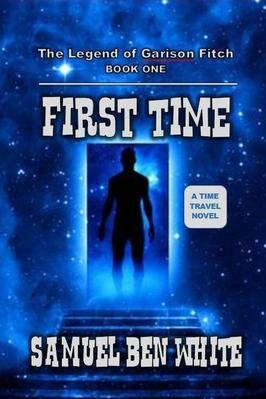
First Time – The Legend of Garison Fitch – Book 1

What if history didn’t happen that way the first time?

Garison Fitch was a scientist and something of a celebrity in the Soviet Americas in the early 21st century until dropping off the map to pursue his theories in the remote La Plata Canyon.

An experiment with such travel surprised him when he landed him in 1744. There he discovered a primitive world of somewhat suspicious people, but a freedom he had never experienced before–which may have been most frightening of all.

When he tries to rid himself of his time machine by sending it into the future, however, it took him with it. Now, he finds himself back in the twenty-first century where a woman he has never met claims to be his wife and the country he grew up in is gone, replaced by something called “The United States of America”.

Should he live in this new world, or try to travel once more through time and return the world to “normal”? As he becomes convinced he can’t return to the past, he’s not really sure if he can live in this new world he created, either.

Order today on ebook (in many formats) or paperback!

The Legend of Garison Fitch continues in “Saving Time” and concludes in “Lost Time“!

Reading Sample

With a flash of light and a complete absence of noise, Garison found himself swept out of the eighteenth century. He had just begun to have the beginnings of a thought that would have turned into wondering where he was going when the trip ended. In all, he had traveled for a length of time that would have registered on his body as less than a nano-second. To the world, however, the trip took longer. Still, it was not as long as Garison would have guessed it to be.

Garison and the interdimensional machine-come time machine reappeared in his laboratory inColoradoapproximately one point three seconds after it had left. With a pop that signified the nuclear core had just melted all the circuits then collapsed in on itself into a ball of radiation with a half-life of a few millennia, Garison found himself dressed for the seventeen-forties and standing in the early twenty-first century.

He was suddenly assaulted by a woman who threw her arms around him before he could get a good look at her and exclaimed, “It worked Garison! It worked! You were gone and now you’re back!”

There were so many thoughts and so much confusion going through his head that all he could do was stand there limply while she hugged him tighter and tighter, kissed him on the cheek, and went on and on about how proud she was of him and how she just had to congratulate him and how she wanted to hear all about it.

When she had worked her way across his cheek and was on the verge of kissing his mouth, he finally got his wits about him enough to push her away and stand back a pace himself. He backed into a bench and turned to look, momentarily surprised to find a work bench where there wasn’t supposed to be one. He also spotted the tarpaulin under his feet, and kicked it away in anger.

The woman looked at him strangely and asked, “Garison? Is something wrong?”

He looked around the room without answering. It was his lab all right, but it was different. The windows were in the wrong places, but only by a foot or so. The workbenches had been moved and the place was, well, decorated differently. His lab had been strictly utilitarian while this one had curtains on the windows and some sort of wall-paper border half-way up the walls.

But, he told himself, the cameras are in the right place. There were four video cameras, one mounted in each corner of the room, but their lights were showing red instead of green. While the workbenches were in different spots, the tools on them were laid out just as he would have laid them out and there was the right number of workbenches.

Then he looked at the woman. She was beautiful. She stood almost as tall as Garison, probably five-eleven or six foot he estimated. She had shoulder-length black hair, done in loose curls such as the women had worn in the twenty-first century he remembered. She had green eyes like Sarah’s, but was dark complected like someone who spent time out in the sun. Her figure was astounding, and quite shocking in a sweater and form-fitting pants made of, it looked like, the sort of material he had once seen warm-ups made of. On her feet, she wore white leather tennis shoes much like the shoes he had once worn himself.

He looked up at her and noticed that his confused scan of the room somehow troubled her. He looked her over from head to foot once more and asked, “Who are you?”

The look of confusion turned to fright as she stepped forward and started to put a hand to his head, “Are you OK, Garison? Did you hit your head?”

He brushed her hand away angrily and stepped to the side. “No, I didn’t hit my head. I’m fine. Who are you?” In fact, he thought to himself, the concussion symptoms of moments before and the dizziness were completely gone.

She looked as if she still wanted to touch him, but kept her distance. Then, it was as if she were seeing him in a whole new light as she said, “Wait a minute, you’ve changed. How did your hair get so long in two seconds? How did you grow a mustache that quick? And those clothes? Except for that jacket, you look like you’re…from the revolutionary war or something. And you look older.” She looked extremely concerned as she implored, “Garison, what happened?”

He demanded more forcefully, pronouncing each word carefully and distinctly, as if she might not have heard him before, “Who are you?”

“Heather,” she replied, as if it were something he should know. She took a step closer, but he took a step further away, backing down the workbench, keeping one hand on the cabinet as if it would steady him.

“Heather? Heather who? I don’t know a Heather. What kind of name is that, anyway? A plant name?”

“You don’t remember me?” she asked, seeming totally at a loss—and looking genuinely worried.

“Why should I?”

“Heather Fitch,” she told him. “Heather Dawson Fitch.”

“Fitch? You’re not related to me. Just what are you trying to pretend here?”

She reached out to touch him again and again he slapped her hand away, this time with more force. As she brought the hand back, seemingly shocked that the slap had stung, she said, “I’m not just related to you, Garison. I’m your wife.”

“My wife?” he replied with a forced laugh. He stood there and stared at her, wondering what this woman’s game could be. A spy? he wondered. The KGB had been known to use some pretty elaborate schemes to learn information, but he had never heard of one like this. Did they think just sticking a stranger in his lab who claimed to be his wife would make him tell some secret? There had to be more to it.

“All right,” he smiled, “What’s going on? Who put you up to this?”

She reached out again and asked, “What happened to you, Garison?”

He stood there rigidly as her fingers reached out and touched the side of his face very lightly. Did she really think that the touch of a woman would make him break down? He almost smiled as he thought of the futility of her actions. Still, he wondered what the point to her actions were. She seemed to have a point, but he couldn’t imagine what it might be.

She came a little closer and looked intently at him. After a moment, she touched the corner of his right eye and asked with something that sounded like genuine puzzlement, “What are these?”

In spite of himself, he mumbled, “Huh?”

“These lines around your eyes. You never had these before.” She pivoted slightly to look at both sides of his head and said, “And you’ve got gray hair that wasn’t there before you left. How do you turn gray in a couple seconds?”

“I’ve been turning gray for—who are you? Tell me the truth!”

“I’m Heather Fitch. I’m your wife.”

Garison had to give the girl credit for acting. She certainly seemed convinced of her part even if her part were ridiculous. In fact, it actually seemed like she believed what she was saying. Could it have been possible that she had been brain-washed or something into believing what she said? If so, he wondered, what was the point? She had to just be a very good actress, he thought. The whole charade was too stupid to accomplish anything.

Toltec Mountain

a Bat & Jody Garrett mystery

Dallas private eye Bat Garrett is called in to investigate a snowboarder who crashed in the “Mind Games”, a made-for-TV spectacular being held at Toltec Mountain Ski Area in New Mexico. What looks like just a routine accident–like the many other accidents that have happened on the slopes–becomes more suspicious when the snowboarder is found dead in her hotel room. Soon, there’s another death, and then another. Is someone stalking the “Mind Games”? Can Bat–and his wife, Jody, who is working the case undercover–unravel the mystery before the bodies pile up higher than the snow?

Order it today on Kindle and paperback!

….

Sample Chapter

It was about lunchtime when I found myself sitting on a bench at “ski-Techers”, getting fitted for boots and skis and poles. Ski boots had come a long way since the first time I had put any on, but they still weren’t what I would call “comfortable”. They were, at best, “comfortable for ski boots”. I think it was Dave Barry who first referred to them as “bowling balls melted down to fit your feet” and they still felt like that in a lot of ways. They had more padding in them than they had back when I first tried the sport, so that was an improvement.

As the tech put my boots to the skis, I commented, “I saw that wreck from Monday with that Nitro lady. Looked pretty rough.”

“Uh hmm,” he replied, checking the bindings against some sort of chart.

But then, one of the other techs, who didn’t have anyone to help at the moment, injected, “Pretty wicked, wasn’t it? Almost looked like she slammed that board down on the rail a-purpose, huh?”

“Really?” I asked. “What do you mean?”

“Oh, it just seemed to me that no one would land on a rail like that unless they were trying to. Maybe she’s got some new trick that that was supposed to be the lead-in for, though.”

My tech had finally done whatever it was he was doing and entered into the conversation by saying, “I can’t imagine what that would lead into.” Then he laughed and offered, “Unless maybe the board’s made out of some sort of space-age rubber where you hit it on the rail and ‘sproing!!’ you go bouncing thirty feet into the air!”

Who still uses the term “space-age” I wondered? That was like something out of the sixties. But then, so were the ski techs. Not that they were old enough to have been born in the seventies, even, but I had noticed before that a lot of the ski techs (at every mountain I had been to) wished for a decade they hadn’t experienced except on film.

“But normally,” I mused, “Wouldn’t a landing like that just be kind of jarring? I mean, those snowboards are built to take some punishment, aren’t they?”

“Sure,” said the tech that wasn’t working on my gear, “But she hit it hard. They were showing a close-up of the crash on the sports channel last night and she hit it harder than those two chuckleheads that were trying to break a snowboard on the post office steps yesterday.”

I kept my mouth shut.

When I stepped up to the first lift line at about one o’clock, I was a little nervous, as usual. The first ski run of the year never bothered me, but the first attempt to get on and off the lift did. I hadn’t fallen off a lift in years, but the memory of my first couple times skiing—when getting off the lift was clearly my weak spot—still lingered.

Most of it was alleviated when the guy standing there telling people, “Stop here and look for the chair” said, “You’re that private detective, aren’t you?”

“How’d you know?” I asked.

“My brother works at the hotel,” he replied. Before I could pursue that line of thought further, the chair was whisking myself and a middle-aged stranger up the mountain.

“You’re a private detective, huh?” he asked in the gravelly voice of someone who smokes too much.

“Yes,” I replied, trying not to sound too cautious.

“Must be interesting,” he replied.

“It can—“ was all I got to reply …

Before he started in with, “I run an auto parts store, myself. I tell you, somebody ought to do a TV show about my work.” The rest of the ride was filled up with the glorious and lewd antics of the auto parts world. I had to admit: I was surprised there wasn’t a show about it already.

Those first few minutes were a microcosm of how my afternoon went. On an afternoon where the mountains were covered with television cameras and actual (or cable, anyway) celebrities were to be found everywhere you threw a snowball, everywhere I went people wanted to talk about being a private detective.

At first, it was kind of fun being a celebrity, but it quickly grew old. For one thing, I had always enjoyed a sense of anonymity in relation to my job. Not that this particular case required it, it still seemed strange to be known—“made” in the vernacular.

Which led to some wild speculation about why I was there. There was a rumor that someone was stealing the high-end equipment used by the athletes. Another one said there was somebody stalking one of the skiers. Still another said there was some suspicion of financial impropriety in regards to the Games themselves. A couple other rumors alleged that the indoor games were fixed in some non-specific way.

Of all the people I heard from, no one hit on the real reason I was there, which I found strange as I would have guessed that someone would have heard the story of the video I had watched with Penny and Pete. In a way, though, that made me feel a little better about my diagnosis because I was thinking that, if someone really had sabotaged Nitro’s board, that rumor would have gone around.

When the runs closed at 4 o’clock, I checked in my equipment, switched back to street shoes, and made my way to supper where I was invited to dine with a couple of the athletes from the Men’s Downhill Extreme, which I was to learn was the ski version of the terrain park Nitro had crashed on. In fact, it was held on the same park, just targeted toward some different obstacles.

The topic of conversation at supper was that day’s outdoor activities and some trash talking about the evening’s indoor games. If Nitro’s crash of Monday entered anyone’s thoughts on that Thursday evening, they said nothing about it. The big topic was a killer run put in by Steve “Onionhead” Wachowski. He wasn’t in our group, but the word at our table was that he would have to really blow his Scrabble™ game to not finish the day as the favorite for the D-E. Apparently, some new trick with a name that meant nothing to me had been the kicker. Something like the “Double-Back-Front-Triple-Lutz-Alpaca” … or something to that effect. They tried to describe it to me, but the terms they used were not, as far as I could tell, in any known language, so I just nodded like I understood them and we moved on.

From there, I made my way to a couple other popular hangouts, was greeted cordially on the street by people I had never met before, and managed to learn absolutely nothing about the case. Monday’s crash was ancient history. If there was any news in Toltec that evening, is was either that there was a P.I. in town or Onionhead’s mind-blowing run. No other topics were being discussed anywhere—at least in my presence.

Finally, I found my way into The Dive Bar and the presence of a beautiful, auburn-haired young lady who I happened to know was a year older than me but looked like she fit in with the coeds around her. Sipping her smoothie, she did a good job of pretending to play up to me and, maybe, even making any casual observers think she was slightly tipsy. Unless someone had spiked the smoothie against her will, I knew she was no more tipsy than I was.

When it seemed like enough time had passed that I could credibly pick her up, I invited her to leave with me and she did. Back in my “real life single scene” I had always been too chicken to meet girls in such a setting, let alone try to get one to leave with me (I could rarely work up the nerve to ask out even the girls I met at church!), so it was kind of a thrill to walk out of a crowded bar with the prettiest woman there on my arm.

Still, I was really curious about that hair!

And the tat.

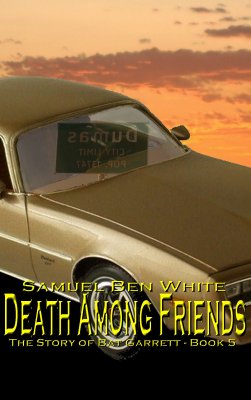
Death Among Friends

a Bat & Jody Garrett novel

Bat Garrett goes to the funeral of a friend from high school, only to find that there are some family members of the deceased who think the death wasn’t accidental. Bat begins to look into the death and is confronted by old memories, some ex-girlfriends, and the disturbing idea that–if it was murder–it was committed by someone Bat knew.

Now available on Kindle and paperback!

Sample Chapter

When I got my private investigator’s license I figured my life would be a lot like the lives of those guys who used to show up late at night in the old shows on cable. High speed car chases, fist fights (where I would always win), and beautiful women who find a guy with a spotty income strangely alluring. Occasionally even solving a case.

Why was I so often surprised back in those days when life didn’t imitate art? Or even TV?

What the TV shows were especially bad at portraying was the stakeout. Oh, you would have the obligatory shot of the guy in his car at night, flashing neon in the distance, as he sips coffee from a thermos to set the mood, but considering the shows were only an hour long (minus commercials) they couldn’t show the reality of a stakeout.

Hour after hour, and sometimes night after night, just sitting there. Trying to stay awake and trying not to drink too much coffee ‘cause then you gotta go to the restroom and leave your post. So you just sit there.

And sit there.

And, if you’re me, drinking no coffee at all because you hate even the smell of it so you drink Dr Pepper like it’s going out of style, which still leads to bathroom issues.

Sometimes, you have a client who wants a meticulous log of everything that happens. “12:15Dog barks. 1:17Pizza delivery. Delivery vehicle license number … “ It sounds miserable and tedious—and it is—but at least with those you have something to do.

This was not one of those nights. I was sitting in my car across the street from an all-night diner that served, based on the smell, fried grease. As a side dish, one could order lard straight. But working in the diner was a woman who was being rapidly stalked by middle age and a husband who was convinced she was having an affair with one of her customers.

Now, you may be thinking that my job would be to watch her through the windows and see if she paid anyone any special attention. Not exactly. The husband was pretty sure who the affair was with, so I was supposed to sit there and watch to see if the Assumed One showed up and, especially, if the Waitress Woman were to leave with him.

Five nights down and not only had the Assumed One never showed, the Waitress had treated all of her customers with the same hostile indifference. Most of her customers left looking less than happy, so I couldn’t really see any of them saying something like, “Hey babe, after that rather belligerent service and a sandwich made—apparently—from old shoe leather, there’s nothing I’d like better than to take a hot mama like you out on the town.” Eight and a half hours after she would clock in (with a thirty minute “lunch” in the middle which she smoked away on a bench around the side of the building from the front door) she would leave and go straight home.

If this were a television show, the reason for the whole farce would be that I had been working on another, more important, case and this whole thing had been cooked up as a means of distracting me. In real life, I had taken this under-paying and boring job because there just wasn’t anything else, and hadn’t been for some time. It was a slack time in the P.I. biz, apparently. And being winter, it wasn’t much of a time for painting houses, either (my other listing in the phone book).

With Jody’s paycheck from her job as a speech therapist barely covering necessities, I was taking any job I could get in hopes of making ends meet. Thankfully, our cars were paid for and we didn’t pay much in rent, but you can’t eat an apartment—even the green moldy stuff on the walls that looks almost edible. We were still newlyweds in a lot of ways but, as much as I like old Glenn Miller tunes, his song about being able to live on love was starting to ring hollow.

Another night looked like it was going to drift by with no consequence when, just after three-thirty in the morning, a car that looked like the one I was told Assumed One drove pulled up in front of the diner. I perked up a little, then. I perked up a lot when the Assumed One, Mister Wally Norris himself, got out of the car. Tall, slatternly, with a one of those big droopy mustaches like country stars wore back in the eighties, I positively identified him from a picture I had been given when he stepped into the lights of the diner’s front entranceway.

As he went into the diner, I slipped quietly out of my car and closer to the diner, camera at the ready. Once in a position where I could get some good pictures of pretty much anywhere in the seating section of the diner, I started snapping.

It was a fairly old—let’s say broken-in—SLRand worked beautifully. For daytime shoots I was transitioning to a digital camera, but for nighttime work nothing beat that oldSLRand some 1200 film. Cameras may have gotten simpler to use as time has gone on, but that old camera could practically take the pictures itself even without auto-focus. It eventually developed a light leak I couldn’t get fixed and I sold it to a collector, but I always regretted it later, thinking I should have given it a place of honor on a shelf in my office. But I didn’t have a shelf in those days, let alone an office, and the collector helped me make a rent payment, which is neither here nor there for this story as it was some years later. Months anyway.

So there I was, getting pictures of him walking into the restaurant. And then there’s a picture of the Waitress looking none too pleased to see him. As I’m snapping away, she points toward the door, instructing him to leave. (It’s clear from the body language; I didn’t have to hear what she was saying.) But Assumed One steps right up to her and grabs her by the arm.

He should have grabbed the other arm—the one carrying a customer’s food—because she slammed the tray full of food upside his head. It was a horrible sight, all that Salisbury steak and candied apple slices spreading across the room. My last picture showed him letting go of her arm as he reached for his gravy-covered face, trying to get the apple chunks out of his eyes.

I dropped the camera—trusting the shoulder strap to take care of it—and darted for the diner’s door. By the time I was through the door, Assumed One had cornered Waitress behind the counter and the one customer was a guy who was rooted in place by fear and shouldn’t have been screaming like that in my humble opinion. His screams were soon drowned out by the screams of Assumed One, who had just taken a saucer of hot grease to the kisser.

No, I don’t usually talk like that, but it is a private eye story.

As Assumed One hit the floor on all fours and clawed at his face, the cook called 911 and the Waitress stood over her assailant with the saucer held in a threatening manner. I wouldn’t have thought it could be done, either, if I hadn’t seen it. If she had been holding a Glock with a round in the chamber, her demeanor could have been no more menacing.

Despite graduating from a correspondence college with a degree in private investigations and a long-ago Boy Scout merit badge in First Aid, I wasn’t sure what the protocol was for “hot-grease-in-face”. Still, it seemed like something ought to be done, so I pulled out my gun.

“The cops are already here?” asked the cook in impressed dismay, popping up from wherever he had been hiding.

“Probably just someone else that wants to kill him,” the Waitress grumbled, remarkably calm about the whole thing. Seeing my weaponry, though, she set down the saucer. Then, told me, “Go ahead and shoot him. I’ll gladly testify it was self defense.”

Assumed One, peaking at me from between his fingers with one red eye, just whimpered and made a larger mess on the floor than had been there previously. “I’m not going to shoot you,” I told him.

“More’s the pity,” said the Waitress.

So Many Books

a Mended Lives story

He had never seen so many books in one room. Stacked on rickety shelves from floor to ceiling, they overwhelmed the room, and the visitor. Chris Farmer, investigator for the Bureau of Indian Affairs, suddenly felt like he knew nothing about the person he was trying to help. But he was suddenly curious. Why would someone so young-why would anyone-have so many books? Alyste Smith was a young woman who lived with an abusive step father and longed to escape. The only way she knew how was through books. So she read and read and read, hoping beyond hope that, one day, a hero like the ones in her books would walk through her door and rescue her.

Order today on Kindle!

Reading Sample

I had never really noticed her until I saw the books. Hundreds of books (thousands, I was to learn later) adorned her small room. She had bookshelves she had brought in from somewhere at, I guess, the start of it. Between them she had built other shelves. They would have made Norm Abrams cringe, but they would have warmed the heart of any librarian.

Some shelves were built by putting a board across cinder blocks, then more cinder blocks, then another board and so on up to the ceiling. In some cases, where cinder blocks or other bricks couldn’t be found, larger books were used to hold the shelves above off the books below. Here and there an ineffectual nail had been driven into a board to secure that board to the side of another shelf or to the wall itself. The whole business showed a profound lack of engineering knowledge but would have made even Rube Goldberg envious.

How the whole mess stood and hadn’t collapsed and killed her years before I have no idea. My own experience with dismantling it all brought a few paper avalanches that threatened to take my own life, but I’ll have to get back to that later.

“You’ve read all these?” I asked in dubious wonder as I looked at the books that lined the walls from floor to ceiling, making the little eight by ten room about seven by eight and a half. If she could have figured out a way to attach a bookshelf to the back of the door, I was sure she would have.

“Uh-huh,” she nodded. Then, in the apparent need for accuracy, she amended, “Everything but these two shelves. I haven’t read them, yet. But I will.” Pulling back the covers on the bed, she revealed a weathered paperback and, picking it up, said, “And this one. I haven’t finished it, yet. I …can I take it with me?”

“Yeah,” I told her, still looking in awe at the walls-which I couldn’t see, but assumed they were back there-somewhere-behind the books.

I knew there were more important and pressing matters, but I couldn’t help stepping closer to the books for a moment. There was no discernible theme in the volumes chosen. I saw a few romance novels, of the kind I would have stereotyped a young woman in her position to read. But I saw much more. There were psychology textbooks and biographies of famous people, from Teddy Roosevelt to Tacitus, and books by Twain, L’Amour and Kafka. There was a shelf of books by CS Lewis, just above a shelf of books by Tolkien (having never read either, I had no idea of the significance of this paring). I saw books on horticulture and agriculture and books of poetry by people with names I couldn’t read, let alone pronounce.

“All of them?” I asked again, though not necessarily meaning it to be out loud.

“All of them,” she confirmed.

“Do you have a favorite?”

I happened to be looking at her at that moment and realized from the look that flew fleetingly across her face that I had asked her a question akin to asking a mother which of her children were her favorite. When her composure was regained, she replied, “Probably whichever book is in my hands at the moment you ask.”

I pointed to the book that she had picked up off the bed and asked, smiling and trying to make it sound friendly, “So right now it’s that one?”

She looked down at it, a slight grimace at the corner of her mouth, then back at me and replied, “No. Not this one. It’s not that good.”

“So why read it?”

There was just the slightest hesitation before she answered, “Because I started it.”

For the first time, I took a look at this remarkable person who had, up until that very moment, just been a part of another complicated if strangely routine and boring case.

The way he looked at the books intrigued me.

Not many people had seen my collection of books, but some had. All the others had had pretty much the same reaction, though. Wondering why I had so many books, why I wanted so many books, or complete incredulity at my claim to have read them all.

People my age were the worst. The couple times I had met people my age who claimed to be readers, when they saw all my books, they usually looked at me like they thought I was crazy. Most of them, I would find out (if given the chance, most were gone after a glimpse into my room), read more than the average teenager, but they only read one thing. All romance books, or all mystery novels or all books on a single subject. That, to me, sounded like eating the same thing meal after meal, year after year. I like pizza, but I have to eat some other things now and then, you know?

So when he looked at the books with amazement, I thought I had found a soul mate. I was so surprised later to find he wasn’t a reader. Oh, he knew how, of course. He had just never known why anyone would do it on purpose. What struck me, though, was that he didn’t dismiss my reading. And when he found out just how many books I had, he didn’t renege on his offer to carry them all out. For the first time since my mother died, someone saw my books and didn’t treat me like a freak.

On the other hand, I have never been able to understand people who don’t read, or don’t love reading. I love reading. Even when my life was going well, I loved reading.

Last at Bat

a Bat Garrett story

A ghost. Bat has to be seeing a ghost. While recuperating in Houston he stumbles across a shopgirl who looks and sounds just like someone he lost a year before. As his friends think he’s going crazy, and even he’s starting to wonder if he watched “Vertigo” one too many times, he tries to piece together the background of the shopgirl. The investigation takes Bat from Houston and Dallas, to Arkansas and Durango (where he meets a young Garison Fitch) and closer to the conclusion that he may not have been the only one set-up by the Home Agency.

Order Today!

Kindle or Paperback

To read more about Bat Garrett, be sure and check out “The Nice Guy“, “The Return of the Nice Guy” and “Up to Bat“. All available on Kindle & in paperback! And, if you want to read this story from Jody’s perspective (as well as find out what happened next), be sure and read “Cheerleader, Gymnast, Flautist, Spy“!


Read a Sample

“What is it we’re going to go look at?” Dave asked as we walked through the mall. I was surprised how few people were there shopping, but I guessed it was because it was a week day.
“Sunglasses. I’m telling you, Dave, these are the ugliest you’ve ever seen. They would have been great for that day in college when we had the ‘Ugliest Outfit’ contest.”
“I didn’t know the Galleria had a gag shop.”
“It’s not intended to be, but these will make you gag.”
As we were nearing the store, I saw a girl walk into the shop ahead of us who just about took my breath away. I stopped dead in my tracks and could feel my heart pounding in my chest like faulty pistons in a Ford Granada. If I had been prone to such things, I think I would have had a heart attack. The quick and unexpected (even to me) stop on the crutches almost made me fall on my face, so I had to take a moment to regain my balance.
“What—what is it?” Dave asked. The look on my face must have scared him. I imagine I went almost completely white—maybe even green.
“That girl that just walked in.”
“So? She was cute; but we’ve seen several of those today. She wasn’t as pretty as Heather, I didn’t think.”
“No. This girl looked like … like someone I used to know.”
“Let’s go see her,” he said. “Maybe it’s her.”
“Couldn’t be.”
“Why not? Houston’s a big city.” He smiled, “Shoot, I bet there’s more than two hundred people in this town. I hit that many cars in the parking lot.”
“But this couldn’t be her, Dave.”
“It’s a small world, Bat.”
“But it’s not the Twilight Zone.”
“What are you talking about?”
“The girl she reminded me of is dead.”

Up to Bat

Book 3 of The Story of Bat Garrett

Dallas private eye Bat Garrett is hired by wealthy Texas oilman Frank Gaston, who thinks someone is trying to kill him.

Bat is skeptical but when Gaston is found dead, slumped over at his desk, the fear seems to have been well-placed.

Darla Gaston, the beautiful young oilman’s daughter, is encouraged by her lawyers to fire Bat and let the police investigate. Darla, however, wants Bat to find out why her father has been calling a number in Colorado for several years. Bat discovers that Gaston has left a trail of lies and deceit, bigamy, and maybe even a decades-old smuggling operation involving children and a massive real estate deal in Oak Cliff.

It’s the biggest case Bat’s ever had, but it may cost him more than he’s ever had to give.

Available on Kindle and paperback.
Make sure you read the whole Bat Garrett (& Jody) saga, beginning with “The Nice Guy“, followed by “The Return of the Nice Guy“, then this book, then concluded (this arc, anyway) in “Last at Bat

Reading Sample

My name is Bat Masterson Garrett. I’m a private detective. I always dreamed of leading a glamorous life like the P.I.s on TV, but it doesn’t seem to work out that way in real life. Real life private detectives track down husbands who don’t pay their alimony, or find out if someone is having the affair their spouse suspects them of having. Once in a while, there is a fight; but there aren’t many shootouts or car chases. I sometimes wonder why I wanted that stuff in the first place.

Detectives on TV always get the girl, too. That never happens. Like I said, the people I deal with are usually already married (albeit trying to remedy the situation). Besides, people in real life don’t even look like the people on TV. Well, some people (my former fiancé Jody Anderson) used to accuse me of looking like Kevin Costner.

Well, what she said was that I probably weighed the same as Kevin Costner. My hair’s almost the same color as his, but I have blue eyes and am only about an even six foot—while I’ve always figured him to be taller. Some girls think I’m attractive, some don’t, so I’ll let you draw your own conclusions.

One day, I was sitting in my apartment in North Dallas looking at my baseball card collection when the phone rang. My phone never rings, so it liked to scared me to death. I hastily picked up the cards I had dropped and went over to the phone, sorting them on the way. I figured the odds were that the cards were more valuable than the phone call and deserved my attention. Having once owned a baseball card shop of my own (for about six months), I knew something of their value.

I answered and a man asked, “Is this B.M. Garrett Investigations?”

“Sure is, what can I do for you?” I was real surprised that anyone wanted me to investigate something. I’m also listed in the yellow pages under “Painters: House”, and that seems to generate the majority of my calls for gainful employment. A couple times people have tried to hire me as a body guard, but I don’t much care for the “rough work” after my limited experience with it. I’m not exactly a “big dude”, anyway, and most of my schooling in self defense would fall under the heading of “run”.

“This is Franklin Gaston,” he told me, “Of Gaston Oil.” He put in a pause like I ought to have heard of him but I hadn’t so I just mumbled noncommittally. I don’t keep up with the oil market except to the extent that I go to the cheapest gas station.

He continued, “I think I am in need of the services of a private investigator, Mister Garrett. You are Mister Garrett, aren’t you?”

“Yes, but call me Bat.”

“Pat?”

“No, Bat. Like those things that sleep upside down in caves.”

“Well, yes,” he said as he tried to regain his train of thought. My name always does that to people. Thanks, Dad.

“What did you need, Mister Gaston?”

“Well,” he said cautiously. “I really think it would be much better for us to meet in private—and in person. I’m confident no one is listening in, but I would just feel more confident if I could talk to you in person.”

“I understand,” I told him. It already sounded like he was going to ask me to trail his wife and find out if she was cheating on him. If that were true, I thought, he was probably afraid she would walk into the room he was in and overhear the conversation. Maybe she was already in there. You never know about these people. One guy hired me to watch his wife then told her I would be there. I didn’t get much on her for some reason.

“Where would you like to meet, Mister Gaston?” I asked. “I’m pretty flexible.”

He seemed to be thinking a minute, then replied, “It needs to be some place out of the way. Do you have any suggestions?”

“I know just the place. It’s on Northwest Highway—”

“That’s not out of the way,” he told me.

“In a way, it is. Think about it, if you were having a secret meeting, would you normally go to one of the busiest streets in town? See, the idea is to do what’s not expected. Like in football, sometimes you run the play that seems like the worst choice because the other team is confident you won’t run that one.”

Joyfully Ever After

a Mended Lives novel

Sean Clarke moves to the town of his dreams, to a house he loves, to a life he’s always wanted.  There he meets and falls in love with Angie. a beautiful young woman.  Sean’s family is happy for him, but they are waiting: for that moment when Sean discovers something he doesn’t like about another perfect woman and dumps her.

A novel of self-discovery, about finding out that the things that irritate us most about the faults of other people are when they mirror our own.

Available on Kindle!

To read more about Brad, Allie and Angie, make sure you read the novel Mended Lives!  To read how Joe and Ellen met, check out Hating God – a love story!

Sample Passage

He let go of her to hold the picture in both hands.  He was looking at it, but he wasn’t seeing it.  He wasn’t seeing anything.  His mind was gone and it didn’t show any signs of coming back any time soon.

“I’m sorry,” she finally said, when she didn’t think he would ever speak again.  “I never meant to hide this—to hide anything—from you.  But I was so ashamed—”

“You should be!” he blurted out.

“I know, I—”

He jumped to his feet and demanded, “What else are you going to tell me, Angie?  When am I going to start meeting all these guys you slept with?  What about the millions who saw you nude?  When are more of them going to show up and start asking me if I’ve seen what they’ve seen?  When, huh?”

She stood up in front of him and tried to reach out to him.  “I wish I could take back all those pictures, Sean.  I do.  But I can’t.  What can I do?”

“You could leave.”

“Sean!”

“What do you expect me to say?  ‘Hey great!  All the men of England have already seen my fiancé naked but I haven’t!’  Just leave, please.”

He picked up the folder, stuck the picture back in it (but not before seeing that there were other similar pictures in it and actually letting one slip out unnoticed that slid under the rocking chair), and thrusting the folder at her demanded, “Take these with you.”

“Sean—”

“Please, go.”

“Can I come back?”

He took a deep breath and replied, through clinched teeth, “I’ll get back to you on that.”

“Sean—”

He stepped around her and opened the front door.  Gently but firmly, he pushed her outside and closed the door behind her.

She turned around to face the door, but heard the unmistakable sound of the deadbolt being thrown.  She thought about knocking but didn’t think it was the right time.  She sat down on the front porch steps, put her head on her knees, and started crying.

It was almost half an hour later that she got up, smoothed out her dress with her hands and, taking the folder, walked back to the café.  Inside, the cook asked if she were all right, to which she nodded but didn’t answer out loud.  She just put on her apron, then put on her customer face, and went out to deal with the public.  She was relieved that the British couple was gone.

She looked around, though, at the crowd now there and wondered if any of them had ever seen her ads for Sutley’s, or Liverpool football, or any of the other ads she had done?  What about just the magazine layouts?  She remembered when she used to pat herself on the back because she had never done full-frontal, but now it didn’t seem like such a big deal.  “Partly evil is still evil,” she muttered to herself.  Then, noticing that a customer had overheard, she smiled, said, “Excuse me,” and took his order.

After that order, though, she went back and relieved the cook.  Not only did she want to be away from the general public, working with food had long been a way to calm down and think.  She did so, now.